
The Twilight Zone Season 1: Episode 24
"A World of Difference" Episode Transcript
Introduction
Welcome to the Key of Imagination. This week we’re going to be looking at the Twilight Zone episode, “Long Live Walter Jameson.” We’ll talk about cowardice and fear; we’ll dive into whether or not someone would grow wiser with immortality; and I’ll reveal to you my moment of awe. So, grab your keys, and let’s open up this door to the fifth dimension.
Plot exposition
A good teacher of history can make it come alive, but for professor Walter Jameson, his history lessons almost seems too real, as if he had been there and participated in its unfolding. And he has. You see Walter is immortal, gifted or cursed by an alchemist with the ability to live forever. No, he isn’t invincible; he can die of unnatural causes, but the decaying hand of time itself simply passes right by him. But, time cannot wipe away the needs of the human: camaraderie, purpose, and companionship. In his latest stop along life, Walter is engaged to a lovely young woman named Suzanna, the daughter of co-worker and friend to Walter, Professor Sam Kittridge, that is until Sam grows wise to Walter’s predicament. A picture of the history professor in a Civil War uniform, and no, this is no costume party. With his suspicions confirmed, Sam attempts to dissuade Walter from marrying his daughter. Instead, Walter decides that he’s going to whisk her away right now to a chapel. But, you can’t run from your past. In this case, that past has a name: Laurette, Walter’s–or rather, Tommy’s, as he was previously known–wife. Laurette is older now, as god-willing, we all will be, but she’s understandably bitter about being left all alone by her husband. A single shot from a revolver is all it takes to return Mr. Walter Jameson back to the earth: ashes to ashes, dust to dust.
Episode Details
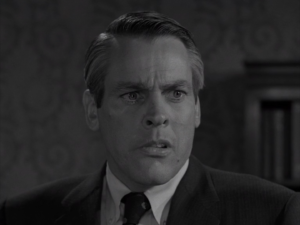
“Long Live Walter Jameson” was directed by Anton M. Leader. The teleplay was written by Charles Beaumont. As for our cast, we’ve got sci-fi royalty here with Kevin McCarthy as Walter Jameson. You should recognize him from the original Invasion of the Body Snatchers. And if you don’t, what are you doing? I’m willing to break the cardinal rule of content creation and tell you to turn this off immediately and go watch Invasion. It’s a classic for a reason. Then, come back here, of course. We’ve also got Edgar Stehli as Kittridge; Dody Heath as Suzanna; and Estelle Winwood as Laurette. The episode first aired on March 18, 1960.
Episode Tidbits
In Grams Jr.’s Unlocking the Door, he discusses in detail the approach that they took to age Walter on screen. Essentially, they used color filters in connection with the camera. By placing red and green lines on McCarthy’s face, they were able to control how much a part of the face would be visible to the camera at any given moment. This effect was also previously used in 1932 on Dr. Jekyll and Mr. Hyde. (266).
In Marc Scott Zicree’s Twilight Zone Companion, he has a great quotation from the director, Anton Leader, about working with McCarthy: “To work with McCarthy was a pleasure. You worked very hard, he worked very hard, and he was always trying. There was no sloughing it off, no superficiality, if he could help it and you could help him” (95). I always think it’s great when you hear that actors were a pleasure to work with, especially in terms of their professionalism. We always hear about someone who is a big joker or prankster, but actually, I have to imagine that this would get old quickly if the actor is not on-point when the cameras are on, so it’s always good to hear a positive word.
My initial Thoughts
My initial thoughts on this one are subdued enjoyment. As I’ll discuss in the first question in a little bit, there’s a kind of lull in this episode. It never really rises to much of a crescendo; it stays perfectly balanced throughout the majority of the episode, but I think that’s by design. It is still, however, engaging. I happen to really enjoy Kevin McCarthy’s acting. There’s a rather uniquely serious quality to it, whether he is Miles Bennell from Invasion of the Body Snatchers or R.J. Fletcher from UHF. And so, although I think the writing is good, typical of Charles Beaumont, I think it’s McCarthy who carries the heavy load on this one. And apparently I’m not alone. As is always the case, I write these sections out of order. I’m actually coming to my initial thoughts late in the process, and after having read Grams Jr. and Zicree for the tidbits. But, in Zicree’s Twilight Zone Companion, he says, “Much of the credit for the episode’s success must go to McCarthy” (95) and I completely agree.
Question 1: How, if at all, does this episode differentiate cowardice from fear?
What makes this episode interesting to me is how hum-drum it is. I don’t mean it’s a boring episode; I like it. In fact, I liked it more with each viewing that I did for this KOI episode. What I mean is, when we think of tales of immortality, even “Escape Clause,” which we talked about a couple of months ago now, there is always some kind of heightened sense of something, an energy that pushes the boundaries of mortality and immortality, a desperate need to own something: knowledge, power, etc.. But, with Walter, what does he want? What does he need? Nothing. He mentions early on that he thought it wasn’t fair to die given how much there is to know, but there is no obsessive pursuit of anything. He isn’t even really accumulating materials all that much, at least the episode doesn’t really show us anything lavish. He is simply existing. But, why? One word, and it is pretty much the central word of this episode: cowardice. Let’s talk about how this word manifests itself throughout the episode.
Now, I do want to be careful here. It’s a pretty serious thing to call someone a coward. It’s different than simply saying someone is afraid of something. Cowardice, I think, includes an element of one’s character and not merely the fear of something. In other words, there’s a choice involved when acting as a coward. Walter doesn’t mince words about this. He tells Kittridge straight on that he wants to die, and Kittridge responds, then why don’t you? And of course, Walter snaps back in a rather honest tone, “because I’m a coward.”
Okay, we’ve established how Walter sees himself, but what is it that he’s so afraid of? The same thing that frightens many human beings: death. Now, on the surface, of course it makes sense to fear death, or does it? I know I’m risking going to the well once too often, but the truth of the matter is, much of what we believe is great philosophy and knowledge today was already discussed by the Ancient Greek’s. Now, it just so happens that Socrates, through Plato’s voice, still happens to have one of the most rational views of death there is, and it’s worth taking a look at here and then we’ll connect it back to our episode.
In the Apology. Socrates states, “For this fear of death is indeed the pretense of wisdom, and not real wisdom, being the appearance of knowing the unknown; since no one knows whether death, which they in their fear apprehend to be the greatest evil, may not be the greatest good. Is there not here conceit of knowledge, which is a disgraceful sort of ignorance?”
Did you catch his point? Being afraid of something presupposes that it is bad or harmful. Who’s afraid of a murder of puppies coming right at them. Is that the correct term for a grouping of puppies? Is it a murder, like crows? Probably not, but I like to think that it is.
Socrates’ point is that since no one knows what death is truly like, there is no rational reason to fear it; it can just as easily be wonderful. For people who believe in a benevolent afterlife, a heaven, this gives many people a great sense of comfort. Now, I can already hear many of you existentialists out there screaming your Heideggerian and Sartrean hearts out: what about the infinite nothingness of existence–not simply silence but the complete and total void of sensation. Brief side tangent. Years and years ago now, I went to I want to say it was the Massachusetts Museum of Modern Art, and they had a stage where you could stand on it and experience actual silence–as in the void of noise. It was freaky. Now, even if you belong to that group who believes in simply the void of existence, that same void includes a void of senses and consciousness. You won’t experience anything; you’ll experience nothing. Or, wait, you won’t experience the absence of all things. You know what I mean.
When we come back to Walter, we actually find an interesting connection to our Socrates example. Again, Socrates is trying to remind us that we don’t know about death because we CAN’T know about death. As I mentioned previously, Walter does mention that it’s unfair to die given all the things there are to know, but the problem is that, at the time he was searching for an elixir of immortality, he didn’t understand the difference between knowledge and answers; he wants answers, but the priests and philosophers were trying to give him knowledge. Answers are often unsatisfactory in matters of human existence. Why does one person get to live a long, healthy life, and someone else has to live in sickness? Now, I’m going to admit something to all of you? I spent the good part of my 20s reading whatever pieces of great literature and philosophy I could get my hands on. That’s right; I was not out there clubbing it up all that much in the discotechs. There’s your Twilight Zone twist for the day. But you know what? I don’t have the answer for you. What I can tell you is that if you have been blessed with an existence that gives you a lot of agency to help others, to sacrifice for the person next to you, you should do so. Sacrifice is a kind of death, it is a willing death of the self for a greater good. Walter tries to explain to Kittridge why he is with Suzanna. He tried to warn her; he tried to stay away from her; but in the end, he just fell in love with her and has to have her. Bologna. It’s not love of her; it’s love of himself. Deep down I think Walter knows that to sacrifice is to experience a kind of death, as I already mentioned, which is why he is able to continually be with these women, never tell them the truth about his condition, and then simply move on. He may be immortal, but these women only have one life to live.
I will give Walter credit for one thing: Shakespeare, the Bard himself, famously wrote, “To thine own self be true.” Walter is the epitome of these words. He is always true to himself, and when he calls himself a coward, he is being truthful. But, his cowardice is not in his fear of death; it’s in his inability to understand the importance of sacrifice. And that if one practices sacrifice enough, one realizes that there is nothing to fear in death because one has already died a thousand times.
Question 2: Is Professor Kittridge correct? If a man lives forever, he does not grow
Wiser?
I think this is one of those questions where the surface-level answer is that’s a stupid question. Of course a man grows wiser as he continues to live. I mean, don’t we grow wiser as we age now? I’m certainly wiser at 44 than I was at 24, and I hope to be wiser at 64 than I am now. If we look at the question that way, then yes, we get wiser as we get older. But, what if there is no cap to how old we get? Would we really be wiser at 124 than say 114? I’m not so sure about that. Let’s bring in one of the most famous Enlightenment philosophers for this subject: the Scottish thinker David Hume.
Hume writes:
“Let a man’s insensibility be ever so great, he must often be touched with the
images of right and wrong; and let his prejudices be ever so obstinate,
he must observe, that others are susceptible of like impressions. The only
way, therefore, of converting an antagonist of this kind, is to leave him to
himself. For, finding that nobody keeps up the controversy with him, it is
probable he will, at last, of himself, from mere weariness, come over to the
side of common sense and reason.” (link)
That was a rather lengthy quotation, so let me summarize it a bit. Hume is basically saying that when you have someone who is insensible, stubborn, and even carries prejudices, if you leave them alone long enough and you don’t continually feed those negative vices, he will eventually come to his senses on his own when he finds that there is no one willing to continually feed those negative feelings. Okay, what does that have to do with age and wisdom? If you were an immortal human, I don’t believe that there is any way around the fact that you will eventually deal with a kind of loneliness that simply does not exist in the human condition right now as we know it. Yes, we have pretty much all experienced loneliness; some of us have even experienced the existential loneliness that comes with losing loved ones. But none of those would be the same as knowing that there is no other human being who has ever and will ever experience the solitude of living a thousand lives, and to lose all sense of what it means to even have a genuine relationship with others.
Now, in my initial thoughts section, I talked about the fact that there is a kind of lull in this episode, a malaise almost, and this is actually quite brilliant on the part of Charles Beaumont. Let’s talk about the important scene in question.
When Walter is telling Kittridge all about his past and how he became immortal, Kittridge thanks Walter for essentially teaching him that a man does not really grow wiser the more he lives. To this, Walter simply smirks and says, “you just go on living. That’s all.” Believe it or not, I actually think that would be true. Don’t get me wrong; you would invariably become incredibly intelligent and probably master all kinds of skills. (Of course this reminds me of Bill Murray’s classic film Groundhog Day, a must-watch if you love comedies.) But wisdom and intelligence are not the same thing. Both of my grandfathers didn’t finish high school, but they were incredibly intelligent and very wise. You see, wisdom is not about how much you know; it’s about understanding what you do know, and being able to apply it to the human condition.
I believe life is complex, but I don’t actually think the human being is. That’s why the wisdom of the past continues to carry forward so well into the present and into the future. I think there is a point in the existence of humanity when our wisdom would top off and not really continue to grow, in fact it would probably regress and eventually get replaced by desires, something that already seems to be happening to Walter. And I’m not so sure that the wisdom wouldn’t stop growing somewhere around the ages in which we currently seem to exist in human form. In other words, I’m not sure we would grow all that much wiser past the ages of 125 or so.
So, to answer our question. I think both Kittridge and Walter are correct here: I don’t think immortality would continually grow our wisdom. The good news is we don’t have to. We have the great works of the past, authors, philosophers, artists, and certainly our relatives who came before us to pass that wisdom down to us, which frees up some precious time for us to live the one life that we have.
Question 3: What are your moments of awe?
As for my moment of awe, this episode serves as a nice reminder about how important it is for us as a species to remember that there is no promise that we will be here tomorrow or even the next hour really. In a moment, I’m going to ask you a question, and I want you to take it very seriously and even answer it to yourself. Here it goes: if I challenged you to do one meaningful thing within the next hour, what would it be? What would you do? Well, if you're like my students, you might feel a little overwhelmed by the question, so let’s break it down to something simpler first. What is meaningful to you? Family, friends, helping someone in a difficult time, doing a good deed? All of those are great answers. I challenge you to take one of those and break down a simple, easy meaningful thing to do within the next hour. And if any of you actually hear this and take me up on my challenge let us know in the comments–no, you don’t have to tell us what it is; it’s your meaningful event. You can just type something like “meaningful deed done.” As for me, I’m going to hug my wife, and say, “I love you.”
My Rating
As for my rating, I give this a really solid Middle Top-Tier. I like it; it has some unique qualities to it in terms of how it addresses immortality with a rather subdued protagonist. The acting is quite good–maybe more could have been done with the Suzanna character. As always, the top tier for me is basically for episodes that would spark a marathon watch, and although that’s not the case for this one, it is absolutely an episode I would sit down and watch if it were on during a marathon.
Next Episode
Next time, we’ll be taking a look at “People are Alike All Over,” and here are your questions to consider when watching the episode:
Question 1: How realistic is the premise that such people would be alike all over?
Question 2: Were there signs from the Martians that Conrad should have picked up on?
Question 3: What are your moments of awe?
Closing
You know, it’s interesting to think about the future of our digital cultural artifacts. For much of our archaeological existence, we’ve dug up and analyzed tangible objects that will eventually break down completely and become nothing more than dirt or sand-like particles. But, what about our digital artifacts? This KOI episode is likely going to exist in some digital form long after I’m gone. Will anyone see it? Probably not–or maybe they will if they do a search for the Twilight Zone, which will absolutely still be around. If you’re listening or viewing this from the distant future, I have one really important question for you: have we normalized pineapple on pizza yet? It’s still a bit of a debate in 2024. I’m pro pineapple, but only if you make it a true Hawaiian and add the ham. That’s right, people. As your interdimensional ambassador to extraterrestrials I promise to ask the difficult questions.
Announcements and Shout-outs
As usual, I’ve got some comments and shout-outs that I want to highlight from the YouTube channel.
Jrod112278, who at this point is basically an old friend of the show, having been with us for quite a while, had the following thoughts on my “Monsters are Due on Maple Street” episode: “This might be your best episode breakdown/analysis I've seen. I'm probably biased because this is my favorite TZ episode that has remained (maybe even more so) relevant today.
In regards to Steve, I don't view him as a failed Just Man. I view as a man trying to be just, but is ultimately worn down by the tide of the mob. Even the best of us are still human and capable of succumbing to greater forces. I'll definitely check that Outer Limits episode soon.” Jrod, as always, I appreciate you taking the time, and actually I picked your comment here because I think it represents how a lot of us feel about Steve, including largely myself. In my breakdown, I conclude that Steve is a failed just man base solely on the traits of the figure, but in reality, if Steve is a failure then what the heck does that mean about the rest of us? It’s such a terrible situation to be in, and I think Steve means well throughout much of the episode. Something I didn’t mention is that Steve is one of the figures who is screaming at the very end for people to stop, so he maintains this idea that what is happening is wrong, and so in that regard, I think he can hold his head up high. I appreciate the kind words as well.
GodisGod777, also on the “Monsters” episode comments, “Can you please do an analysis on season 3's "Death's Head Revisited" next? Love the content!” Thanks, God. We’re going straight down the telecast list of episodes, so I’ll get there eventually. Now, I will say, pace yourselves. That’s the key for both of us, you and me. They’ll be some episodes that people will like more than others, but my goal is to create a body of work at the end that can offer people a different way of looking at this great show, and hopefully provide some thoughts about life along the way that can have a positive impact. But, there’s a long journey ahead of us, so I totally understand if people pop in and out at times.
Finally, frip9822 comments on the same episode, “I was looking forward to this episode analysis and boy were my expectations exceeded, great job! I love what you're doing for us, fans of the Twilight Zone by providing thematic angles in which we could further appreciate the show beyond its own narrative—also, speaking of angles. I need to mention how much I enjoy seeing your side view accompanied by the show's title screen in the background throughout the analysis, it's a nice aesthetic touch to your format.” First, thank you for taking the time to leave a kind word. I genuinely appreciate it. As for the camera angle, I’m learning that this is somewhat of a controversial topic. Some people absolutely hate it and they have let me know, which by the way, is totally fine. I think the majority of people mean it as actual constructive criticism. It might be when I have a little bit more time on my hands, I’ll think about changes to the aesthetical format, but for now, I’m okay with it, and I’m really trying to work more on just producing the best ideas that I can. Offering a different camera angle changes up the monotony a bit, which I think is good, but I can completely understand the argument that I’m no longer engaging the audience with my eyes. It’s a valid argument. But, between work and trying to be a good husband, limited time is, unfortunately, a reality. I mean…I’m still trying to get the Twilight Zone trinkets page up and running that I keep mentioning in my how to support the show section. Speaking of which…
How to Support the Show
Head over to thekeyofimagination.com to continue our conversation. You can rate this episode, learn more about me, watch previous episodes of the show, and check out my curios page where I showcase some of the Twilight Zone trinkets I’ve bought over the years. I encourage people to email me thoughts and comments, whether it’s about a particular Twilight Zone episode, your rating for an episode, or about the Key of Imagination Show. You can get those to me as a text email, an audio clip, or even a video clip of roughly no more than 5 minutes to keyofimaginationshow@gmail.com. Keep in mind, even though we talk about some serious topics, we’re trying to maintain as family-friendly of an atmosphere as we can. If you would rather I not use your comments on the show, please indicate that so I can respect your decision.
If you enjoyed the show, I ask that you please take a moment and do one of the following to help build our community. Rate the show, review the podcast, leave comments, thumbs up, all of the usual algorithmic gymnastics. That will help get the show in front of more people and help us build our community of Twilight Zone fans. However, even if you do none of that and absolutely hated every minute of this, I would still like to thank you for spending some time with me. Until next time, remember, all doors are open to those who possess the key of imagination.
Works Cited