
The Twilight Zone Season 1: Episode 26
"Execution" Episode Transcript
Introduction
Welcome to the Key of Imagination. This week we’re going to be looking at the Twilight Zone episode, “Execution.” We’ll talk about what this episode is trying to say about evil; we’ll dive into the difference between vengeance and justice; and I’ll reveal to you my moment of awe. So, grab your keys, and let’s open up this door to the fifth dimension.
Plot exposition
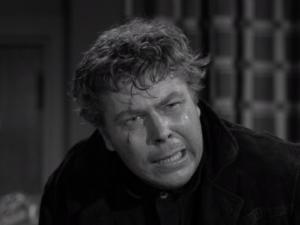
Joe Caswell is a bad man, no way around it. He’s killed multiple men, and he doesn’t seem to be all that remorseful for his actions. But as he’s hanging there, his neck moments away from snapping, something strange happens. He disappears–vanished, like he never existed at all. When Caswell wakes up, he asks, “where am I?” But the more appropriate question is when am I, as in what year? Caswell is the first time traveler in human history, brought forward 80 years by Professor Manion. And although the strange marks on Caswell’s neck might be hidden by a coller, the festering hatred that gnaws away at his spirit cannot. A lamp to the head ends Manion’s thoughts of sending Caswell back to face his judgment, leaving our time traveler to face this new world on his own: complete with horse-less carriages, blinking lights, and drowning in sound. It’s all too much for Caswell to handle. He returns to the professor to beg for help, only to find that another lost soul, a detestable figure like himself, is looking for what he’s owed. When the two men scuffle, Caswell comes out the worse, suffocated with rope around his neck. As for our new friend, well, he becomes the second man to ever travel through time, ending up at the end of the very rope that was meant for a man named Joe Caswell.
Episode Details
“Execution” is directed by David Orrick McDearmon. The teleplay is by Rod Serling, but it’s based on an original short story proposed by George Clayton Johnson. As for our cast, we’ve got Albert Salmi as the dastardly Joe Caswell–of course, we’ll see Mr. Salmi again a few times in the show; and we’ve got Russell Johnson as Professor George Manion. Most will, of course, recognize him not as the professor here, but as the professor of a different show: Gilligan’s Island. The episode first aired on April 1, 1960.
Episode Tidbits
As for our tidbits, this one has quite a few really good ones, so I’ll give my usual plug for picking up a copy of Grams Jr’s book, Unlocking the Door. I’ll just relay one here: Apparently, CBS had a problem with the phrasing of one part of Caswell’s speech to the professor, which I I’ll reference in one of my questions in a moment. Caswell originally said, “I’ve been to hell and back.” But, CBS didn’t like it, so it was changed to “I’ve been to hell and now I’m back.” But, what’s the difference? Well, I suppose the original is really more of an idiom that we use to show a kind of triumph of the human spirit. It ends with a bit of a positive upswing, whereas the new line, “I’ve been to hell and now I’m back” actually maintains Caswell’s depiction as a despicable individual. Now, I obviously wasn’t in the room, so I don’t know if that was part of the conversation or not. But, in this instance, I tip my hat to the CBS producers. I think changing the line is the right call here.
My initial Thoughts
As for my initial thoughts, I actually used to really dislike this one. I thought it was boring; I thought it was a bit nonsensical in terms of what we should be taking away from it. But, as is sometimes the case, writing about it for this KOI episode has actually made me appreciate it a lot more. I always view the episodes a minimum of two full times, and then I’ll go back in for specific scenes as needed. But, with this one, I actually viewed it the second time right away. I was looking forward to seeing it again. It’s by far not a perfect episode, but there is a lot more meat on this bone than I had remembered.
Question 1: What does this episode want to say about evil?
At the beginning of the episode, The judge says, “I can tell you this, Caswell. You’re an evil person, a disease, and when we hang you, it’s a service.” But, what does this mean? What does it mean to call a man evil? We’re going to bring in the psychoanalyst Carl Gustav Jung to help us better understand this term evil. Now, before we really get into this, you have to understand that Jung had a fascinating relationship with religion. I won’t get into his beliefs because that is a really complex topic and it’s better for someone who actually studies Jung, the man, to talk about. But through his professional work, he was able to see god and religion in a rather unique way: both as real and yet conceptual. In other words, he treated the notion of a god as if he were real because he believed that conceptually one had to give this force that moves us a face and/or name in order for us to interact with it and comprehend it. Let me quote Jung here about good, evil, and god and it might actually help me better explain it.
Good and evil are principles of our ethical judgment, but, reduced to their ontological roots, they are “beginnings,” aspects of God, names for God. Whenever, therefore, in an excess of affect, in an emotionally excessive situation, I come up against a paradoxical fact or happening, I am in the last resort encountering an aspect of God, which I cannot judge logically and cannot conquer because it is stronger than me. (86)
Okay, what does he mean here? At its core, there is no way around the fact that good and evil are in a sense subjective concepts. You say something is evil. I say something different. But, Jung’s point here is that there is something about good and evil that transcend simply the context of subjective judgment. That when we encounter evil or good we are in a sense encountering god, meaning that we cannot necessarily impose judgment on it because there is something foreign and powerful about it that is almost unapproachable to us–ie, godly. To try and sum it up, being in the presence of pure evil or pure good is like being in the presence of god. Let’s go back to our episode.
When the professor says, “you killed someone?” Caswell responds, “A whole territory full. I stopped counting after 20.” In his voice is of course almost this sense of pride in it. Or rather, maybe it isn’t pride; it’s indifference, which is just as bad in many ways. Now, I’ll be using parts of this particular exchange between Caswell and the professor in my next question more prominently, so I won’t belabor it here. The speech I’m referring to is when Caswell tries to explain why concepts of justice and right and wrong have no real meaning when you’re out in the cold and starving. This is clearly a moment where we CAN feel sorry for him, should we choose to do so. But, as someone who believes in mercy and forgiveness and second chances, this rings incredibly hollow to me. In fact, what it actually exposes is that Caswell knows exactly what he’s doing. He knows that it’s wrong, and yet, he doesn’t care. He knows that he took these men’s lives, took them away from their families, from their hopes and dreams, and never even second guessed it. Had Caswell even expressed a genuine moment of remorse, this entire story would be different. But, some people, simply do not wish to be forgiven; as Michael Cain says in The Dark Knight, some people just want to watch the world burn.
I began this section by talking about what is essentially a childrens’/young adult show that introduced the concept of evil in a really fascinating way. Whether you believe in evil as a proper entity or simply believe in it as a concept, I actually think it’s really important for us as a species to maintain our connection and identification with things that are evil because it can help us remember that we are all capable of committing atrocities, and if we are not careful, we can start to slide down that road–now, the angle might be steeper for some more than others, but there is always an angle toward evil for us to slide towards. Jung understood this really well, which is why
I think Caswell probably was evil. I think we can always, and probably should always, lament the loss of an individual to evil ways–as in, Caswell was a baby once, an innocent child. What led him down that pathway? Could we have stopped his slide at certain points in his life? I think it’s a sign of a healthy society to lament the loss of a human being to an evil will. But, we also have to be careful about mixing evil with sympathy to the point that we can no longer tell where one ends and the other begins–and I will be the first to admit. I’m not always good about that, nor am I always able to see it. But, I suppose, if I’m going to be on the wrong side of that, I would still rather be wrong in offering someone my sympathies than in offering him the back of my head.
I think what this episode is trying to say about evil is that we have to be careful about using subjectivity as an excuse for evil. Diversity of thinking and subjectivity are built into a healthy society; we don’t want people thinking the same ways. That inhibits our growth. But, we also can’t simply chalk up every decision that we make to well that’s just my subjective opinion. We also need ways in which we can come together and agree that X is wrong, or Y is how we believe we should treat others. That’s also a sign of a healthy society.
Question 2: What is the difference/line between vengeance and justice?
Toward the beginning of the episode, Caswell tells the judge that, if he had to do it all over again, he would still invite the man he killed out for a duel because he had “too much mouth and not enough brains.” To this, the father of the man he killed attempts to set the record straight by pointing out that his son was shot in the back in a rather cowardly fashion. This exchange is easy to overlook, but it sets us up to learn two things about Caswell: he is a liar about things of great human importance; and he is a fabricator of reality. Now, you might be thinking, Joe, you just fabricated some reality there. Those two things are the same thing. Well, yes and no. The lying part is fairly straightforward, but the fabrication of reality part is actually much more nuanced. It is a type of lie at its core, but there is the added element of attempting to incorporate others into the narrative as well. To me, that’s a different problem than just lying, and it’s far more problematic. Why am I bringing this up? In order to sufficiently answer this question, we’re going to stick with our theological focus a bit because it will help explain why we need to be careful about seeking vengeance.
In the first question, we talked about Jung and his approach to understanding evil and good as god-like concepts. I think that approach still works here as well. There is something external that presses upon us when we enter the realm of vengeance. Think about all of those vengeance movies, John Wick, of course, is the first that comes to my mind. He becomes something else, something external to the locus of who he wanted to be when he was a loving husband–and we’re excited by these films because of that external force, that cosmic justice element. We are in some ways changed. We take pleasure in seeing John Wick kill the people on the screen. So, what does God have to say about this? In Romans 12:19 from the Bible, it states, “Dearly beloved, avenge not yourselves, but rather give place unto wrath: for it is written, Vengeance is mine; I will repay, saith the Lord.” I remember reading this concept of vengeance belonging to God as a young adult and thinking, why? Why can’t–or to be more accurate, why shouldn’t–we be involved in the concept of vengeance? We feel it in the depths of our very souls sometimes: one word corruption.
At one point in the episode, the father of the man who Caswell killed says to the murderer, “The more you kick, the more justice I figure there is in the world.” I’m not going to pass any judgment on his anger. What I will say is that, there is something to the language he uses here. He says, “more justice.” Justice is an important concept. It helps to build trust within societies and leads us toward acting in a way that reminds us about the importance of accountability for our actions and decisions. But, is what the father here is talking about justice or vengeance? I think there needs to be a certain amount of emotional distance for justice to work as a societal norm. In this sense, can there be such a thing as “more justice” or simply justice?
In a scene we previously discussed in the first question, when the professor tells Caswell that he is going to send him back to the moment he was being hanged, Caswell says, “And that’s supposed to be justice, huh?” He then says something interesting. He says, “I died once already, Mr. I been to hell. Now I’m back.” This is actually a far more fascinating line for us to break down than people might realize. Put aside for a moment whatever beliefs you may or may not have in an afterlife. It’s a legitimate question in The Twilight Zone, where there are angels, grim reapers, and all manner of religious figures and superstition. It is actually a fair question for us to ask. In other words, does Caswell mean this literally. As in, did he die and actually go to hell? You might say, well, the professor says that he got him a split second before his neck snapped. But, we don’t know how the time machine actually works. In between the movement of matter from the 1800s to the 1900s, is there a second in between where Caswell could have actually experienced death and hell? The reason why I’m bringing this up and staying here is because it grants a bit of credence to Caswell’s thoughts here. The temporal judgment is that he is to be hanged until dead. If he died, then he served out his sentence, IE justice has been carried out. But, one would think that if he actually experienced hell, he would have a more remorseful attitude or at least a feeling like I need to get my life in order to avoid hell when I die again. His life should be about redemption. If God is in the universe of this episode then he’s involved in all things, which means Caswell has been given an opportunity here to be redeemed, and that reminds me of a very famous section from the great epic poem Paradise Lost by John Milton.
There’s a moment in Paradise Lost when a set of stairs appears before Satan, often referred to as a ladder, or Jacob’s Ladder. Students–and some scholars–often read that moment as being one of mockery, and the text acknowledges that one can read it this way if one wants to: it states, “The Stairs were then let down, whether to dare / The Fiend by easie ascent, or aggravate / His sad exclusion from the dores of Bliss.” (link). The logic being, God knows all things, and so he knows that Satan will not take the option of ascending back to Heaven through asking for forgiveness. Since God knows this, the stairs become a kind of mockery. But, although there is logic there to the reading, it’s not a particularly persuasive one for me when you take the author, John Milton, into consideration. It’s far more likely that Milton is writing this as a way of showing us that there are these moments of potential redemption built into life, victories that require us to face something that pulls us toward acts of hatred, greed, or jealousy, and if we can get our egos out of the way and find the strength to turn away, we have achieved a great victory, not just for ourselves but for good in general.
This time machine is like Caswell’s ladder; this is his moment. And he has the free will to accept the assist, the mercy, or reject it. And he has clearly made his choice.
Caswell takes umbridge with the professor's push for justice. He basically fires back that these words “Justice, right and wrong, they sound good in this nice, warm room, with a nice full stomach, just a few short feet away from a soft bed.” Now, similar to our first question, there should be some room here for us to consider what Caswell is saying seriously. If people are pressed to the point of mere survival, it becomes a lot easier for them to justify acts against humanity for self-preservation, which is why we cannot stop the fight to help others in need of basic provisions: food, water, and shelter. But, the key difference is that Caswell took pleasure in killing those people. And it’s that pleasure in causing evil part of the story that makes it difficult to separate justice and vengeance.
The thing about Caswell is that he is always ready to refashion himself within a narrative so that he is always at the center. All actions and emotions need to come through him and must be seen through his eyes. He needs to kill; he is the victim of circumstance, and when the professor challenges him and says, “what about those men you killed,” Caswell can only act out physically because to face the possibility that others have meaningful lives will only harm his ability to fashion and refashion his world as he sees fit.
Let’s answer our question. What is the difference between justice and vengeance? I think we can take away a few things from this episode.
There needs to be some emotional distance for justice to not become vengeance.
If Caswell did actually die once, there is an argument to be made that justice has been served, but that Caswell is far too caught up in the cycle of hate to ever see the ladder of peace and redemption that is right in front of him.
We have to be careful about letting justice become vengeance because of the transformative nature of it. If you become vengeance, there is little chance that you can go back to what you once were.
Question 3: What are your moments of awe?
As for my moment of awe, this one actually disturbed me a bit. It’s one of those episodes that is rarely discussed or mentioned, but there’s actually a lot to it in terms of concepts to discuss. By the time I got to the end of writing this episode, I felt this overwhelming sense of despair, this overburdening weight of tragedy. It’s what Captain Ahab in Moby-Dick refers to as the “the sum of all the general rage and hate felt by his whole race from Adam down.” I think it’s one of the reasons why I try and create opportunities for good to exist. Although, don’t get me wrong. I’m not like Michael Landon in “Highway to Heaven.” I still have plenty of miserable moments where I’m the one who started the misery. But, and here’s the key, if you can do something nice for someone and it will cost you little to nothing in resources, whether physical, emotional, or monetarily, that’s when you should do it. The little things do add up, and even a properly timed smile can really make someone’s day. And so, we continue to fight the good fight. But, lord help me if we ever run out of coffee, because I am become death in the morning if I don’t have at least two cups of coffee.
My Rating
As for my rating, I give this one a solid middle lower-tier. It’s better than I remembered, but I think the running around in town and the bar scene goes a bit longer than it should. I would have liked more interaction between Caswell and the professor or even Caswell and the burglar at the end. Still, it’s a good episode that sparks some serious questions for us to consider.
Next Episode
Next time, we’ll be taking a look at “The Big Tall Wish,” and here are your questions to consider when watching the episode:
Question 1: Why does Boli ruin the magic?
Question 2: What’s wrong with Henry’s wish?
Question 3: What are your moments of awe?
Closing
Well, that was a heavy episode: good, evil, justice, vengeance. It reads like a good old fashioned cowboy picture. Speaking of which, if you have never had the chance to see Rod Serling’s other television show, no not Night Gallery, I mean The Loner, definitely check it out. It’s about a former Union army soldier, turned roaming cowboy. It doesn’t have your typical amount of cowboy action, but it delivers on the good vs evil trope in spades, and I believe the episodes are on YouTube freely, so give it a shot.
Announcements and Shout-outs
I do have some announcements and shoutouts to get to. I’ve got a couple of specific ones and then one general.
On my “Long Live Walter Jameson” episode, kellystanton7378 writes, “Another great episode - Love Kevin McCarthy and I could listen to Edgar Stehli croak the phone book, lol! I know you won't believe this, but as I was watching this episode on my PC, my second monitor was tuned in to Pluto TV - and they show a LOT of TZ . Swear to dog, "Long Live Walter Jameson" was showing! Cue creepy TZ music. BTW, I'm in the Immortality Won't Make You Wiser camp. I've always felt that some wisdom is just the learned ability to make good decisions, as a result of experience gained by making bad decisions.” Thanks Kelly. I love when these little Twilight Zone moments happen in life. There is something about them that makes life feel somehow both more random and more scripted at the same time. It’s really interesting. And thanks for leaving your thoughts about immortality and for the kind words.
On my “Hitchhiker” episode, PHXDOG offered the following reading of the hitchhiker character that I thought was fascinating. He writes, “I always saw the Hitchhiker as an angel assigned to pick up a "lost Soul" and bring her "home" on the Road to the Afterlife. He was in no rush because eventually everyone comes to accept death, some sooner than others for a number of reasons but he as all of eternity. The look that he gave her, that you talked about, I saw differently. I saw it as a look of dread because he knew that she is lost and may take the wrong road without his guidance. A road to a destination that she could never return from.” Thanks PHXDOG. I like that you see it differently and that you’re willing to share it with us. Yeah, If I haven’t said it by now, I’ll just mention it here. I’m definitely not trying to give definitive readings of these episodes. I just like posing questions and having conversations, so I love when people have different readings. But, more than that, I love that people feel comfortable enough to share them. You’ve got a good reading here, PHXDOG. And as I think I replied to you in my comment, I love the focus that you give to the final part of this episode taking place on the seventh day. I think that’s fascinating.
Finally, I want to give a general shout out to all of you who participated in my little challenge to do something kind. I heard everything from helping veterans with PTSD, helping parents with difficult healthcare language, and even a promise to do something later, but only because it was like 2am in the morning at the time of watching the KOI episode, which is totally understandable. I hope that something we’re all getting out of this is that it doesn’t take a lot to bring some goodness into the world, and often times, it actually has the benefit of making us feel better as well, which I don’t think is selfish, by the way. I think it’s a sign that we’re doing something right.
How to Support the Show
You can continue our conversations by heading over to our Discord server and either starting a conversation about this episode or taking part in one that is already happening. The link to join the server should be in the episode notes section. You can also head over to thekeyofimagination.com, where you can rate this episode, learn more about me, watch previous episodes of the show, and check out my curios page where I showcase some of the Twilight Zone trinkets I’ve bought over the years. I encourage people to email me thoughts and comments, whether it’s about a particular Twilight Zone episode, your rating for an episode, or about the Key of Imagination Show. You can get those to me as a text email, an audio clip, or even a video clip of roughly no more than 5 minutes to keyofimaginationshow@gmail.com. Keep in mind, even though we talk about some serious topics, we’re trying to maintain as family-friendly of an atmosphere as we can. If you would rather I not use your comments on the show, please indicate that so I can respect your decision.
If you enjoyed the show, I ask that you please take a moment and do one of the following to help build our community. Rate the show, review the podcast, leave comments, thumbs up, all of the usual algorithmic gymnastics. That will help get the show in front of more people and help us build our community of Twilight Zone fans. However, even if you do none of that and absolutely hated every minute of this, I would still like to thank you for spending some time with me. Until next time, remember, all doors are open to those who possess the key of imagination.
Works Cited
Jung, C. G. (Carl Gustav), and Murray Stein. Jung on Evil. Princeton, N.J: Princeton University Press, 1995. Print.