
The Twilight Zone Season 1: Episode 30
"A Stop at Willoughby" Episode Transcript
Introduction
Welcome to the Key of Imagination. This week we’re going to be looking at the Twilight Zone episode, “A Stop at Willoughby.” We’ll talk about the significance of the first boardroom scene; we’ll dive into the roles the conductors play in this episode; and I’ll reveal to you my moment of awe, which deals with a certain fantasy colonie of blue people–and no, I don’t mean the smurfs. So, grab your keys, and let’s open up this door to the fifth dimension.
Plot exposition
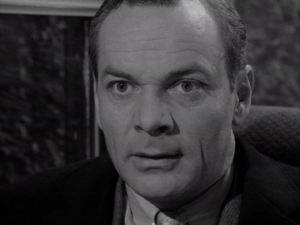
Gart Williams is an ad man. Essentially, he sells time and space to anyone who is willing to pay top dollar for it. And although he is seemingly quite good at his job, there is at least one person he can’t find the time and space for: himself. Gart is tired. Tired of the push, push, push world of corporate America; tired of not being able to find a moment of rest that he can call his own; tired of a spouse who appears to only be with him because he had excellent prospects as a young man–and those appear to be fading by the day. And so, Gart does what tired people do; they sleep. On one such nap while on the train ride home, he is suddenly awakened by the sounds of a conductor he had never seen before calling out a stop he had never heard before: Willoughby, a beautiful serene town, right out of Currier and Ives, as he says. And, before he can get off to see this magical place, the train starts moving again. But, the seeds have been planted; Next time, he is going to get off at Willoughby. After a series of stressful events leads to a nervous breakdown, Gart once again finds himself confronted with the choice of getting off at Willoughby. This time he does. Just as he wished, everything is now quiet for Mr. Gart Williams; time means nothing. As the conductor tries to explain why this passenger jumped off of a moving train, we see Mr. Williams’ body being taken away in a hearse from the Willoughby and Son funeral home,
Episode Details
“A Stop at Willoughby” is directed by Robert Parrish. The teleplay is by Rod Serling. And as for our cast, we’ve got James Daly as Gart Williams; Patricia Donahue plays the loving and sympathetic wife, Janie; Jason Wingreen is our Connecticut conductor; James Maloney plays our Willoughby conductor; and Mr. Misrell, our push, push, push man, is played by Howard Smith. The episode first aired on May 6, 1960.
Episode Tidbits
As for our tidbits, once again, Martin Grams Jr. comes through with some really interesting notes in his Unlocking the Door book. Apparently, this episode was originally conceived to be a the pilot film for The Twilight Zone back in 1958-59, but scheduling conflicts forced Serling to put it on hold and move on. Additionally, this was apparently Producer Buck Houghton’s favorite of Rod Serling’s scripts from season 1. He wrote in a memo to Serling that it was a “good, tight, step-beyond-reality script, with a downbeat ending that might be against it. I like it, however. I think the moral is worthwhile and vividly shown” (283).
My initial Thoughts
As for my initial thoughts, I’ve been discussing The Twilight Zone with people for much of my life, but in the past 10-15 years or so, this is the one that I think has grown in popularity the most. I think it’s because people are really starting to feel Gart’s sense of being overwhelmed by the constant chatter of the world and the growing difficulty of being able to enjoy a slow moment of silence and just recognize that we are alive and that should be a wonderful thing. My initial reaction for this watch is quite melancholy. Not for Gart but for the people out there who find this episode terrifyingly relatable. I’m hoping by the end, we can find a way to push back against that feeling and find a little bit of hope in the despair.
Question 1: Does the initial business meeting scene reveal more about Gart’s state of mind than we might have previously considered?
I’m going to admit something: I struggled with writing for this episode. The reason why is because I like it a lot, and it speaks to problems that we very much still struggle with today. When my students tell me that they’re experiencing a kind of writers’ block, my advice is always the same: write through it. Don’t worry about the clarity of language or grammatical mistakes; compose your thoughts. Now, if you do that long enough, most people eventually hit a kind of eureka moment, and that just so happened here when I watched the episode for the third time and I thought a bit more about the initial boardroom scene. I started thinking about Serling’s monologue, Gart’s body language, and even the business crisis at hand. And as I wrote, it finally hit me: when we watch the scene without giving it too much thought, it basically lays out the stressful nature of Gart’s job and how his boss, Mr. Misrell, plays a role in the continuing degradation of Gart’s mental state. But, oh, there’s more meat on this bone, so let’s get to it.
In Serling’s opening narration of the episode he says something that made me stop and rewind it. Can we say rewind anymore? Or has that word lost all meaning in a digital world. I remember how technologically advanced I thought my local video rental store was because they had a machine that was dedicated to rewinding VHS tapes. At the time, I thought this…this is the pinnacle of human technological advancement. And I was right. Be honest: has anything gotten better since then? I don’t think so. In Serling’s monologue he says that Gart’s “sensitivity has straddled him with humiliation.” That’s a wonderfully composed phrase by Serling, and it is what prompted me to think about how Gart’s sensitivity manifests itself in this episode, and that led me right to this initial boardroom scene.
First, let’s remind ourselves about the particulars of the scene. The big crisis at his job is that Gart loses a multimillion dollar advertisement account. Now, how he loses it is actually really important. Essentially, Gart tries to mentor a young man named Jake Ross; he tries to give a Ross a chance to prove his worth. Instead of returning this kindness to Gart, the young man steals the advertising account and takes it to a rival firm. This obviously upsets his boss, Mr. Misrell. And that leads his boss to saying a few things about Gart, some that are actually right and quite fair, and some that I think are a bit shortsighted given the fact that Misrell is the one who promoted Gart. When Mr. Misrell says to Gart, “you don’t delegate responsibilities to little boys,” the wording is harsh, and he even adds a dig of “personally” prior to saying it, but he’s not wrong. It probably was too big of an account for Ross–even though he seems to have successfully procured it. It should have been handled by Gart himself with a more managed mentorship along the way. Now, Gart did not get to his position at the table by being bad at his job. [Somehow, I don’t think Mr. Misrell is into giving out promotions because it makes him feel warm and fuzzy.] So, why did Gart make this mistake? I would argue it’s because of his sensitivity, and I’m going to build my case through Mr. Misrell’s own words.
First, Misrell calls the young man Gart’s protege, as in either a younger person or at the very least a person who has not yet fully matured in a specific field or skill, someone who still needs guidance. Secondly, the boss refers to the act of taking this young man under Gart’s wing as a pet project. Now, don’t gloss over this line. A pet project is essentially something you work on outside of your working hours; it’s a personal investment in something that YOU believe in, but that does not necessarily have the backing of others. Finally, there is a subtle implication made by Misrell about the young man’s character that we have to break down a bit to see where we land. When Gart tries to cover for the young man’s lateness by saying that it was probably a big lunch crowd, Misrell counters that it was “more likely a big martini, or three or four of them.” The subtle to us but not so subtle to the room implication is that the young man is a heavy drinker. Now, how do we jump to that conclusion? At this point, Misrell doesn’t know that the young man is at a meeting with a rival company; he’s just taking personal shots at both Gart and his protege. Could he be wrongfully accusing the young man of being a heavy drinker? It’s possible, but think about people that you know who are like this in real life. They reach a certain point of authority where they don’t need to use lies to hurt people; they can simply highlight the ugly truths of our existence. Think about it. For as much as we despise Misrell, when he lays into Gart for his choice to give over so much authority of this big advertising campaign to the young man, is he wrong? No. But, that doesn’t mean he’s right. It’s an odd fact of life that we can sometimes be right for the wrong reasons and wrong for the right reasons, and I think Misrell falls into this category here.
Now, you might be thinking: Joe you’re a monster, you’r worse than Misrell. How can you go after Gart Williams? Okay, hold on a moment. I’m just doing a little Aristelian drama gymnastics to establish the proper tragic distance of Gart’s fall here. My real point in this is to show that Gart did not have to take Jake Ross on; he did not have to step out on a limb for him and try to provide this young man with what seems to be a fantastic opportunity for his career; and from this scene we learn that he quite literally puts his job on the line. Why? His sensitivity to others. We know that Gart dislikes his job; and because we know his personality, we also know that he must have really struggled to get to that position in the boardroom. Misrell says famously that it is a push, push business, but Gart was clearly trying to help a young man out not by pushing but by nudging, by guiding. By showing him that there are potentially other ways to get to the top. I did a little dive into the peer-reviewed archives on mentorship in the workplace, and I found a great article by Sloane et al that talks all about the positives of quality mentorship programs, but this was the line that really stood out to me: “employees who benefit from mentoring relationships report a lower level of stress at work (Kram and Hall, 1989). (1041).
When you break down what’s happening in this initial scene, what we learn is that Gart Williams is an even better person than we might have previously thought. He is, as Serling stated, humiliated by his sensitivity, by his willingness to give someone a chance to prove their worth, their loyalty, but he isn’t humiliated for us; he isn’t for those of us who believe that people deserve opportunities not to prove themselves unworthy but to prove themselves worthy. Yes, in this case, it did not work out and Misrell is probably correct that he should not have handed over such a large project. But, then again, I’ve been in that situation before myself: placing my faith in people who prove me to be a fool. But, I will gladly play the fool 2 out of 3 times, if I can help that one person realize their potential for greatness.
Question 2: What role do the conductors play in this episode?
There are three important conductors in this episode. Yes, you heard me right. There are three. Let’s start off by talking about the two who are conductors by vocation. We have the “real” one who is on the Connecticut line that brings Gart to and from work. We’ll call this one the Connecticut conductor. Then, we’ve got the one who is calling out for Willoughby. We’ll just call him the Willoughby conductor. Let’s start by breaking down the Connecticut conductor first and talk about the role that he plays here.
Let’s be honest: just about everyone in the episode treats Gart rather badly–or at the very least they continually add to the negative pile of thoughts and events that are leading Gart toward his fatal act, except for one person: the Connecticut conductor. What makes this conductor so special is that he not only shows respect to Gart, but he genuinely listens to him. At an important point in the episode, the conductor comes over and reveals that he could not find any Willougby in the current or older books as a stop on the Connecticut line. This is something that I’ll even try to do with my students: I’ll log something really specific that they said and then I’ll find a way to come back to it a little later on so as to remind them that when they talk, there are people who are listening. And that sometimes has the added effect of reminding them that, when they talk there are people listening. The Connecticut conductor is even standing there over Gart’s body at the end with at the very least a sympathetic thought in his mind about the loss of this man, an individual he didn’t really know except through his job. I think this conductor represents a reminder that there is such a thing as acquaintances. We don’t have to be best friends or enemies–there is a middle ground for us to be able to share moments of connectivity with others through the common repetition of a shared space and time.
As for the Willoughby conductor, I’ll be honest, I go back and forth on him. I’ll be curious to hear if any of you have a definitive reading. It’s similar to the hitchhiker from the “Hitchhiker” episode. There is something oddly evil about the beckoning of the conductor for Gart to exit the train. I think our reading of this conductor is heavily tied to our reading of the ending of the episode: does Gart simply die in reality, or is Gart actually taken in by the Twilight Zone. If it’s the former, I think the Willoughby conductor is a malevolent figure. However, if it’s the latter, then he’s a kind of agent of good–guiding or conducting Gart toward a place where he can be that man who lives his life in full measure.
Now, there is one more conductor in this episode: Gart’s wife, Janie. You didn’t think we would go this entire episode without discussing one of, if not the worst, spouses in the entire series did you? Why do I say she’s a conductor? Well, she clearly had manipulative goals in mind when she married Gart. When Gart tries to express to her what is going on with him and his fantasizing about this magical place he discovered known as Willoughby, this is what she tells him: she says, “I’m sick. And I’m tired. Of a husband who lives in a permanent kind of self pity. A husband with a heart bleeding sensitivity that he unfurls like a flag whenever he decides that the competition is a little too rough for him.” Now, I had a really odd feeling when I watched this episode and focused on Janie the second time through. I had this idea in my head that I had heard this before. But where? Then, it me. Our old friend, Billy Shakespeare, and one of the greatest–I mean one of the worst, spouses in literature, none other than Lady MacBeth from Macbeth. Take a listen to one of the most famous speeches from Lady Macbeth regarding her husband>.
Glamis thou art, and Cawdor, and shalt be
What thou art promised. Yet do I fear thy nature;
It is too full o’ th’ milk of human kindness
To catch the nearest way. Thou wouldst be great,
Art not without ambition, but without
The illness should attend it. What thou wouldst
Highly, That wouldst thou holily; wouldst not play false
And yet wouldst wrongly win. Thou ’dst have, great
Glamis, That which cries “Thus thou must do,” if thou have
It, And that which rather thou dost fear to do,
Than wishest should be undone. Hie thee hither,
That I may pour my spirits in thine ear
And chastise with the valor of my tongue
All that impedes thee from the golden round,
Which fate and metaphysical aid doth seem
To have thee crowned withal. (I.v.15-33).
Lady Macbeth is essentially saying the same thing about her own husband. You’re too kind; too sensitive. You don’t have what it takes to take what you want. You need to be cutthroat and willing to destroy anyone who gets in your way. Even in Shakespeare’s day, it was a push, push, push world. Both women are attempting to play the role of conductor on the train of their husband’s lives, and at one point, it was probably their ambition that their husbands mistook for love–emotions are often mistaken that way by us. And these spouses are willing to run both of their better halves right off the track and into a ditch.
What the conductors in this episode show us is a bit of mixed bag. The Connecticut one reminds us that we can have meaningful engagements and relationships without necessarily having to be the best of friends; the Willoughby conductor is a kind of siren, beckoning us to self destruction with the promise of a utopian vision of our personal heaven; and then there is Janie, the worst conductor of all, willing to ride the car for free until it gives way to something better. It’s up to us to be able to see the conductors in our lives and to make sure that they are leading us to being the best versions of ourselves. If not, you need to get off the train–but, wait until it stops first.
Question 3: What are your moments of awe?
As for my moment of awe, we have to address the difficult conversation in this episode: suicide. Now, if you’re one of the many people who have been touched by this topic and the wounds are still fresh, please, consider skipping right past this, because I’m going to speak plainly. The most reliable recent data we have shows a fairly steady increase in suicide rates in the US from 2000 to 2018 and then a brief dip between 2018-2020, with a sharp increase back to its previous high between 2020 and 22. I’ll make sure to link this data in my episode transcript so people can see it themselves (link). I’m going to stay within the confines of the episode itself and not wander too far. You can probably make an optimistic reading of the episode by saying that Gart is ultimately taken by the Twilight Zone, and he’s living his best life in Willoughby. That’s fine if you want to read it that way. But, there’s no way around what actually happens in the real world. What I want to highlight here is Gart’s draw for a different world. I recall going to the movie theater and seeing the first Avatar film with a close friend of mine, and when we walked out of the theater, I remember feeling so incredibly sad. Why? Because I knew that people were going to long for living in that kind of utopian world where we are completely in tune with nature and live an existence of substance only, no gloomy, gray days; everything is colorful and just perfect. And i told my friend as we were literally leaving the theater that there were going to be people who left that film, not marveling at the cinematic achievement of the effects, which were phenomenal at the time, but they would leave depressed, wishing that they could live in that world. The next week, there was a story of someone ending his life for that exact reason. Now, are you ready for this, as of me writing this moment of awe there is a name for this phenomenon: post avatar depression syndrome. No. It’s not an official medical term, but it’s a term that has been given to this phenomenon. Listen to me very carefully. There is so much beauty and wonder in this world, in the world in which you are listening to me right now. Yes, it can sometimes hide behind terrible moments and horrible feelings–and we as a species don’t always make it easy for others to see it. But, it’s there. If you’re having trouble finding that beauty, talk to a friend, a loved one, and/or a professional. Let them help you regain your ability to see and experience the wonder, the awe, that this world has to offer. Don’t give in to the despair.
My Rating
As for my rating, I mean, I’m not even going to pretend. This is top top-tier for me. There is just so much that can be pulled out of this episode, so much important information that serves as a warning to us all about work-life balance, about seeing when others are in trouble in front of you, and about the importance of not crushing the spirit of those we love.
Next Episode
Next time, we’ll be taking a look at “The Chaser” and here are your questions to consider when watching the episode:
Question 1: What does this episode want to say about love and emotions?
Question 2: What makes Professor A. Daemon unique among the others of his kind in
story?
Question 3: What are your moments of awe?
Closing
I’ve always paired this episode with “Walking Distance.” I feel like Gart Williams is a potential version of Martin Sloane if Martin had not received those guiding, loving words from his father to recenter him around what is important in life. We desperately need meaningful connectivity with people to help us remember that to be human is not to be constantly bombarded with information and entertainment; to be human is to act human; to live human; to work together in order to overcome great problems; and to celebrate that those of us who are alive right now are sharing this brief time that we have on this planet together, and that this should mean something. This episode is always a reminder to me that I might feel like Martin Sloane, but it doesn’t take much to push us to become Gart Williams.
Announcements and Shout-outs
I only have one announcement for this episode, and I wish it were a happier one. Earl Holliman the pioneering Twilight Zone actor from “Where is Everybody” passed away recently. Some of you had some really nice things to say about him when I posted the alert on my YouTube community page. He lived a long life and will be remembered for not simply the Twilight Zone but for quite a successful acting career. We should all be so fortunate to pass away having entertained and touched so many lives.
How to Support the Show
You can continue our conversations by heading over to our Discord server and either starting a conversation about this episode or taking part in one that is already happening. The link to join the server should be in the episode notes section. You can also head over to thekeyofimagination.com, where you can rate this episode, learn more about me, watch previous episodes of the show, and check out my curios page where I showcase some of the Twilight Zone trinkets I’ve bought over the years. I encourage people to email me thoughts and comments, whether it’s about a particular Twilight Zone episode, your rating for an episode, or about the Key of Imagination Show. You can get those to me as a text email, an audio clip, or even a video clip of roughly no more than 5 minutes to keyofimaginationshow@gmail.com. Keep in mind, even though we talk about some serious topics, we’re trying to maintain as family-friendly of an atmosphere as we can. If you would rather I not use your comments on the show, please indicate that so I can respect your decision.
If you enjoyed the show, I ask that you please take a moment and do one of the following to help build our community. Rate the show, review the podcast, leave comments, thumbs up, all of the usual algorithmic gymnastics. That will help get the show in front of more people and help us build our community of Twilight Zone fans. However, even if you do none of that and absolutely hated every minute of this, I would still like to thank you for spending some time with me. Until next time, remember, all doors are open to those who possess the key of imagination.
Works Cited.
Sloan, David, Alan C Mikkelson, and Sebastian A Vaduva. “The Importance of Mentorship in
Diminishing Workaholism and Increasing Heavy Work Investment: Evidence from the
United States.” Amfiteatru economic 22.SI 14 (2020): 1030–1048. Web.