
The Twilight Zone Season 1: Episode 31
"The Chaser" Episode Transcript
Introduction
Welcome to the Key of Imagination. This week we’re going to be looking at the Twilight Zone episode, “The Chaser.” We’ll talk about the difficulties that come with love and emotions; we’ll dissect what makes Professor Daemon different from others in this story trope; and I’ll reveal to you my moment of awe, a disturbing thought involving the potential future of this episode’s key character. So, grab your keys, and let’s open up this door to the fifth dimension.
Plot exposition
Roger Shackleforth is a man in love. And just who is it that has captured his heart? None other than the enchanting Leila. From the moment we meet Roger, we realize that this is a man who will do anything to win–or get–the affections of his Leila. When our lover boy makes a visit to a curmudgeon named Professor A. Daemon, he quickly realizes that there are other ways to win someone’s affections. A little alchemy will do the trick; better living through chemistry; sometimes known to us throughout history as a love potion. It doesn’t take long for Leila to fall madly in love with Roger, and all is right in the world. Well, maybe not all. It’s a bit annoying just how much Leila loves Roger. In fact, it’s downright detestable. Roger can’t seem to get a minute to himself. She’s always there, loving him. Chemistry is what got Roger into this and chemistry is what will get him out of it. And so, Roger pays one more visit to the Professor for his famous glove cleaner, a potion that gets rid of problems, and is completely undetectable. And just as Roger is about to administer his anti-love potion, Leila unveils an adorable knitted sock, the perfect size, for a perfect little bundle of joy. As the glove cleaner solution falls to the floor, so, too does Roger’s jaw.
Episode Details
“The Chaser” is directed by our old friend Douglas Heyes. The teleplay is by Robert Presnell Jr., but it’s based on a short story by John Collier entitled, “The Chaser” As for our cast, we’ve got George Grizzard as our loverboy, Mr. Roger Shackleforth; Patricia Barry plays our lady of interest, Leila; and John McIntire is our alchemist extraordinaire, Professor A. Daemon. The episode first aired on May 13, 1960.
Episode Tidbits
As for our tidbits, Martin Grams Jr. details the business behind procuring the rights to telling this love story. As usual, Grams Jr. does an excellent job of making what is mostly dry business into an interesting narrative. But, here is the part that caught my eye. Collier, the original author of the short story, sold the rights to Robert Presnell Jr. so that it could be made into a play in 1951. Presnell at this point in the story owns the rights to the live performance. When Producer Buck Houghton was looking into getting the rights for the Twilight Zone, he was actually able to get them directly from Collier, and at the time, Houghton wanted Serling to adapt it for the show. But, they went with Presnell for the teleplay seemingly because of the fact that he had already previously adapted the short story for television/theater. I bring this up because it’s interesting to think what Serling could have done with this story. Just letting my thoughts wander a bit here, I think it would have had more bite with Serling in a couple of ways: first, I think there would have been more intrigue with the Professor. We’ll talk about him more in our second question, but I also think Serling would have probably made Leila more interesting. Obviously, there is no way to know this as fact, but Serling had a way of writing incredibly tight scripts, so I do think he could have made some improvements here.
My initial Thoughts
As for my initial thoughts on this watchthrough. It’s not one of my favorites. When it comes to entertainment, I don’t really consider myself to be overly critical. What I mean is that, I appreciate when scripts and directors try to do something–even if they fail at it. I like taking chances not for chances sake but for a legitimate vision. To me, this episode lacks a bit of a vision. You’ve got a “careful what you wish for” storyline, but what makes it different from the probably thousands of others? Not much, and that’s my problem. The acting is perfectly fine; the cinematography, specifically the door sequence when Roger first enters the professor’s abode, reminds me of playing the old Resident Evil games on PS1, where you just see the doors opening as transitions from one room to the next, so that was a nice little bit of nostalgia. But, what do we walk away with from this story that we don’t get from something like “The Monkey’s Paw?” Again, not much. That line kept coming up in my head as I rewatched this: not much.
Question 1: What does this episode want to say about love and emotions?
It would seem odd not to address the romantic relationship itself in this episode, and yet, I wanted to do so in a way that can both potentially uncover a fairly unique way of reading our protagonist, Roger, and also provide some information for some of you out there who might benefit from the research I uncovered here. Now, granted, I am an incredibly blessed man with a happy marriage–we have our difficult times like every relationship, but I would not want to be on this journey of life with anyone else–period. But, the anecdotal evidence all points to the fact that romantic relationships are incredibly difficult now, especially for young adults. We can certainly blame social media, the loss of common points of popular culture, and all manners of divisiveness in the way we talk with each other, but I’m going to go a different route here and use our characters to paint another side of the picture. First, let’s get a better sense of our man Roger Shackleforth.
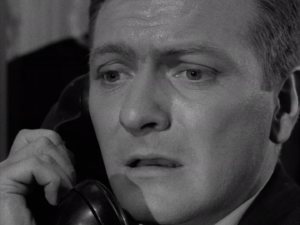
When we meet Roger, he’s holding up the line of a payphone. For my younger audience members, that was a kind of mobile phone that was too big to fit in your pocket, so we encased it in a glass enclosure for privacy and so British doctors and high school students who need to compose presentations for their history class could transcend time and space. Roger is obsessively putting coins into the phone, hoping that the love of his life, Leila, will pick up and talk to him. When he does finally get through to Leila, he says to her, “I must see you darling–must, furiously, fiercely, darling, must!” When I teach rhetoric to my college students, I often try to help them remember that pathos is an emotional appeal by hamming up some Shakespearean Romeo and Juliet and asking them to think of a word that we use that looks like pathos. Someone eventually says it: pathetic. I could really just show them this clip of Roger and it would probably work the same. To get serious for a moment, let’s say that Roger actually does feel this way. For anyone older than about 16, we all know that such feelings can become quite problematic if they are not properly reflected upon and contextualized. In fact, Leila even says to him, “Roger, you’ve got to stop this. You’re acting like a baby.” Now, such feelings can of course become much scarier things like deep-seated infatuation and obsession. But, rather than move right to the extreme, let’s actually talk about how we can better avoid these terrible emotions by building healthier relationships. Let’s talk about healthy emotional regulation.
Okay, I can already hear some of you out there: Joe, I thought you were the sappy emotional type–you recite Shakespeare, you study poetry, epic narratives, and you talk a lot about emotions. Yes, guilty as charged. However, for me, a part of a healthy relationship is understanding how we balance the value of the self in relation to our romantic partners. My wife is everything to me. But, in order to be everything to her, I have to understand how to regulate my own emotions and energy so that I can be my most available self. If you are constantly obsessing over your romantic partner, it will lead to not only most likely the end of your relationship, but it leads to terrible results in terms of one’s mental health. I found a fantastic peer-reviewed article that talks about a direct relationship between romantic obsession and psychological well-being. In the article, Misrili et al conclude, “as the intensity of relationship-centered obsessive-compulsive symptoms increases, there is an associated increase in emotion regulation difficulties. Moreover, it was found that as the severity of relationship-centered obsessive-compulsive symptoms and emotion regulation difficulties increase, psychological well-being decreases” (303). In layman’s terms, the more a person obsesses over the relationship, the more difficult it is to regulate one’s own emotional state, which leads to a decrease in one’s mental health. Now, if we’re being our most charitable to Roger, we can say that his choice to pursue using the elixir is a result of his compromised mental health and a genuine belief that no one will treat Leila with as much love as he will–but, we could also just as easily and just as fairly say that he’s a jerk. But, there’s something else here for us to pursue as well.
At one point in the episode, Leila is kneeling at Roger’s feet while he’s trying to read a book. He says to her, “couldn’t you please sit in a chair?” To which, she replies, “oh, yes, my darling.” But, it’s what she says right after that line that is really telling. She says, “which chair?” This response is typical of someone who has given over all agency to another person, and it’s not a good thing at all. We don’t want people to give up their agency, even in relationships that are not abusive in nature. What I mean is that long-lasting relationships tend to have a healthy push and pull effect. If one of the partners is growing more reticent about making decisions in their lives, that can put a strain on the relationship. When I went to the research to look into the role that submission plays in relationships, I got a lot of articles that had to do with domestic violence, which is understandable. It’s a terrible problem and it’s something we have to continue to learn about and prevent. However, the situation with Roger is a little different from that. What I found was an interesting article by Pietromonaco et al that discusses power dynamics in a romantic relationship, and I think the results they found in their study can help us understand Roger’s situation with Leila a little bit better as well. In the study, Pietromonaco concludes, the link between low power within relationships, as in never having a say in key decisions about the couple’s goals and submission, “is particularly important in romantic relationships because submissive responses (e.g., holding back) are associated with poorer relationship functioning, probably because submission limits people’s ability to achieve core relational needs and goals” (Pietromonaco). In the case of Roger and Leila, Leila is submissive, but I don’t think it’s because of a loss of power. In fact, Leila does not really know that she has no power at all. That is the real magic of the love potion. It’s not that it makes people fall in love; we’ve been doing that forever as a species. It’s that people fall in love and they don’t even know that they’ve given over their agency. Because Leila doesn’t know that she’s done this, she has no need to push back, no need to find her places to take a stand on something. In short, there is no power dynamic in their relationship because Leila is like silly putty–she simply takes on the shape of whatever comes her way.
So what is this episode trying to say about love? I think it wants to teach the value in emotional regulation; it wants to remind us that healthy romantic relationships require a push and a pull from both sides; and if someone wants to sell you a love potion, you’re probably better off just buying the person you’re interested in a cup of coffee and trying to have a conversation with them.
Question 2: What makes Professor A. Daemon unique among the others of his kind in
story?
When I talk about others of his kind in story, I’m referring to the tempting devil motif. You can find this everywhere in our literature. The idea is very much the same: the contractor has something that the contractee wants: power, fame, knowledge, money, etc. What seems to always connect these tempting figures is a kind of confidence. They know that someone is desperate or hungry for this knowledge, and that gives them a kind of upper hand in the negotiation. But, that’s not really the case here. It’s a bit of an odd scenario if you think about it, so let’s do just that.
When Roger meets the Professor we find this curmudgeon man who seems to simply want to quickly make his transaction and move on with his life. He’s yelling at Roger to get on with it, but Roger has no idea why he’s even there. This is the first odd thing about this professor character: he has odd motivations. The professor clearly values money enough that he charges a premium price for the glove cleaner because he knows that this item has the most value and its an answer to a problem that he himself creates. It’s a brilliant model. And it’s one that we are very much seeing today in colleges and primary schools all over the world. Let me explain.
Undoubtedly you’ve heard about how schools everywhere are struggling with students using large language models like ChatGPT to cheat and have their essays for school written for them. The students get an assignment; they run the prompt through these AI language models and out pops a paper that is many of the times worse than what they could have produced on their own if they had just done the assignment. But, what’s interesting about this is they use a company that built the large language model to generate the essay and then the schools pay oodles of money to, often times, the same company to identify that it is Ai-generated content. So the company gets money from both ends. It’s the love potion and the glove cleaner.
In the case of the Professor it seems a bit odd to me that he has this business savvy-ness. It’s not that it doesn’t make sense; he’s a human; humans need money; get the money. It’s that, we end up losing a bit of the mystery and intrigue that is often involved in the transaction that takes place in this usual deal-with-the-devil situation.
The second thing that I find interesting about the professor is the way in which he pushes the glove cleaner, especially in his first interaction with Roger. He mocks Roger for saying he wants his Leila’s love by saying, “if it isn’t his Leila’s love, it’s his Dorothy’s love, his Rhea’s love, his Gwen’s love.” The mockery being that the pursuit of love is so commonplace, it’s boring. Again, that’s perfectly fine, but then he says, “Tell me, are you sure you wouldn’t be interested in the glove cleaner as I call it? There are many names for it, including the eradicator…., clean, colorless, tasteless, and unidentifiable for sure.” Finally, when Roger says, I’m not interested in glove cleaners, the Professor adds this: “Why not, It’s sure; it’s swift; it leaves no trace. It’s perfect for its purpose”.
What’s interesting and a bit different about this character versus say someone like a mephistopheles from Faust or your typical devil in disguise is that the Professor seems a lot more interested in what he wants than the person who is being tempted. In this case, he finds someone wanting the glove cleaner to be interesting because it’s much more of an accomplishment to make a glove cleaner than it is a love potion, which he refers to as the cheap parlor trick of his profession. That makes me think of him as a child. Have you ever seen someone–maybe even you–give a small child or a dog a really nice gift only to see them play with the box it came in or the wrapping paper instead? [As I write this, I’m pulling together my Christmas presents for people, and I fully expect this scenario to happen at least twice.] That’s how I see the Professor here. In short, he’s bored, and that’s odd for this type of figure. Additionally, he’s quite a needy fellow. He really wants people to recognize his achievements and hard work, and if they don’t, then they are not worthy of his trade, which reminds me of a certain soup-serving character from Seinfeld who would do the same thing. If you didn’t appreciate how hard he worked to create the soup and respect his rules, he would kick you out of his establishment and say, “no soup for you!” I think we can finally state our answer to the question: what makes the Professor different from many of the other types of literary figures like him is that he is incredibly insecure when you break it all down, and I find that it makes him…less interesting.
Question 3: What are your moments of awe?
I had the oddest moment as I was finishing up writing for my first question. I realized something. In a lot of ways, this episode actually mirrors “A Nice Place to Visit.” In that episode, Rocky Valentine gets everything that he wants, wins at everything he plays. But, what makes it a hell scenario is that he only ever wins. There is no sense of losing, no sense of fighting for something, no struggle, no work to put into anything, and thus no difference day to day in his life. This is exactly what Roger is also facing with Leila. She does whatever he wants, thinks only of what will make him happy, tries to make it so that he is always winning. In short, he’s in a kind of hell. Now, what would make this even worse is if the baby turns out to be similar to Leila in that the son or daughter is always asking Roger what he or she can do to make him happy, to please him and make him proud. We certainly want children to court some sense of making their parents proud. But, I would think that most parents would also realize that kids will need to make their own mistakes and find their own way in the world. For the sake of the kid, I hope Roger just ends up with a very loving wife.
My Rating
As for my rating, I’ve already probably given away that this is not going to get a high rating from me. And the idea that the big reveal is that she’s pregnant and so now Roger is stuck with her is…a bit much for me. I mean, I get the joke; it’s the humor of the Twilight Zone. I’m going to give this episode a middle lower-tier. I think it just barely leaves the lower upper-tier based upon some decent acting and some good direction and cinematography. But, I mean it just barely makes it into the middle tier. In fact, if I have to keep talking about it, I’m going to put it back into the lower tier. I’ll do it.
Next Episode
Next time, we’ll be taking a look at “A Passage for Trumpet” and here are your questions to consider when watching the episode:
Question 1: Why does Joey think the music only comes out beautiful when he’s drunk?
Question 2: What do we make of this in-between life and death space?
Question 3: What are your moments of awe?
Announcements and Shout-outs
I’ve got some comments to highlight from the YouTube channel, but I encourage people who are listening through Spotify or any of the other platforms to leave comments as well.
On my trivia post in my Community tab for the “A Stop at Willougby” episode, PHXDOG comments, “The 2nd time he "dreams" about Willoughby he is getting closer to letting go. He does not question the conductor about Willoughby, he is excited about seeing it again, but he is not ready. That is the reason why he goes back for his briefcase. He goes back to his life not willing to let go 100%. That is why the train starts moving and the conductor ignores his calls.” This is a great point, and I think it’s one that we can easily miss. That brief moment when Gart goes back for the briefcase on the second dream sequence is a fantastic choice by the creatives for the episode. It shows that Gart has in fact moved closer to getting off the train, but he’s not quite there yet. These are the kind of moments that I think we need more of in our television and films today, nuance, small movements that add up to larger payoffs when you think about them more carefully.
Ofinfinitejest had a great comment on the “A Stop at Willoughby” episode itself, writing, “The basic idea in all of these tales is nostalgia (or a wish) for another time, another place, a far different life, that, real or not, represents a dream or vision of a more calming existence than the distilled madness modern "civilization" has created for us. While in ICU and near death from a gunshot, Tony Soprano's coma dream of a better, more simple life. one free of the turmoil of his family versus The Family, has a stunning and emotional resonance with this episode of "The Twilight Zone." Thanks for the great connection and thoughts, ofinfinitejest. In fact, a few of you brought up the pull of nostalgia today. I don’t find the pull to nostalgia concerning as much as I find why and how we’re doing it, which I think many of you would also agree with. The termnostalgia goes back to the Greek nostos, so it has been with us for a long time. I don’t think it’s unhealthy to have a kind of longing for something beautiful from the past; however, what Gart is doing is actively seeking to escape the present and actually live in the past. That is a sign of an unhealthy mind and culture, and I think it’s probably a bigger problem for us as a civilization than we might even recognize.
Keyllstanton7378 also had the following to say about the “Willoughby” episode: “Excellent as usual, Joe! "Willoughby" has always been one of my favorite TZ episodes. [Gart] Williams is such a tragically relatable character - I would describe his experience as, at best, major burn-out - and at worst, an existential crisis. Whether our jobs are great or small, don't we all, at some point, wonder, "what am I doing all this for?" The shark-infested, eat-or-be-eaten atmosphere depicted here also reminds me of Serling's other scathing indictment on the corporate world - "Patterns." Kelly, as usual, great stuff, and thank you for the kind words. “Patterns” is excellent, and you can often find the 1956 version on YouTube, which I highly recommend, if for no other reason than to play one of my favorite games: find the Twilight Zone actors bingo. There are quite a few in the 1956 “Patterns.”
How to Support the Show
You can continue our conversations by heading over to our Discord server and either starting a conversation about this episode or taking part in one that is already happening. The link to join the server should be in the episode notes section. You can also head over to thekeyofimagination.com, where you can rate this episode, learn more about me, watch previous episodes of the show, and check out my curios page where I showcase some of the Twilight Zone trinkets I’ve bought over the years. I encourage people to email me thoughts and comments, whether it’s about a particular Twilight Zone episode, your rating for an episode, or about the Key of Imagination Show. You can get those to me as a text email, an audio clip, or even a video clip of roughly no more than 5 minutes to keyofimaginationshow@gmail.com. Keep in mind, even though we talk about some serious topics, we’re trying to maintain as family-friendly of an atmosphere as we can. If you would rather I not use your comments on the show, please indicate that so I can respect your decision.
If you enjoyed the show, I ask that you please take a moment and do one of the following to help build our community. Rate the show, review the podcast, leave comments, thumbs up, all of the usual algorithmic gymnastics. That will help get the show in front of more people and help us build our community of Twilight Zone fans. However, even if you do none of that and absolutely hated every minute of this, I would still like to thank you for spending some time with me. Until next time, remember, all doors are open to those who possess the key of imagination.
Works Cited
MISIRLI, Melis, and Gamze KARADAYI KAYNAK. “Effects of Relationship-Centered Obsessive
Compulsive Symptoms and Difficulty in Emotion Regulation on Psychological Well-Being
in Young Adults.” Psikiyatride güncel yaklaşimlar 15.Supplement 1 (2023): 298–306.
Web.