
The Twilight Zone Season 1: Episode 32
"A Passage for Trumpet" Episode Transcript
Introduction
Welcome to the Key of Imagination. This week we’re going to be looking at the Twilight Zone episode, “A Passage for Trumpet.” We’ll talk about why Joey thinks the music only sounds good when he’s drunk; we’ll take a deeper dive into this in-between life and death space; and I’ll reveal my moment of awe, which includes a reference to a very famous miser from the Dickensian era. So, grab your keys, and let’s open up this door to the fifth dimension.
Plot exposition
Joey Crown can blow the trumpet with the best of them. So, why isn’t he? He loves music, loves playing, but those moments do not fill up a day. When he doesn’t have a trumpet in his hands, he has a bottle, a magic elixir to him and unfortunately for a lot of other people that helps make the blues disappear. But, this particular magic potion does not share itself well; it wants all of its host’s attention and submission, and so Joey stands on the outside of the clubs, waiting, waiting for someone to give him a chance to prove that he can still play a mean trumpet. But, when his final chance is ruined by the drop of a bottle, he decides there’s no point anymore. He pawns his trumpet, and steps out in front of a moving car. He thought people ignored him before, but this new world is something else. No one can see or hear him. But, Joey isn’t dead. He’s in an in-between place. In the distance, a beautiful, familiar sound can be heard: a trumpet. When Joey goes to see who it is, he finds a rather interesting fellow–and what is even more intriguing is that this man can see and hear Joey. Through his conversation with his new friend, Joey begins to remember that there was more to life than just the dark moments; there were people who cared; enjoyable memories. When this mysterious figure gives Joey a choice to stay with the deceased or to go back with the living, the choice suddenly becomes easy: let’s go back. When Joey asks his new friend for a name, the man replies, “Gabe, as in Gabriel.”
Episode Details
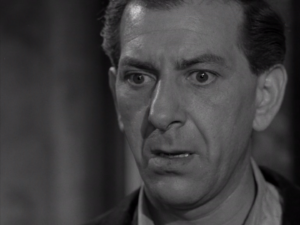
“A Passage for Trumpet” was directed by Don Medford. The teleplay is by Rod Serling. As for our cast, we’ve got two main characters here. The incredibly talented Jack Klugman is our main cat on the horn, Joey Crown, and John Anderson is providing some cool notes directly from the man upstairs as archangel trumpeter, Gabriel. The episode first aired on May 20, 1960.
Episode Tidbits
As for our tidbits, if you have Gram’s Jr’s book Unlocking the Door, there is a ton of extra information for this episode, including an interesting quotation from Serling’s agent regarding learning when to throw away bad scripts. However, I want to highlight something funny here. According to Gram’s Jr. both Klugman and Anderson took some lessons on trumpet in order to come across more realistic. However, one of them took it more seriously than the other. Here is an exchange between the two friends, John Anderson and Jack Klugman, about that topic. Anderson says, “Jack, how did you do the trumpet practice? He said, “what practice?” I said, ‘Klugman! Are you telling me you didn’t even practice? You’re gonna fake it?’ He said, ‘For Christ’s sake, Anderson, who’s gonna notice if we’re hitting the right valves or not? If the audience is so busy looking at our fingers, then we’re really in trouble’” (290). Anderson had to admit that Klugman was right. I think they both pull it off just fine.
My initial Thoughts
As for my initial thoughts, this is, again, one of those episodes that I hadn’t seen in a while, and I mostly remember it as being rather mediocre. But, when I watched it again for this episode, I found myself really drawn into it–a lot more than I thought I would be. This is the first of the four episodes we get with Jack Klugman, and in some ways, you can make the argument that it’s his best performance–now, wait, don’t jump out of the screen and start hitting me with pool sticks. I love “A Game of Pool.” It’s one of my favorite episodes. I use it quite a bit in classes when I get the chance to show Twilight Zone episodes. But, there is a fantastic story behind “A Game of Pool.” The premise itself is quite rich. I don’t think this episode has a particularly deep premise, which means it falls a lot on the actors to make a dollar out of 15 cents. That’s what I mean by you can make the argument that it’s his best work in the Twilight Zone.
Question 1: Why does Joey think the music only comes out beautiful when he’s drunk?
This is a sensitive question, somewhat, so we want to treat it respectfully. We have an oddly romantic relationship as an audience with musicians who use drugs or alcohol to produce their art. It’s as if we respect the artist’s selling of their soul for the sake of producing something beautiful for us, but what tends to get lost in this conversation is that substance abuse, whatever form it takes, still plays a destructive role on the human being behind the musician–and there is a human being behind all of the art. Jimi Hendrix, Kurt Cobain, Amy Winehouse–these are just the immediate ones that came to my mind. Is substance abuse and music really as prevalent as it seems? Well, actually, there does seem to be a specific relationship there. In fact, according to American Addiction Centers, “substance use and abuse in the music industry is not a random occurrence. It exists at an estimated rate of 11-12 percent” (link). That is quite a disturbing number. But, I think there is still a nuanced discussion that has to be seen here. I think you have to put the music aside a little bit and find the problem at hand. Our friend Joey from our episode is quite clear about why he drinks.
He tells his musician friend Baron, “when I’m drunk, boy, I don’t see all the dirty walls or the cracked pipes. I don’t know the clocks going, the hours going by. Cuz then, I’m Gabriel. I’m Gabriel with a golden horn. And when I put it to my lips, it comes out jewels…,when I’m drunk, Baron.” This notion of forgetting your problems is of course one of the primary reasons why people abuse any substance. Another famous musician, Charlie Parker, said it best in a conversation that he had with Walter Bishop. Parker says, "…you know there's quite a number of things wrong with me. I go to this heart specialist, you know, give him a hundred dollars for the relief of my heart. He treats me, don't do no good; my heart is still messed up. I go to this ulcer man, give him seventy-five dollars to cool my ulcers out; it don't do no good. There's a little cat in a dark alley around the corner. I give him five dollars for a bag of [stuff]; my ulcer's gone, my heart trouble gone, everything gone, all my ailments gone” (link).
We can abuse all manner of things, food, video games, entertainment, etc.. But, you have to understand one of the primary reasons we do it is to not be consciously aware of our present feelings, but that doesn’t just mean the presently bad feelings; it also means the good ones. And so, when Joey says that somewhere along the line he forgot all the good things; he’s right. He did forget the good things because they were being masked by the alcohol, by his inability to confront the feelings that he expresses at the beginning of the episode when the fellow musician asks him why he threw all of his talent away, and Joey simply responds, “because I’m sad.” In an interview with Steven Tyler, frontman for the legendary rock group Aerosmith, he had the following to say about drug use:
"What happens with using is: It works in the beginning, but it doesn't work in the end. It takes you down. There's nothing but jail, insanity, or death.
"I was just an angry [person] when I got high. And holding on to anger is like grabbing on to a hot coal with the intent of throwing it to someone else. You're the one that gets burned.
[Far be it from me to interrupt a genius of any kind, and Tyler is a genius. But, I believe if you throw a hot coal at someone, you are not the only one who gets burned. The person who has the coal thrown at them, will probably also get…you know what…never mind. Let’s continue.]
He continues, "The experiences I had, and that learning process, was something I cherish forever. It's like looking for Alice and chasing the rabbit down the hole. Your thinking is around everything that you witnessed in Wonderland.
"It's not a bad thing - if you can write about it and make sense about it with music, then you're golden. But that got taken away from me. I'd get so high that I couldn't be creative anymore.
"But these moments, I don't regret them. It was the greatest time. I'm just happy I survived, crawled out of the hole" (link).
We’ll get to the part about the music in a second, but I want to address what Tyler says at the end because it can absolutely be destructive if not properly contextualized. He says, “it twas the greatest time,” which makes it sound like it’s something that should be done, but then he adds, “I’m just happy I survived.” You see, that’s the problem. He gets to be nostalgic because he survived, but not everyone does, and we lose a tremendous amount of people each year to drugs and alcohol, and they don’t have the chance to look back at how great the time was because they’re dead. Oh, and the time for the people who love these individuals is not the greatest of times. This is what I mean by romanticising the relationship. Tyler said that and the interviewer wrote it up because there’s something about it that sounds dangerous and fun, but we tend to not think about all of the people surrounding the user, the ones who spend all of their time worrying about overdoses, alcohol poisoning, the loss of time with that individual that we can never get back again. Because when you’re using, you do not belong to anyone but that substance. If you’re struggling right now with something, and I’m striking a particular nerve for you, you can go right ahead and turn this video off and go get help now because that is way more important than anything else I or anyone else on YouTube has to say.
As far as the music part of the Tyler interview, I’m taking away something here that I don’t think most people think of when they hear the usual drugs make the music better stories: it’s not that the drugs and alcohol make the music better; it’s that they provide opportunities for narratives that otherwise might not have been experienced without them. It might sound like I’m being nitpicky here, but I’m not. The music itself comes from the talented musicians, not the drugs. Additionally, as people first and consumers second, we should always be in favor of sacrificing the great music for the sake of the person. I’m sorry if that makes me sound boring and a party pooper, but I would rather have the talented musicians around for 75 years than one great album and then lose them to a tragic overdose. When we start to care too much about our need to be entertained over the importance of recognizing the human being, we move the needle of civilization a bit closer to uncivilization, and that’s just not something that I’m always trying to be careful about because I can be guilty of it myself.
Let’s bring this around to our question about the music. Why does he think that the music only sounds good when he’s drunk? It’s because he is unable to process the times when the music does not come out wrong, the mistakes. Additionally, without inhibitions, he’s able to take more chances and experience more narratives in life because the shame of potential mistakes are no longer a concern. I don’t think that the music necessarily sounds better when he’s drunk, but it is perceived to be better by him because of the dropping of the inhibition. You hear this a lot about music and drug abuse. Finally, what Joey knows for a fact is that when he’s consciously aware of his state of being, he often finds his mind wandering toward melancholy and depression, but with the alcohol, that doesn’t happen, which means the times that he’s drunk are perceived by him to not necessarily be better, but rather they are the absence of depression. Those aren’t the same things. It isn’t until he has a clear enough mind to recognize that there were good times in the past, there are good times in the present, and there will be great times in the future that he can start the healing process. He admits as such when he says to Gabriel, “somewhere along the lines, I forgot all the good things. That’s what happened, you know. I just forgot.” And that’s the thing about substance abuse, whether it’s drugs, food, or doom scrolling–yes, that is a term that I learned from my students. I’m hip; I’m cool. I know what the kids are saying these days. You don’t just forget the bad; you also potentially forget the good, and the hopefulness.
Question 2: What do we make of this in-between life and death space?
Something that I hadn’t remembered from when I used to watch this episode in marathon runs was the setup of the in-between zone with the people. I think I always thought that they were fake or people who were alive and just couldn’t see him. In short, I kept my focus on Joey and didn’t really pay much attention to the other people in the scenes. But, in actuality, it’s more interesting than that. And, it’s one of those premises that grows more interesting the more you think about it. So, let’s get to the thinking about it already.
Okay, so what is going on exactly with these people? Let’s get the word from the man himself: Gabriel. At roughly the 17:50 mark of the episode, Gabriel tells Joey, that the people in the streets “are dead. They’re the ghosts, Joey; they just don’t know it. That’s all. Sometimes, to make it easier, we have to work it that way. We let ‘em go on with a life they’re familiar with. They never know for a long while.”
As usual, I had a moment where I felt like, wait, where have I heard this before? And then it hit me: Poltergeist, as in the movie. Now, to be honest, this probably won’t be the only time I bring this reference into our conversations; it will likely come up again in the “Little Girl Lost” episode, but I have to use it here because this episode actually creates, in some ways, a better appreciation for the film. I’m geeking out a bit. Calm down, Joe. Use your words.
In Poltergeist, the “this house is clean” lady, Tangina, explains that the ghosts in the house do not know that they are dead, and the major problem is that they are drawn to the lifeforce of the young girl, Carol Ann. They want to feel and experience what it means to be alive, and they can’t do that, so they have grown resentful. What they want more than anything is a guide to bring them back to existence. Can you see where I’m going with this yet? Okay, stay with me.
In the Twilight Zone episode, the people seem relatively happy and fine. Why? They are experiencing what it means to be alive still, so there is no resentment that is building up inside them. Additionally, Gabriel’s presence is proof that there is a kind of mechanism behind all of this, a thought process where divine figures can make sure that they slowly and methodically come to terms with their passing in a way that will likely make it easier for them to transition to heaven, or to the light, if we’re using Poltergeist language. Now, let’s go even a little deeper. You have the role of the guide or transitioner that helps move the people in Poltergeist from the ignorance of their death to awareness. That’s Tangina. In the Twilight Zone episode, we have Gabriel, a figure who plays an instrument, but that’s not the only way that we know musicians. We also have the old story of the pied piper, a musician with the power to make people follow him through his music. At one point toward the beginning of the episode, when Joey is trying to make the case for why the other musician should let him play with the band, Joey says, “when I pick it up and I blow it, I can make ‘em cry.” There is a kind of way that music does actually move us; it can have that effect on our bodies.
In the same conversation with Joey, Gabriel says, “right now you’re in a kind of limbo; you’re neither here nor there. You’re in the middle, between the two: the real and the shadow.” Now, the next line, Gabriel’s question, is really the interesting part to me. He says, “which do you prefer?” But, it’s the way that he says it. He says it in the same way that we often ask questions when we know deep down what the answer should clearly be, and we just need the person to say it and acknowledge it. In other words, from the way he asks the question, it feels like you could rephrase it as, “do you really prefer to be a part of this?” If this is the case, then our connection with Poltergeist makes even more sense. In the movie, it’s a negative thing that these ghosts are where they are. They’re trapped and need to move on. That seems to be the case here as well. Although the people are not suffering in this Twilight Zone space, it’s clearly not supposed to be a forever thing. They need to move on at some point. The only difference between the two is that, Gabriel and maybe the other angels, are responsible about the way this particular place is run. They know what needs to happen and they provide a kind of responsible oversight of the place to make sure that people get where they ultimately need to go.
With this connection in mind to Poltergeist, I actually think it has a mutually beneficial appreciation for both stories and triggers within me a kind of thought that there are other ways that this particular in-between space can be explored creatively. Yes, there are definitely a lot of creative stories of limbo zones, but I mean, I think there is still some meat on the bone regarding the exploration of the mediums, the ones who are the conduits. After having thought about it more, I’m intrigued by this shadow zone in the Twilight Zone.
Question 3: What are your moments of awe?
My moment of awe stems from the story that Joey tells when he’s in the bar, about how Charlie, the bar owner, bought a record for the jukebox, simply because he knew that Joey had played on it. You think about these kind of things and you remember that, it’s quite difficult to make ourselves happy, but it’s often very easy to make others happy. We’re heading into the Christmas season and every year around this time I reread Charles Dickens’ A Christmas Carol, which I highly recommend. It’s super short, but it has so much more to it than the adaptations often reveal. One point in the story that is often reproduced is how Scrooge’s old boss, Fezziwig, would put on a Christmas party for the employees, and how much Scrooge loved it as a young man. And the ghost of Christmas past makes the comment, how much could it have cost Fezziwig, not much at all, but look at the joy it is able to produce in others. Today, we often purchase things for ourselves to avoid dealing with our melancholy, but in many cases, not all, but many cases, we can purchase the joy for someone else, and in doing so, reap the benefits of doing something kind for another person: the feeling that you have made a difference. And there’s not a darn thing wrong about feeling good because you’ve created some good in the world. If that is selfishness, then we could all afford to be a little more selfish these days.
My Rating
This is the first of four Jack Klugman episodes, and they’re all fantastic in their own ways. I will say this: if you asked me to rate this episode before my rewatch, I probably would have given it something like a Middle Middle-tier rating. However, after watching it again (three times, actually) and then writing about, it moves up in its rating for me to the Upper Lower-tier. It just barely cracks into the upper tier because of the depth that is wonderfully hidden in this episode, if you just look for it. Plus, the acting is absolutely fantastic in this episode.
Next Episode
Next time, we’ll be taking a look at “Mr. Bevis” and here are your questions to consider when watching the episode:
Question 1: Should this be considered a comedy episode?
Question 2: Is Bevis actually a dislikeable figure?
Question 3: What are your moments of awe?
Announcements and Shout-outs
As always, I have some announcements and shoutouts. First, I want to say that I know that I’m pulling my shoutouts almost totally from YouTube, but for my audio-only listeners on Spotify or Apple, you can leave comments there as well on these episodes, so don’t be afraid to leave some thoughts there as well.
On the YouTube channel, I got some great comments on the “A Nice Place to Visit” episode, including an interesting exchange with Tomg6318, who comments, “That's why I always wish there was a part two to this episode. He was always allowed to go anywhere he wanted; I might be one of the people OK with his fate, but not if I couldn't leave the house.” First, thanks Tom, I appreciate the interesting exchange we had. I’m highlighting this second part of our exchange because I almost made it our hypotheticals in the Twilight Zone question, but I couldn’t quite make it work right. I think this point that you’re making gets overlooked somewhat. The key moment that really makes it a hell for Rocky at the end is that he can’t leave the room. Like you, I’m left wondering what happens after this point–not in a negative way against the episode, just out of pure curiosity. I appreciate the comment.
On that same episode, elmermedina1713 writes, “I like how Rocky was well aware of how evil he was in life and had no place in Heaven.” Thanks for the comment. This came up a few times in the comments, and I completely agree with it. There is something remarkable about Rocky’s level of self-awareness that makes him almost endearing or at least maybe more palatable. It makes me wonder how close he was in life to flipping this around and becoming one of the best representations of humanity that we might have had.
How to Support the Show
You can continue our conversations by heading over to our Discord server and either starting a conversation about this episode or taking part in one that is already happening. The link to join the server should be in the episode notes section. You can also head over to thekeyofimagination.com, where you can rate this episode, learn more about me, watch previous episodes of the show, and check out my curios page where I showcase some of the Twilight Zone trinkets I’ve bought over the years. I encourage people to email me thoughts and comments, whether it’s about a particular Twilight Zone episode, your rating for an episode, or about the Key of Imagination Show. You can get those to me as a text email, an audio clip, or even a video clip of roughly no more than 5 minutes to keyofimaginationshow@gmail.com. Keep in mind, even though we talk about some serious topics, we’re trying to maintain as family-friendly of an atmosphere as we can. If you would rather I not use your comments on the show, please indicate that so I can respect your decision.
If you enjoyed the show, I ask that you please take a moment and do one of the following to help build our community. Rate the show, review the podcast, leave comments, thumbs up, all of the usual algorithmic gymnastics. That will help get the show in front of more people and help us build our community of Twilight Zone fans. However, even if you do none of that and absolutely hated every minute of this, I would still like to thank you for spending some time with me. Until next time, remember, all doors are open to those who possess the key of imagination.
Works Cited