
The Twilight Zone Season 1: Episode 33
"Mr. Bevis" Episode Transcript
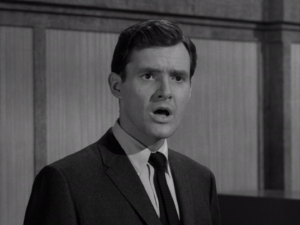
Introduction
Welcome to the Key of Imagination. This week we’re going to be looking at the Twilight Zone episode, “Mr. Bevis.” We’ll talk about whether or not this is actually supposed to be a comedy episode; we’ll do a bit of a character analysis to see if Mr. Bevis is as likeable as they say he is; and I’ll reveal my moment of awe, and talk a little bit about car emissions, but I promise I won’t be simply blowing smoke in your faces. So, grab your keys, and let’s open up this door to the fifth dimension.
Plot exposition
A cluttered space in both home and mind–those are some of the more accurate descriptions for Mr. James B.W. Bevis. But, if you’re going to be fair about it, you’d also have to add kind to children, confident in who he is as a person, and someone who is not willing to give in to the temptations of money. Those are also accurate descriptions of Mr. Bevis. Freshly relieved from his employment, his apartment, and even his car, Mr. Bevis is left searching for what comes next. He was not expecting, however, that the next thing would be his very own guardian angel. In fact, one person in every generation of Bevis receives special protection from the angel J. Hardy Hempstead. New clothes, new car, and a new promotion–Bevis has it all laid out in front of him. The only problem is that he had to give up everything that made him, well, him: the children no longer want to play with him; the car he loved is gone; and he has become what is in his mind is just another business suit. A dream scenario for many, but a nightmare for him. So, he tells his angel, thanks but no thanks. And he goes back to being jobless, homeless, and without much of a sense of his future, but he will at least get to be himself–and he won’t be completely alone; he’ll still receive a little help still here and there from his guardian angel.
Episode Details
“Mr Bevis” is directed by William Asher. The teleplay is by Rod Serling. As for our cast, we predominantly have two players here. Orson Bean plays our titular character Bevis; and Henry Jones is our guardian angel J. Hardy Hempstead. The episode first aired on June 3, 1960.
Episode Tidbits
As for our tidbits, I have an interesting one here, brought to you by our old friend, Martin Grams Jr. and Unlocking the Door to a Television classic. The actor who played Bevis, Orson Bean, came into the filming of this episode with a lot of excitement, thinking it was a pilot for a television show. He’s quoted as saying, “My God, Rod Serling? Henry Jones was a dear man to work with and kept thinking to myself how poorly executed the pilot [was filmed]. Looking back at it today I can see why. The script was not up to Serling standards” (293). Now, those are pretty harsh words at the end, but I don’t think they are unfair. Every so often, when I have something critical to say about an episode, I think to myself, Serling was under a tremendous amount of pressure to get these out every week. I come out with a script every two weeks, and they aren’t all fantastic, although I have a wonderful community of people out there listening who continue to push me to get better. If you think about it, the fact that you have only really a handful of Twilight Zone episodes that aren’t particularly wonderful is an absolute miracle straight out of the Twilight Zone itself. And so, as the great Val Kilmer as Doc Holliday says in the cinema classic Tombstone, “my hypocrisy only goes so far”...and so does my criticism of Rod Serling.
My initial Thoughts
As for my initial thoughts, I certainly don’t go out of my way to watch this episode. As I’ll talk about in my second question, there’s actually something odd about the Bevis character, something dissident or incongruent about him. And the dissonance doesn’t stop there. It extends itself to the genre of the episode itself: that being a comedy. But, and this leads us to our first question. Is it really a comedy? I don’t know about that. Let’s get into our first question and talk about it a bit.
Question 1: Should this be considered a comedy episode?
Okay, I might get myself in a bit of trouble with this question, but I’m going for it. I watched
this episode three times, and as I just indicated in my initial thoughts, like many, I don’t particularly love it. I was aware of the overall general dislike that people have for this episode when I came into it, but, as is the case, I try to simply let the episode speak to me and see what questions naturally arise. With this episode, however, I did something I don’t normally do. I went to various Twilight Zone lists of the worst episodes to see what people largely complained about and one of the top complaints was that it was not funny. And I thought, wait–is it supposed to be? Was this supposed to be a comedy? It never hit me that this episode was really supposed to be funny in the sense that it should be categorized as a comedic episode. But, sure enough, on the top 10 worst lists, this episode is usually there, and it usually includes some kind of paraphrasing of the following–stop me if you’ve heard this before: “The Twilight Zone can’t do comedy.” Now, I get it. The comedy episodes are usually the ones that are least liked, but I do think there is a bit of misunderstanding there when it comes to Serling’s definition of comedy as it relates to the Twilight Zone place itself, not the show title. But, I think we’ll get into that conversation at another time. Let’s actually try and tackle this question about whether or not this episode should be considered a comedic Twilight Zone episode. First, we’ll need to lay some foundation about comedy through an old friend.
What is comedy? Well, today, we think of it as some form of entertainment that elicits a laugh from an onlooker or an audience of some sort: laughing being a key component. However, that is actually quite different from one of our earliest, perhaps the earliest, discussions of comedy as a genre. Aristotle makes a very clear distinction between tragedy and comedy. In fact, we discussed Aristotelean tragedy in our “The Fever” episode when we talked about whether or not Franklin was a tragic figure. But, this is the other side of the proverbial dramatization coin. Aristotle links the two genres, tragedy and comedy, because they are essentially ways at looking at one particular spectrum of human existence. Here is what he states in his famous work, The Poetics: “Comedy aims at representing men as worse, Tragedy as better than in actual life” (link). But, what does that mean? We have to approach this conversation with intention in mind. I actually found a great peer-reviewed article that sums this up best. It talks about how Homer, as in the author of The Iliad and The Odyssey, helped to bring about comedy as a genre with a shift in intention. In the article, the author, Quinn, states, “Homer is therefore responsible for bringing about a shift in intention: he ceases to compose in the spirit of blame or with intent to injure, but rather to amuse….For Homer, as Aristotle puts it, ‘dramatizes the ridiculous’” (Quinn 5).
I think this helps us, but we can probably still boil this down more. The point is this: tragedy in the Greek sense is a fall from greatness. Think about figures like King Oedipus. We feel for his plight because in a lot of ways, nothing he did was really his fault, and his punishment does not really seem to fit any crimes he might have committed. For Aristotle, this is a very serious story. However, life is not filled with only serious stories. We also have ridiculous things that happen to us. That is where comedy comes in as a very specific kind of genre, and for Aristotle, Homer is really the first one to give it a sense of direction or purpose by intentionally bringing our attention to what dramatizing the ridiculous actually looks like. Take note of my language here: dramatizing the ridiculous, as in, we’re still not talking about laughing, per se–although I’m sure people chuckled at the idea of something ludicrous being dramatized in front of them. This probably seems a bit comedic to all of you out there right now. But, hear me out. The idea that anyone would intentionally dramatize something ridiculous, something that is rather unworthy of story, was really quite unique. Aristotle has to defend it here because it seems frivolous. What do we learn from frivolity? Well, not really anything that is important. It’s in tragedy that we learn to take life seriously, to be careful about how we conduct ourselves. From comedy, at best, we get a view of something strange. Okay, that was quite an introduction, and I always appreciate you letting me get a bit long-winded. How does this connect with our story?
Bevis is not a tragic figure. He isn’t a great man–I’m of course talking in the ancient Greek sense. This isn’t about his morals. There is very little distance between his life when it is at its best and his life when it is at its worst. In fact, he even tells us that he’s been in this same predicament of no home, no job before. So, there is very little for us to feel sorry about regarding him as a tragic figure. There is, however, plenty of comedy in the Aristotelian sense, but not in our modern laughing sense of comedy. He is, at times, a ridiculous man–again, I’m talking in the Greek sense. Bevis’ quirkiness and charms do not actually raise his status for us to care enough about what happens to him. And, as Aristotle notes, there’s not really anything to be learned from his ludicrous behavior. So, what are we left with? We’re left with a series of ancient Greek moments played out on the screen with very little substance behind it. Think about it: he slides down the bannister in the beginning and falls on his butt into the street. Is it funny in the modern sense? Well, maybe? I like physical comedy–and I like older physical comedians like Buster Keaton–who we will eventually meet in a future episode. However, and here is the real problem with the episode “Mr. Bevis” as a comedy, there is a disconnect between the character and the comedy genre.
Serling establishes for us at the beginning that the world is better off with Bevis in it. That’s a very serious statement; Bevis loses his job; he gets kicked out of his home; his car rolls over in the middle of the street; he gets drunk; he loses his identity–are you starting to see the problem? There is nothing ridiculous about this. It’s all really serious stuff, and what is worse is that Bevis is only a frivolous figure in seemingly unimportant situations. In other words, we’re not really seeing a ridiculous figure reacting to serious problems. We’re seeing a man who is quirky, but when it comes time to face reality is actually quite serious about it. So, what’s the comedy? Nothing. This is one of the main reasons why I think people say that the comedy in the Twilight Zone doesn’t completely work. So, what’s the answer to our question? Is it really a comedy episode? You know, I’ve rewritten this conclusion like three times already. It doesn’t feel right to me to say that it is or it isn’t. But, I am going to take a stand here, and you can push back on me if you want in the comments. I actually don’t think it is a comedy episode, nor do I think Serling set out for it to be a comedy episode, especially when you consider how weighty everything is right from the get-go. I think it’s a serious story about the importance of preserving one’s identity and not allowing the various weights of the world to crush that sense of self. The fact that Bevis is somewhat odd or quirky is, to me, simply a choice. He could have just easily been maudlin or happy, but he isn’t. Had he been quirky all the time and reacted that way to everything that happens to him, then, I think this is a comedy. So, no, you might be surprised to hear me say this, but “Mr. Bevis” is not a comedy.
Question 2: Is Bevis actually a dislikeable figure?
This might seem an odd question as well. I think it’s pretty clear that we’re supposed find Bevis at the very least a charming individual. After all, he’s great with kids; he treats people kindly; and he seems like a pretty well-liked figure within his community. So, what’s not to like about him? Well, I actually think that one of the reasons people dislike this episode so much, even if it isn’t something that we say out loud, is that there are traits in Bevis that grate against our sense of humanity, maybe even our primordial senses of safety. Yes, you heard me right. We’re going primal.
What do I mean by our primordial sense of safety? One part of the conversation has to do with his chaotic self. An important aspect of civilization is that we create general agreements that help bind us together so that we can spend the majority of our time focusing on what is either most important or most desirable for us. Could you imagine if you had to consciously acknowledge every single person’s existence around you at all times? Now, I know what some of you are thinking: Joe, I do that all the time. Yes, me too. I’m also a kind of socially aware ninja, always ready for when something goes wrong. [I’m pretty sure socially aware ninja was NOT on any one’s bingo cards for this episode. It doesn’t really make sense, but we’re keeping it in….Wait, is this a KOI comedy episode?] Yes, we have to be aware of our surroundings constantly. But, that’s not really what I mean. We use social and environmental heuristics to shorten the distance between our perceptions of the environment and the decisions that we need to make. A common example that I use with my students when we discuss this is crossing the street–a simple task, right? Well, not really when you break down how many subconscious decisions and heuristics are being used. If you had to consciously make every decision just to cross the street, it would drive you crazy. Look on the ground in front of the left foot, if clear, take a step forward, look on the ground in front of the right foot, if clear step forward, if not adjust your stride appropriately to land in a clear spot, look up, look to the left, assess the speed of the oncoming car. Calculate it against your own walking pace. If your pace is faster than the approaching car, move forward. But, if the car…okay. You get the point. We have not even crossed yet. That’s why we shortcut those decisions, to avoid the headache that would happen if we really tried to think about every single step. But, when you include a chaotic element like Bevis, it disturbs our ability to use heuristics and makes us more consciously aware of our decisions. And that can be dangerous because our attention is now fixated on one specific thing or task, whereas before we could take in multiple scenarios of our environment at the same time. And that is when the saber toothed tiger comes up behind you and eats you. But wait, there’s more.
Let’s talk about Bevis at work. Here, too, we run into a problem concerning the reality behind the situation. One of the things that is most charming, or at least it’s supposed to be, about Bevis is his quirkiness regarding his tchotchkes or items that he collects in his home and also at work. His desk is full of random items, scattered all over. In fact, his boss calls it a museum. Again, the other workers in the office seem to really like him, but here’s the problem for anyone who has worked a day in a job with a team of people: quirkiness can be a fantastic qualitiy in a colleague, when all other aspects of the job are being fulfilled. This is where I think the episode missed an opportunity to really lean into our liking of Bevis. You’ll recall that he is actually late for work. Additionally, the boss begins his assessment of Bevis by saying, he keeps a ledger like an ape. What does that mean? A ledger keeps track of records; accurate records are essential to any business; In short, he’s a bad employee. What’s worse is that he’s not actually a particularly good colleague. His being late, and it’s probably not a stretch to say that it isn’t his first time being late, is bad for everyone else because they are the ones who likely have to pick up the slack. And if you’ve ever been in that situation before, you know that this can build resentment within the office and bring down the morale of the group. And that’s never good for either the business or the employees.
I think this episode reads a bit differently if Bevis is a good employee and simply gets fired because, as the boss also states, his “eccentricities are beyond any kind of understanding.” That is not a fireable offense. We would still like Bevis and find him charming. But, given how bad of an employee and colleague he seems to actually be, I don’t find much of that to be kind or charming. So, is Bevis a dislikable figure? I mean, it’s actually still a little complicated. Children do not have that same sense of responsibility as adults; they haven’t been fully forged by the social contracts of civilization, and so chaos to them is simply a creative way of existing in a given moment. For children, Bevis is probably the most likeable guy in the world, and that’s great. We 100% need people who are good with kids. But, for adults, the more you drill down into him as a functioning figure in society, the more difficult it becomes to like him. And it has nothing to do with eccentricities. It has to do with a sense that he is kind but somehow not thoughtful, which is a really odd juxtaposition in a human being. Those two things are usually simpatico, but not with him. If we just look at Bevis from an adult perspective, no, I don’t think he is a likeable figure. That sounds wrong coming out of my mouth, but I can’t really argue much against it, and that makes me a little sad–and probably a little less likeable myself.
Question 3: What are your moments of awe?
My moment of awe came when I was trying to do a little research on 1924 Rickenbacker cars. You see, I like to try and find nicknacks myself that connect with Twilight Zone episodes. It’s a part of that Twilight Zone trinkets page that I’m always promising to finish in my how to support the show section of every episode, but I have yet to actually finish it. Don’t worry; I’m not at Bevis level of collections. But, I was actually looking for a little model 1924 Rickenbacker to display in the side view of the video for this episode. I struck out and wasn’t able to find one, but what I did find was an advertisement for the 1924 Rickenbacker from 1924, and something in it caught my eye in relation to this episode. In the advertisement, the company touts the invention of the air cleaner, which “protects the lungs.” Now, whether you buy my argument about this potentially not being a comedy episode or not, I think we can all feel better about the scene where he allows the children to push the car to get going only to blow all of that smoke right into their beautiful little age 5-12 lungs. Have no fear moms and dads: that’s good smoke, clean smoke; [that’s Rickenbacker smoke.]
My Rating
As for my rating, yeah, I’m obviously not a big fan of this one. I’m actually going to give this one a lower upper-tier rating. If you think that’s a bit harsh, I get it. But, the reason for the low rating is that, when you break this episode down like we did, you actually get no payoff at all in this episode. Why is he going back to his previous life? He simply wants to, but the episode doesn’t do Bevis justice to set him up as the person Serling mentions at the beginning. Remember, Serling says the world is better off with him in it. And I guess you can make the argument that he’s absolutely good to the kids, but…I don’t know. If an episode does not even deliver on its premise, that is when you get the lower upper-tier from me.
Next Episode
Next time, we’ll be taking a look at “The After Hours” and here are your questions to consider when watching the episode:
Question 1: What is it that draws the mannequins back to the department store?
Question 2: How does this episode showcase the complex relationship we have with
consciousness?
Question 3: What are your moments of awe?
Announcements and Shout-outs
It’s time for some announcements and shout-outs. Our friend Anthony from the “Fever Dreamland Theater” channel on YouTube had the following to say regarding “The Chaser” episode: “Hey Joe! I've been curious about your thoughts on this one. Episodes such as this which are not fan-favs make for rough watches but they are always fascinating to discuss. The Chaser is definitely on my worst list. That said, I agree, if Serling had tackled this one maybe he could have salvaged it…” Anthony, as always, thanks for taking the time. And, as always, I encourage people to go and check out The Fever Dreamland Theater channel for some great content. In fact, Anthony is about start a new endeavor over there where he is breaking down Night Gallery episodes. So, if you love Night Gallery or even just Serling, Fever Dreamland Theater is a good channel to go to. As for your thoughts on “The Chaser,” I do wonder about what Serling would have done. As I mentioned, I think he could have made the other characters at least more rounded out. But, I also think he might have been able to tap into the seriousness of the obsession angle, which actually takes us to our next comment.
Kellystanton7378 aptly described Roger’s situation from “The Chaser” as such, “What a fascinating old episode, and great commentary as usual, Joe! So... Roger, my man - what did we learn? Obsession isn't so sweet when you're on the receiving end, is it?” As always, on point, Kelly. You know what: talk about missing the forest for the trees, I actually wasn’t even thinking about that point. It’s not even so much just that he learns to be careful what you wish for, but he gets that same level of obsession thrown back at him that he had for her. In a very academic way, I flew right past that very important point. Thanks, Kelly.
How to Support the Show
You can continue our conversations by heading over to our Discord server and either starting a conversation about this episode or taking part in one that is already happening. The link to join the server should be in the episode notes section. You can also head over to thekeyofimagination.com, where you can rate this episode, learn more about me, watch previous episodes of the show, and check out my curios page where I showcase some of the Twilight Zone trinkets I’ve bought over the years. I encourage people to email me thoughts and comments, whether it’s about a particular Twilight Zone episode, your rating for an episode, or about the Key of Imagination Show. You can get those to me as a text email, an audio clip, or even a video clip of roughly no more than 5 minutes to keyofimaginationshow@gmail.com. Keep in mind, even though we talk about some serious topics, we’re trying to maintain as family-friendly of an atmosphere as we can. If you would rather I not use your comments on the show, please indicate that so I can respect your decision.
If you enjoyed the show, I ask that you please take a moment and do one of the following to help build our community. Rate the show, review the podcast, leave comments, thumbs up, all of the usual algorithmic gymnastics. That will help get the show in front of more people and help us build our community of Twilight Zone fans. However, even if you do none of that and absolutely hated every minute of this, I would still like to thank you for spending some time with me. Until next time, remember, all doors are open to those who possess the key of imagination.
Works Cited
Quinn, Timothy Sean. “Aristotle, Comedy and Menander.” The Classical bulletin (St. Louis, Mo.)
77.1 (2001): 3-. Print.