
The Twilight Zone Season 1: Episode 35
"The Mighty Casey" Episode Transcript
Introduction
Welcome to the Key of Imagination. This week we’re going to be looking at the Twilight Zone episode “The Mighty Casey.” We’ll break down whether or not this is the future of sports; we’ll talk about the differences between machine logic and human logic; and I’ll reveal my moment of awe, which has to do with a certain NY baseball team and how they leave me in awe. So, grab your keys and let’s open this door to the fifth dimension.
Plot exposition
The Hoboken Zephyrs are a baseball team on the rise. Why? Because they are literally the worst team in the majors and there is nowhere else to go but up. For the ballclub manager, McGarry, he’s at his wits end with the amount of talent that he has to work with, so when the team holds an open tryout for new talent, he is less than enthused by the results. That is, until Casey shows up. Young, tall, and strong as an ox, when Casey takes the mound, he puts on a show that no man has ever done before…and actually, no man has ever done it before still. For you see, Casey is a robot, built by Dr. Stillwell. But, McGarry doesn’t care; all he sees is the opportunity to win, all that is necessary is a contract and the understanding that this will be our little secret. Everything works to plan, and nothing can touch Casey when he’s on the mound…except for a ball off the bat of an opposing hitter that bops him on the head. When Casey is checked over by the team physician at the hospital, the secret is out. And the baseball commissioner rules that Casey can’t pitch. You see a man has a heart, and since Casey has no heart, he isn’t a man. But, just when his teammates need him most, Casey arrives at the ballpark, and with a new ticking heart to match. But, something’s wrong. Hit after hit, the other team is crushing every pitch he throws. When Mcgarry asks what happened to him, Casey confides to his manager that he simply doesn’t have the heart to strike out the men on the other team.
Episode Details
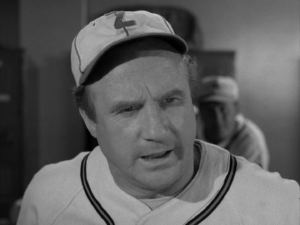
“The Mighty Case” is directed by Alvin Ganzer…at least mostly. Robert Parish came in at the end to finish it up. I’ll talk more about that in my episode tidbits section. The teleplay is by Rod Serling. As for our cast, we have Robert Sorrells as the mighty Casey; Abraham Sofaer as Dr. Stillman; and our old friend Jack Warden, whom you might remember from “The Lonely” episode, as the manager McGarry. The episode first aired on June 17th, 1960.
Episode Tidbits
As for our tidbits, this information comes again from our old friend, Martin Grams Jr. I mentioned in the episode details this production had two directors: Alvin Ganzer and Robert Parish, both of whom were incredibly skilled directors at this point for the Twilight Zone. What happened was Cayuga Studios, which is Serling’s production company, originally cast the actor Paul Douglas to play McGarry, but Douglas was not looking well on film. Some believed that it was because he was drinking heavily. As it turns out, he passed away only two weeks after the primary filming was done due to heart complications. Serling and producer Buck Houghton had a problem on their hands. They didn’t want to release the episode because the performance was quite poor by Douglas, and they didn’t want to besmirch his good reputation after his passing. But, the CBS network, which had a 50 percent stake in the Twilight Zone, did not want to reshoot the episode for monetary reasons. Serling stepped up and paid the difference for director Robert Parish and actor Jack Warden to come out and reshoot the episode. It would have been easy for Serling and Houghton to simply let the episode air. I say that because the very next week it would have been buried by a new episode. Today, you can’t really bury content anymore; it’s always there. So, the fact that Serling paid the difference out of his own studio’s pocket is yet another example of the fact that he had a good understanding of the relationship between money and humanity. Not everyone is in a position to do so, but if we can, we ideally should.
My initial Thoughts
As for my initial thoughts, I know that this is, again, not an incredibly well liked episode, but I don’t hate it. I find it to be a perfectly fine episode. It’s funny, my initial thought after watching this episode the first time was that it was actually more entertaining than I had remembered. I found myself left no better or worse off than when I had begun my watch, which is, again, just fine with me. In my rating section, I’ll talk a little bit more about some of the potential issues I have with it, but I pretty much left my initial watch of this episode in a very neutral space.
Question 1: Is this episode giving us a glimpse of the future of sports?
Each semester for the last few years, I have my students do a group project where I make them research, critically analyze, and then present their opinions on the current trajectory of technology and their overall level of comfort with where they see it all going. My goal is very straightforward. I’m not interested in telling my students what to think; I’m interested in telling them to think about these topics, to force them to face the fact that there are likely big changes coming their way, and they should start the process of thinking about those changes right now so that they are not caught off guard. I think this question about the future of sports is a valid one for us to start considering, so let’s do just that, but let’s begin by first breaking down an important scene in the episode: Casey’s tryout.
Casey’s first time on the mound pitching for McGarry is an odd scene. In some ways, I think we might even call it a highly problematic one by the end of our analysis. Now, you might already be thinking that I’m taking what is a somewhat goofy scene a bit too seriously, but let me lay out for you why I think it’s an important one for us to evaluate. Casey begins by just warming up. Now, why does a robot need to warm up? I have no idea. But, after a few warmups he starts to get serious, and he showcases his top three pitches. First, he throws a fastball. We can hear it whooshing through the air, and then we see smoke coming from the catcher’s mitt. Then, he throws a curve that seems to go all over the place, back and forth all over the screen. Finally, he throws his slow ball–a kind of changeup I assume, which reminds me of a pitcher named Orlando Hernandez, better known as El Duque. He would throw a pitch called the ephus pitch,, and it would come out of his hand at about 55 to 60 mph, which is a lot slower than MLB hitters are used to. And it would sometimes get batters out. Anyway, Casey’s pitch is exceptionally slow. Now, what’s the problem? It’s clear that Serling is having a bit of fun a la Bugs Bunny style with the character. The sound effects all indicate that this is somewhat of a gag, but it’s not funny–and not because it isn’t a joke but because it establishes that Casey has abilities that defy normal levels of competition–and even to a degree normal levels of human physical capabilities. Additionally, there is a comment during this sequence that is sooooo easy to miss if we aren’t paying attention; it comes from Dr. Stillman, Casey’s creator. When Casey throws the slow pitch, the Dr. looks at his watch and says, “he’s a bit late.” That’s fascinating because it means that something external, a variable, has impacted Casey’s ability to perform at his expected automaton levels. In other words, there are limitations to this mechanical superman, and that’s important for our conversation. Let’s get a little bit deeper into Casey’s actual performance on the mound when it actually counts.
What we know about Casey’s pitching prowess comes through the form of a montage. Now, at the beginning of the montage, he does something that, again, if we aren’t careful, and if you’re not familiar with baseball, is easy to miss. He shakes off the catcher’s signals. Now, what that means is the catcher called for a certain pitch to be thrown, a fastball, let’s say, and Casey said, no, I would rather throw something else. That logic indicates that Casey knows that it’s important for him to throw the correct pitch or he can give up a hit, which is not all that different from every other pitcher who has ever done it. [I myself used to pitch. I gave up three homeruns in one inning in varsity baseball, and one of the balls hit a person’s house. I mean that’s not a great story for me, but it was a great story for the other player. I’m just borrowing it.] What this means is that Casey himself is recognizing that there is at least a surface level of potential competition that he has to be concerned with. And, If you watch the newspaper headlines, it never says anything about Casey striking out 27 batters and pitching a perfect game. He throws three shut-outs in a row, which simply means he didn’t give up any runs over three starts, and another headline says that he struck out 18 batters in a game. Now, don’t get me wrong, any baseball fan would take a pitcher who could routinely do all of that, but he struck out 18, which means that there must have been some hitters who were able to make contact against him, or get on base, and possibly even score a run or two. So, he can be hit, a fact corroborated when he actually gets hit in the head by what we can presume to be a hard line drive up the middle. Okay, what does this mean for our question?
At the heart, no pun intended, at least not yet, at the heart of the issue here is competition. As humans, we pride ourselves on winning, on developing cultures of success. We tend to look down upon or even dismiss people and institutional cultures that do not win. So, with that kind of scenario in place, we know why the manager is willing to try and get a competitive advantage here. But, something that we, unfortunately, don’t talk enough about anymore is thinking about the longevity and viability of our sports institutions. If you take this episode seriously and actually think about what it would be like for a team to have such a pitcher as Casey, you might marvel at it for a game, and you might even find yourself still somewhat enthralled the second time you saw him on the mound, but, by the third or fourth time when you realize that, his talents are quickly moving beyond anything that a human being can achieve, well, then it is no longer a competition; it’s an exhibition, and that’s not what we’re signing up for when we watch sports, not really.
I think we’re touching upon an important part of this question about the potential future of having robots participate in sports. If the gap in talent is too wide, there’s no reason to watch because it’s not competitive, but what if the robot has a talent cap placed upon it? Again, taking as a point, Casey. From his tryout scene, he can throw a pitch that creates fire; he can make a ball dance for 10 feet. If you actually had such a pitcher, he would probably throw perfect game after perfect game, so the fact that he doesn’t pitch that way, must mean that there is in some respects, a kind of talent cap on him. Is that enough? Would that be enough for you to watch robots play sports autonomously against humans? Well, at least we’re a long ways off from it ever happening, right? Well…[Come on, you KNOW I had to do some digging into this topic.]
It turns out that Toyota created an AI robot that it believes can eventually take the place of NBA basketball players some day (link). Their prototype is called Cue, and it is a 6’ 10” robot with a whole bunch of sensors and cameras, and it’s quite the amazing shooter. In fact, it is in the Guinness Book of World Records for hitting 2,020 free throws in a row. Impressive? Well, no. Okay, okay, I can hear many of you screaming at me through the screen. Yes, the creation of the robot is an impressive HUMAN feat. As in, I’m impressed by the humans who made it; I’m not impressed by the machine itself, and because i”m feeling a bit more ornery than usual, I’m just going to add the following: I don’t care about its record of hitting 2020 free throws because, guess what: the next robot will be able to do the same thing, so who really cares?
Look, my first college degree is in computer science. I still program on the side. I’m very much in awe of how far we’ve come from punch card programming to someone creating a real robot that can play basketball, but that’s not sports to me anymore–that’s engineering. When I was younger, I would get upset when my teams lost, but now, I’m actually more interested in just watching the human elements of sports play out in front of me. This might make me sound like an old man screaming at the sun, but I have to be honest. If this is the future of sports, you can probably count me out. I’m interested in what the human being can achieve when pushed to their limits. It might be cool to see Casey pitch, and maybe even to step up to the plate against him, but if he’s throwing curves with 10 foot breaks on them, we might as well all just pack up the equipment, and yes, I’m taking my ball with me and going home, in petulant human defiance.
Question 2: How does this episode showcase the differences between machine logic and human logic?
This episode actually has one of the more fascinating exchanges between man and robot. Just prior to Casey going out to pitch his first game, the manager, McGarry, says to him, “Now, above all, kid, don’t be nervous.” To which Casey replies, “nervous?” And Dr. Stillman chimes in to let Casey know that it means “ill at ease.” Then, McGarry gives a hypothetical scenario of thinking about pitching in the bottom of the 9th with two out and Joe Dimaggio coming to the plate “looking intent.” Here is where it gets interesting. Casey says, “that wouldn’t make me nervous. I don’t know anyone named Joe Dimaggio.” If you think about this exchange on a surface level, it actually seems pretty normal, pretty human. Take me for example. I’m not a big soccer fan. So, if someone tries to tell me that I shouldn’t be nervous about this penalty kick I’m about to take against Alisson Becker, even though he looks really focused, that might not mean that much to me because I don’t know who that is. [Yes, I had to look up who Alisson Becker is. I’m really not much of a soccer fan. Never let it be said, however, that I am not a man of culture.]
There is what we might call a kind of Socratic logic here. You might have heard people mention Socrates, through Plato’s Apology, saying something along the lines of “I know nothing” or “I know that I know nothing.” I think people sometimes take Socrates’ ideas here a bit too far. His real point in making that claim is to showcase that he is at least aware of and willing to admit that of the things in which he does not know, he is ignorant. As opposed to people who, say, I don’t know, talk about things like soccer in their shows, having never played it nor watched more than about 2 minutes of YouTube shorts. [Hey, I have never had a problem telling people I’m stupid about things. Of the things I’m stupid over, I am the stupidest. I don’t think that came out nearly as Socratic as I had hoped.]
My point is this: it might seem on the surface that Casey is utilizing a kind of Socratic approach to knowledge here, and thus a rather human one, but that doesn’t completely hold up under human logical scrutiny. The reason why Socrates is making this grand statement is because he is fully aware of the fact that most of the time human beings are all-too ready to come up with all kinds of feelings, presuppositions, and uninformed opinions on why we should think a certain way. We have to actually work somewhat harder as a species to not jump to conclusions and fall prey to things like confirmation bias and cognitive dissonance. The difference being that built into human logic is not simply logic but the complex social performance part of being a human being, of being a part of a collective culture that has its own set of norms and current cultural milieu that can sometimes dictate whether we can rely on pure logic or instead recognize that a kind of human logic is more fitting.
Additionally, there is something else that I want to address here in terms of machine logic vs human logic, and why human logic sometimes even makes more sense. The big Twilight Zone moment is that Casey receives a heart, and because he now feels empathy, he can’t get himself to continually strike out the men on the other team because it hurts their careers. This is another example of where these two logical worlds, I think, don’t quite meet up perfectly. By not striking the men out, he’s obviously hurting his own teammates as well. So, how did we, as humans, achieve an equilibrium for this scenario? We created what we might call the spirit of competition. Think about it? We say, “in the spirit of competition,” I’m going to try and rip your head off. In the spirit of competition, I’m going to run right through you; in the spirit of competition, I’m going to eat his children…?” [I loved me some Iron Mike Tyson growing up, but in the spirit of humanity, that line probably went a bit too far.”]
Through human logic, we’ve figured out a way to be competitive, aggressive, and even downright destructive at times while maintaining the dignity of the human experience. But, that came from thousands of years of failures and successes, and you can definitely say that we’re still trying to figure out the exact lines of when competition goes too far. Nonetheless, AI has not learned that, and I’m not sure that it ever will be able to. So, what this episode, in an odd way exposes is that we often praise pure logic, but as even the great Spock from Star Trek would sometimes admit, it might be illogical but there is something fascinating about us humans and our particular brand of logic.
Question 3: What are your moments of awe?
My moment of awe actually came right at the beginning and the end of the episode. Serling’s monologues have echoes in them of the Brooklyn Dodgers, who were a much-beloved franchise in New York until they went to the West Coast in 58’ to become the Los Angeles Dodgers. My grandfather was a Brooklyn Dodgers fan, my father a brief one until they left, and then both of them became Mets fans. And that’s where I find myself today, a third-generation Mets fan since the early 1980s. My moment of awe came when I began to think about the etymology of the word awe. It is Norse, originally, I believe and it means to be afraid of something to the point of a kind of reverence. That still tracks today. You see something that is bigger than you are, something that inspires a kind of deference to your existence and takes hold of your senses. So, the original use was to explain the horror we feel when we see something. It is then that I realized that everything in my life has led to this moment. The playoff run The Mets had last year was magical, and I think when it came down to us against those former Brookly bums out in LA, I’m pretty sure the larger baseball community was rooting for us to win. Maybe we have a good year this year, and maybe we lose a hundred games. That’s the beauty of being a Mets fan; either way, I’ll be left in awe, wondering…how the heck did that happen?
My Rating
As for my rating, I’ll give this one a Middle Lower-tier. I don’t hate the episode at all. I do think there were opportunities to explore more interesting sci-fi scenarios and ethical concerns, and as much as I enjoyed the win one for the gipper speech, I think that could have been cut to make some room for those other conversations. That being said, I find it to be a perfectly serviceable episode that I would leave on in the background during a marathon while I was trying to recreate a Taj Mahal out of a plate of nachos. That’s…that’s a bigger compliment than you might think.
Next Episode
Next time, we’ll be taking a look at “A World of His Own” and here are your questions to consider when watching the episode:
Question 1: Should we be focusing more on Mary in this episode?
Question 2: Is Gregory a kind of Twilight Zone god?
Question 3: What are your moments of awe?
Announcements and Shout-outs
I love when people find connections to other shows or movies between actors in the Twilight Zone. Anitarichmond8930 made the following connection with an actor from the “Mr. Bevis” episode. “Henry Jones is a particular favorite of mine,his performance in “The Bad Seed” where he played Leroy, helped to make that a must see movie in our family.” I don’t think I’ve seen that film in twenty years; you’ve sparked my wanting to see it again. Thanks, Anita, and welcome to the community.
Elmermedina1713 expressed well what is I think a lot of people’s frustrations with the ending of “Mr. Bevis:” “I found Mr. Bevis to be quite odd, not because of his eccentricities, but rather his willingness to remain homeless and jobless. He could have had the angel allow him to keep his way of life but with a new Rickenbacker, keep his job, and his apartment.” Elmer I think that pretty much sums it up well for me as well. Without being too critical, again, I can’t imagine the stress that Serling was under to come up with a new episode every week, I do think there could have been a more carefully constructed middle ground here, or go the complete extreme route and remove the guardian angel at the end completely so that Bevis is on his own.
How to Support the Show
You can continue our conversations by heading over to our Discord server and either starting a conversation about this episode or taking part in one that is already happening. The link to join the server should be in the episode notes section. You can also head over to thekeyofimagination.com, where you can rate this episode, learn more about me, watch previous episodes of the show, and check out my curios page where I showcase some of the Twilight Zone trinkets I’ve bought over the years. I encourage people to email me thoughts and comments, whether it’s about a particular Twilight Zone episode, your rating for an episode, or about the Key of Imagination Show. You can get those to me as a text email, an audio clip, or even a video clip of roughly no more than 5 minutes to keyofimaginationshow@gmail.com. Keep in mind, even though we talk about some serious topics, we’re trying to maintain as family-friendly of an atmosphere as we can. If you would rather I not use your comments on the show, please indicate that so I can respect your decision.
If you enjoyed the show, I ask that you please take a moment and do one of the following to help build our community. Rate the show, review the podcast, leave comments, thumbs up, all of the usual algorithmic gymnastics. That will help get the show in front of more people and help us build our community of Twilight Zone fans. However, even if you do none of that and absolutely hated every minute of this, I would still like to thank you for spending some time with me. Until next time, remember, all doors are open to those who possess the key of imagination.
Works Cited