
The Twilight Zone Season 2: Episode 37
"King Nine Will Not Return" Episode Transcript
Introduction
Welcome to the Key of Imagination. This week we’re going to be looking at the Twilight Zone episode “King Nine Will Not Return.” We’ll talk about Embry’s use of logic in this episode; we’ll dive into a complex conversation about temporal displacement; and I’ll reveal my moment of awe, which has to do with filling the gaps of traumatic narratives. So, grab your keys, and let’s open up this door to the fifth dimension.
Plot exposition
The year is 1943, in a desert somewhere in Africa. Captain Embry has just woken up into a nightmare. Face down in the sand, airplane parts from the King 9 strewn about, and no sign of his crew–all that is left to do is try and figure out what has happened. The clues are all in front of him; it appears his B-25 bomber has been brought down, but he can’t quite remember exactly how it happened. After wandering about a bit, he starts to put the pieces together, only to be shaken to the core when he suddenly sees one of his crewmates in the passenger seat, just as happy as can be. But, when he runs over to greet his colleague and friend, the man disappears, like a phantom. Just when he believes he’s starting to pull it all together, he spots a grave marker with the name of one of his crew members. In the background, he can hear the sounds of jet engines flying overhead–but the odd thing about that is there were no such jet planes in 1943, and even more strange is how Embry would know that such aircrafts shouldn’t be around yet. One final vision of his entire crew staring back at him sends Captain Embry into the ground again, clutching at the sand–until he wakes up, in a hospital bed, back in 1960. It turns out that the King 9 did crash in 1943, and the crew did not survive, but Captain Embry wasn’t on that mission that day, and he has never forgiven himself for it. As for his trip back to the desert, was it all a dream? A handful of sand spilling out of his shoes at the hospital muddies our answer just a bit.
Episode Details
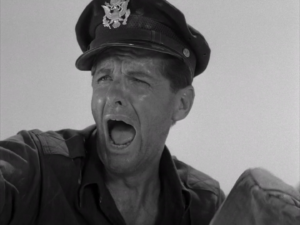
“King Nine will not Return” is directed by Buzz Kulik. The teleplay is by Rod Serling. As for our cast, we pretty much have a solo act here: Bob Cummings plays our Captain James Embry. As I was watching Cummings give his performance, I had an odd thought. At one point, he just starts laughing rather hysterically at the situation, and there was something to that laugh that made me think he would have made a really good joker. It’s a laugh with something a bit unsettling mixed into it. The episode first aired on September 30, 1960.
Episode Tidbits
We actually have some really important changes to the Twilight Zone that make their inaugural appearances in season 2. Right off the bat, It’s here that we get the more famous opening musical theme from Marious Constant. You know, the whole do, do, do, do…But, for all the Bernard Hermann fans out there, no need to fret. We will still hear plenty of his jingles and background themes throughout the series. Additionally, this is the first episode for Serling appearing on camera for his opening monologues. Up to this point, it has been only voiceovers. Pretty cool. I’ll include one more item from our friend Martin Grams Jr. Apparently, Serling was inspired to write this episode after reading in the news that a B-24 bomber by the name of “Lady Be Good” was found (314). So, this seems to be one of those instances where art is imitating life.
My initial Thoughts
As for my initial thoughts: I had a largely positive experience rewatching this one, but I’m also a bit of a sucker for single-person performances, and I think Bob Cummings does a really good job here with not all that much to work with. We’ve got vibes of the Tom Hanks film Castaway here, a film that I enjoy. There are a few points where the episode seems a bit drawn out, but that’s, again, largely because there isn’t much in the way of points of action–when I say points of action, I don’t mean like jumping and fighting. I mean that it’s a lot of inner monologue and somewhat sparse direction toward something, but that’s not necessarily a negative to me. Overall, I enjoyed it.
Question 1: What role does reasoning play in Captain Embry’s understanding of his situation?
Who doesn’t love a good Sherlock Holmes quotation when talking about logic? In fact, one of the more famous lines that often makes its way around the internet comes from the short story “The Adventure of the Blanched Soldier” by Sir Arthur Conan Doyle. The quotation is “when you have eliminated all which is impossible, then whatever remains, however improbable, must be the truth” (11). It’s easy to see why people love it so much, but I think it is sometimes misused and stretched a bit by us when we are in the throes of a bit of confirmation bias syndrome. I’ll give you an example: “there was no one home at the time of this incident. So, when I found that used mug of coffee on the kitchen counter when I got home, and it wasn’t there when I left, the only thing that it could have been is a coffee ghost.” Now, in the mind of the person building this logical study, they have eliminated the impossible, as in, no one was home. Therefore, we move to the improbable: a ghost drank my coffee and left a dirty mug on the counter. But, that’s not really what the Sherlock Holmes’ line means, and part of the problem is that people are not including an important context of the quotation at the very beginning. Here is the full sentence: “That process,” said I, “starts upon the supposition that when you have eliminated all which is impossible, then whatever remains, however improbable, must be the truth.” Some of you might be thinking, Joe, you’re playing semantics here. What’s the difference? The difference is that by leaving out the beginning of the quotation, you’re cutting off the fact that it is a process. It starts with a supposition, and what is a supposition? It is something that you believe to be true. However, often times, we think we have eliminated all possibilities, when in fact, we’ve actually simply exhausted what possibilities we can think of–and that’s how we get coffee ghosts. Now, what does this have to do with our episode?
Embry is actually a pretty interesting character for a few reasons, the first of which is he attempts to use all kinds of logical reasoning in order to figure out what is going on, including some deductive and some inductive reasoning. When he begins to walk around the plane and realizes that no one else is around, he says, “all right now, all right now, piece it together; piece it together.” I love this part because this is a legitimate way that we sometimes have to calm ourselves down in order to better see a particularly complex situation that we might be in. He realizes that he is going to have to use some kind of logical approach to make sense of what he is experiencing, which in some ways makes this a kind of detective tale for us as well to work through with him. So, let’s do that. Here is what we both know: he wakes up on the sand, face down, parts from the cockpit of a plane thrown everywhere, a broken windshield on a plane in front of him, and he assumes–with some pretty good logic to back him up–that he has crashed. In fact, he even says that he remembers what happened: “We bellied in, and I must have been thrown clear of the plane.” Now, that makes sense given the circumstances of our environment. What I mean is the layout of the initial scene of him on the sand, face down, coupled with his broken memories of the actual crash. When you put all of this together, you have a perfectly reasonable conclusion to the question: what happened? But, when you finish the episode, you of course learn that he actually wasn’t on that mission, and he didn’t actually crash, or did he? Nevermind, I’ll talk more about that in question two. In some ways, our Captain Embry is trapped in a perfectly reasonable, at least by normal standards, logic. But, could knowing a couple of types of logic actually help him here? The answer is maybe.
Before we apply these logics to our friend Embry, let’s get a quick reminder about the difference between deductive and inductive reasoning. I think people sometimes overthink this topic. First, we need to recognize that they are both tools, with very different purposes and for different situations: like hammers and screwdrivers. You wouldn’t use a screwdriver to bang in a nail; and you shouldn’t use a hammer to bang in a screw. [I learned that last one the hard way when I tried to build a treehouse. It turns out, screws don’t really like to be hammered in.] The big difference is this: deductive reasoning always must produce a valid outcome from its premises. Here’s an easy example: premise 1, all humans are mammals; premise 2, joe is a human; the conclusion, joe is a mammal. You want to think about this like a mathematical formula that always produces the same testable result every time. If a is true and be is true then the conclusion must also be true always. If you can prove that the conclusion is not always true, you’ve likely got bad premises and your deductive reasoning is invalid. However, inductive reasoning is used when you can’t get true certitude, and you’re simply trying to make a probable decision. We use inductive reasoning all the time to make decisions. For example, premise 1, I hike a lot in these woods. Premise 2, I’ve never seen a bear while hiking in these woods; conclusion: these woods are safe to hike from bears. Now, what’s the immediate difference between this and our deductive example? Can a bear still maul the heck out of me on my next trip? Yes. But, we’re going for probability with inductive reasoning, and as you can also see from my example, not all inductive reasoning is alike in terms of strength. In our woods example, that’s just my experience, so it might be valid in terms of its structure, but it’s not a particularly strong inductive conclusion because it’s just me. But, what happens if a thousand people say they hike in the woods; they’ve never seen a bear; the woods are safe to hike from bears. Now, we’ve got a stronger inductive structure. So, with that in mind, what the heck is Embry supposed to do here?
Let’s reconsider the opening sequence. Premise 1: I’m lying face down on the sand; premise 2: there are broken parts all around me that lead to a plane; premise 3: there is a plane with a broken windshield in front of me; conclusion: I was thrown out of the plane. Can you already tell what kind of logical reasoning we’re dealing with here between deductive and inductive? That’s right; we’re heavy in the inductive area, as in, we’re trying to find a strong probability of success. Now, there are some additional complexities here that should be considered, such as the position in which he is facing on the ground, and the condition of his body. Both of those might weaken the structure of our argument, but, nonetheless, you can draw a fairly good conclusion here. Given the high likelihood that Embry is correct in his logic, we can begin to understand why he starts to lose his grip on reality, but I would argue he never fully does.
That being said, there are times when he falls into a common problem of beginning with a false premise. For example, toward the beginning he says that the other men “couldn’t be dead.” Of course that’s not true in the least. Just because they aren’t in the immediate vicinity doesn’t mean that he could know if they are dead or not. But, Embry is doing exactly what you’re supposed to do: think of premises, test them, follow through to their logical conclusions and see where you land on the inductive probability scale. He has this great line where he says, “The crew is someplace, for some reason. And I’m alone, for some reason. But, there’s logic behind it; there’s logic to everything.” This is the line that I keyed in on the most, and in some ways it’s a line that harkens back to our Sherlock Holmes quotation. Embry, like most rational people, dismisses the impossible, leaving him with only what is improbable–like the good detective tells us. But, when he starts to experience the impossible, the phantoms and the jet planes, rather than abandon logic, he very astutely extends his thinking to the improbable–he’s asleep; he’s dreaming; he’s in a hospital. And, in fact, he’s right. So, what role does logical reasoning play in this episode, first it helps Embry establish an initial calmness that helps him establish a baseline for his reality, and then it eventually helps him uncover what is really happening to him. The only question that is left to answer is what to do about the sand in his shoes. If I were the people in the hospital, I would probably just chalk it up to coffee ghosts.
Question 2: Is there a hidden discussion of time and space happening here beyond the plot?
Bear with me: I’m going to get really speculative on this one. It seems to me that we have an important initial question to answer from which we can then build the rest of our exploration into this question: when does Embry actually set foot on the African beach? In other words, what year? On the surface, the plot seems to indicate that the most current year of reality is 1960, and Embry is supposed to be in a bed having a kind of dream. So, when we see the sand in his shoes, it obviously tries to imply that he was actually on the beach. [we’ll put aside our earlier conversation on logical reasoning for the moment.] We know that the show wants us to believe that the sand came from Africa, and I think it wants us to believe that during his sleep he did a kind of astral projection there, which is why he also sees the jets, but for me there is still an odd question about the timing. Let me explain why.
The source of my confusion or interest in this is because of Serling’s opening monologue. You’ll recall in the previous Twilight Zone episode, “A World of His Own,” I made the argument in the second question that I think of Serling as a kind of character, an overgod if you will who sees everything and has a kind of omniscience and omnipotence. So, when Serling’s voice comes in at the very beginning, and he says, “This is Africa, 1943,” it hit me in a really odd way. I thought, wait, is he lying? Then, I had a really crazy thought: what if it is 1943 and 1960? What if the jets are out of time just as much as Embry? That would mean that there are multiple planes of existence and times occurring at the same moment–a kind of phasing of realities, overlapping. Now, I completely understand that this is probably not what is happening, but, again, the only reason why I’m even bringing this up is because Serling gives us a date–had he simply said, “this is Africa” then we can go to sleep after watching this and feel nice and cozy about our astral projected ending, but with the date, there is something else happening and it’s worth at least a brief conversation.
If this is actually Africa, 1943, then it also seems to me that we have to grant a little more credence to Embry’s memories, as in maybe he actually does crash the plane–even if it is without his crewmates–hear me out. I know it sounds really ridiculous, but what I mean is that, as part of his Twilight Zone experience, it seems that Embry might be able to not only go to the spot where the crash took place, but it appears that he also experiences the crash itself, which is why he has vivid memories of what happens. I get it. It’s an odd explanation–and in some ways it’s not even a necessary explanation, when you have the astral projection one already available. But, ask yourself this: the sand in the shoes is supposed to indicate that he was physically there, and by physically I mean in a solid enough state that his shoes could hold solid material like sand, which means he must have existed in that particular spot, so what happened to his body in the hospital? No one says anything about him ever leaving the bed, or disappearing. In a way even the astral projection argument breaks down because of his ability to carry sand with him back to the hospital. At that point, it almost seems that the more likely thing is that he exists in two places at once, and even in possibly two times at once, and is able to somehow phase back together when he wakes up in the hospital.
Embry himself has an odd line while he is talking to the men at the hospital. He tells them about seeing the jets in his dream, and he says, “isn’t that wild, 1943, African desert, and jet planes.” Now, on the surface this is most likely him just trying to piece together just how much of a strange dream it was. But, Serling himself comes in at the end, and drops this bit of information on us on his way out: “Odd how the real consorts with the shadows, how the present fuses with the past.” So, we can certainly say that this episode plays with the concept of space and time, and you can probably make an equally easy argument that maybe it all comes down to writing for a deadline, but I do think that there is something interesting going on here if you take a moment to actually dissect the possibilities and have a little fun with it.
Question 3: What are your moments of awe?
My moment of awe has to do with the human mind and what it is capable of. We went to a lot of different places with this episode, but the core plot is that Embry sees the discovery of his plane in a newspaper and his mind completely fills in the rest of the story. This is certainly not a Twilight Zone moment; our minds often do this. In fact, there is a specific therapy that utilizes this very concept today to help veterans and individuals who have experienced trauma. It’s called Narrative Exposure Therapy, and the purpose of it is to narrate the traumatic event and fill in the parts that are cloudy so as to give one’s trauma a full narrative experience, with a beginning, a middle, and an end. This has shown to be quite effective for people, and it’s what I immediately thought of when I watched the episode, that Embry was attempting to fill in the gaps and create a story. And the story is not so much about truth as it is trying to create a space for comprehension of the event. I think we sometimes still take for granted just how powerful our minds really are in terms of its creative capacity; it’s both wondrous and at the same time a bit terrifying just how easily we can produce impactful, seemingly real stories.
My Rating
As for my rating, I give this one a middle middle-tier rating. I like it. And it definitely moved up a notch in my rating the more I broke it down in my writing. There are some gaps here and there that keep it from going into even the middle upper-tier, some of the stuff we actually discussed, like how that sand could have really come from multiple places–including even somebody in the hospital making a mistake and dropping sand in the shoes, but I do think it’s effective enough for us to enjoy the episode. To be honest, I try not to be too picky with stuff like that. For me, it either works or it doesn’t, and I do think that in this instance the sand works good enough to get the point across.
Next Episode
Next time, we’ll be taking a look at “The Man in the Bottle,” and here are your questions to consider when watching the episode:
Question 1: Is the genie really being fair to Mr. and Mrs. Castle or not?
Question 2: What is it that Mr. Castle really desires?
Question 3: What are your moments of awe?
Announcements and Shout-outs
I’ve got a quick announcement. The conference paper I read on AI, companionship, and the Twilight Zone episode “The Lonely” went over pretty well with the audience–except for the final joke at the end, which fell quite flat. All you have to do is listen to enough of these episodes, and you can probably figure out where it goes wrong. That being said, I still plan on recording it and making it available for the channel and for anyone who is interested in my quest to build up a bit of an academic presence in the writings of Rod Serling.
As usual, I have a couple of thoughts that I would like to highlight from the YouTube channel. The first one comes from Galantski who left a fantastic quotation from H.P. Lovecraft on my “And When the Sky was Opened” episode. "The oldest and strongest emotion of mankind is fear, and the oldest and strongest kind of fear is fear of the unknown." -- H.P. Lovecraft. I like when people put quotations from authors or philosophers into a comment for an episode, especially ones that connect really well like this one. As for the Twilight Zone episode, I do love getting a chance to watch this one whenever I can; I enjoy Rod Taylor’s journey into the void of sanity and his ultimate acceptance of what is going to be. I find that fascinating.
On that same episode, AppalachianAmerican7171 writes, “Not bad, held my attention most of the time. Plenty of room to grow.” I appreciate the kind thoughts and the motivation to keep moving and keep improving. This new season of the Twilight Zone brings with it some changes, and that’s something that I’m always trying to get my students to understand: you can’t be afraid of trying something and failing. It’s through failure that we often learn the most. So, I’m certainly not above tinkering with the show and, as AppalachianAmerican states, growing a bit. But, any thoughts there would have to wait until the summer when my workload is a bit lighter.
How to Support the Show
You can continue our conversations by heading over to our Discord server and either starting a conversation about this episode or taking part in one that is already happening. The link to join the server should be in the episode notes section. You can also head over to thekeyofimagination.com, where you can rate this episode, learn more about me, watch previous episodes of the show, and check out my curios page where I showcase some of the Twilight Zone trinkets I’ve bought over the years. I encourage people to email me thoughts and comments, whether it’s about a particular Twilight Zone episode, your rating for an episode, or about the Key of Imagination Show. You can get those to me as a text email, an audio clip, or even a video clip of roughly no more than 5 minutes to keyofimaginationshow@gmail.com. Keep in mind, even though we talk about some serious topics, we’re trying to maintain as family-friendly of an atmosphere as we can. If you would rather I not use your comments on the show, please indicate that so I can respect your decision.
If you enjoyed the show, I ask that you please take a moment and do one of the following to help build our community. Rate the show, review the podcast, leave comments, thumbs up, all of the usual algorithmic gymnastics. That will help get the show in front of more people and help us build our community of Twilight Zone fans. However, even if you do none of that and absolutely hated every minute of this, I would still like to thank you for spending some time with me. Until next time, remember, all doors are open to those who possess the key of imagination.
Works Cited