
The Twilight Zone Season 2: Episode 38
"The Man in the Bottle" Episode Transcript
Introduction
Welcome to the Key of Imagination. This week we’re going to be looking at the Twilight Zone episode “The Man in the Bottle.” We’ll talk about our genie friend, and whether or not he’s treating the Castles fairly; we’ll dive into what it is that Arthur really seems to desire; and I’ll reveal my moment of awe, which is really quite a laugh. So, grab your keys, and let’s open up this door to the fifth dimension.
Plot exposition
Mr. and Mrs. Castle own a respectable antique shop, one that has been in the family for multiple generations. But, times are hard, and these days the shop feels more like an albatross than a business. Nonetheless, Arthur still finds ways to help out the locals, if he can, by purchasing…well…let’s be honest: he buys their junk. But, just as Arthur and Edna Castle begin to question the merits of their kindness, a bottle gets knocked on to the floor, and an odd smoke begins to bellow out. What emerges from the smoke is a man, a bonafide genie, willing to grant the Castles four wishes, provided they accept the consequences of each request. A new glass enclosure in the front of the store convinces Arthur that this genie is on the level. A few words later, and Arthur and Edna find themselves practically swimming in a million dollars. $500 here, another $1000 there–they give away a nice sum of money to all of the local residents, but the most grateful recipient of all is the tax man. Once the taxes have been accounted for, the Castles are left with virtually nothing. This time, Arthur will get the wish right: he asks to be the leader of a modern foreign country, one where he cannot be voted out of power: a nod of agreement from the genie sends Arthur streaming through time–right to Germany, at the close of WWII–with a very recognizable mustache on his face. The only thing Arthur can do is use his final wish to go back to his old life, which he does. And as terrible as the ordeal was, it did provide some much needed clarity: the Castles can find some beauty in their lives, and they will be able to push through the difficult times together.
Episode Details
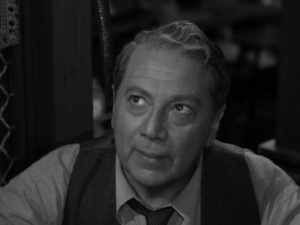
“The Man in the Bottle” is directed by Don Medford. The teleplay is by Rod Serling. As for our cast, we’ve got Luther Adler as Arthur Castle; Vivi Janiss as Edna Castle–it’s nice to see that she has a better spouse in this episode than in the last time we saw her in “The Fever.” And Joseph Ruskin as our genie. The episode first aired on October 7th, 1960.
Episode Tidbits
My tidbit is something that I think probably hit some of you out there right away as well. That voice? Where have I heard that voice of the genie before? Then, it hit me: “Mr. Chambers.” Joseph Ruskin was the representative voice of the Kanamits from “To Serve Man.” However, he is not credited with the role. People always remember the late great Richard Kiel’s work as the visual representation of the Kanamit, but Ruskin’s voice is wonderfully cold and detached. The fact that he went uncredited for that part in the story is an absolute crime. We can talk more about that when we get to the “To Serve Man” episode. I just thought it was interesting and wondered if anyone else out there immediately picked up on the voice.
My initial Thoughts
My initial thoughts were that this is a perfectly fine episode, nothing too amazing, nothing really bad about it. I like the characters; I find the genie to be really fascinating in his mannerisms and in the ways he defends his honor against being called a conman. Something else I appreciated, these be-careful-what-you-wish-for stories can get really negative and really dark fast. I actually appreciate the fact that Arthur and Edna are laughing at the end of this ordeal. That being said, there are some odd things about it that I’ll bring up in my rating section.
Question 1: Is the genie really being fair to Mr. and Mrs. Castle or not?
I struggled a bit with this episode for quite a while. I watched it probably a total of four times–more than I’ve seen any other episode I’ve reviewed thus far. The reason is because there is something just a bit off when it comes to the dynamics of the genie character in relation to his services and the consequences of Arthur’s wishes. The more you watch the episode, the more this dissonance grows in your mind that something just isn’t right here. I’m going to do something a little different today than usual. I’m going to spoil my answer to this question early and say that the genie is being fair, but he is doing so in a somewhat deceptive manner. Let me explain what I mean.
Let’s jump right into the fire here. After the second wish for the money yields very little in the way of results, Arthur is understandably upset. Additionally, you have the genie sitting, somewhat smugly, something we will come back to a little later, offering the following commentary: “It was my suggestion that you reflect very carefully, Mr. Castle, very, very carefully.” Of course, this is a nice bit of I told you so coming from a cosmic being. Now, we might not like the way he says it, but is it fair? Well, let’s keep going a little further. Arthur asks the genie, “what can come to us without tricks?” And the genie takes exception to this, replying: “Without tricks? I question the semantics here, Mr. Castle. There are no tricks involved. There are simply normal and understandable outgrowths and conditions that go with any windfall. No matter what you wish for, you must be prepared for the consequences.” Let’s give the proverbial devil his due here. Is he right? Yes. We’ve all heard or read the very real stories of people winning the lottery and then losing family members to greed, going completely bankrupt, and even losing their lives in some cases because of extreme changes in the way they live. And so what the genie is saying certainly has merit, and so, again, it seems to me like you have to say that the genie is being fair with the Castles in terms of the message he is delivering with his words, but what happens when we start to focus on his mannerisms and the ways in which he is delivering said message? Now, we’re starting to get into problematic territory.
I mentioned previously that after the money wish, the genie is sitting in a rather smug fashion on the staircase, calmly letting the Castles know that he tried to warn them to think of the consequences of their wishes. The problem here is that we as a species are quite susceptible to body language and even atmosphere. Because the genie is sitting on the staircase that goes up to their apartment, it produces the effect of the Castles having to look up to him when they speak. That might seem like a small thing to many of you, but our brains do acknowledge things like our positions in a space. You ever walk into a conference room for a meeting and consciously pass right by the seat at the head of the table? Why? Because we have created this idea that this seat should go to the person in charge, the person highest up in the social hierarchy of that particular community. There are power structures involved. And the genie absolutely knows this. Think about his first moves when he appears. What does he do? He walks over to the light and turns it on. Why? Because he wants the light and the focus to be on him. He then walks over to the front door, reverses the open/close sign so that the store is now closed, and draws the shade down so as to not be disturbed. Again, you might be thinking that these are absolutely nothing gestures. But, I promise you that these moves will often have the result of inviting challenges from others. And if I’m right about this, then we’ve got an even more intriguing question to pursue within this first one. Can you already tell where I might be going with this setup?
I just made the argument that the genie’s persona essentially invites challenge. Now, remember, what is Arthur’s third wish? What is the wish that he believes is absolutely foolproof? It’s the desire for power, to become the head of a country. Now, now, okay, think about the exchange that takes place here between Arthur and the genie. When Arthur says that he wants power, and that he could wish to be a leader, the genie alters his head position and facial expression in acquiescence, almost to indicate that Arthur has finally reached the place that he wanted him to get to the whole time. In fact, the genie replies, “possible, very possible.” He’s excited, and not only that he even offers a slight suggestion to Arthur saying that he wants to be the head of a country that can’t be voted out of office, replying “do you want to be more specific than that?” The question here is not a good-faith question; it is an invitation for a challenge, a game of sorts. Do you want to try and outwit me? Remember, the genie throws it in their faces that he warned them to think carefully about the consequences, which in some ways indicates that there are potentially perfect wishes. Arthur, of course, takes him up on this and he ends up taking the place of Hitler in Germany at the end of the war.
Okay, let’s return to the question at hand. Is the genie being fair to the Castles? I think it is a bit of a mixed bag here. Yes, what he is saying is lining up with the realities of the situation, and so from that angle I think he is being fair to them. The genie is justified in saying that he offers the wishes and people need to accept the potential consequences for them. However, the mannerisms and games of power that the genie plays with the Castles does effect, I believe, how they think about and construct their wishes, and to me it seems like there is a correlation between the complexities of the wishes and the level of consequences involved. The smaller the ask, the more controllable the consequences. If you do it right and limit the scope of your wishes, I think you can end up with what the genie says, “a modicum of happiness.” I think The Simpsons nailed this part of the puzzle when they did their Treehouse of Horror ode to “The Monkey’s Paw.” Homer uses one of his wishes to get a turkey sandwich, and that’s exactly what he gets. The only downside is that the turkey is a little dry. If dry turkey is the worst thing that happens to you when you make a wish, you’re doing all right.
Question 2: What is it that Mr. Castle really desires?
After Arthur gives the money to Mrs. Gumley, Edna, his wife, comes down the stairs and, understandably so, reminds him that they are also in a bad place when it comes to finances. He then pours out his soul a bit to Edna. He says, “”Maybe all I have left is to find some poor clod who I could feel sorry for.” It’s actually an interesting psychological line if you think about it. He’s using a kind of mathematical or tautological approach to the psychology of socio-economics. If there is at least one person who is worse off than me and requires something from me, I can at least be more comfortable knowing that I’m better off than one other person. Now, I’ve drawn that out a bit for the sake of clarity, but I think this thinking falls a bit under the category of intuition–what I mean is that, I think we intuit this kind of thing sometimes. But, that’s also a rather cold reading of the situation, and I actually think Arthur is simply more emotionally aware of the pain that comes with being this broke, and thinking that someone could be in a worse position than he is in, just makes him feel the need to help another human being. Do you see the difference? Mathematically both are the same; the position of Arthur to others doesn’t change, but the perspective of the situation does based upon the lens through which it is being viewed. The reason why I’m beginning this question with that scene is because in some ways it establishes the complexity of Arthur’s desires and it shows that, I think, in some ways Arthur finds it difficult to meld his material wants with the metaphysical. I think that might make more sense if we jump into the episode again.
Let’s come back to that second wish of a million dollars. Why does he claim to want the money? He lists for Edna that they can acquire jewels, fancy clothes, and a new shop on 5th Ave. These are all very materialistic in nature–with maybe the exception of the shop, which can be interpreted slightly differently as a chance to still maintain his relationship to his family legacy of shop-ownership, but still, I think we can list it here as a bit materialistic in that he he wants to sell better items. But, to these items, he also adds: “We wouldn’t have to grub anymore; we wouldn’t have to sit here and waste our lives away.” And finally he exclaims, “no more worries for the rest of our lives.” It’s interesting how the way we talk about money shifts in time. For a while in the 2000s and early 2010s, researchers would talk about the relationship between money and happiness or well-being. It’s still a popular topic today for research. However, there was one particular study that came out in 2010 from Daniel Kahneman and Angus Deaton. The article is titled “High income improves evaluation of life but not emotional well-being.” What made this study particularly intriguing is that it talked about how emotional well-being and life satisfaction essentially plateaus at roughly $75,000. That isn’t to say that they didn’t find a correlation between life satisfaction and higher incomes, just that it flattens out at roughly $75k. I see what they were trying to do, but this is one of those instances where I think the academic research hit the public in an odd way. For one, the $75k number just doesn’t seem to work intuitively because of the differences in cost of living everywhere. I’m not saying that they didn’t set the study up correctly; I”m just talking about how the numbers hit the public. My understanding is that more up-to-date research on the topic has since found that the correlation extends much further than $75k, which again is a bit of a “you don’t say?” Okay, so why am I bringing this up?
Philosophy and great works of literature have been saying this for a thousand years: life satisfaction does not come from a number. It comes from the belief that you have enough resources to pursue meaning, which is really what I think Arthur wants. Just look at what he does with the money once he has it: he starts to give it away to the people in his community. He wants to give them enough money to create the space for meaning. You can’t expect a mother who doesn’t have enough money to feed her children to care about Plato and Shakespeare–or even to care about the ethical concerns of economic policy. This echoes Maslow’s hierarchy of needs: you must take care of the physiological needs first: food, water, shelter, and then you can start to pursue the ones that are higher up, such as self-actualization.
I think this helps us better understand what Arthur really wants. He wants enough space to create a meaningful existence, to experience self-actualization. Where Arthur, perhaps, goes wrong with the third wish, the one to be a leader of a country, is that he tries to extend his sphere of influence beyond the scope of personal meaning. That wish was no longer about developing the space for self-actualization; it was about good old fashioned power, about having the authority to alter the ways that others can potentially create their space for meaning. As I mentioned in the previous question, I think the genie bates him into that; I don’t think it truly comes from what Arthur wanted, and that serves as an important lesson to us all. We have to be careful about when our search for personal meaning becomes an attempt to control how others find theirs.
Question 3: What are your moments of awe?
My moment of awe has to do with the final scene between Arthur and Edna. After Arthur breaks the glass enclosure with the broom, they simply laugh. This made me think a bit about why people laugh at situations like this. There are surface-level answers of course in the episode. This is how it was at the beginning of the episode so breaking the glass again becomes a kind of return to where they were at the beginning. Fair enough. That’s a totally fine reading. But, I also think we can return to our topic of power for a moment and extend power to include control. When something like this happens, we sometimes rage about it. Why? Because there is something within us that desperately wants to believe it is unfair. That we do not deserve what author Herman Melville refers to in Moby-Dick as the universal thump, the moments where all humans experience their turn at the wheel of fate. If we were simply in complete control of things, this would not have happened, we might think. But, I think you can argue that, after the Castles’ attempts to control things, they realize that total control of life is impossible. Things are going to happen to you, whether you want them to or not. And although some incidents are too terrible to laugh about, I would encourage you and even challenge you that the next time something like this happens to you and you experience a kind of breaking of the glass moment, take a breath, realize that this is an accident, one that is wholly human, and try to laugh it off, or at least recognize that although it is inconvenient, it will be okay. See into that future moment when it will be okay. And believe me: I’m telling myself this one as much as I am trying to tell all of you.
My Rating
As for my rating, I’m giving this one a Middle Middle-tier. I went back and forth a bit between Middle Middle-tier and Middle Lower-tier, but the thing that moved it out of the lower part of the middle tier is the successful execution of its premise. Whether you like the episode or not, it does what it sets out to do, and for me, that means something in how I rate my episodes. That being said, something odd involving the last two wishes and Arthur becoming Hitler: where is Edna? When Arthur comes back to the store, she’s just sitting at the counter, looking like she is doing regular business work. In fact, she almost looks like she doesn’t even know that he left, but then she indicates that she does know about what has happened. It’s an odd moment to me. Overall, I could sit through this episode during a marathon run if I already had snacks in front of me and the remote control was on the other side of the couch.
Next Episode
Next time, we’ll be taking a look at “Nervous Man in a Four Dollar Room,” and here are your questions to consider when watching the episode:
Question 1: Is there something more psychologically profound to Jackie’s friend in the mirror?
Question 2: How is George able to maintain control over Jackie this whole time?
Question 3: What are your moments of awe?
Announcements and Shout-outs
I’ve got a couple of shoutouts to highlight that popped up on my “A Stop at Willoughby” episode. You know, I think I mentioned this in that episode somewhere, but “A Stop at Willoughby” is one of those episodes that is really a pulse episode. What I mean is that it’s popularity to discuss, I think, is tied a bit to the pulse of how we feel as a people all over the place. The more people want to talk about it, the more concerned I am about the world, if that makes sense. I want to highlight two comments from that episode. The first one I’m going to shorten just a bit from astrostar49. He writes, “Nice analysis. Nice helpful advice. This is a top 3 episode for me, but sadly I've watched it at times in my life when I've really been at a low point. Admittedly it probably wasn't a good idea, but at the same time when feeling alone, and wanting a feeling of outside understanding...this 20 minute story was something I could really relate to.” First things first, like always, I want to thank you for the time. People do not need to leave comments; I think they do so to be kind, so the least I can do is say that I appreciate all of you out there for giving me more to think about. Now, as to the comment itself, I want to point out something that astrostar49 says that is not always so easy for us to see. I don’t talk as much about this as I used to with students, but I used to do a lesson where we discussed why crave depressing music or sad movies when we are feeling that way. The short of it for me is that it makes us feel that our emotions are validated in some way–that they make sense. The problem is that these media choices can feed the growing sense of pain and dread that is already within us if we are not careful, and that can be a bad thing. If you find yourselves out there craving painful, destructive media constantly–not just sometimes, which we all do–but because it’s the only time that you feel right and in sync with the world, it’s likely that you’re dealing with something more serious. Turn it off; get out doors; seek human contact from people who care about you; understand that we are an old species now. Others have been through it before, come out the other side, and so can you. And, if that feeling simply will not pass, get some help from professionals there is not a damn thing wrong with that. I hope you know that you’re important to the world astrostar49, and I hope anyone else who needs to hear that today, gets that message loud and clear.
How to Support the Show
You can continue our conversations by heading over to our Discord server and either starting a conversation about this episode or taking part in one that is already happening. The link to join the server should be in the episode notes section. You can also head over to thekeyofimagination.com, where you can rate this episode, learn more about me, watch previous episodes of the show, and check out my curios page where I showcase some of the Twilight Zone trinkets I’ve bought over the years. I encourage people to email me thoughts and comments, whether it’s about a particular Twilight Zone episode, your rating for an episode, or about the Key of Imagination Show. You can get those to me as a text email, an audio clip, or even a video clip of roughly no more than 5 minutes to keyofimaginationshow@gmail.com. Keep in mind, even though we talk about some serious topics, we’re trying to maintain as family-friendly of an atmosphere as we can. If you would rather I not use your comments on the show, please indicate that so I can respect your decision.
If you enjoyed the show, I ask that you please take a moment and do one of the following to help build our community. Rate the show, review the podcast, leave comments, thumbs up, all of the usual algorithmic gymnastics. That will help get the show in front of more people and help us build our community of Twilight Zone fans. However, even if you do none of that and absolutely hated every minute of this, I would still like to thank you for spending some time with me. Until next time, remember, all doors are open to those who possess the key of imagination.
Works Cited
Kahneman, Daniel, and Angus Deaton. “High Income Improves Evaluation of Life but Not
Emotional Well-Being.” Proceedings of the National Academy of Sciences - PNAS 107.38 (2010): 16489–16493. Web.
Yu, Xin, Bo Xu, and Entao Zhang. “Others’ Facial Expressions Influence Individuals Making
Choices and Processing Feedback: The Event-Related Potential and Behavioral Evidence.” International journal of environmental research and public health 20.1 (2022): 568-. Web.