
The Twilight Zone Season 2: Episode 39
"Nervous Man in a Four Dollar Room" Episode Transcript
Introduction
Welcome to the Key of Imagination. This week we’re going to be looking at the Twilight Zone episode “Nervous Man in a Four-Dollar Room.” We’re going to get a little psychological with what’s happening to Jackie; we’ll dive into how George is able to hold such control over our nervous protagonist this whole time; and I’ll reveal my moment of awe, a personal story about my own interaction with a set of bullies. So, grab your keys, and let’s open up this door to the fifth dimension.
Plot Summary
As the title indicates, Jackie is indeed a nervous man. His whole life, he has been pushed and dared to do things that are against his better judgment, but fear and an unwillingness to stand on his own two feet have led Jackie to this dirty, four-dollar room. Soon, a man of perceived clout will give Jackie a task, one that will move him up in the ranks from being a burglar to a murderer. And if Jackie is successful, there won’t be just one man who is dead; there will be two, as any remnants of the man known as Jackie Rhoads will also die that day, if not literally at least figuratively. But, there is one person who is trying to talk some sense into our Mr. Rhoades, a man close to his own heart–or, perhaps closer to his head: Jackie’s repressed self, the man who he could have been had he not given over all of his agency to others, now relegated to a life in the mirror. But, Mirror Jackie has had enough. He’s ready to take back the reins of their life once and for all. And after a long conversation of compassionate memories and dark truths, Mirror Jackie finds his moment and takes control, just in time to wallop George right in the face. No more a petty crook, Jackie Rhoades is ready to begin the next chapter of his life with a renewed sense of confidence that his actions and decisions are his own to make.
Episode Details
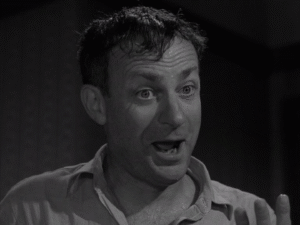
“Nervous Man in a Four Dollar Room” is directed by Douglas Heyes. The teleplay is by Rod Serling. As for our cast, it’s a pretty straightforward one. We’ve got Joe Mantell as our nervous man, Jackie Rhoades; and we’ve got William D. Gordon as George. The episode first aired on October 14th, 1960.
Episode Tidbits
As for our tidbits, both Martin Grams Jr. in Unlocking the Door and Marc Scott Zicree in the Twilight Zone Companion talk about the original idea that was floated for shooting this episode. They were thinking of doing a split screen, where you have the same actor side-by-side with each other. We actually still do this now. Instead, Heyes and the rest of the production crew decided to do it as a mirrored image with a rear projection. They shot all of the scenes of Mantell as Mirror Jackie from the front, and then they shot Mantell playing off of his mirrored self from the rear. I love when people get creative and think of new ways to try and film or represent something. In this case, I think it works fine, and at some of the points when Jackie is moving around the room and the eyes are following him from his mirrored self, I think it looks pretty cool even by our standards of today.
My initial Thoughts
My initial thoughts are just okay. I think all of the writing that I do for these episodes has started to impact how I see a lot of these on my first rewatch. I’ve never particularly loved this episode, and I still don’t. But, there are some parts of it that I think I appreciate more now than I did in the past. For example, Joe Mantell’s acting. When I was younger, I found his nervous ways to be somewhat annoying and off-putting to listen to, but, with some years of adulthood on my bones, I realize that this is the point. The word that seems to be most appropriate here is sniveling, and you have to give it to Mr. Mantell; he plays that word incredibly well. But, that’s about as far as I go with my initial thought. I can talk more about the aspects that I liked and didn’t like in my rating section.
Question 1: Is there something more psychologically profound to Jackie’s friend in the mirror?
There are a lot of really interesting places to take this episode when you’re talking about psychology, particularly if you’re trying to extend the conversation around Jackie’s relationship to his mirrored self. I want to go in what is, I hope, a more healthy direction, but in order to do so we have to once again bring back an old friend, a psychiatrist that we’ve discussed before on the show, in a segment that I will simply call the Jung and the restless. [Get it! As in Carl Gustav Jung. Ah…what do you kids know with your fidget spinners and Zucchini pasta.]
Now, this is one of those episodes that I think suffers a bit under its own intentions. What I mean is, the character of Jackie and even the mirrored image, is rather two dimensional. There isn’t much to them: one is a nervous man; the other is a confident one. Of course, we can break them down even further, but they really are quite simplistic–and that’s by design. They are supposed to be that way because they are essentially psychological projections, or avatars, of these states of being. I do think the initial brief monologue that Jackie has in front of the mirror, before the other version of him appears, provides us with some important context into what is about to happen. He says, “Boy, I wish I could trade you and use another model. Eh…it’s not your fault; it’s not my fault. It’s just the breaks–that’s all. Why am I scared? Why am I all the time scared?”
I like this moment because there is something very genuine about it. We have these kinds of conversations with ourselves sometimes. We might ask, why did I do that? Or, why do I dislike this person? We’re trying to match up the feeling and psychological perception of something with a somewhat disjointed sense of logic and reality. To put it simply, I think Jackie is actually trying to find out why he spends the majority of his days in complete and utter fear? Now, it isn’t so easy to figure out why we feel a certain way. But, as a famous character used to say, “Who knows what evil lurks in the hearts of men?” If you know the answer to that question, you know exactly where we’re about to go. The answer is the shadow knows. I don’t want to leave people hanging here. We’re going to talk about Jung’s shadow archetype and why it’s a useful concept for us all to become familiar with. But, first, let’s get a better idea of what it is.
According to Jungian psychologist Dr. Andy Drymalski, the shadow can be “the emotion, such as anger or love, that we refuse to acknowledge and stand up for. Sometimes it is the ancestral ape that rattles the cage of our overly rational, “civilized” mind. It can also be the child we once were, but have lost touch with; the inner artist, musician, dancer, writer, explorer, healer, hippie, student, bum, comedian, warrior, etc. that we have locked in the “Not Me” dungeon of our unconscious. Jung put it simply when he said that the shadow is who we are, but refuse to be. (link). So, the shadow is, in a sense, the version of us that we deem is not fit for public consumption. This is in opposition to the persona, which is the version of us that we present to the public. Mirror Jackie understands this all too well. When Jackie says, “Now I get it: I’m talking to myself.” Mirror Jackie doesn’t deny this at all. He says, “That’s just who you are talking to. Part of yourself–the part of yourself you never let come out.” So, mirror Jackie is the shadow, the figure that is inside, lying unacknowledged publicly but always there.
But, here’s the kicker, the shadow does not stay completely dormant always. It bursts out of us sometimes. Did you catch that brief moment early in the episode where his shadow emerges? At roughly the 4:57 mark, Jackie raises his voice at George and says, “listen, George, I’m not knocking you; I don’t see why all the time you gotta’ knock me.” He gets angry; he stands up for himself. That is the shadow coming through. You’ll note that right after he says this Jackie IMMEDIATELY becomes consciously aware of what he has done and represses it right back down inside. He changes his voice, his pattern of speech, back to a submissive one. Now, think about this, and it will probably sound like a silly question, but bear with me. Is Jackie wrong in that moment to lash out and put George in his place? No. Absolutely not. This was also one of the points that Jung would try to make about the shadow. There is often really important character information hidden in there that can be quite healthy for us. Anger is not always negative; it can be focused and used to stand up to a bully, to fight on behalf of another. The problem for Jackie is that he has reserved fortitude, courage, and anger for his shadow and so when those emotions emerge they often happen at times that are not ideal and well thought out. What does that mean for us? If you can find a way to recognize what lies within your shadow you can begin to organize how you can incorporate it into your persona, into the daily parts of life when they are most beneficial to you.
There is a really interesting part of this episode that I like. When mirror Jackie becomes the new norm, you get that final scene where nervous Jackie is still present with him, still inside of the new Jackie. But, he will have to be careful. There is a time and place when one should be nervous. That’s built into the very structure of our existence as humans as well. So, the goal for our new Jackie in some ways still remains the same. He will need to learn to integrate the positive aspects of the shadow into his life, just like the rest of us, and that makes this episode, for me, an interesting psychological experience.
Question 2: How is George able to maintain control over Jackie this whole time?
This question can become a bit simplistic if we’re not careful. What I mean is we could always simply say, “George is a bully. That’s the answer. Good night, ladies and gentlemen.” And, of course, there’s a lot to that answer. George is a bully. But, I actually want to come at this from the other side. I want to talk about Jackie here. In a perfect world, there would be no Georges, no individuals who prey upon the anxieties in others, but we don’t live in a perfect world, and we never will. So, we need to work with what we can control, and that means we need to think about Jackie. If we can figure out Jackie, there isn’t a George in this world who can touch him.
After Jackie finally realizes that he’s talking to a version of himself, he says, “I was a runt, a skinny little runt. And if you want to join a street gang you have to go along with them. You back down, they give you business.” To this Mirror Jackie relays what seems to be the origin story of their move toward crime: the stealing of the teacher’s locket. The other students dared him to take it, and so he did. What I want to highlight in this exchange is the ways in which we give over our authority over ourselves so easily. And I’m not trying to pick on Jackie here. I think there are times when we can all have these moments when we feel like we’re being pushed or nudged toward some kind of action or decision, and we’re not particularly happy with it but we go along. Why? Well, one surface answer is to avoid conflict. And conflict is a key term for us in this question so let’s make a quick stop there and then come back to our man Jackie.
When I went into the research on conflict and conflict avoidance, I found an interesting book titled, Conflict is Not Abuse: Overstating Harm, Community Responsibility, and the Duty of Repair by Sarah Schulman. One of her main points of the book is essentially that we need to be able to address personal conflict if we want any chance at addressing more serious global ones. And, one of the first ways that we can address personal conflict is by doing a better job of recognizing the difference between our being placed in harm vs discomfort. She writes, “Confusing being mortal with being threatened can occur in any realm. The fact that something could go wrong does not mean that we are in danger. It means that we are alive. Mortality is the sign of life.” I liked this quotation because it made me think of how we conflate conflict with fight sometimes. Those are often used as synonyms, but I think when we break them down, they’re quite different. You can be struggling with a conflict and not be fighting with someone; however, if you’re fighting with someone, you’re in a conflict. Additionally, as Schulman points out, discomfort is not mortal danger. In fact, discomfort can, at times, be the ideal palace for us to be in. When I’m challenging my students, they often give the typical “I don’t get this. Or, I’m really frustrated.” My response to them, and it usually doesn’t go over well, is “good!” That means your minds are stressed and trying to accommodate new information and skills that you didn’t have before. In short, you’re learning. [To be fair to them, sometimes I look at my own directions and say, I have no idea what I was trying to say here, so this one’s on me. You’d be surprised how much the students appreciate when you just own your own mistakes.]
Let’s come back to Jackie. We began this section by talking about why Jackie wanted to join a streetgang. He felt small, powerless. A gang or a group of people can make an individual feel powerful, feel protected. I don’t think I need to bring in peer-reviewed research to state that it can be really difficult for us as a species to stand alone on our own two feet against others sometimes, and so we can sympathize a bit with Jackie’s plight. And so, enter George. George is obviously seen as a powerful figure. He’s not particularly imposing in terms of his physicality, but he can move and bend the wills of the people around him, and that is most definitely a type of power in our social world. With that type of influence over others, we can begin to see how someone like Jackie would want to be in the good graces of someone like George. But, that still doesn’t completely get us to our answer for why George is able to control Jackie the way that he does. For that, we’re going to have to add a final element to this conversation.
When we think of power dynamics between people, we tend to do so only when conflict is at its highest point. In this play before us, we have George asking Jackie to kill a man, something that he has never done before and doesn’t really want to do. And Jackie is struggling with this. If I walked up to one of you and said, hey, I want you to kill this guy. You’re going to say, no. And you likely won’t even waste more than the breath it would take to get that one syllable out of your mouth. So, when that same question is applied to Jackie and we isolate it as a single moment, theoretically, Jackie should also be able to simply say no and move on, but he can’t. Why? Because of the weight of every decision he made before this one, because of all of the times he said yes to things he didn’t really want to do. And, we should think of this almost as actual, physical weight. What’s easier: to hold a single pound of weight for five minutes or to try and hold 15 pounds? We love a good dramatic moment when it is on television or in movies, but in life, the easiest way for us to stand up to bullies and to protect our agency, our ability to make our own choices in life and live the way we want to live is to know when to say no to the small things. To come back to the book I brought in earlier, we need to recognize the difference between a small matter and a mortal danger. The more comfortable you become with saying no to small things that you find objectionable the less likely you are to have to face the mortal dangers that sometimes come our way. And so how is George able to gain control over Jackie? One seemingly small decision after another.
If you want to make a change in your life because you feel a bit like you’re already on a bad path of small yeses that could lead to a more difficult one down the road, start with something small, something seemingly inconsequential and just say no. You don’t have to be rude; you don’t have to justify your existence. You just have to stand by it. It’s okay to say no.
Question 3: What are your moments of awe?
Watching this episode and talking about these kinds of bullying moments brought back a memory that I had. I wasn’t a big bike rider, but I did have a bike that I would use occasionally. One day, some kids came by and stole my bike. I knew one of them because he lived up the street from me. When I told my father, he said, get in the car and drove me right to that kid’s house and said, “you need to go tell that kid that you want your bike back.” As a kid, you’re in a weird predicament there. I was pretty sure that if I did this, I was going to get my butt kicked at school by the lot of them, but I mustered up the courage, walked up to the door and told the kid, “I know you know who took my bike, and I want it back.” Now, this wasn’t a bad kid–in fact, he was probably a kind of Jackie himself. The next day at school he brought over one of the bigger kids to confront me, and they both threatened to beat me up and I basically just stood flat-faced to them and said nothing. And you know what, I didn’t get beat up. I didn’t get my bike back, either, but it was a moment. It was one of those moments that stay with you. You don’t particularly like it, but you value it. If you’re in a relationship, or maybe it’s even something at work that makes you feel like you’re just getting bullied by someone–unless it’s truly dangerous to do so, you need to know that it’s okay to stand up for yourself. It’s okay to say, “No, I don’t think I’ll be doing that today.” You might lose your bike, but you’ll gain something that is much more valuable.
My Rating
As for my rating, I’m giving this one a Middle Middle-tier. Mantell’s acting certainly saves this one for me from being in the lower tier, especially the scene where he picks his head up out of his hands at the end and emerges as the brand new Jackie. That’s a fantastic moment. But, it’s a bit long in the tooth at times. I always appreciate some of the camera tricks that the Twilight Zone employs, and I think this one is pretty successful with the two Jackies. But, it’s not one of my favorites.
Next Episode
Next time, we’ll be taking a look at “A Thing About Machines,” and here are your questions to consider when watching the episode:
Question 1: Are the machines just as bad as Finchley?
Question 2: Can I get away with a mustache like Finchley’s? Okay, the real question is
do you think Bartlett’s reaction to machines will be something that more people trend toward in the not-too-distant future?
Question 3: What are your moments of awe?
Announcements and Shout-outs
I want to begin the announcements and shoutouts with a bit of bad news for our Twilight Zone community. The charming Jean Marsh passed away recently. Now, she had a wonderful career outside of the Twilight Zone, but for us, she will always be Alicia, the robot companion who gives Correy new life in “The Lonely”. Death is, of course, a part of our lives, and as I try to point out when any of our prominent actors pass away from this show we all love, we should all be so fortunate to leave behind something that touches as many people as she did with her Alicia character.
I’ve got a bit of a funny group-oriented comment to touch upon. After I released my “King Nine Will Not Return” episode, more than a handful of you pointed out how you felt like it had strong echoes with the first episode from season one: “Where is Everybody.” Well, yet again, I have to say that this is why I love hearing your thoughts because I’m going to be honest: I did not see that at all. It didn’t come into my head once as I was watching and rewatching the episode and then writing and rewriting my episode draft. But, as soon as you all started commenting on it, it hit me like a ton of bricks: you’re right. All of you. The tone, the atmosphere–even the premise itself is pretty darn close. Now, I think they are certainly enough differences that the two episodes can stand on their own merits, but I just didn’t see it until you all pointed it out. And now, I can’t unsee it. So, keep the comments coming. You’re really pushing me to think about these episodes in a different light.
How to Support the Show
You can continue our conversations by heading over to our Discord server and either starting a conversation about this episode or taking part in one that is already happening. The link to join the server should be in the episode notes section. You can also head over to thekeyofimagination.com, where you can rate this episode, learn more about me, watch previous episodes of the show, and check out my curios page where I showcase some of the Twilight Zone trinkets I’ve bought over the years. I encourage people to email me thoughts and comments, whether it’s about a particular Twilight Zone episode, your rating for an episode, or about the Key of Imagination Show. You can get those to me as a text email, an audio clip, or even a video clip of roughly no more than 5 minutes to keyofimaginationshow@gmail.com. Keep in mind, even though we talk about some serious topics, we’re trying to maintain as family-friendly of an atmosphere as we can. If you would rather I not use your comments on the show, please indicate that so I can respect your decision.
If you enjoyed the show, I ask that you please take a moment and do one of the following to help build our community. Rate the show, review the podcast, leave comments, thumbs up, all of the usual algorithmic gymnastics. That will help get the show in front of more people and help us build our community of Twilight Zone fans. However, even if you do none of that and absolutely hated every minute of this, I would still like to thank you for spending some time with me. Until next time, remember, all doors are open to those who possess the key of imagination.
Works Cited
Schulman, Sarah. Conflict Is Not Abuse : Overstating Harm, Community Responsibility, and the
Duty of Repair. Vancouver, British Columbia: Arsenal Pulp Press, 2016. Print.