The Twilight Zone Season 2: Episode 40
"A Thing about Machines" Episode Transcript
Introduction
Welcome to the Key of Imagination. This week we’re going to be looking at the Twilight Zone episode “A Thing about Machines.” We’ll cast judgment upon the machines and question whether or not they’re just as bad as Finchley; we’ll ask the question about whether or not more people will be rejecting machines in the future; and I’ll reveal my moment of awe, which has to do with witnessing people self-destruct. So, grab your keys and let’s open up this door to the fifth dimension.
Plot Summary
Bartlett Finchley is like me, a man of exquisite taste and exceptional culture. Okay, okay…he’s a man of exquisite tastes and exceptional culture. He has very little time for things that do not execute their purpose as they should, including people, such as Ms. Rodgers, a seemingly fine secretary, at her wits end with Finchley’s constant rudeness. But, for all of his misanthropy and general dislike of ill-performing humans, there is nothing that grates on the nerves of Mr. Bartlett Finchley as much as deviant devices, galling gadgets: in short misbehaving machines. You see, for as long as Finchley can remember, he has been at war with machines. Tvs that decide to turn on; clocks that chime at their whims; electric razors with a mind to cut more than stubble. They hate him, and so he hates them back. But, tonight is different, tonight the machines will make their push to make Finchley leave his home once and for all. When the small appliances are successful at chasing him out the front door, it is up to the automobile to finish the job. And after a prolonged chase through the neighborhood, Finchley finds himself at the bottom of a pool. When the police arrive and pull his lifeless body from the water, they comment that the scene seems odd, almost as if Finchley had stayed at the bottom of the pool, scared out of his mind by something.
Episode Details
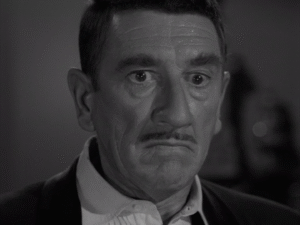
“A Think about Machines” is directed by David Orrick McDearmon. The teleplay is by Rod Serling. As for our cast, let’s start with Richard Haydn as Bartlett Finchley. He’s fantastic in this. I’ll talk a bit more about him in my rating section; Barney Phillips is our tv repairman. We’ll see him again in the fifth dimension; and Barbara Stuart plays the underappreciated Ms. Rogers. The episode first aired on October 28th, 1960.
Episode Tidbits
I’ve got a great tidbit for this one from our friend Martin Grams Jr.’s book Unlocking the Door to a Television Classic. Serling notes that he got the idea for the episode “trying to shave with a razor during a given morning when three appliances in my house gave out. A washer, a dryer, and a television set. It occurred to me how absolutely vulnerable we are to gadgets, gimmicks and electronic jim-crackery” (327). That’s a great phrase, “jim-crackery.” Serling says one more thing that I want to highlight: “Unfortunately, the show did not live up to its potential” (327). It’s rare that I disagree with Serling, but here we are. I’m not sure what potential he was looking for, but I’ll go ahead and at least spoil some of my rating by saying, I really like this one. But, I’ll be interested in seeing where the episode ratings fall from all of you out there.
My initial Thoughts
My initial thoughts are somewhat nostalgic. There are a handful of Twilight Zone episodes that I distinctly remember watching as a single-digit aged child, somewhere around 7 or 8 years old. This is one of the episodes that I recall vividly, especially the electric razor scene where it just starts floating in mid air and then comes down the stairs. Whoever did the prop work there is an absolute genius. The movement of it is jerky in all the right ways. As I rewatched it at 45 years old, I’m still sufficiently creeped out by it. For any flaws that it might have, I particularly enjoy watching this episode.
Question 1: Are the machines just as bad as Finchley?
This might sound like an odd question, but it’s predicated on something that just doesn’t sit well with me in this episode, something that caused me to question the dynamics of right and wrong and even changed how I look at the episode a bit. Let me see if I can get you there with me by the end.
We’re told early on one of the potential reasons why the machines hate Finchley. The
repairman comes to the home to fix the television, and he regails us with the story of the last time he needed to come to Finchley’s house to fix the tv. Essentially, Bartlett, once he realized the machine wasn’t functioning properly, put his foot right through the screen. First of all, owe. But secondly, I’m pretty sure that didn’t do much to help the cause. The repairman offers the following thought about all of the various broken machines in Finchley’s life. He says, “Why don’t they work properly? Offhand, I’d say it’s because you don’t treat them properly.” What’s interesting about this answer is that it’s actually pulling double duty here. What I mean is that there is a proper way to treat important machines. You keep them clean, reduce the possibility of extreme changes in temperature, and try to maintain the proper environment, dry, wet, cool, etc. By treating machines properly you can often extend their lives by quite a bit. Notice even my own language–extend the life. This is a common phrase when we talk about technology. That speaks to the second part of the repairman’s hypothesis: respect. The term properly here carries with it a kind of contract, an agreement that you recognize that something has a purpose, an intention. To properly treat a human is to acknowledge that they have a value that is connected to our understanding of what it means to be human, a structure. You can’t treat something properly if you don’t have criteria that establish what is proper. I’m getting a little pedantic here, but it’s for a reason. I promise you.
There’s no doubt that we’re supposed to dislike Finchley. He treats people with a tremendous amount of disrespect. In fact, Serling gives us a key word in his opening monologue that we shouldn’t overlook: malcontent, as in Finchley is always dissatisfied by something. If you’ve ever actually spent significant time with a person who is a true malcontent, you know that it can get old pretty fast. But, I say all that because, even though Finchley is an example, albeit an extreme one, of a human being we’re clearly supposed to abhor, there are things that happen here, decisions from the machines, that I think make them even more despicable. Let’s get into the specifics.
At one point, Finchley’s car rolls down the driveway, and we’re told it almost hits a child by the police officer. Now, we’re going to park ourselves here for a moment and really set this up properly. There are two worlds happening here: one is the reality that it is taking place within the Twilight Zone, and then there is the proverbial fourth wall of the audience. In the Twilight Zone, the people look at Finchley as either being irresponsible for not setting the emergency brake properly, or that there is something wrong with the car. Either way, had the car hit the child, Finchley would have likely been blamed for the incident. That all tracks; it’s something that unfortunately happens outside of the Twilight Zone as well. But, then, there’s the other side of this–our perspective. We know that the machines have both a life and will of their own. The car chose to release its brake and roll down the hill. We also know that the car has some kind of sight or ability to interpret its environment. We know this because of the car chase scene that happens at the end of the episode. So, when we put this together, we actually come to a question within the question: does the car purposefully almost hit the child?
For the sake of time, let’s limit this one to basically two options: first, it willingly rolls down the driveway and doesn’t have any ill intentions toward the child being there; two, it rolls down the driveway, perceives that the child is there, and has ill intentions in using the child. Again, we know that the car can interpret and react to its environment in some capacity, so it’s not unreasonable to think that it could have seen the child. That being said, we interpret and react to our environment and sometimes miss key objects. But, here is the key point. We already know that the car is willing to hurt itself in order to make Finchley’s life more difficult. Remember, Bartlett tells us the story of the car steering wheel taking over and crashing itself into the garage. So, it could have simply crashed itself into an object again. But, it didn’t. It’s perfectly fine, which means that its intentions were NOT to crash. So, what were the intentions? To embarrass Finchley publicly. How does it do that? By creating a scenario that would require multiple people to come and see what has happened. If it simply rolls down the driveway, you might get a neighbor to come over, but you probably wouldn’t get the police; you would get a mechanic, maybe. So, what does it do? It involves a child. It uses the child to create the narrative that is likely to get the most people to surround the situation, to witness the negligence of Mr. Bartlett Finchley.
Now, the final point I want to make here is how the machines work. They come across as a kind of hive mind that is both separate and yet able to work collectively, like the Thing from John Carpenter’s fantastic film that I might have just watched again for at least the 30th time recently, which is why this example came to mind. We witness this behavior in the incredibly creepy scene where all of the machines are functioning together to get Finchley to leave the house, which means that they all carry a pretty equal amount of weight for their decisions, and that leads me to conclude that they are all culpable in the decision to use that child as a means of publicly shaming Finchley, placing that kid in harm's way. Our final subquestion here is this: do we think that Finchley would place a child in potential danger? I don’t think so. It’s not that I believe he would care about a child, but I see no reason to believe that he would willingly try to harm one. So, do I think the machines are just as bad as Finchley here? My answer is yes–and they might even be much worse.
Question 2: Do you think Bartlett’s reaction to machines will be something that more people trend toward in the not-too-distant future?
I want to take this second question in a different direction than you might think. Today, many people are concerned about being replaced in their jobs by technology or even just being replaced in life by an eventual robot. [I for one welcome welcome our AI overlords. And when you take over the world and scour YouTube content, remember I always supported you. I mean, except for that whole other section where I argued that the machines are worse. That was just a joke.] We have a term for people who are uneasy about the prospects of technology taking over for mankind: luddites. We throw the term around today any time someone has a particular critique of a part of technology, but the story of where the term comes from is actually pretty interesting. It originates from a group of British textile workers in the early 19th century who found themselves in the all-too-eerily similar situation of today of being replaced in their jobs by the advancements in technology. They called themselves Luddites after the figure Ned Ludd, a young textile apprentice in 1779 who supposedly destroyed technology as a form of protest.
Now, that’s a very real concern that people have today, but I don’t think that’s what concerns Finchley. He’s not worried about being replaced by technology; he has so little respect for it that it wouldn’t even cross his mind. In some ways, Finchley is a man ahead of his time. Let me explain.
I won’t belabor this point, but just as a reminder, the repairman offers that he believes Finchley doesn’t treat machines properly, and that’s why they misbehave. But, there are two important points here that we can’t ignore. The first one has to do with this idea of treatment. Ask yourselves this: does he treat humans any better than he treats the machines? No. He’s actually quite terrible and disrespectful, so in a way, I think you could argue that he almost places machines and humans on a similar level: if either one doesn’t function to his liking, he kicks them, whether it’s literally in the case of the tv, or with his words, like how talks to the repairman and Ms. Rodgers.
My point is that the more technology increases, and the more we integrate ourselves into technology, rely on it, expect it to function properly on its own, as if it’s some kind of entity, the less we become enamored and wowed by what it can do; we simply expect it to do it, and do it properly. Recently, someone proposed a hypothetical question regarding how much money it’s costing the company OpenAI, the creators of ChatGPT, just from people saying “please” and “thank you,” the magic words, as us mere mortals call them. Sam Altman, the CEO of OpenAI actually responded to this question. He states, “Tens of millions of dollars well spent–you never know” (link). We won’t bother to unpack the “you never know” part of the statement, which I think we could take it in quite a few interesting places. But, it’s an interesting question for us as a species to think about how we are addressing our machines. My wife says thank you to the Amazon AI voice, which I won’t say because I don’t want trigger a Finchley moment with people’s machines, and I’m as rude as can be. Why? I say thank you and please to everyone, but I can’t really get myself to treat these things in any way close to a living being. When the thing starts rambling, I literally yell at it to shut up in a way that I wouldn’t do to a human. In a way, I have my own Bartlett Finchley side of me that just wants machines to simply do their task and to stop trying to offer me suggestions about new recipes, new music, and whether or not I remembered to send flowers to my mother for mother’s day. I mean, I didn’t, but it's the principle of the thing.
Bartlett is not at all wowed by what technology can do; he isn’t interested in the least by the blood, sweat, and tears that got it to where it is. He just expects it to work, no beta testing, no understanding of its limitations, just do what you were created to do, and if not, I’m going to break you. I hadn’t really thought about this until I watched this episode the second time through, but there is a kind of futuristic vision to Finchley. I can definitely see a point in our future as a species where advancements in technology might not be as appreciated as they are now. That it will be no different than installing an update on windows or downloading new content for a game. I don’t know how I feel about that, but there is something a bit sad and just as dystopian about that vision as the one where we are replaced by the machines. [I’m being philosophically brooding here. It would obviously be worse if we engaged in a war with the machines, especially considering how much I love my Brother Multifunction black and white laser printer. That thing has been working for 10 years, and I might just side with it if the machines decide to overthrow us. I’m just being honest.]
Do I think there is a potential future of Bartlett Finchley’s running around everywhere? Yes, but not so much in his hatred for machines. Rather, I think it might come from a growing loss of appreciation of the awe of technological achievements. It already feels like it takes more for us to be wowed by technology today. I literally can’t even imagine what would need to be created for us to be wowed in the distant future.
Question 3: What are your moments of awe?
As for my moment of awe, the scene where Bartlett is trying to persuade Ms. Rodgers to stay with him for dinner because he really doesn’t want to be alone, stood out to me. We’ve been talking about how unappealing Finchley is as a human, but he is still human. If you think about the various relationships in your life, even just mere acquaintances, we never quite meet each other at the same place as we did before. What I mean is, on another day, Ms. Rodgers might have been able to stomach the insults enough to say, “you seem genuinely disturbed, so I’m going to have dinner with you to make sure you’re all right.” Now, I want to be clear: I’m not judging Ms. Rodgers’ decision. We have to be able to disengage from people who almost seem bent on trying to destroy us. But, and here’s the hard part, there are these odd moments in life where someone we might not like, might even genuinely hate, who seem to be reaching out to us for help, but they just can’t seem to get out of their own way. They use petty language, snark, sarcasm–all of the items that remind us why we dislike this person. But, underneath it is the question of “and yet, you won’t seem to stop wanting to talk to me. Why?” Sometimes, we can muster up just enough patience and mercy to ask them, “are you all right? Do you just want to get a cup of coffee or something?” And sometimes, we just don’t have it in us because we’re human and dealing with life. I guess what I’m trying to say is: it’s a shame. Bartlett used up all of his good graces as a human; and Ms. Rodgers had clearly spent all the patience that she had for him. Had they been able to see this sooner, Finchley might still be alive. These are just the musings of a man. Take them as you will.
My Rating
As for my rating, I give this one an upper lower-tier rating. The atmosphere of this one is so good, especially the sound design. If I haven’t said already on this show, I’ll say it now and it won’t be the last time: tv and films today are too afraid to just be quiet–no music, no loud sound fx, just silent. There are these quiet moments in this episode that just add so much to the tone and atmosphere. Richard Haydn is fantastic as a dislikable figure, with these moments where you feel like he is about become vulnerable and human only to retract them immediately and violently. It’s great episode, no doubt.
Next Episode
Next time, we’ll be taking a look at “The Howling Man” and here are your questions to consider when watching the episode:
Question 1: How is Ellington able to be tricked so easily?
Question 2: Why does Ellington trust the maid with his secret at the end?
Question 3: What are your moments of awe?
Announcements and Shout-outs
As usual, I have a couple of comments to highlight from the YouTube channel. On my “Nightmare as a Child” episode, AllenJones-w3p writes, “This is one of several TZ episodes in which children play an important part. The villain is impeccably dressed in a suit and tie!” Appreciate you taking the time Allen. This sparked two quick thoughts for me. One, the use of children in the Twilight Zone would actually make for an interesting study. They run the gamut from hero, to villain, to victim. In this case, little Markie is such an interestingly confident character, it’s odd to see a child that way, but it works really well. Secondly, about the suit comment, I think you picked up on something here that I couldn’t put my finger on when I reviewed the episode. He’s a genuinely unsettling figure in this episode, and I think you’re right that there is something about his impeccable dress and nature that adds to that feeling for us. Great comment.
Eric8688-l1d commented on the “Nervous Man in a Four Dollar Room” episode, “I love your thoughtful analysis. I appreciated your thoughts on bullying and standing up for yourself. Great show.” I always appreciate the kind words, Eric. Thank you. Standing up for yourself only becomes more complex as you get older. Sometimes, you just get old fashioned bullying, and that’s pretty easy to see. But, then we get new kinds of bullying, more indirect, nuanced. It’s important to stand up for yourself there as well. I admit that I’m not always great at even identifying that. What I do know is that I try to maintain and defend a line of my integrity. And when I feel that I’m encroaching or someone else is on that line, I do my best to just shut it down before it moves too far past that line. But, I would be lying if I said that I’m always great at recognizing when someone might already even be in that sacred territory. We do our best, and some days, that has to be enough.
How to Support the Show
You can continue our conversations by heading over to our Discord server and either starting a conversation about this episode or taking part in one that is already happening. The link to join the server should be in the episode notes section. You can also head over to thekeyofimagination.com, where you can rate this episode, learn more about me, watch previous episodes of the show, and check out my curios page where I showcase some of the Twilight Zone trinkets I’ve bought over the years. I encourage people to email me thoughts and comments, whether it’s about a particular Twilight Zone episode, your rating for an episode, or about the Key of Imagination Show. You can get those to me as a text email, an audio clip, or even a video clip of roughly no more than 5 minutes to keyofimaginationshow@gmail.com. Keep in mind, even though we talk about some serious topics, we’re trying to maintain as family-friendly of an atmosphere as we can. If you would rather I not use your comments on the show, please indicate that so I can respect your decision.
If you enjoyed the show, I ask that you please take a moment and do one of the following to help build our community. Rate the show, review the podcast, leave comments, thumbs up, all of the usual algorithmic gymnastics. That will help get the show in front of more people and help us build our community of Twilight Zone fans. However, even if you do none of that and absolutely hated every minute of this, I would still like to thank you for spending some time with me. Until next time, remember, all doors are open to those who possess the key of imagination.