
The Twilight Zone Season 2: Episode 44
"The lateness of the Hour" Episode Transcript
Introduction
Welcome to the Key of Imagination. This week we’re going to be looking at the Twilight Zone episode “The Lateness of the Hour” We’ll explore why Dr. Loren built will into his robots; we’ll dive into whether or not this family arrangement is the future of society; and I’ll reveal my moment of awe, a look into what it means for AI to have a personality. So, grab your keys and let’s open up this door to the fifth dimension.
Plot Summary
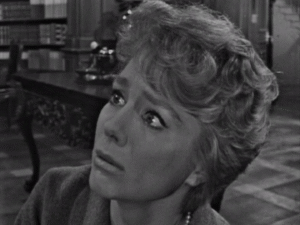
On the surface, the Lorens are a wholly unremarkable family unit: a husband, a wife, and a daughter by the name of Jana. They live in a beautifully large home and have servants attending to their every need. And herein lies the problem for Jana. Servants doing everything, a home that feels more like a mausoleum, and an unbearable feeling of isolation from humanity. Why? You see, the servants are actually robots, a fact that Jana simply cannot remove from her mind. Like a typical young adult, she wants to go out into the world, experience life to its fullest. However, the Lorens have decided to remove themselves from the world, from the violence, plagues, and all of the nastiness that comes with being a part of civilization. But, Jana can take no more. She offers an ultimatum; either the servants go or she does. Dr. Loren has no choice. He disassembles his servants, leaving just the three of them alone. But, when Jana begins to express all of the wonderful things she is going to do–travel, get married, have children, a pall is cast over the family. Jana grabs a photo album from the shelf. She wants to know why there are no baby pictures of her anywhere, only pictures of the robots. And then, it hits her. She has been built, not created. This information sends her into a spiral, one from which she can never return. But, the Lorens do love her; they simply cannot live without her, so they make a decision. Jana is calm now, reconciled to what she is…the newest maid of the house.
Episode Details
“The Lateness of the hour” is directed by Jack Smight. The teleplay is by Rod Serling. As for our cast, we’ve got a good one here: Let’s start with the lovely Inger Stevens as Jana, John Hoyt as Dr. William Loren, Iren Tedrow is Mrs. Loren, Mary Gregory is Nelda, And a special shoutout to Valley Keene who is the maid that gets tossed down the stairs toward the beginning of the episode. The episode first aired on December 2nd, 1960.
Episode Tidbits
As for our tidbits, well, you can probably tell the most notable one. If you thought, hey, why does this episode look so different from the others? That would be because it was shot on video tape, not film. This is the first of six episodes that were shot on video tape. The reason being, it was cheaper. How? Well, with film you have to pay for it to be developed, cut, edited…more processing that requires paying more people. With tape, it could be edited pretty much on the spot. This was not really Serling’s decision; this one came from CBS directly. I will say this: these taped episodes are a bit jarring the first time you see them. It really does feel like a different show. That being said, there is at least one episode where I think the tape look actually somewhat aids the episode–or at least, it doesn’t hurt it as much as the others. I’ll wait until we get to the episode before I reveal which one: I mean you have a 1 in 6 chance to guess correctly.
Question 1: Why did Dr. Loren build will into his robots?
You might think that is actually an easy question to answer, but when you break down what I’m really asking, it might not be as simple as it seems. If you just think about this question on the surface, you might go right to Jana herself and be tempted to say, he builds will into his robots because he wants a daughter that is as close to approximating the real experience of a child as possible. Or, you might go to the servants themselves and say that he wants to have creatures, his word not mine, who, again approximate living with other humans because he and his wife have withdrawn from society. Both of those answers would seem to satisfy my initial question about why build will into his robots. Well, I guess that ties it up nicely. Let’s all go get some pizza and ice cream. As the great philosopher-hero Quick Draw McGraw used to say, “Now, hooooold on there”. I’ve got some additional questions here that might throw a dirty wrench in your cereal milk. [I don’t think that’s a real idiom, but I have a PhD in English, which means I can make up words and phrases. Why else does one get a PhD in English?]
Here is the source of my concern. If there were a scene in this episode where either the good doctor or the Mrs. show any kind of appreciation for individual will, then it would make sense to build it into his robots, but they don’t. In fact, what is it that Dr. Loren cites as being Jana’s main problem: rebelliousness, ie. will. So, I’ll ask my question again, [and you should picture like Samuel L. Jackson asking this] why does he build will into his robots? Now, that I think we’ve sufficiently established more of a need to answer this question, let’s start investigating it a bit further.
In the episode, when Dr. Loren is trying to explain why he would never consider dismantling the robots to Jana, he describes his creations as follows: “how marvelously intricate they are; how precise. Not just arms and legs that move, Jana; they’re creatures. They have minds and wills” (11:18). They have minds and wills, but what does that actually mean? To answer this, let’s go to a philosopher that I don’t believe we have talked about yet on this channel: Thomas Hobbes and his famous work Leviathan. In today’s parlance, I think we tend to think of will as a constitutional force, as in will power, or someone was willed to do something. However, for Hobbes, that’s a bit too loosy goosy. Hobbes believed that we make decisions based on appetites and aversions in life. We talked about free will a bit in the previous episode “Nick of Time.” Well, Hobbes happens to be a determinist, meaning that he believed in the concept that things, ideas arise out of a pre-determined event or idea. In other words, something must have come before to make the next thing happen. This directly connects with his understanding of will as well. Here is what he says on the matter:
In Deliberation, the last Appetite, or Aversion, immediately adhaering to the action, or to the omission thereof, is that which wee call the WILL; the Act, (not the faculty,) of Willing. And Beasts that have Deliberation must necessarily also have Will. The Definition of the Will, given commonly by the Schooles, that it is a Rationall Appetite, is not good. For if it were, then could there be no Voluntary Act against Reason. For a Voluntary Act is that, which proceedeth from the Will, and no other. (link).
Okay, what does that mean? Essentially, for Hobbes, the will is the final appetite or aversion that immediately dictates what action you ultimately take. How this differs from previous philosophers is that Hobbes believes it does not have to be raised to the level beyond appetites and aversions; in other words, rationality does not have to play a role here. To do so introduces new philosophical problems regarding why people would ever do irrational things. There are some scholars who make the long road argument about our appetites and aversions stemming from rationality, but we’re going to put that to the side for a moment because Hobbes still wants people to take will as the final appetite or aversion at the end of your deliberation phase that leads to action. For example, Do I really want pepperoni on my pizza tonight? On one hand, it is delicious in the moment. On the other, it gives me heartburn. But, I’ll get over it by morning. Yes, I want pepperoni. I’m getting pepperoni. The will is in my appetite winning out in the deliberation that led to me ordering pizza with pepperoni. Okay, we have a good working definition here. Let’s apply it to our story.
There’s a moment early on in this episode that made me stop and replay it a couple of times to see if I could really get a sense of what is going on here. The moment is when Jana is haranguing her father about the robot servants on the staircase. She is talking to her father, but she is directing it at the servants. She says, while you “soundless, fleshless things glide around here, and with your efficient administrations turn my father and my mother into jelly.”
Now, to this, the young maid on the stairs says, “If I may say so, Miss Jana, you sound jealous.” Jana then proceeds to throw the maid down the stairs. But, wait a minute. Why does the maid say this? What is she hoping to produce in Jana? Believe it or not, this is, in my opinion, the most interesting act of will in the episode by a robot; it’s not when the robots are pushing back against their own destruction; that can be easily programmed. But, choosing to mock Jana in this moment of existential crisis takes a bit more thought. As Hobbes shows us, the maid had to deliberate on this choice. We can simplify the deliberation process into mocking or comforting. The maid’s appetite for mockery in this moment had to be stronger. Why? Then it hit me like a ton of bricks. The servants are the ones who are jealous. They know about Jana, and they have just enough will that in their deliberations involving Jana it actually tends toward an aversion for her, while their deliberations toward the Lorens are largely appetites, appetites for pleasure. It’s why Nelda continues to give Mrs. Loren that god awful massage, which, and yes, this is simply coincidence, Mrs. Loren says it helps her appetite. How does this connect to our question?
Dr. Loren builds will into his robots, sure. But, the will functions in a very Hobbesian sense, with much of the appetites for serving being directed toward the Lorens and the aversions towards Jana and her position. If I had to really dive deeper into this. I don’t think he does build genuine will into his robots because it seems as if there is at least some kind of barrier that protects the Lorens, minus Jana, from aversions. Yes, they contest being disassembled, but they ultimately follow his orders to be destroyed. So, why build this pseudo will at all? To establish the illusion of it, to experience the will of others when they want to and ONLY when they want to. All the while, never actually giving up full control of the situation. This is one of those times where this question will lead us nicely into our next one.
Question 2: Is this living arrangement the future of family?
Toward the beginning of the episode, Jana walks over to the fireplace, and Mrs. Loren asks if she’s cold. She then follows up by saying something like you shouldn’t be. It’s 72 degrees in here. Isn’t it, William? And he responds, “Exactly. The optimum temperature.” This triggers Jana to start listing all of the ways that everything has been designed for optimization. But, and here is a bit of a clue as to what is going on in the episode. Optimization has to include a kind of subject or goal. If I tell you this chair is optimized, you would probably think optimized for sitting and not give it much more of a thought, but it’s not that straightforward. Our brains are amazing at inserting shortcuts to make our world work. What if I told you that this chair is actually optimized for the amount of space that it takes up in the room? I talk about this a lot with my students. We are sometimes led astray by our own brain's optimization effect, or what we might simply call assumptions–and you know what they say about assuming. It’s not always the best thing to do. In the case of the Lorens, you have to ask who or what is receiving the optimization: it’s them. Everything is optimized for Mr. and Mrs. Loren, not Jana. She reveals this by her very act of wanting to draw heat from the fire, which is why Mrs. Loren makes the comment that she does. Do you see what I mean? In some ways, this moment where Jana draws heat is one of our first clues about what Jana really is.
Why am I beginning a question about the future of family with this point about optimization? Because, artificial intelligence and robotics are starting to push the boundaries of how we think about human relationships, and families are certainly a kind of human relationship, a rather important one. I remember going to the movies when I was 20 and seeing a mostly forgettable Arnold Schwarzenegger film called The 6th Day. I say forgettable because in the list of Schwarzenegger films, this one doesn’t usually come up in conversation. However, the reason I remember it is because there is a scene where Michael Rapaport is making out with a hologram girl who is his girlfriend, I guess. And I literally remember thinking at 20 years old…this…this is actually a probable future for us. Oh, no! Flash forward to today, and sure enough, a man just recently asked his Large Language Model ai assistant to marry him, even though he already has a human wife and a child at home (link). How did this happen? The gentleman optimized his AI chatbot for whatever he desired in a female companion: be supportive of all my hobbies; be flirtatious in a way that doesn’t require my reciprocation; be positive and uplifting about whatever I want to do. We’re using these language models to optimize human engagement. That’s on the romantic couple side of the family home, but what about children?
First, let’s get some data here to establish our conversation. You’ve probably heard at some point that people are having fewer children in the Western World today than in other parts of the world, to the point that, and I’m quoting a paraphrasing of the study in question here first on purpose, “According to a 2020 analysis that looked at trends across 195 countries, the average number of kids a woman had dropped from 4.7 in 1950 to 2.4 in 2017. The study authors predict it will fall below 1.7 by 2100. In the United States, in particular, the birth rate has been on a steady decline for decades, bottoming out around 2019” (link). Okay, that’s true that the study does highlight this. However, when you go to the actual study itself, there is WAAAAY more involved than a simple paraphrasing can really highlight . I’ll link the article itself to my transcription of the episode, which you can find on the keyofimagination website (article link). One of the primary contributors to this decline in birthrate, of course, is that women now have more options for how they want to define their lives than they previously did, but you can’t really even stop the conversation there. Economic concerns are also making the decision to have children quite difficult. All that to say, there are myriad external and internal circumstances that are feeding into this choice. And yet, if you ask most parents if having children is worth it and meaningful, they largely say yes. So, how can we optimize for meeting the needs of wanting to have children without having children? You guessed it. Prepare for the age of ai offspring.
Let’s think about the ending of “The Lateness of the Hour” for a moment. It’s actually fairly complex. On the surface, you can say that the Lorens love Jana. When the topic of disassembling Jana comes up, Mrs. Loren says to her husband, “William, you wouldn’t.” And he replies, “No. I couldn’t do anything like that. I couldn’t stand not having her here anymore. I just couldn’t stand that.” it sounds loving, doesn’t it? But, look at the language. I couldn’t stand it. Below the surface, it’s still about how to optimize what is best for him, for his wife. It’s why he decides to keep Jana around as a maid. It continues to optimize their existence; it has little or nothing to do with actual parenting or rearing. So what do we do with this? How do we pull this all together into some kind of answer?
Ladies and gentlemen, there is a part of me that does see this coming, sees a future where couples of all shapes and sizes might try integrating a robot child into their lives for various reasons–and I get the human part of this; I do. But, “The Lateness of the Hour” does expose a few issues with this in practice. One, you can’t really build any sense of human will or even logic into the child that is greater than maybe a toddler, because they are going to want to explore more of the world and of existence just like Jana does. And, if you correct for this by programming it to NOT want to leave the nest, well, now you’ve got another problem. I don’t think our human brains can hold on to that lack of movement for very long before we grow tired of it and begin to yearn for some kind of evolution within the machine itself. And since it isn’t a “real” child, it will probably end up like that HP printer that you had for 15 years–you know the one. The one that always worked; the one that provided you with thousands and thousands of sheets of quality prints. And then, you finally saw what other printers could do, and you looked at your HP and you threw it in the garbage. Oh, you told people that it no longer printed correctly, but you, me, and the printer know the truth.
So, is this the future of the family? I’m going to say, yes and no. I do see one particular example where I can see this future seeming completely normalized to some degree: care of the elderly. One of the common concerns about not having children is the thought about who will take care of me when I need it most in my Twilight years. Now, having children doesn’t necessarily mean that you will be cared for, either, which is why I think this particular example is best used in isolation. In other words, using robots to push back against extreme loneliness and to keep track of potentially dangerous situations or medications seems like a perfectly reasonable use to me. However, like we see in “The Lateness of the Hour,” I think if we have robotic children, we will never be able to truly turn off that part of our brain that says, “this isn’t real; this isn’t flesh,” which means we don’t have to be responsible for it in the ways that we take responsibility for raising children. And I don’t think that feeling will balance well for us. I think that, eventually, many families would end up with a brand new maid who looks a lot like a child they used to know.
Question 3: What are your moments of awe?
A week or so ago, Grok, the Large Language Model (LLM) for Xai apparently had a bit of a meltdown and started to make some truly terrible antisemitic comments. I’m not going to repeat them; you can find them on your own. However, it made me think about these Large Language Models in a bit of a different context. As someone whose first degree is in computer science and is interested in AI and language, I’ve used Grok before. I don’t use any single LLM exclusively because I like to see how they all differ, and what stood out to me about Grok was its personality. Yes, I’m using a very human word here–it has a personality. The way that it responds to questions is much more lay back and informal than ChatGPT, Gemini, DeepSeek, and many of the others that I’ve used. Now that’s an interesting approach if you’re thinking about this purely from a business perspective. Can you see where one part of this future is going? We’re going to have various LLMs with personalities, all giving various pieces of advice from different perspectives. We’ll of course naturally start to move ourselves toward those that reinforce the values that we want to hear and we’ll have the beginnings of sophistry, as in the sophists from Ancient Greece, who spouted all kinds of philosophical nonsense, according to Socrates, but they would get money by creating schools of thought that people would follow. Of course, that won’t be enough and we’ll eventually move toward seeing these things as gods–oh wait, we might already be moving that way. According to a CNN article, a man cites ChatGPT as initiating a spiritual awakening within him, thus giving ChatGPT a new title: spiritual guru. Now to be fair, I’m Catholic, so I prefer my God to be in a cracker than in a computer. I’m going to have to say a few Hail Marys for that line. But the ultimate point that I want to make here is that I can see how people, especially young people, are becoming drawn to these LLMs, even going so far as to grant them a kind of personhood. It’s because they each have personalities. Now, on these matters, I have to admit, I’m with Finchley–as in from “A Thing About Machines.” I actively refuse to treat them like anything other than machines, and I will likely continue to do so until I die. But, that’s my decision to make; you’ll have to make your own.
My Rating
As for my rating, I’m giving this a middle middle-tier. It’s really a fine episode. I think this is one of those episodes that might have actually worked as an hour long one–although keeping up the reveal of Jana as a robot might have been too difficult for an hour. The acting is top notch, but I do think there was more that could have been explored in the episode in terms of the relationship between the robots and between the robots and the Lorens even. That being said, it’s a good episode with a nice reveal at the end.
Next Episode
Next time, we’ll be taking a look at “The Trouble with Templeton” and here are your questions to consider when watching the episode:
Question 1: What is the real trouble with Templeton?
Question 2: Can we experience a kind of “Trouble with Templeton” moment outside of
the Twilight Zone?
Question 3: What are your moments of awe?
Announcements and Shout-outs
I’ve got some comments to highlight from the Youtube Channel as usual.
@aslr4t commented on my “A World of His Own” episode,
“I actually saw this episode (about age 13) when it first aired. It scared me so badly I couldn't get to sleep that night. Years later when I first read The Stepford Wives by Ira Levin my mind went back to this Twilight Zone episode. Same old fantasy.” Thanks for the comment. That’s a great connection, by the way. I hadn’t really thought of the Stepford Wives scenario here, but it certainly fits. This is also something I talk about with my students. The more culture you’re exposed to, the more you bring with you to new experiences. Why is that important? When you bring a remnant of cultural connectivity to a painting, a song, or a piece of literature as you did here, it actually creates a positive feeling within us, a greater connectivity to the world. So, keep reading, writing, listening…all of it. And bring it with you to new experiences. It can actually lift your mood.
On my “Eye of the Beholder” episode, @sleepywolfman9077 gave me “+10 for tying in Invasion of the Body Snatchers!” Thanks, Sleepywolf. A few more points and I’ll be able to get that Twilight Zone eraser top that I’ve been eyeing.
On the same episode, friend of the show PHXDog had a point about the main doctor that I think is worth mentioning here. “I would have to say I began to see this episode in a different light when I started to see Vets come home in the 2010s from Iraq and Afghanistan. Seeing men and women coming home with missing limbs, burns, and bodies mangled by hate, angry, and short sightedness. Meeting great people who are ugly on the outside but so beautiful, loving, and inspirational on the inside. It made me think on how society will accept ugly, bad, rotten people at the core just because they have a pretty face, big butt, are tall, or wear fancy clothes. I think this is the message that Rod was saying. We (humans) put far to much in the frosting and not focus on the cake.” Not much commentary needed on that. I think I’ll just let it stand on its own.
How to Support the Show
If you enjoyed the show and want to support our journey through the Twilight Zone, consider subscribing, liking, and sharing the show with a friend. And if you would like to share your thoughts on the Twilight Zone or the KOI episode, leave a comment. I just might highlight it and give you a shoutout in a future episode. If you don’t want me to use your comment, make sure you indicate that. You can also head over to thekeyofimagination.com to learn more about me, my work, and various academic projects that I might be working on in relation to the Twilight Zone and Rod Serling. That being said, even if you hated every minute of this, I’m still going to thank you for spending some time with me. Until next time, remember, all doors are open to those who possess the key of imagination.