
The Twilight Zone Season 2: Episode 47
"The Night of the Meek" Episode Transcript
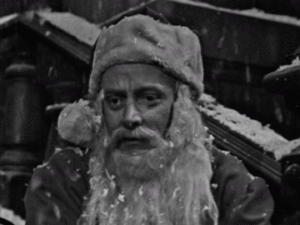
Introduction
Welcome to the Key of Imagination. This week we’re going to be looking at the Twilight Zone episode “The Night of the Meek.” We’ll see if we can come close to reconciling commercialization with gift-giving during the holidays; we’ll attempt to see if our Santa Clause from the fifth dimension can help us better understand substance abuse during the holidays; and I’ve got a special moment of awe, one that comes directly from the mouth of Rod Serling himself; So, grab your keys and let’s open up this door to the fifth dimension.
Plot Summary
Henry Corwin is a department store Santa with a big heart. And when he dons the suit of Jolly old St. Nick, he gets to pretend, even for just a few days, that he has the power to make the world a little better for those in most need, especially the children. But when he’s not finding the perfect toy at the bottom of his bag, he’s finding the imperfections of reality at the bottom of a bottle. For when he drinks, he is able to dull the part of his brain that reminds him that miracles aren’t real; the world is not fair; and the meek will only ever inherit the dearth. And when Mr. Corwin is let go of his position as Santa at the department store because of a combination of inebriation and a mother with a bratty child, Henry is left wandering alone on Christmas Eve, looking for his next chance to dull the pain–that is until a bag falls down at his feet, but not just any bag, a magical one, with goodies for all god’s children–young and old. A visit to the local missionary house provides him with the opportunity to help the less fortunate, and it gives the police an opportunity to track him down. Word of his gift-giving exploits have been spreading all over town. And so, down to the police station he goes where his former employer can collect the items that he obviously stole from the store. Well, It’s not quite water into wine, but Corwin’s ability to produce expensive brandy from his magical bag clears his good name. Having given out all the gifts that he could, he walks out into the world with his head held high, which is good because had he not he would have missed the sled, reindeer and elf who were waiting for him. You see, there’s one last gift to give on this night: Mr. Henry Corwin will be allowed the privilege of doing this wonderful work every Christmas Eve as the new Santa Claus.
Episode Details
“The Night of the Meek” is directed by Jack Smight. The teleplay is written by Rod Serling. As for our cast, let’s start with the great Art Carney, you know, Norton from “The Honeymooners," as Henry Corwin / Santa Claus. We’ve also got Val Avery as our bartender, Bruce; John Fiedler as Mr. Dundee; Robert P. Lieb as Officer Flaherty; Burt Mustin is Burt, and Meg Wyllie plays the good Sister Florence. The episode first aired on December 23rd, 1960.
Episode Tidbits
I’ve got a wonderful tidbit from Marc Scott Zicree’s Twilight Zone Companion. Zicree has a great quotation from Twilight Zone producer Buck Houghton. He writes, “Once in a while, Rod would have an enthusiasm…He’d say to himself or to me or to Carol or whomever, that he particularly liked somebody. There was a Christmas show that we did just because he wanted to see Art Carney play Santa Claus” (188). How about that? Could you imagine the pride that would come from someone saying, I created this project just because I, and in an existential sense, the world, needs to see you playing Santa Claus, what an honor. Another quick tidbit I want to mention is that in Grams Jr., he talks about Serling’s unproduced Christmas play from his days in radio, 1949-1951, titled “No Christmas This Year.” I was fortunate to be at Serlingfest last year when Tom Elliot of the Twilight Zone Podcast gave a wonderful presentation on this radio drama. If you have some time, head over to Tom’s podcast website to check it out.I’ll put a link in the episode transcript (link).
Question 1: Does this episode actually provide us with a way of reconciling the relationship between consumerism and gift-giving?
So, I actually started writing a couple of paragraphs that were humor-based for this question at first, talking about how I myself have partaken in the commercialization of Christmas when I tell my relatives to just go ahead and buy me giftcards to Amazon so I can purchase what I want when I need it. But, after watching the “Night of the Meek” episode a couple of times, and thinking about what Corwin was fighting with through his successive movements between drinking and weeping, I began to see layers to this problem that I hadn’t before. And this question suddenly became much more serious of a problem to me, one that I want to actually break down here quite methodically, so here is my attempt to do so, and maybe we can learn something useful together for this next holiday season.
Let’s start with one of the first and most serious questions that Corwin himself brings up, one that if we’re not careful can be, I think, easily dismissed because of both the nature of the question and the nature of Corwin, that nature being inebriated. Corwin asks the bartender, “why do you suppose there is no Santa Claus?” Now, let’s pause here for a moment and talk about Santa Claus. We’ll get to the good people of the Coca Cola corporation in a moment. But, we’ll actually begin with St. Nicholas of Myra, a Turkish Bishop who was eventually canonized in the Roman Catholic tradition and became the patron saint of quite a few categories of people, but two stick out for our story: the first being children. And the second being brewers. So, Corwin fits right in with our Turkish Bishop here. So, we have this real individual who, according to scholar Adam English, had inherited some money, and when he hears about a father with three daughters in town who are on the verge of complete destitution he anonymously tosses a bag of money through the window. Additionally, according to English, he does this a couple of times in order to help the daughters with their dowry, the payment that the woman’s family would have to provide to enter into marriage (59-60). And so, what is particularly interesting about this story is that the gifts are given to people he doesn’t really know, and they are given with an intention of solving a human problem. We’ll come back to this.
After Corwin is kicked out of the bar, the children start to surround him and make their wishes known. They begin by asking for things like dollies and forts, but then their cries change and they start asking for things like a job for daddy and a turkey for dinner. In many ways, we can read this episode as being about the thin lines that often separate our shifts of reality and how we position ourselves as perceiving beings within these realities. That was some graduate school level gobbledy gook, so let me clean that up a bit.
Think about Corwin’s drinking for a moment. He drinks to actively alter his perception of reality, to shift his position as a thinking, perceiving being somewhere else, a place where the meek can inherit the earth. But, and if this doesn’t break your heart, I don’t know what will, think back on the scene I just mentioned with the children. They are somewhat trapped as well in two different realities. In one sense, you have this big culture of consumerism, where the buying of a toy equates with the amount of love that someone has for you. Even if it’s just Santa, the toy is telling the children they are special to someone. This is where the problem of the commercialization really comes into play. So, let’s address that and then I promise I’ll pull this all together like a Christmas miracle. You just have to have faith in me a little longer.
When we think about the more famous image of Santa Claus, the jolly fat man with red cheeks, it doesn’t really start with Coca Cola, although they do play a role here. Now, this is essentially the American history of Santa; other cultures will have their own version of the story. We can begin with the 1823 poem “A Visit from St. Nicholas,” where Santa is described as having “rosy cheeks,” and a round belly, that “shook when he laughed like a bowl full of jelly” (link). Then we have Thomas Nast, a Bavarian immigrant who wanted to do his part to help the Union during the Civil War by including this jolly elf known as Santa giving gifts to Union army soldiers in the famous publication Harper’s Weekly in January 1862. Later, in 1888, Nast would pen a drawing of Santa in his most popular form as we know him today with white beard, red suit, and white fluffy trimmings. Now, this is a form of commercialization, but it isn’t quite on the same level as Coca Cola. So, what did they do? They standardized the image through commercialized association.
Why does that matter? The reason why it matters is because when we assign happiness to a product, particularly a mass-produced product, and make that product something you can buy, it can eventually become one of the primary means by which we achieve happiness. Let me tell you something. I love food, like many people. And you know what? For a 1.49 I can buy a cheeseburger at a fast-food restaurant, and when I’m eating that burger, I’m pretty darn happy. But, do I need the food? No. So, what am I really buying? Happiness…cheap…mass produced…and readily available happiness and for a 1.49 it’s an absolute bargain. And because most people are aware of the image of Santa Claus, if I want to buy something Christmassy for someone and I purchase that mass produced image of Jolly St. Nick, I’m also cheaply buying their happiness–and for a moment that might be enough, but it’s not solving a problem, and it’s not really addressing what is perhaps at the root of the unhappiness that we’re seemingly masking every day as a people. And so, when I’m finished with my burger, I’m right back to all the problems I had before I ate.
Now, my main point here is simply to show how mass consumerism impacts our psychology in fairly subtle–and sometimes not so subtle–ways. When we return back to the children at the beginning of the episode, we realize that these are prime examples of Maslow’s unfortunates, unable to have their basic needs met, and because they can’t have those basic needs met, they are constantly bounced back and forth between that yearning to be a part of the culture of toys and feeling special and the realization that they might not have a home or food. But, here’s the difference, they don’t have a readily available mechanism that gives them agency to manually shift their perspectives from intense despair to blunted apathy like Corwin does with his use of alcohol; they have but one choice: to weep.
Thanks, Joe. Are there any other holidays you would like to destroy for us? Okay, okay I didn’t say I was finished. And you should know me better to think that I wasn’t going to get us back to a place of hope. Have some faith. I’m about to pull a little Christmas miracle here.
The original question I proposed is whether or not there is something here for us to take away that can help us reconcile this issue of commercialization and gift-giving? Well, yes, but you have to look closely. There is this beautifully subtle moment that I never really noticed before until I watched this the second time through. At the 15:13 mark of the episode, when Corwin is handing out the presents to the men in the mission house–after Sister Florence storms out–Corwin looks at this man who is sitting. And you realize that if he could stand up in this moment of wonder with everyone else, he would, but he seems to either not be able to or it’s too difficult, and so Corwin hands him a cane. And you realize what Serling is doing here, in the middle of this Christian moment where the sister seems so cynical–and I don’t want to be too harsh on her–but, she clearly feels cynical toward this moment and can’t believe it. And yet, here is Rod Serling pointing out for Christians the Book of John, chapter 5, verse 8, the story of the man who could not walk, “And Jesus saith unto him, Rise, take up thy bed, and walk.” Now, in that case, you have a miracle of the divine, but Serling reminds us that, although we’re not providing absolution, there are miracles that we can provide for others that are just as loving and just as awe inspiring. For in his action did Corwin also not say, “Rise, take up thy cane, and walk”?
What this episode reminds us of is that there are myriad problems that reveal themselves to us in our home, in our communities, in our world, and it just might be that you happen to be the one who is there to provide a kind of miracle, a cane, a toy, a meal, or just some much-needed hope. Yes, this episode actually does help us reconcile this issue of commercialization and gift-giving by reminding us that we have powers of our own to do good. I’m going to leave you all with a challenge, and this is a challenge for me as well. And you can do this at Christmas, birthdays, hanukkah whenever you find yourself in a position to buy gifts. Let’s you and I look for one person, and all the better if it is NOT someone you know, but it certainly can be. Let’s see if we can buy one gift that solves a problem for someone, like St. Nicholas of Myra and like Henry Corwin of the Twilight Zone. Let’s make a miracle happen.
Question 2: What is this episode trying to say about the relationship between substance
abuse and the larger culture of humanity?
There are a couple of significant moments in the episode where substance abuse, Corwin, and humanity converge that I want to break down and discuss. But, first, I want to bring in Henry’s own words regarding the relationship we’re discussing here. He says, “I find of late I have very little choice in expressing emotions. I can either drink or I can weep. And drinking is so much more subtle.” Now, I’m going to first strengthen what he’s saying here with some research on the potential neuro chemicals that are involved in this particular conversation. According to Dr. Jeremy Day, a professor of neurobiology at the University of Alabama at Birmingham, “Our brains use a neurotransmitter called dopamine to help us learn about positive experiences, and as a result, dopamine plays key roles in motivation and goal-directed behaviors,” Day adds. “This neurochemical is also a major target of almost all drugs of abuse, which act on dopamine systems due to pharmacological actions of these drugs.” Now, here is a key point that I want us to really focus in on. “When dopamine is disrupted by stress or anxiety, the brain can become more likely to seek ways to relieve or escape these negative states. This can result in the use of substances like alcohol and drugs” (link).
What I want to pull out of this is, perhaps, a more nuanced or even empathetic way of thinking about this conversation. Day’s point is that the brain starts to actively seek ways to relieve itself of its pain. Now, here’s where we can bring Corwin back in and actually see that what he is saying is far worse than we may realize. On the surface, we can pull all of this information together and essentially reiterate what Corwin says, I can drink and thus relieve the pain or I can weep and situate myself inside of it. Now, underneath that second part of situating one’s self within that pain is the very real danger that this pit of despair can deepen and deepen. Thus, Corwin in his state of depression has essentially trapped himself inside what is very clearly a false dichotomy, but one that many people get trapped within–that there are only those two choices before him: drink or weep. And when people offer this false dichotomy to us as compassionate listeners, it can even trick us as well. In other words, by Corwin presenting this dichotomy to us, it automatically limits what help we can offer. But, there is help.
What’s fascinating to me is that the moment that Corwin receives the magic bag and sees that it has all of these gifts for everyone, the moment that he realizes that something outside of the realm of normality has occurred and that he has been given this unique moment of experiencing it, when there are billions of other humans on this planet, then…what happens? He no longer really appears drunk. Yes, when he’s in the mission house with the other men and the officer asks if he’s drunk, Corwin claps his heels and says, I’m drunk, but at this point in the episode he’s clearly acting 85-90% sober with all of his faculties intact, So, what has changed? As you all know, one of the primary characteristics of this channel is my belief in the power of awe, and there is good research out there, which I’ve talked about before to show that there are neurobiological effects on the brain when one is truly placed in a state of awe. Now, there is also a bit of Twilight Zone going on here as well, but the power of experiencing something outside of the normal patterns of existence or something truly awe-inspiring is that our brains essentially have to go through what researchers call an accommodation phase. It has to resituate itself within reality, and often that brings a new perspective of one’s self in relation to humanity. And that brief window of accommodation provides people struggling with substance abuse an opportunity to get help. For some, it’s experiencing a supernatural connection with the divine; for others, it could be a psychotropic event. Many people suffering with PTSD are finding relief through carefully monitored use of psilicybin mushrooms to provide access to that accommodation phase.
So, what is this trying to say about the relationship between substance abuse and the larger culture of humanity? In the case of Henry Corwin, this supernatural experience provides him with this window to begin to reprocess himself out of this false dichotomy that there are only two ways that he can live: drinking or weeping. But, we know that this is a lie. And if you feel that you are stuck in that position right now as well; forgive me, but I’m going to tell you it’s a lie as well. Get help–resituate yourself within this amazing experience known as life and within this wondrous existence that provides ample ways to help yourself and others. And if you’re waiting for a sign, for some miraculous moment when the universe is telling you that it’s time to heal, this is it. I’m talking to you out there, and you know it’s finally time.
Question 3: What are your moments of awe?
For my moment of awe, I’m going to read you a portion of a story that Rod Serling himself experienced and used to tell in various interviews and in print. It’s the story of his most memorable Christmas. The date is December 24th, 1944, the place is the Philippines, and Serling and the rest of his 511 Paratrooper Infantry are about to move out (21).
My Rating
As for my rating, no bah humbug for me…this is in the top tier, but I will say that the taping of the episode and the limitations of staging that this particular medium brings does drop it down into the Top Lower-tier for me. So, this is NOT the taped episode that I believe actually benefits a bit from the cheaper format. That being said, it’s a staple in my house around Christmas and a wonderful reminder of the magic that we can bring to ourselves and others around this time of year.
Next Episode
Next time, we’ll be taking a look at “Dust” and here are your questions to consider when watching the episode:
Question 1: How does this episode approach the topic of vengeance vs. justice, and what do we take away from it?
Question 2: How is the landscape shaping the characters, and where does its culpability
end?
Question 3: What are your moments of awe?
Announcements and Shout-outs
As per usual, I’ve got a couple of comments to highlight from the YouTube channel.
Anthony over at the FeverDreamLandTheater channel, which, by the way, if you have not yet checked out his work on the Twilight Zone, Night Gallery, and other tales of horror, you need to go check it out, Anthony comments on my “Trouble with Templeton” episode, “Being present in the moment is something many of us struggle with, especially when viewing old photos and seeing faces who sadly may no longer be with us, as you mentioned. I know I've been there. I also really liked this one and I agree - that moment when the speakeasy goes dark is powerful. This episode felt like a Serling story to me, maybe because it covers similar ground as Walking Distance”
As always, thanks, Anthony. Yeah, that was a genuinely odd feeling writing for that episode, and I meant it when I said that I actually experienced a kind of “Trouble with Templeton” moment. And good call on the connection between Serling and “Walking Distance.” Both episodes also have Twilight Zone experiences that can be somewhat experienced in our reality as well when we come back home to a place we used to live in or visit as kids.
On that same episode, @roycrowley2674 comments, “I watched all your analyses of Twilight zone episodes. You hit the mark on this one( not that you don't do any other time). After re-watching this episode recently, it s become one of my favorites, maybe cause it hits a little too close to home.”
Appreciate the comment. One of the things that separate great works of art from ones that might simply be good is how our experience with great works tend to evolve with us. That is 100% the case with the original Twilight Zone. I’m seeing things in these episodes at 45 that I never saw or never cared about at 25, and I’m certainly hoping to see it in new ways at 65.
How to Support the Show
Now, this is normally where I talk about supporting the show, but this is going to change a bit. I’ve got a video that I hope I can release this coming week that will talk more about how our supporting the show will also support some charities that Rod Serling himself would be proud of. So, stay tuned for that. That being said, I still appreciate a good thumbs up, comment, sharing of the show with a friend, and all of the algorithmic gymnastics, that get this show in front of more people and expand our community of Twilight Zone fans. But, even if you hated every minute of this, I’m still going to thank you for spending some time with me. Until next time, remember, all doors are open to those who possess the key of imagination.
Works Cited
English, Adam C. The Saint Who Would Be Santa Claus: The True Life and Trials of Nicholas of
Myra. Baylor University Press, 2012.