
The Twilight Zone Season 2: Episode 49
"Back There" Episode Transcript
Introduction
Welcome to the Key of Imagination. This week we’re going to be looking at the Twilight Zone episode “Back There.” We’ll try and figure out how this theory of time travel actually works; we’ll talk about whether or not a time traveler can actually return the same as when they left in terms of their psychology; and I’ll reveal my moment of awe, a look into the journal of John Wilkes Booth himself. So, grab your keys and let’s open up this door to the fifth dimension.
Plot Summary
Peter Corrigan sits at a table to play cards with a few friends at a country club in Washington D.C.. The topic of conversation? If a person goes back in time, can they alter the future? On one side, we have Millard’s argument: that with the knowledge of history, a person can absolutely alter an event in a meaningful way and thus change the trajectory of history. On the other side, we have our man Corrigan. His argument is that history consists of fixed points in time and thus are immovable. After a bit of back and forth between the two, Corrigan decides to bow out for the night, but not before William, one of the employees, of this fancy club, spills a drink on Corrigan. A little wetter than he was, but no worse off, Corrigan steps out of the building. And then, something odd happens. HIs mind gets a bit fuzzy, and the environment around him changes before his very eyes. What was once an electric lamp is now a candle. He heads home, undoubtedly hoping that a good night’s sleep will shake these visions loose, but finds someone else living there. And when a young couple comes down the stairs dressed in garments from the 19th century, mentioning that they are about to go to a play that will be attended by President Lincoln, Corrigan realizes what’s actually going on and does everything he can to warn people about the assassination looming. But his ravings only land him in a holding cell, until a kind gentleman offers to take custody of him and help him find his rightful state of mind. But, this fine gentleman turns out to be none other than John Wilkes Booth, and he is not going to let Corrigan stand in the way of what he believes is his date with destiny, so he poisons Corrigan and locks him away in his hotel room. By the time a local police officer, the only person who believes Corrigan’s story, comes to the rescue, it’s too late. The deed is done. It’s now back in the present day 1961, and there is a new face in the group of distinguished club members: William, the employee who previously spilled the drink on Corrigan–or rather never spilled the drink. It turns out he was related to that young police officer who believed Corrigan back in 1865, and it catapulted the family into high society. So, can you change the future by going into the past? Corrigan learns that some things can change, but others stay the same.
Episode Details
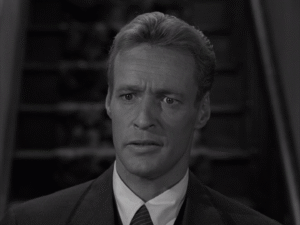
“Back There” is directed by David Orrick McDearmon. The teleplay is by Rod Serling. As for our cast, we’ve got our leading man Peter Corrigan played by none other than Russell Johnson, better known as the inventor of the coconut battery recharger, as in the Professor, from Gilligan’s Island; John Lasell is our dastardly John Wilkes Booth; Raymond Bailey plays Millard; Bartlett Robinson is William, the butler; and the lieutenant officer who believes Corrigan is played by James Lydon. The episode first aired on January 13, 1961.
Episode Tidbits
As for our tidbits, I do have one that offers us an interesting question at the end. In Martin Grams Jr’s Unlocking the Door, he notes that Serling initially wanted this episode to be an hour long. But, the sponsors were “not willing to expand their half-hour slot” (356). So, my question for you out there, if you want to answer in the comments, would the extra time have helped this episode or not? In some ways, I think it probably could have helped go into more depth of the premise. There are definitely parts of this that seem rushed, but in a weird way, I’m not sure that it would have necessarily made it better, if that makes sense. Yeah, I’ll just let that one sit there for the time being.
Question 1:What exactly is the time travel theory here?
Certain oddities emerged in my mind as I watched this episode the second time through, questions about what exactly is the time travel theory being espoused here and how is it actually playing out in practice. Here’s what I don’t want to happen; I don’t want this to just be a critique of the episode. That’s too easy and it’s not really what I like to do. So, rather, I would like to try and take some of these time travel oddities in good faith and really attempt to see what they produce if we take them seriously–well, as seriously as someone who still finds it amazing that bread goes into a toaster as one thing and emerges as something totally different: the 21st century, am I right?. So, let’s get into it.
The first thing we notice is that Corrigan gets a kind of headache when he steps outside. This is accompanied by a lack of focus on the screen. What does that mean? It means that his brain has undergone something, some kind of physical change with an accompanying feeling of disorientation. This emphasis will be important in a moment, so let’s keep that in the back of our disoriented minds.
What is more interesting to me is the change in his clothes. This is actually, in my opinion, the most interesting aspect of his entire time travel. Why? Think about it. He came outside in a 1960s suit; that’s what he was wearing. When the shift happens in time, his 1960s suit becomes an 1860s suit. Why did his clothes change?
Corrigan might have given us a bit of a clue in his initial conversation at the club. When the other gentleman says to him, “using this prior knowledge, there’s a hundred things you can do to protect yourself,” Corrigan counters with, “But, I’d be an anachronism; I really don’t belong back there.” You can make the argument that his clothes changed because they didn’t exist in 1865, as in the conceptualization of the modern suit; they don’t belong back there. But, neither did Corrigan. Are you starting to see why I think this is an interesting thread for us to pull on…ah…ah…thread…get it. We’re just havin’ some fun here.
So my initial argument here is that time travel appears to be about proper object conceptualization within history. In other words, you couldn’t go back to 1865 with an iphone because iphones didn’t exist in 1865 as a concept; you can make a longer argument for the existence of the cobalt, copper, and other raw materials, but there are no conceptual blueprints for one to be able for history to pull it together. That would mean that there might be parts of Corrigan’s suit that were not able to be conceptualized in 1865. In fact, according to Victoria & Alberts Museum, which is, I believe a conglomerate site of multiple museums of creativity, “The 1960s fell in love with new, man-made materials, with young designers keen to find new angles on established forms. They exploited the potential of modern plastics and synthetic fibres – Perspex, PVC, polyester, acrylic, nylon, rayon, Spandex, etc. – to create easy-care outfits that were eye-catching and fun” (link). Now, if there were a part of Corrigan’s suit that contained even ONE of these newer materials, it would in essence destroy the entire concept, which is why it does not carry over with him to the past. Meanwhile, there were of course humans conceptually in the past, so he was able to stay largely intact. Largely. Remember I said to hold on to that headache that Corrigan has? Let’s talk about that.
What if the headache is because Corrigan’s brain is attempting to conceptualize itself within the past. There’s another odd moment that happens. Corrigan starts to mumble about going home, so he goes to his old apartment, and rather than make a fuss about how it’s completely different, or even that there are other people living there, he just sort of starts to walk upstairs, as if that’s the right thing to do. His brain is trying to conceptualize who he is within this structure of time, and at this point, he is simply Corrigan the man who occupies this space at this time. But, he can’t quite shake off who he really is in the future, which is what causes all of the trouble.
Okay, okay, we’re getting somewhere now. What about the John Wilkes Booth hanky? Great question, me. [Yes, sometimes we need to be our own greatest cheerleaders.] Can you all already see why it makes sense that he can bring that with him to the future? Right! Because conceptually all of the parts of it exist and can be reassembled in 1961.
That just leaves us with William. All of the parts of William are perfectly available in 1960 to be reconceptualized as this new millionaire, so there is no real problem with his new position, either. So, what exactly is this time travel theory? It seems to me to be about whether or not the concept of an object can be re-established into its whole in different points of history. That would mean that traveling into the past is greatly different than traveling into the future. It means that moving into the future seems easier to do in this world than traveling into the past.
Question 2: Do you think if we travelled back in time we could ever actually return
psychologically the same as when we left?
Toward the end of the episode, after Corrigan returns from his trip through time, when he’s trying to explain that some things can be changed in the past and some things cannot, he places his hand on his head to indicate that he is still experiencing a kind of disorienting effect from his journey. But, it seems to be more than just a physical problem. We also get a sense that he is struggling to process what to do with the information. We can hear it in his tone of voice even. In fact, this episode leaves us in quite an interesting predicament psychologically. Let’s break this down a bit, and I think you’ll see why it might not be as straightforward as it seems on the surface.
Let’s back track for just a moment. We should recall that the initial premise of the episode is that two men are arguing over whether or not a time traveller going to the past can change the past and thus alter the future. This is a fairly common binary approach to the conversation. We’ve got films like Back to the Future and even the more recent Marvel cinematic universe film Endgame that talk about this topic to different ends. In fact, I don’t think there are that many examples of movies and television shows that take the stance that this Twilight Zone episode does. You can give me examples in the comments if you can think of any, the stance being: some things in time can be altered, but other things cannot.
Joe, if you start talking multiverse gobbeldy gook, I swear, I will go back in time and not click on this video. Okay, okay…no gobbeldy gook. We’re going to play this one rhetorically straight. Besides, maybe you were always meant to click on this video; and you can’t stop yourself from clicking it. Muhahaha. Okay, enough of evil time Joe. Here’s what I think is so interesting about this stance on time travel. We tend to find comfort in our binaries. Either we can do something or we can’t. It makes organizing our lives and energy a lot easier. Let’s say Corrigan was wrong at the beginning. And the answer is you CAN change anything from the past. There’s actually a mixture of some comfort and danger there. You can simply DECIDE whether or not you wish to do so. Now, the other side: let’s say Corrigan was right. You can’t change the past. There’s comfort there as well because you now know that there is no point in wasting your physical, psychological, or emotional energy on the idea. You can move forward with your life.
Now, consider the actual stance of the episode. You can change some things but not others. Think about what that actually entails. You would have to spend a lot of energy trying to change things, only to find out that maybe the one thing, the one item that you truly wish you could change–cannot be altered. But, you can alter something that is parallel to it. That’s what happens in the episode. The police officer who tries to help Corrigan has his parallel future altered by Corrigan, and that timeline continues to branch throughout history with no real sense of where it is going to end or what it will change. All because you attempted to change the one thing that you wanted to change the most. That is exceptionally frustrating, and you would have to live with that knowledge that, for whatever cosmic reason, you have been denied this request, denied the ability to change what you most wish to alter. And that leads to a great psychological problem: the whys.
Why can’t I change this? Why can I change that? What is governing the choices behind what can and cannot be altered? Am I being singled out or punished? The questions would go on forever. And what will eventually rise out of the questions? Most likely, there would be at least a couple of years where you feel like if you can’t change what you want to change then I will change what I can in order to spite whatever cosmic order is denying me what I want to do. In other words, you will attempt to burn the whole thing down.
Hmm…okay, we should probably never allow Joe access to a time machine.
Relax, that would just be a phase. I think eventually the person would settle into a complete release of all time travel and a realization that time travel and attempting to change the past is likely not worth it, even for things that we care about the most. I know that sounds crazy, but hear me out. There’s a fascinating DC superhero villain named Vandal Savage. There are variations on his origin stories and whatnot; however, the base of his story is that he’s an immortal figure who has lived for so many years that he has acquired great knowledge and skills. In one particular storyline that I love, he is successfully able to essentially destroy all aspects of society, meaning that it’s just him. Now, Superman is able to cross time due to plot, but when Superman sees Savage in this future desolate world, Savage tells him, “you have to go back in time and stop me.” It takes Savage the destruction of society to finally figure out that there is nothing beyond that victory, that there is only loneliness and the realization that his victory is ultimately his greatest defeat. I think there is something to this idea for us, and I do believe that our minds would eventually realize that trying to comb through what can and cannot be changed would eventually leave us realizing that time and life must be left alone; it must be able to flow as it sees fit.
Question 3: What are your moments of awe?
My moment of awe comes out of a thought that I have sometimes about time travel–and this is a dark one, so buckle up. In the episode, you have the example of John Wilkes Booth, the actor and man who assassinated President Lincoln. You know, I used a famous quotation from Booth for the opening of my dissertation: let me read it to you here:
God try and forgive me and bless my mother….I do not repent the blow I struck. I may before God but not to man. I think I have done well, though I am abandoned, with the curse of Cain upon me. When if the world knew my heart, that one blow would have made me great, though I did desire no greatness. (qtd. in Rhodehamel and Taper 155)
This comes from Booth’s own diary, dated April 21st, 1865, just a week after he killed President Lincoln. When we write about time travel, we tend to do so much like our Twilight Zone episode. We frame it as heroic acts of stopping someone from doing something horrific. But, what we often do not seem to either do or wish to write about is going back in time a bit earlier to try and figure out what is going on with them. You think about the language of Booth here: I may repent before God but not to man; if the world knew my heart, they would think me great. Now, he says that he does not desire greatness, and I actually believe him. That being said, embedded within these words is a yearning for something grand, something that I believe troubles a lot of people today: the simultaneous yearning for meaningful engagement mixed with an inability to express authenticity. We go on platforms like YouTube, Tik Tok, Facebook, Instagram…whatever. And we scream into the void of people, hoping for someone to say back to us…I hear you, friend. And I can see why this is important to you. There’s a part of me that wonders, if we could go back in time, rather than creating some action-packed, drama-filled story of stopping Booth at the last second, if we could, instead, talk to him on a random Sunday, offer him a cup of coffee, and just let him get his thoughts out of his brain, would that be a lot easier? Can we put a hand on someone’s shoulder today and say, hey, I hear you. It wouldn’t make for nearly as exciting of a film, tv episode, or Tik-Tok, but then again, and I’m showing my bias here, sometimes, I very much prefer a boring Sunday where virtually nothing exciting happens. In fact, and I think my American colleagues will agree, I think we could all use a few boring Sundays these days.
My Rating
As for my rating, I’m going to give this a Middle Lower-tier. Again, one of my main criteria for a Twilight Zone episode staying out of the lower tier is whether or not it at least successfully fulfills its own premise, and I do think that this episode does that. Do I love it? No. I think having read the fact that Serling wanted this to be an hour does help explain why at times it feels a bit compressed and a little jumpy. But, the premise itself is interesting and the acting is overall okay. Plus, it’s another example of an episode that I actually enjoy more now after having written about it a bit.
Next Episode
Next time, we’ll be taking a look at “The Whole Truth” and here are your questions to consider when watching the episode:
Question 1: Is there a particular slant to the kind of truth that must be told when it comes to the car?
Question 2: What is Serling’s overall point here with this episode?
Question 3: What are your moments of awe?
Announcements and Shout-outs
Quick announcement this week. Serlingfest was great as usual. I got to see an interview with Serling that I had never seen before, which is always fun. He talked about a fairly common topic for him: censorship and the role of the writer, but what was different about it is that he also discussed whether or not the culture of Hollywood had/has an effect on him and/or other writers, on their approach to writing. It was a nice little Twilight Zone moment, considering that one of my questions for the “Dust” episode, which came out while I was at Serlingfest, had to do with how environments impact us. Go figure.
I’d like to give a special shout out to Rob A. Gabor; it’s always a pleasure to see you at Serlingfest and catch up; and a shoutout to a wonderful couple I met who also happen to listen to the show: Jamillah and Josua. Their positive energy and enthusiasm for Serling’s work was wonderful, and I look forward to seeing you both again next year if we are all able to do so. And I would of course love to meet more of you out there as well, should you find yourself with the chance to go.
I’ve got one comment that I would like to highlight from my “Dust” episode.
@anonymouslypostedcomment
Is this guy an AI? He sounds like an AI... everything about him seems like AI.” Anonymouslypostedcomment, how could you think such a thing? Me, AI? What, like I’m some ChatJoePT. ChatJoePT…yes…I shall build it. And it shall be the most useless AI man has ever created. If you ask me more than three questions, I’ll just start ignoring you or saying, look, I obviously can’t help you, so like…go get a pizza and chill out or something. I’ll be the only AI that consumes less energy the more you use me because I just become exponentially lazier with my responses…just a gutteral mess after 15 minutes.
How to Support the Show
If you enjoyed the show and want to support our mission, get some extra content, which I’m starting to roll out this coming week, and give money to not one but two great charities all in one, consider joining one of our membership tiers on YouTube or on Patreon. 50% of every dollar taken through this show, after the platform fees, is going to charity: 25% to the Rod Serling Memorial Foundation and 25% to the Gary Sinise Foundation. That means every gift, superchat, thank you, and membership will help us get closer to our goal of leaving a legacy of giving that Rod Serling himself would be proud of. And thanks to a couple of really generous donations and all of you out there, we’re about to hit our first donation mark. [Roll the list of supporters]. We’re preserving a way of life for future fans of Serling’s work, especially the Twilight Zone. To learn more about me, our mission, why we’re doing it, and how you can help, head to thekeyofiagination.com. Keep in mind, If you watch, like, thumbs up, subscribe, and share the show with a friend, all the algorithmic gymnastics, you’re also doing your part to support this mission and I’m grateful for it. And if you leave an interesting comment, I just might use it in the show. That being said, even if you hated every AI generated, I mean, non AI-generated minute of this, I’m still going to thank you for spending some time with me. Until next time, remember, all doors are open to those who possess the key of imagination.