
The Twilight Zone Season 2: Episode 52
"A Penny for your Thoughts" Episode Transcript
Introduction
This week, we’re taking a look at the Twilight Zone episode “A Penny for your thoughts.” We’ll attempt to figure out what it would be like to actually have this gift of telepathy; we’ll dive into the whether or not it was ethical for Hector to dump the water on Mr. Brand; and I’ll reveal my moment of awe, some thoughts on the value of simulating ideas and actions. So, grab your keys and let’s open up this door to the fifth dimension.
Plot Summary
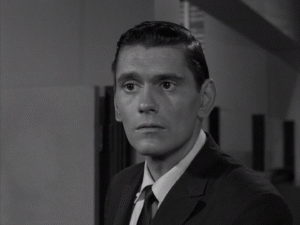
Hector B. Poole on a day just like any other casually flips a quarter into the cashbox of the local newspaper man so that he can he read all about the news of the day. However, on this day, Mr. Poole will get a lot more for his money. It just so happens that the quarter lands on its edge and remains standing, quite the statistical phenomenon. But, that’s not the most unbelievable thing that will happen to Hector today. He begins to hear voices; people clearly talking to him without moving their mouths. Late to work, he attempts to explain to his boss, Mr. Bagby, why he was tardy only to learn that his boss is seeing another woman. How does Hector know? He can hear Mr. Bagby’s thoughts. In fact, he can hear everyone’s thoughts, including Miss. Turner, Helen, a lovely woman who works at the bank with Hector. It isn’t long before Poole begins to see the upside of his new gift. He’s able to protect the bank from taking on a bad loan, although to his colleagues it looks like he lost a big account. But, there are also some drawbacks as well, including learning things about his colleagues that he wished he never knew about them. Of particular importance are the thoughts of Mr. Smithers, a man who has worked at the bank for quite a long time. Poole overhears Smithers planning to rob the bank, and he lets his boss know about it right away. But, when the security guard checks for the money on Mr. Smithers, there is nothing there, no incriminating evidence, no nothing. It’s true; Mr. Smithers had fantasized about robbing the bank, as he always does, but he never goes through with it. This accusation, mixed in with the loss of the big account earlier earns Hector a lovely pink slip. But, before he can leave, his boss rushes back to thank him for preventing the bank from taking on that bad loan from earlier. It seems Mr. Bagby was too hasty in firing Hector. Miss Turner, through telepathic thought, reminds Hector that he’s worth a lot more to the bank than they realize, which prompts Hector to engage in some negotiations: a new position and an all-expensed paid vacation for Mr. Smithers. All it takes to convince Mr. Bagby is a little reminder about Felicia, the woman who is waiting for him–the one who is not his wife. As Poole and Helen leave for the day and walk back together, Hector throws another quarter into the newspaper man’s cashbox to read the evening news, knocking over his original coin that was still standing from earlier. And suddenly, all is quiet in the head of Mr. Hector B. Poole. The only thoughts he hears are his own.
Episode Details
“A Penny for your Thoughts” is directed by James Sheldon. The teleplay is written by George Clayton Johnson. As for our cast, our leading man, Hector B. Poole, is played by Dick York. This is number two for Dick York; we also saw him in “The Purple Testament.” June Dayton plays Helen Turner. Dan Tobin is our bank manager, Mr. Bagby; Cyril Delevanti, as actor we’ll see again in a few of my favorite Twilight Zone episodes, plays Mr. Smithers. And James Nolan plays the scoundrel Mr. Brand. The episode first aired on February 3, 1961.
Episode Tidbits
As for our tidbits, there’s actually quite a bit in Martin Grams Jr.’s book about this episode, but I’m going to hyperfocus on one thing because I think it’s a good thing for us all to hear sometimes. Today, George Clayton Johnson is a legend, especially for his work on The Twilight Zone, but he had to begin somewhere as well. It turns out that Johnson had a friend by the name of Charles Beaumont, and Beaumont was exactly the kind of friend that we all need sometimes. He said to Johnson, “‘Put up or shut up’ [you] really ought to write something if [you’re] going to have so many ideas about what’s good or bad” (366). Now, this might sound nasty or mean to some of you, but I read it more as Beaumont trying to tell his friend to take the chance. Too many times in life we think, “I can’t do this, or no one will care anyway.” If you have something to say, something you want to contribute to the world, say it; do it. Even if only a couple of people hear it. It’s okay; sometimes the most important reason to do it is to get it out of you and let it live somewhere else.
Question 1: What would it be like to actually hear the thoughts of others?
I actually want to begin this question by jumping right into some academic research, specifically in the field of social theory and anthropology. What I’m about to read is a snippet from an interesting book that I remember reading a long time ago by Murray Leaf and Dwight Read titled Human Thought and Social Organization. In chapter four they talk about idea systems or ways that ideas and definitions interact with each other, and granted, what I’m about to read will probably sound a bit like gibberish until we contextualize it a bit more. But, as I tell my students, if you stay with me, I’ll get you to the end. I promise. Here is what Leaf and Read have to say about idea systems.
As idea systems, their most basic form is as sets of interrelated ideas. Clearly
defined ideas are created only through articulation with other ideas. A definition of one idea stipulates its formal linkage to other ideas. Definitions link up into systems of definitions. The process of using such systems to form the actual relationships we observe through behavior reaffirms the idea systems, reasserts them, and sanctions adherence to them. (93)
Okay, so, what does it mean? Well, actually, in some ways, what we’re doing right now as a community is an example of what they’re talking about in that block quotation. Let’s go from the abstract to the practical.
If I were to create an extreme closeup, point to the screen, and say, “there’s a man on the wing of the plane,” what is your immediate thought–I mean besides…Joe, you’re an idiot. After that. I bet you’re thinking…I get it; he’s talking about the Twilight Zone episode “Nightmare at 20,000 Feet, “ a classic! Perfect! Now, simulate this for a moment with me…pretend like you’ve either never seen that Twilight Zone episode or you’ve never even seen the Twilight Zone at all. What would me saying, “There’s a man on the wing of the plane” mean to you? Absolutely nothing. But, because we love the Twilight Zone and presumably a good Bill Shatner reference to the Twilight Zone, by me saying that line, I’m strengthening and reasserting its importance as an idea or shared communal reference. The more we use ideas, the more we strengthen them and codify them within our respective communities, and that scales all the way from our small families to towns, cities, states, countries, and even all of the world. Whoa! Now, I can read your minds out there: Joe, what does this have to do with our episode? Fair enough. Let’s connect this.
At the heart of this episode is a fascinating interplay between internal and external worlds, particularly how the internal structure of our minds does not always translate well to the external world. Let’s get an example from the episode on the board: Mr. Smithers and his dream of robbing the bank. I have to admit, I’ve always loved this storyline in the episode. I think without it, the premise is not nearly as strong. So, an immediate question that we might ask is why does Mr. Smithers have this recurring thought or fantasy of robbing the bank? In some ways, in comes back to what we talked about earlier: the establishment and strengthening of systems of ideas. He tells Pool that he often dreams of robbing the bank and going somewhere, “where I’m not a little man with no future and no past”
You see, in the external world, Smithers has no real agency, no power, no easy way to create an existence where he is someone who is dangerous, a man who takes what he wants when he wants it and should not be trifled with. Because in the external world, we as a society have decided to reinforce the idea that people who are dangerous and take what they want when they want it are actually not all that enjoyable to be around. But, in his mind, Smithers doesn’t have to worry about that. He controls the definitions of what dangerous and daring actually mean. A perfect example of this is when he tells Poole about the places he would like to go with the money if he ever went through with it. He says, “I don’t always plan on Bermuda, though; sometimes it’s Siam, Fiji, beautiful exotic places where there are no books to keep.” He keeps them to himself because he doesn’t want others to push back on his world, on his system of ideas.
So, what would it be like to have this gift? If you concentrate hard enough, you’ll find that you, too, likely have entire structures of ideas, opinions, and even definitions of various things that you keep to yourself because deep down you might realize that they won’t really make sense to others, but they are important structures for how YOU interact with the world around you, and so they are not trivial things. But, if others could hear these structures, these personal definitions, they likely wouldn’t understand because they lack your roadmap, your legend for how to interpret and translate your structures against those that have been codified by outside communities and the larger society. One of the things about this episode that made me laugh a bit as I watched it this time around is how clearly everyone thinks–beautifully full, flowing sentences–as if we’re surrounded by a bunch of Ellisons and Fitzgeralds out there. Please, let’s be human for a moment, can we together? There are times when I think something and then I have to double think for a second and go, what was the point of that thought? What was I trying to say? If all of you out there could actually hear my thoughts, well,...you would probably think…[pizza…mmm…good, meat, crust, extra cheese…yes!] . You’d probably think, that sounds about right for him.
Question 2: Is there an ethical responsibility to use or not use the information you learn through your gift of telepathy?
Let’s dive into an example from the episode for this question first and then we’ll work our way toward a better understanding of our ethical predicament. At one point in the episode, Hector thanks Helen for her kind thoughts, which is of course an odd thing to her because she never said anything to Hector directly out loud. Then, Mr. Brand, one of the employees from the bank walks over and interrupts them. He makes an odd and rather unprofessional comment, asking Poole if he’s “romancing the help.” He then adds, “well, who can blame you? Miss Turner is the prettiest girl in the accounts section.” Now, even adjusting for a different time period, I think this is an inappropriate conversation for the workplace that does nothing but puts both Helen and Hector in an awkward position. But, let’s grant Brand some good faith for a moment–just for a moment for the sake of our conversation. Let’s take his comment as a compliment with the intention of making Ms. Turner feel good about herself. Again, stay with me; it will make sense in a moment why we’re doing it this way.
Brand unleashes this compliment into the external world and he makes sure that both Helen and Hector clearly hear it. In doing so, he’s able to control the external perceptions of his character–he’s a good guy; he’s complimentary of others, etc. Hector, of course, can hear the simultaneous internal monologue that Brand is building within his mind, and it is in essence, not only unflattering of Helen but crude. Of course, Brand keeps those thoughts to himself; he recognizes that these thoughts are not appropriate for the external world, but not because they are stupid and unkind; rather, it’s because they would dent the false face that he wears around the office. Additionally, it could lead to a kind of social ostricization–something we spoke a bit about in our first question, and he definitely doesn’t want that. So, we now have these two worlds of Mr. Brand: the external, polite, albeit still inappropriate version, and the internal version, who doesn’t seem to see Helen as anything other than just another physical representation of a woman. Here is where we enter into the realm of actual ethical philosophy. What is the appropriate use of information here if you’re Poole, when you consider that in all fairness, Brand never meant for those thoughts to come out to the external world. Are you starting to see the philosophical/ethical problem here, so how do we figure this out? Well, I’ve got just the philosopher for this moment.
Jeremy Bentham is an Enlightenment philosopher/great thinker from the 18th and early 19th century in England. Specifically, I want to use his opening thoughts from his work An Introduction to the Principles of Morals and Legislation, which was published in 1789. What is particularly groundbreaking about this work is that Bentham lays out the foundation for his philosophy of Utilitarianism. Today, many people talk about John Stuart Mills’ version of this, but Bentham was the inspiration for a lot of Mills’ ideas. The following comes from the previously mentioned work;
Nature has placed mankind under the governance of two sovereign
masters, pain and pleasure. It is for them alone to point out what we
ought to do, as well as to determine what we shall do. On the one hand
the standard of right and wrong, on the other the chain of causes and
effects, are fastened to their throne. They govern us in all we do, in all
we say, in all we think: every effort we can make to throw off our subjection, will serve but to demonstrate and confirm it. In words a man
may pretend to abjure their empire: but in reality he will remain subject
to it all the while. (link)
Okay, from this, I just want to point out two important points for us. What Bentham is trying to do is figure out where what we SHOULD do because of a sense of moral goodness meets what we SHALL or WILL do because we know that it will impact our very real senses of pain and pleasure in life. The last part as well is worth noting for our conversation: “a man may pretend to abjure their empire: but in reality he will remain subject to it all the while.” It’s a great line. In other words, a person can say whatever they want publicly to the world, but at the core, the decisions regarding what they do will still have to come back to this idea of what will cause pain and pleasure. Okay, hold that. Let me add one final part from Bentham’s work. This is where he pretty much defines his theory of utilitarianism:
By the principle of utility is meant that principle which approves or disapproves of every action whatsoever according to the tendency it appears to have to augment or diminish the happiness of the party whose interest is in question: or, what is the same thing in other words to promote or to oppose that happiness. (link)
All right, now we’re getting somewhere. If we want to think about the ethical framework here behind Poole’s decision to dump water on Brand, we have to figure out Bentham’s “party whose interest is in question” or what actually augments or diminishes the happiness of that party. So, who is the party in question? Is it Brand? Is it Poole? Is it Helen? Remember, we gave Brand some initial good faith for his remarks. He initiates the interaction through that compliment to Helen, but he involves Hector in that decision as well because he’s somewhat speaking on Poole’s behalf for engaging Helen in conversation. The party in question here is really both Helen and Hector. And we do get a sense of how much pleasure or pain it augments based on their reactions: Helen looks at Poole with a kind of eye roll, as if to say, I don’t take Brand’s comment in good faith, but I’ll simply give a quick smile to acknowledge the public attempt. Poole on the other hand, gives a rather cute kind of smile as if to acknowledge that he does think she’s pretty, but he didn’t want it to come out in this clumsy disingenuous way–causing him pain. And hearing the negative thoughts after the fact augments that pain, and so he dumps the water on Brand. But is it ethical use of the information? Yes! At least by Bentham standards, I think. Why?
It not only augments the pleasures of the party in question: Helen says, “good for you. He had it coming.” But, it also augments the happiness of Poole AND, perhaps, the rest of the office. Brand might think twice about behaving in such a disingenuous way. Now, as is the case with all philosophy and ethics, there are limitations and potential weaknesses involved in Bentham’s utilitarianism, some of which probably emerged even in just our little conversation here, but it does remain a fairly useful theory in difficult times when we’re confronted with potential ethical dilemmas. And it’s rather simple: which decision before me will create the most happiness. All things considered, it’s not a terrible way to go through life.
Question 3: What are your moments of awe?
My moment of awe has to do with thinking a little bit more deeply about Mr. Smithers. As I mentioned in question one, I’ve always loved this character, his honesty, his willingness to explain to Poole that he enjoys simulating this fantasy of robbing the bank and running off to Siam or Fiji. Simulating these kinds of things in our minds can be quite healthy for us. English mathematician and philosopher Alfred North Whitehead is often credited with the common phrase "The purpose of thinking is to let the ideas die instead of us dying," I have to admit; I do like this little phrase, even if Whitehead didn’t say it directly. For whatever reason, I’ve been using the phrase, “let’s simulate this” a lot with friends, colleagues, and even students. The idea being that we can play out a potential decision or idea and if it doesn’t work, we can simply walk away from it with little loss of actual human currency other than the time it takes to do the simulation. We sometimes get a bit lost in the idea that there is only the reality of the external world and the fake world that we create in our minds. However, it’s just not that simple. Have you ever referenced a bad memory in your mind and then actually felt badly in your body? That internal fake world has suddenly had a very real impact on the real one, hasn’t it? I think I like Smithers so much because there’s something about the sweet happiness within him when he talks to Poole about enjoying his fantasy of robbing the bank; it’s enough for him to keep that in his mind. He actually uses them to better his relationship with the external world. The hard part is knowing what should stay in the mind and what needs to be made external. When does the fantasy become unhealthy obsession and then in its last legs violent resentment. If I had the answer for you, I would reveal it. The best that I can do is say, when your simulations no longer make you a better version of yourself to the external world, it’s probably time, to figure out what it is that you actually desire, and it’s not usually an actual object–it’s usually a human concept: a feeling of being loved, respected, or heard–if you’re starting to feel a creeping resentment in your fantasies, it’s probably time to stop simulating life and to actually start living it.
My Rating
As for my rating, I’m going to give this one a Middle Middle-tier. I like the premise; I like the acting. The ending comes on a bit abruptly for me and leaves me with a bit of a this has to come to an end soon so let’s rap it up feeling, but I’m always entertained by it. And I would likely not leave the room to get a snack if it came on during the marathon, but I might, which is why it doesn’t quite creep into my upper tier.
Next Episode
Next time, we’ll be taking a look at “Twenty Two” and here are your questions to consider when watching the episode:
Question 1: Is this a story of horror or triumph?
Question 2: How are we supposed to read the doctor in this?
Question 3: What are your moments of awe?
Announcements and Shout-outs
I’ve got some comments from the YouTube channel I’d like to highlight.
The first one comes from @edwardbliss8931 on my “A Passage for Trumpet” episode. Edward writes, “On most Twilight Zone episodes, you can always recognize the actor that went on to make appearances on TV and movies, but I would've never guessed that the guy who played Gabe was also Kevin Uxbridge in that Star Trek Next Generation episode.” I love when you all out there find these connections. Keep them coming. I had not made this connection actually, but I have to admit, it’s been a while since I’ve seen The Next Generation. My wife and I just finished up her first watch of the original Star Trek series, so we might check that series out at some point, and I’ll make sure to look for this reference.
Friend of the show Anthony from over at FeverDreamLand theater, a fantastic channel by the way with great Twilight Zone reviews, Night Gallery Reviews and horror flicks, had the following to say about the “Whole Truth” episode:
“Fantastic review & analysis Joe. Your rating here is very fair. I think hearing you thoroughly break this one down is actually quite helpful because there's deeper aspects here that get a bit muddied along the way. And no that's not just due to it being shot on rather rough looking video. ha ha I feel like this one was maybe one more pass from being another great entry from Serling.” Anthony, I think you’re right. There is something about this episode, almost like an opportunity was missed that could have really been good. It might be because the script was modeled off the failed Mr. Bevis show, but I almost feel like Serling should have just pocketed this one and came back to it. There was some meat on this bone. I wonder if Serling felt that way himself after he saw the final product. As always, appreciate you stopping by.
How to Support the Show
If you enjoyed the show and want to support our mission, potentially get some extra content, and give money to not one but two great charities all in one? Consider joining our membership tier on YouTube or on Patreon. 50% of every dollar taken through this show, after the platform fees, is going to charity: 25% to the Rod Serling Memorial Foundation and 25% to the Gary Sinise Foundation. That means every gift, superchat, thank you, and membership will help us get closer to our goal of leaving a legacy of giving that Rod Serling himself would be proud of. [Roll the list of supporters]. Plus, we’re preserving a way of life for future fans of Serling’s work, especially the Twilight Zone. To learn more about me, our mission, why we’re doing it, and how you can help, head to thekeyofiagination.com. But, keep in mind, If you watch, like, comment, thumbs up, subscribe, and share the show with a friend, you’re also doing your part to support this mission and I’m grateful for it. That being said, even if you hated every minute of this, I’m still going to thank you for spending some time with me. Until next time, remember, all doors are open to those who possess the key of imagination.
Works Cited
Leaf, Murray J, and Dwight W Read. Human Thought and Social Organization : Anthropology on
a New Plane. 1st ed. Lanham, Md: Lexington Books, 2012. Print.