
The Twilight Zone Season 2: Episode 53
"Twenty Two" Episode Transcript
Introduction
This week, we’re taking a look at the Twilight Zone episode “Twenty-Two”. We’ll try and see if there is a triumphant tale lurking behind the horror; we’ll attempt to figure out what is going on with the doctor in this episode; and I’ll reveal my moment of awe, a look into the fantastic–and sometimes no to so fantastic–world of dreams So, grab your keys and let’s open up this door to the fifth dimension.
Plot Summary
Liz Powell sits in a hospital bed, clutching her stuffed animal in absolute fear. Why? She knows that she is about to relive the same nightmare that she has had for the previous 5 nights. It all starts when she wakes up, thirsty, reaching for a glass, knocking it over. Then, the sound of footsteps just outside the door. She follows them into an elevator and takes it down to the bottom floor, where she walks down another hallway to room 22, otherwise known as the morgue. A woman opens the doors, with a serious countenance on her face, stares at Liz and says, “room for one more, honey.” Every night, the same nightmare, even when Liz tries to break the sequence, it still ends the same way. Neither her agent Barney nor the doctor seem to be able to offer much help, although even the doctor is forced to admit that it seems oddly coincidental that Liz should know that room 22 in the basement is actually the morgue, considering she has never been there before. Time and a little rest seem to work their magic, and Liz is able to leave the hospital. At the airport, and waiting for her flight to Miami, she begins to experience odd events: the breaking of a glass lamp, the sounds of footsteps, the experience of walking down a long corridor, leading to her plane–it’s like her nightmare. And just as she is about to get on the plane, the stewardess emerges and tells her “room for one more, honey.” Liz screams and runs away, never getting on the plane. And it’s a good thing. As the plane begins its ascent into the air, it suddenly explodes. A horrible tragedy–for all involved. As for Liz, her life has been spared, but at what expense, we will never know.
Episode Details
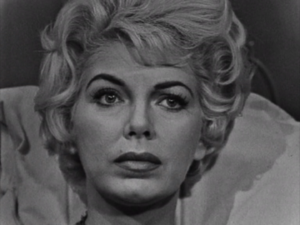
“Twenty-Two” is directed by Jack Smight. The teleplay is by Rod Serling but based on an anecdote from Bennett Cerf’s Famous Ghost Stories. As for our cast, let’s start with our leading lady, Barbara Nichols who plays Elizabeth “Liz” Powell. Just a quick early tidbit about her. I found out that she started as a showgirl, but when she was offered a fairly lucrative move to become a striptease, she actually turned it down because she wanted to be an actress. I bring this up because you might recall in our episode Liz is adamant about being referred to as a dancer, not a striptease (link). And Nichols has quite a few credits to her name, so good for her for betting on herself. The doctor is played by Jonathan Harris, whom you might recall as Dr. Smith from Lost in Space. We’ll see him again in another fantastic Twilight Zone episode as well soon enough. Fredd Wayne plays Liz’ agent, Barney; And our nightnurse of the morgue is played by Arline Sax, who later became known as Arline Martel. She had quite a good career as well. But, she’s familiar to us as the young woman who receives the cleaning liquid from the Twilight Zone episode “what you need”. And just to close this out, we’ve got this fun little tidbit: Barbara Nichols is from Queens and Arline Sax and Jonathan Harris from the Bronx–throw in Serling who was born in Syracuse but called Binghamton his home, and my NY brothers and sisters are certainly representing with this episode. So let’s give them a cheer, but not a bronx cheer. The episode first aired on February 10th, 1961.
Episode Tidbits
As for our main tidbit, this comes from Martin Grams Jr.’s Unlocking the Door. You’ll recall that I said in my episode details section that Serling did the teleplay based on an anecdote from a friend named Bennet Cert, but that’s only half of the story–literally. Serling also got the other half of the teleplay from Mrs. Peter D. Matthews of Needham, MA–a fan who wrote to Serling and gave him two newsclippings about a man, a construction worker, who told his friends goodbye because he said that he would be dead before Wednesday. Now, as you can probably guess, this came true. An unfortunate accident with a crane ended the poor man’s life–sometimes, the Twilight Zone hits a little too close to actual life. No joke here from me; it’s quite a sad story to think that this man was carrying this feeling for days with him and that it actually came true. That must have been quite difficult to his loved ones and the people with whom he confided this feeling.
Question 1: Is this a story of horror or triumph?
As is the case with many of my questions, this might seem like a really easy one to answer. It’s clearly a horror story, right? I mean the atmosphere, the tone, the screaming, the creepy characters, the fact that you have all of those people presumably on the plane at the end–how can this not be a horror story? It’s certainly at the very least tragic, but the reason why I wanted to explore this question a bit more intricately is because this is clearly Liz’ story; we as an audience are tied in to what happens to her from the opening scene to the very end–and in the end, she is saved from the tragic event, and her salvation comes down to two very important and extremely basic human concepts: a narrative and a decision. And when you break down how both of these concepts needed to function in order to secure her safety, it becomes a little easier to see this story in a potentially different light.
Let’s address the dark, shadowy elephant lurking in the corner of the room. There’s no way around the fact that from the opening, we do have this dark atmosphere. Our leading lady is clearly trapped in some kind of recurring nightmare. But, and here is one of our first questions, what is the goal of this dream? If we only think of nightmares as tools for horrifying us, then, yes, this seems like a pretty straightforward case. However, we know that it’s not that simple, and that this nightmare has a purpose–and you can certainly make the case that it’s a positive purpose for Liz, so I think one of our first approaches to answering this question is actually by asking another one: Is it possible that a nightmare can actually help us? The answer is yes.
As I was doing some research into the relationship between narrative structure and nightmares, I came across a concept that is quite fascinating: it’s called imagery rehearsal therapy. According to Rousseau et al, “Imagery rehearsal therapy (IRT) is a cognitive-behavior therapy (CBT) targeting recurring nightmares that combines rescripting a nightmare with visualising the new script every day” (749). In essence, you replay the scenario during the day and you rewrite the script of the nightmare in order to try and create a change in the events. Now, the doctor in the episode, someone we’ll talk a lot more about in question 2, offers the following advice to Liz regarding her recurring nightmare: “Tonight, when you’re dreaming, or as you say, when you’re waking up, don’t reach for the glass. See if breaking the routine of it won’t stop it from happening.” In essence, the doctor is asking her to rewrite the narrative, offering the idea that she can do something other than what the nightmare entails. It’s pretty close to an early form of image rehearsal therapy, especially if we grant the doctor some good faith here that he wants to empower Liz to overcome the script of the nightmare.
Now, a second part of this conversation that we have to bring in is that the doctor is also prompting Liz to work on achieving agency over her dream, what psychologists call mastery, which they define as “ the conviction patients have that they can control their dreams and nightmares; this feeling would be gained through concrete experiences of control, mainly through application of therapeutic techniques” (Rousseau et al 749). Techniques such as image rehearsal therapy. If we think about this a little bit further, the mere fact Liz is able to alter the dream somewhat adds a bit of complexity to our conversation. You’ll recall, the next time she has the dream, after speaking with the doctor, she gestures toward the glass, but she takes the cigarettes instead. Therefore, she has in a sense achieved a state of both lucid dreaming, where she knows she’s in a dream and has a clear sense of her cognition within this dreamscape and she has a kind of mastery as well, able to choose to take something other than the glass.
As we all know, the glass is eventually still knocked over, producing the loud crashing sound. Why this is so fascinating to me is because, we realize that it’s not about internal narrative consistency but the consistency of sensual perception: she has to hear the crash; she has to experience the sensation of walking toward a door; she has to be able to recall the sharp facial structure of this woman, and yes, I use sharp here not in any way as an aesthetical slight against the actress; rather to simply point out that there is a dimension to her facial make up that is quite unique, emphasized even more by the contrasty make-up that she’s wearing.
If I’m right about this, that the purpose of the dream is to simply establish a sensory roadmap, then it’s a fair question for us to ask why do it in the form of a nightmare? Could you have had a party where people celebrate and break glasses? A lovely wedding where a bride is walking down a long runway? Or a woman who is making your coffee in the morning with a smile on her face? Well, yes. Actually you could have, so why a nightmare? There needs to be a corresponding emotional reaction–and it has to be a reaction. That’s the difference. If the elements in the dream are too abstract, it invites interpretation, and if the person has to interpret what is going on, there is a chance for misinterpretation–and that means that Liz might end up getting on the plane. In order to avoid misinterpretation, you have to elicit a response, a triggered reaction that would compel her to want to get as far away from the impending event as possible, which is why you encase the sensory map within the genre of nightmare. And that is how a nightmare can specifically help in a way that a lovely dream might not be suited for.
So, Let’s get to our main question: is this a horror story or one of triumph? If you look at it from the perspective of the people who were on the plane, it’s a tragic horror story. If you isolate the images and the tone of Liz’s recurring nightmare, it is absolutely a horror story. But, if you think about what the intentions were for the dream, and you begin to break down why the sensory map had to be situated within a nightmare in order to create a response, and that the response ultimately worked; Liz does not get on the plane, if you take all of that into consideration, then I do think there is some room here to talk about this story as a triumphant one.
Question 2: How are we supposed to read the doctor in this?
The doctor is a genuinely odd character to me. I want to break this section down into three distinct parts: the introduction, the epiphany, and the salutation. Hopefully, by the end of this we can get a better sense of what is going on with this character.
When he first arrives on the scene, I’m not 100% sure how we’re supposed to read the acting here. He is a bit all over the place. He makes the comment about her looking beautiful, which I’m going to take that in good faith and say that he was trying to be nice to her–and I think that is probably the case. He then makes the comment about her making him want to be a young intern again. And then, he laughs–it’s a rather unique laugh in the sense that each sound is incredibly consistent and sharp, and not to go back to question 1, but her reaction to the laugh is to cover her ears–showing that she is rather sensitive to sound or sensory perception. He then laughs again after the agent, Barney, mentions how talented Liz is as a dancer. And she, again, comments on his laugh. Now, you can’t really go too negative on someone’s genuine laugh; it’s one of those things that somewhat comes out naturally the way that it does.
I actually just saw an interview with comedian, actor Eddie Murphy not long ago where he said that he trained himself out of his iconic laugh because I think he didn’t want that to be associated with him too much. It’s a shame, honestly. For those of us who grew up on Eddie Murphy movies, the laugh was like 50% of the fun. The real problem with the doctor’s introduction is that he is essentially both hyperfocosed on Liz and dismissive at the same time. When she says that there is nothing wrong with her, he actually fires back: “There most assuredly isn’t, Ms. Powell. That’s what we’ve been trying to tell you.” The main problem for me with this character is how quickly he moves between complete dismissiveness of Liz and frustration with her as if she’s a child. He says that there isn’t anything wrong with her, but then he prompts her to continually talk about the dream, so why? And his sudden change in demeanor when going over the dream makes him seem almost masochistic in his need to hear it again and again. This introduction plays a role in making our next section even a bit more odd.
A little more than halfway through the episode, the doctor is talking to a nurse and he suddenly realizes out loud that Liz specifically mentions going down the corridor, taking the elevator downstairs, and seeing the nurse go into the morgue, or room 22. The reason why that is so odd is because has never been to that part of the hospital; it’s off limits to patients. So, how is she able to know all of that? He then does this odd thing. He assertively walks over to the door, as if he’s about to leave the room, and he just slowly stops and reconsiders. I think we, as the audience, are probably supposed to assume that he was going to speak with Liz about that, but he doesn’t. Why? Why not try and find out how she knows this? I suppose we can, once again, grant him some good faith here in the sense that he might not want to feed the nightmare even more. You could argue that if Liz knows that she is correct here then the nightmare can take an even greater hold on her, and everything becomes even more real. But, does even my good-faith interpretation hold up? Well…maybe not, especially considering that he already busted the nightmare by bringing in the nurse who works on that floor–and it isn’t the nurse that she sees in her dream. So, he simply holds on to this information until the very end, which brings us to the goodbye scene.
The salutation part, where the doctor is congratulating Liz, is also a rather odd scene, similar to the introduction. I think this scene essentially reveals that the doctor might mean well, but he’s simply not very good at small talk and bedside manner. He’s kind for a second, wishing her well; then he starts to reassert his notion that it is all a dream and nothing more, getting almost angry as if Liz did something wrong, which doesn’t really help the situation. It seems like, given what he realized in his epiphany, that finding a place in the middle of all of this might have helped her more. He concludes with, again, a really weird comment. He could have just said in a rather soft tone, I’ll be ringside for your performance, and you can just give me a wink to let me know you see me. Instead, he does a creepy eyebrow raise. So, what the heck do we do with this?
KOI friends, I’m going to admit something to you. I’m a bit at a loss on this one. I suppose one way we can read the doctor is that he is a bit like the dream. There are parts of him that just keep repeating, but enough randomness that you can’t quite dismiss him when he’s in the room. His borderline anger with Liz reads a bit like an attempt to infantalize her, which she does a wonderful job of rejecting–reasserting herself throughout the episode and pushing back against him. The reason I bring up the infantilization part is because had Liz simply taken everything the doctor said and allowed herself to be reduced to an almost child-like state, I think it’s more likely that she gets on the plane, because she will hear his voice in the back of her mind saying, “it was just a dream, nothing more.” So, I suppose we can read the doctor as a kind of much-needed antagonistic voice that continually challenges Liz to believe herself, to resist being somewhat infantilized through her care, and giving her the agency to simply say, I’m not getting on that plane.
Question 3: What are your moments of awe?
My moment of awe has to do with the way that this episode blurs the boundaries between dream and reality. Is there such a place like this in our world? I think the answer is yes. Now, before you start sending me emails and messages to see if I’m all right, let me explain what I mean. I definitely subscribe to the idea that dreams, even nightmares, are our mind’s attempts to work through something that is plaguing our perception of ourselves in relation to the world around us. It could be something as simple as overwhelming feelings of guilt, hurt, or even our sense of control over our own lives. As a species, we certainly have a long, rich history of the notion of revelation–from one of our earliest texts of the Dream of the Rood and Gilgamesh, to Dante’s Divine Comedy, all the way to Twilight Zone episodes like “Perchance to Dream” and Twilight Zone alum Richard Matheson’s What Dreams May Come. There is something embedded within us as a species to believe that we are able to receive information in a different way through dreams. Now, I’m one of those lucky people who seemingly either never experience nightmares or I don’t remember them, but I will get the occasional dream. And I’ll sometimes sit there, if I can for a moment, and try to figure out what human concept is behind my dream–what am I struggling with. And sometimes, big surprise, I’ll write about it–not for an audience, just for me. And that sometimes helps. So, if you’re struggling with nightmares or recurring dreams that are really starting to get to you. I merely offer this one suggestion: write about them. Write out what is going on, and then try and write out what you think it’s trying to say. Then, maybe practice a little image rehearsal therapy and rewrite the ending. And if that doesn’t work, there is nothing wrong at all with seeking out some professionals. Sleep should be a peaceful thing; and you are every bit worthy of that peaceful state.
My Rating
As for my rating, I’m going to go middle upper-tier. There’s a lot to like about it. But, this is one of those rare cases where writing about it and really diving into what’s going on actually might have made the episode slide down just a hair in my book. Now, this is NOT the episode that I think is aided a bit by the video tape format–and I think we only have two left, so you have a 50/50 chance to get it right at this point. Actually, I think the taping hurts this one more than the others. It’s such a great concept, but the way it is shot, I think limits what it could have been. You think about the ways that “Perchance to Dream” was shot, or as we’ll see later on, “Shadow Play” and even “In Praise of Pip,” which is not strictly a dream episode, but it is dream like. I think had it been shot on normal film, this episode probably would have been top tier for me.
Next Episode
Next time, we’ll be taking a look at “The Odyssey of Flight 33” and here are your questions to consider when watching the episode:
Question 1: Does knowing a little bit of the technical aspects of flight help our enjoyment of this episode?
Question 2: Is there enough information available in this episode that we can actually develop a theory for how time travel functions?
Question 3: What are your moments of awe?
Announcements and Shout-outs
I’ve got a couple of quick comments from the YouTube channel. @shawnmalone9711 commented on my “The Four of us are Dying” episode: "This episode was on MeTV, November 29th, 2025." First, thanks for taking the time, shawn. The reason why I’m highlighting this comment is twofold: one, I want to show that I appreciate all of you who comment with your quick thoughts and call outs of actors from different series and whatnot. But, secondly, I do love when people also talk about these little Twilight Zone in real life moments: when a KOI episode you’re watching just happens to correspond with one that is randomly on tv or something. You don’t want to dismiss these moments so easily. The truth is these are the little fun things about life that should make us crack a quick smile–little pick-me-ups of life. Lean into them–and let me know when you come across them.
@bingerz237 had the following to say on my “Night of the Meek” episode. “My absolute favorite episode, more than Talky Tina or all the rest, even though I really don't care much for how it looks. It is one of the best teleplays plus one of the best performances (Art Carney) that makes this the quintessential episode for me. I watch it every year and still get choked up at all the right spots. Thanks for talking about it.” We’ve got Christmas coming up here pretty soon, so it’s funny to see that episode get a bit of a bump. And yes, I’m with you bingerz, there are just certain spots in that episode that get right at my heart. And it doesn’t have to be the sad scenes. Let your hearts be taken by the joyous parts as well. I love when he tears through the mission hall with all that energy and just starts giving out gifts, especially the gentleman who is having trouble standing. It’s wonderful.
I’ve got a new member of our Key KOI partner membership to thank: PhXDog, aka, BillDog. He joins Rob A Gabour and Bionicskater as part of our membership group. I am incredibly humbled by and grateful for your generosity. Thank you.
How to Support the Show
Want to support the channel? Consider subscribing, liking, commenting, and sharing the show with a friend–you know all of the usual algorithmic gymnastics, that will help us expand our awesome community of Twilight Zone fans. Plus, you never know, I might just highlight your comment in an episode of the show–as long as it's family friendly. And if you want to have your name immortalized forever on our KOI as a part of our list of key KOI supporters, consider joining one of our membership tiers on YouTube or Patreon. 50% of all money taken through this channel, after the platform fees, is going to charity. 25% to the Rod Serling Memorial Foundation, and 25% to the Gary Sinise foundation. Speaking of which, I’ve got an end-of-the year video planned for our first pair of donations. Yes, the first set of funds have been released, and I’m excited to send out our gifts, which in my mind, come from all of us as a community. For more information about me, my scholarship, and the show, head over to the keyofimagination.com. That being said, even if you hated every minute of this, I’m still going to thank you for spending some time with me. Until next time, remember, all doors are open to those who possess the key of imagination.
Works Cited
Rousseau, Andréanne, et al. "Self-efficacy as a Mechanism of Action of Imagery Rehearsal
Therapy's Effectiveness". The Journal of Nervous and Mental Disease, vol. 206, no. 10,
October 2018, pp. 749-756. doi: 10.1097/NMD.0000000000000862.