
The Twilight Zone Season 2: Episode 56
"Static" Episode Transcript
Introduction
Welcome to the Key of Imagination. This week, we’re taking a look at the Twilight Zone episode “Static”. We’ll try and figure out if there is really room for audio-only entertainment in an age of constant video; we’ll dive into the question of if there will ever be a nostalgic return to television; and I’ll reveal my moment of awe, a special look at one particular character in this episode who is close to my heart. So, grab your keys and let’s open up this door to the fifth dimension.
Plot Summary
Ed Lindsay sits in a boarding house, surrounded by a mixture of regret and a yearning for the days of yore. But, when Ed decides to start listening to his old radio again, something strange happens: all of the old shows from when he was a younger man–they're all playing–Major Bowes and Tommy Dorsey, just as clear as my voice right now. And suddenly, Ed’s bitterness about the present begins to fade away, replaced by the sounds of better times. But, whenever Ed tries to share this wonderful moment with others, the radio delivers nothing but static. Each time–the same result: only static whenever someone else is in the room. And so, some of the other residents begin to get worried, especially Vinnie, a woman who at one point would have been called the apple of Ed’s eye, now little more than the recipient of looks of scorn. At least the radio still works when it’s just Ed in the room, and so that is how it will have to be, until Ed returns one day to find that Vinnie and Professor Ackerman have given away his radio to the junk dealers out of concern for Ed’s quickly deteriorating psyche. However, this simply will not do. Ed is able to get his radio back. And when he’s able to turn it on again, he’s greeted by Tommy Dorsey’s “I’m Getting Sentimental Over You.” Suddenly, we hear energetic, lovely steps running into the room. Why , it’s Vinnie, young, pretty…and still in love with Ed. And how about our man, Ed. Strong, handsome–because of this magical radio, they seem to be getting another chance at a life together. Or, are they? I guess we’ll never really know.
Episode Details
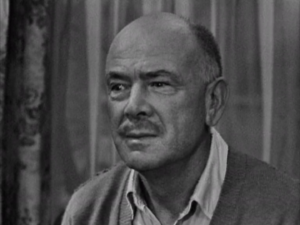
“Static” is directed by Buzz Kulik. The teleplay is by our good friend Charles Beaumont, based on an unpublished, original story by OCee Ritch. As for our cast, TEN-HUT! We’ve got a general on deck. Dean Jagger, probably known to a lot you out there as General Waverly from the movie White Christmas. He’s our main man Ed Lindsay. Vinnie is played by the lovely and talented Carmen Mathews; Professor Ackerman is played by Robert Emhardt; and you might have recognized the voice on the radio. That’s Bob Crane from Hogan’s Heroes. I’ll come back to why that’s interesting in a second. The episode first aired on March 10, 1961
Episode Tidbits
As for our tidbits, I’ve got one that I learned while I was at Serlingfest last year, and it connects with a name I just mentioned: Bob Crane from Hogan's Heroes. It turns out that Serling was NOT a fan of the show; he didn’t appreciate the concept of making light of the Nazis, and depicting them as bungling fools, instead of the heartless purveyors of much pain and suffering that they were. I’m sure we can understand why Serling had that opinion, given his status as a veteran of World War II. Just an interesting little Twilight Zone moment.
Question 1: In an age of easy video, is there still an argument to be made for the value of just listening as a form of entertainment?
Okay, okay! I know; I know. We’re living in the golden age of podcasting. This very show could just as easily be called a podcast, and there are definitely people who only listen to this show and don’t consume this handsome face you see before you. And podcasts are a lot like radio, so this is just another one of your silly questions, Joe, right? Well, maybe. I can certainly pose a silly question with the best of them. But, I do think where I’m going to take this question is not quite as silly as you might think.
Let’s jump into a scene from the episode to set our stage. The moment I want to focus on is when everyone is sitting at the dinner table and Ed starts to hum a tune: “I’m Getting Sentimental over you” by Tommy Dorsey. Now, Ed accuses Mr. Brag of being the modern man, and of having his brain turn into oatmeal while watching television. I grew up hearing this all the time: tv will rot your brain. But, why? We have eyes for seeing. Why not use them? Why is there always this connection between watching things and our brains rotting? Well, let’s talk about this for a minute from a very specific perspective and then we’ll use it to reenter our episode.
Okay, everyone out there. Close your eyes for just a minute. Now, try to visualize an apple in your mind. Great. What does it look like? Is it red, green, shiny, dull? Does it have a bite in it or is it pristine? Maybe you weren’t able to even do so. That’s a possibility. If you were able to visualize an apple, you just took part in the practice of mental imagery. Now, I had some fun looking into the peer reviewed research on mental imagery and actually found a fantastic book titled Mental Imagery: Philosophy, Psychiatry, Neuroscience by Bence Nanay. It’s a really interesting read, a bit dense at times, but good. In the book, Nanay defines mental imagery as “perceptual representation that is not directly triggered by sensory input” (4). Now, that definition comes with a lot of caveats in the book, but I’m going to simplify things a bit for time sake. Listen to the following sound and then see if an image emerges in your mind: (old creaky door). If you saw some kind of door closing…Nanay would actually count that as within the definition of mental imagery because an external image of a door did not directly produce the internal image
within your mind. Okay, that’s a simple example. Let’s get a little more difficult, and see if you can actually keep up with my instructions.
Picture that door again that you had in your mind. Now, make it yellow. Now, make it a dutch door with a top and a bottom that independently open. Open just the top part of the door. Now, make someone you know appear in the top half of the door and have them waive to you. Okay, you’re almost there. Stay with me. Now, turn that person into a cyborg with one single glowing red eye. Okay, were you able to actually do it? Tell me in the comments if you could do each step in your mind. Joe, I have to imagine that you’re going somewhere with this? And you would be right, my KOI friends. And you’ve used the key word. Let’s bring in an old friend of the show to talk about imagination.
The philosopher Kant in Anthropology says the following about imagination:
The power of imagination, as a faculty of intuition without the
presence of the object, is either productive, that is, a faculty of the original presentation of the object, which thus precedes experience; or reproductive, a faculty of the derivative presentation of the object, which brings back to mind an empirical intuition that it had previously (An 7:167).
To sum it up, Kant sees two forms of imagination, one in which you can create an object without the need of the actual object to have existed: a monster with green eyes and four tails that you produce. And one form of imagination where you reproduce something from an actual experience, like the person you made appear in my dutch door example. Both forms of imagination are incredibly powerful because they allow us to create both within the laws of our world or outside of them. You can imagine a human being who is limited by gravity, or you can give them the power to fly all over the world. In the case of the cyborg version of your person from my earlier example, we’ve somewhat combined the two. And this is where we reengage our episode.
Ed is able to essentially combine the two as well through the radio. He hears Tommy Dorsey on the radio and that sound is able to trigger images from his very real experiences in the past with Vinnie. But, the part of his mental imagery that allows him to create outside of the laws of existence is what allows him to also manifest new experiences, through a past aesthetical framework, into the present and even the future. He even says to the Professor and Vinnie, as he’s pointing to the television in the living room, “When I started listening to radio again, I kept wondering, what happened to the picture tube? And then I remembered, the picture tube is right here.” He then says something really fascinating and easy to miss. He adds, “radio, boy I tell you radio, is a world that has to be believed to be seen.” Now, did you catch that sudden flip of our usual phrase? Normally, we say something has to be seen to be believed. For Ed, radio has to be believed to be seen. Let’s pull all of this together and answer our question.
Is there room for audio-only entertainment today? The answer is of course. But, this episode does showcase something quite interesting that we can probably learn in our current golden age of podcasting. The power of the medium lies in the fact that we have to do some additional work to maximize our entertainment with audio-only media. We generate potential images in our mind that help us create a connection with the words, and thus we do also manifest a different level of connectivity. The Twilight Zone radio drama episodes are a good example of this. They can sometimes create whole new ways of thinking about episodes simply because of the way the voice actors deliver a particular line. But, and here is the potential downside. Because we create the images that go along with the audio; we also develop a kind of ownership over the narrative, and that can create issues sometimes when the narrative breaks down. Ed lives in the world of the images that he creates when listening to the radio. They are divorced from reality, but it is the reality that he wants to live in, which is why little by little he withdraws from not simply the world but from the intake of additional pieces of information, of varying opinions, and finally of other people. In this episode, we get a glimpse of a kind of cognitive dissonance, a running away from information that can potentially disrupt the story that Ed wishes to live in. Television, the visual element of it, would be too restrictive for Ed. It would break his ability to continue to manifest the scenes he wishes to see. And that, I do believe, is something that we struggle with today in the golden age of podcasting; we don’t always realize that our senses, when taken on simply an individual account, can produce wildly different narrative experiences within our mind. And narrative cohesion, maintaining a story that we believe is essential for maximizing a meaningful existence, is incredibly strong within us–it’s practically a survival mechanism. And so, we need to be careful when listening to narratives that we are not ignoring other pieces of information that can come from our other senses.
Question 2: Do you think it’s possible that we will experience a nostalgic return for
television--I mean in the non-recordable, in-the-moment sense of it?
Gather round, friends. It’s time for another story from Uncle Joey. I’m old enough to remember when the majority of people still did NOT have easy access to recording devices in their homes for television shows. Yes, it wasn’t long until we had VHS tapes that we could use to record broadcasts, and then Tivo came out of nowhere. Remember TIvo? I bring this up because I absolutely do remember the experience of seeing something in real time, and then it was pretty much gone, unless you were able to catch it on a rerun at some point or later on find it in a video rental store. In fact, I vividly remember watching a Dinosaur documentary as a little kid that was hosted by none other than Christopher Reeve, as in Superman himself. It had claymation dinosaurs that were incredible. I was absolutely in heaven. But, I only got to see it that one time, which made it a bonafide special experience that is logged in my memories forever.
Today, I can view just about anything I want, whenever I want–including that awesome dinosaur documentary. Yes, If you search Christopher Reeve Dinosaur on YouTube. You’ll get it, but wait…don’t click off just yet. Oh, man. I have to stop excitedly sending people away. All right, you can all go check it out. Just promise you’ll watch the T-Rex scenes and then come back here and let me know you’ve seen it–oh, and leave me a thumbs up. Algorithmic gymnastics and all that.
Now, the upside today is that we could theoretically decide to all watch the last season of Stranger Things or a particularly good performance by a musician at the Grammys on our own time and then plan a discussion together. This show somewhat relies on the ability to watch the episodes when you can and then use my show as just another way of thinking about those episodes. But, does it carry that little bit of specialness in terms of an experienced event? I don’t know. That sent me to the peer review files once again, where I learned a bit more about FOMO: And no, that’s not a Pokemon. It’s an acronym for fear of missing out. Now, here is where things get interesting. I was able to find a peer-reviewed study that specifically looked at streaming habits in relation to FOMO, and here is one part of their discovery: “One could then conclude that FoMO would be lessened in regard to serialized dramas, reality shows, and situation comedies, as there has never been a wider range of TV consumption possibilities. However, evidence suggests that the inverse may be occurring, as FoMO may be prompting people to consume TV at a rapid pace to stay part of a culturally relevant conversation” (154). What does this mean? Because we have access to so many more shows, movies, everything, the size of our cultural boundaries has grown so large that it is almost impossible to truly be completely in the know. And so, if you have a tendency to fear you are missing out on something culturally relevant, you will sit your butt down and watch every piece of culturally relevant shows, movies, and Tiky-Toks that these platforms are willing to feed you. And so, as many of you probably intuited on your own, streaming has in some sense devalued or at least disrupted the notion of the collective cultural artifact that was once created by television schedules because of the sheer number of items available. Now, there is one last really cool point in the study. But, before we talk about it, I want to come back to our Twilight Zone episode to help us contextualize it better.
There’s no way around the following: Ed is the happiest version of himself when he listens to his radio, allowing it to take him away to the past. But, there’s more to it than just that. The last scene when Vinnie comes into Ed’s room with this glowing face of joy, it’s odd; it’s dreamlike; it’s seemingly detached from reality. And Ed’s face is really interesting as well if you look at it. It’s almost sorrowful, a kind of resigned joy; I don’t know if that’s the right word, but I think you know what I mean. There’s something somewhat sad in it, and yet, he is happy. What has happened here? Ed is able to use the radio to create a cultural bubble, one that doesn’t really care what you or I or anyone else thinks is culturally relevant. When Vinnie and the professor give away his radio to the junk dealer, Ed says to Vinnie, “I might have known…take away the one thing.” And then he cuts himself off. I’m sure we all had a similar thought here: he was going to say, the one thing that makes me happy, the one thing that allows me to live in this world of personal cultural relevancy, completely ignorant of what is happening outside of that. And you know what? I don’t know about you, but there are definitely times when I am introduced to a new show or music or something, and I kinda’ dismiss it. I don’t hate it; I don’t love it. I just feel like I have what I need at the moment in terms of my entertainment. I’m not accepting any new applications, but I’ll keep yours on file should I start looking again.
Coming back to the scene where Vinnie runs up to the room at the end, what does she say? When Ed says, “Vinnie, Tommy Dorsey.” She says, “ I know, Dear. It’s on this time every Thursday.” I love this line because it offers Ed that control that he’s yearning for: it’s on every night at this time. And what does that mean? It stalls progress; it inhibits change. There is no fear of missing out for Ed because his life is now so structured by what is playing on the radio that there is nothing for him to miss–there is no time outside of what the radio dictates.
I promised you that there was one other part of that study by Conley that I found to be remarkable. I’m going to paraphrase it here. What they found is that people used their media choices in direct relation to their personal satisfaction needs (154). What does that mean? If you want a one-time experience in life, you probably saw the last episode of Stranger Things when it came out at like midnight. If you needed a more personalized, tailored viewing of it, you waited until you had the proper time to enjoy it–or maybe until some friends could come over to watch it with you. It’s about controlling satisfaction–delayed or instant. We’re self-replicating what we want our experiences to be.
Confession time: I began writing this section thinking that I would end it with an answer to the question that, yes, I think we will find some way to try and re-create the single watch, in-the-moment viewing experience of television from the past. But, after consulting the research, I’m not so sure anymore. I don’t think it’s about missing out. I think it’s about creating an experience that makes us feel like we are truly enjoying something meaningful. As I sit here, I’m waiting for my wife to finish what she’s watching so that we can watch Alice in Borderlands together on Netflix. Do I want to just watch it now? Yes. But, the meaningful experience that I want is to see my wife’s excited face in the moment, as she tries to figure out how she would get out of the puzzles in the show. And so, I think I fall into this category of tailing experiences as much as the people in the study, and even to a small degree, like Ed himself–again, small degree. I’m not time traveling or anything as I watch old episodes of GI Joe or Voltron. You know, this was a more complex topic to write about than I had anticipated. Given the research, it seems like there is a kind of balance that we need to strike here: not quite Ed’s complete dismissal of all things progress, but not quite so quick to dismiss the importance of some stability. I think this one is going to stick with me for a little while.
Question 3: What are your moments of awe?
My moment of awe is somewhat near and dear to my heart. I like the professor in this episode. Now, technically I’m a Lecturer at rank II at the University at Albany, so I’m professor only really to my students, but what I love about the character in “Static” is his willingness to maintain a kind of neutral ground, his yearning to be a part of the wonder of others. When Vinnie asks the professor if it’s so impossible that Ed heard the old broadcast, the professor says, “impossible? Now that’s a dangerous sort of a word to use nowadays, Vinnie. You know we take things for granted today that we called impossible just a few years ago.” This is a fantastic answer, but it’s the kind of answer that people tend to think is soft or sidestepping the question. Then, when Vinnie asks him in the hall if the professor really thinks Ed heard those broadcasts, he responds, “Vinnie, I believe he thinks he did.” Again, a wonderful answer because it allows for enough space that the person, in this case Ed, can maintain at least a sense of connection to reality–it’s hopeful. The professor isn’t saying that it happened; he’s saying Ed’s senses might have created a kind of scenario that would lead him to believe that it happened. That’s an important nuance. You know, I haven’t seen this episode in quite a while actually, but the professor is one of my favorite non-lead characters for his humanity and approach to where knowledge and experience coincide.
My Rating
As for my rating, I actually like this one more than this KOI episode probably led on. I’m going to give this a middle upper-tier rating. It’s not upper tier for me, but I really do enjoy the acting, particularly, Carman Matthews’ performance as Vinnie in the scene where she finally tells Ed what she thinks of him. It’s just wonderfully done. Now, for those of you who have been keeping up with the KOI episodes, I’ve been talking about the taped episodes, and how I believe that one of them is actually aided a bit by the way the format looks–and yes, this is the one. I don’t mind the look of this episode a bit. It looks like tv–like the old black and white that I had in the kitchen as a kid, and then when it shifts at the end of the episode to Vinnie and Ed holding each other–it looks like an episode of I love Lucy or something. It’s quite beautiful.
Next Episode
Next time, we’ll be taking a look at “The Prime Mover” and here are your questions to consider when watching the episode:
Question 1: Is Serling right in his closing monologue? Is talent a curse when it possesses someone?
Question 2: Do you think ACE would have eventually returned to his normal self anyway?
Question 3: What are your moments of awe?
Announcements and Shout-outs
We have another new member of the key KOI partner group: 五次元猪人 (Fifth Dimension Pig Man). The name itself shows up in Chinese characters, but the translation that I got from Google is Fifth Dimension Pig Man, which is awesome. I appreciate the support, and I know the charities do as well. Thank you.
As always, I have a couple of comments to highlight from the YouTube channel. @dbrooks7190, on my “Odyssey of Flight 33” episode, had the following to say:
“My moment of awe was definitely coming to the realization that there is no ending to the story, normally the twilight zone wraps most plot points up by the end of the episode. But in this case leaving the story open ended by them braving the storm once more makes me wonder did they ever make it? What changes happened from the time jump? ( example in result of them jumping time maybe the war in the 1930’s didn’t happen or had a different cast of main countries calling the shots?) but in conclusion I agree this was a very middling episode. Thank you for the banger content as always.”
Always appreciate you taking the time to leave your thoughts. Something I hadn’t really thought about much until your comment: to some degree, we know that there is at least one potential ending because of the finite amount of fuel that they have. However, there is definitely this feeling that there is no real end to the story, almost like they’re forever in the sky trying over and over again. I’m not really sure what to do with that other than to say thanks for making the episode even more awesome.
On that same episode, @Itsajerrycartoon for some reason commented on the fact that I said the plane was going ludicrous speeds. “Ludicrous speedd!!!!” What? That’s a perfectly reasonable way to describe the increasing velocity of the plane. I would never drop a thinly veiled allusion to a Mel Brooks film that I still think holds up well today. All I have to say is itsajerrycartoon, may the Schwartz be with you–and to the rest of you out there as well.
How to Support the Show
Want to support the channel? Consider subscribing, liking, commenting, and sharing the show with a friend–you know all of the usual algorithmic gymnastics, that will help us expand our awesome community of Twilight Zone fans. Plus, you never know, I might just highlight your comment in an episode of the show–as long as it's family friendly. And if you want to be immortalized on our list of key KOI supporters, consider joining one of our membership tiers on YouTube or Patreon. 50% of all money taken through this channel, after the platform fees, is going to charity. 25% to the Rod Serling Memorial Foundation, and 25% to the Gary Sinise foundation. For more information about me, my scholarship, and the show, head over to the keyofimagination.com. That being said, even if you hated every minute of this, I’m still going to thank you for spending some time with me. Until next time, remember, all doors are open to those who possess the key of imagination.
Works Cited
Conlin, L., Billings, A. C., & Averset, L. (2016). Time-shifting vs. appointment viewing: the role of
fear of missing out within TV consumption behaviors. Communication & Society, 29(4),
151–164. https://doi.org/10.15581/003.29.4.151-164
Nanay, B. (2023). Mental imagery : philosophy, psychology, neuroscience. Oxford University
Press. https://doi.org/10.1093/oso/9780198809500.001.0001