
The Twilight Zone Season 2: Episode 58
"Long Distance Call" Episode Transcript
Introduction
Welcome to the Key of Imagination. This week, we’re taking a look at the Twilight Zone episode “Long Distance Call”. We’re going to come to a conclusion as to whether or not we can label grandma evil; we’ll try and figure out the real motivation behind giving Billy back to his parents; and I’ll reveal my moment of awe, a look at why sometimes it’s okay for others to be mad at us. So, grab your keys and let’s open up this door to the fifth dimension.
Plot Summary
Billy loves his grandmother. There’s certainly nothing wrong with a child loving their grandparents, but when it comes to how much grandma loves Billy back–well, that’s when things get a bit more complex. You see, Grandma loves Billy as if he were her own child–overstepping boundaries at times in the process. All the while, Chris and Sylvia, BIlly’s actual parents hold their tongues, choosing instead to try and maximize the happiness of their baby boy. And that happiness is put on full display at Billy’s birthday party, where he receives a very special gift from his grandmother: a toy phone. But, the joy of the occasion proves a bit too exciting for grandma, and she has to be escorted back to her room, where things take a turn for the worse. With her last breath, she asserts that Chris is no longer her son, having been stolen away by a woman. And so, Billy is now her only son. As grandma takes her final breath, young Billy is left inconsolable. As time passes, odd things begin to occur. Billy is acting dangerously, playing in the road, and he keeps talking on his toy phone–always on the toy phone, like he’s having a real conversation. When Sylvia snatches the phone from him one day, she hears a terrifying sound: the voice of grandma. In a moment of horror, Chris and Sylvia find their baby boy unconscious in a pool, unable to speak, and with little breath left in his body. Chris, in a last attempt to save his child, picks up the toy phone, and pleads with his mother, to let Billy go–let him live. His prayers are answered; his pleas are heard, and Billy takes a deep breath. It looks like he will live to see another birthday.
Episode Details
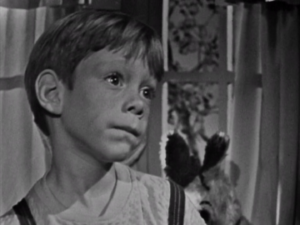
“Long Distance Call” is directed by James Sheldon. The teleplay is by Charles Beaumont and William Idelson. As for our cast, we’ve got some Twilight Zone royalty here. That’s Bill Mumy as our little boy Billy. Of course, we’ll be seeing him again in the not too distant future. You should probably think good thoughts about him until then. Lili Darvas plays grandma, and I’ll just stop for a moment and say that she does a fantastic job of being creepy while still maintaining this authenticity of a real grandmother. It’s pretty amazing. Philip Abbot plays Chris. And Patricia Smith is our good sport of a wife, Sylvia. The episode first aired on March 31, 1961.
Episode Tidbits
As for our tidbits, I’m going to turn to Marc Scott Zicree’s Twilight Zone Companion for this one. There were a bunch of reshoots and rewrites with this episode. But, one of the more interesting ones is the monologue that Chris gives into the phone at the end. In the original script, he says the following:
I find the choice to rewrite the speech interesting, and I’ll actually come back to why that is later in my second question.
Question 1: Is the grandmother evil or a product of circumstances?
We’re going to have to do a bit of clarification of definitions here. What exactly do we mean by evil? For some, the term evil has a specifically supernatural connection, think Satan. However, that doesn’t always have to be the case. In fact, we’re going to come at this question from a bit of a different angle. And to do that, we’re going to be bringing in our old friend and distinguished archetypal psychiatrist Carl Gustav Jung in another edition of the Jung and the Restless.
Jung has an interesting take on the topic of evil. He essentially makes the argument that it does not have to be tied to the supernatural for it to still have a similar feeling attached to it. Let’s bring in his language. That should help to clarify what I mean here. Jung writes:
The reality of good and evil consists in things and situations that happen to you, that are too big for you, where you are always as if facing death. Anything that comes upon me with this intensity I experience as numinous, no matter whether I call it divine or devilish or just “fate.” Something stronger than oneself, invincible, is at work and one is up against it. (88)
The first thing I want to address is this term numinous. What does it mean? In short, the numinous is an awe-inspiring event, moment, a confrontation, one that can have the effect of resituating your position within the world–or even within existence. It is overwhelming, powerful, and can leave you feeling quite small. Think of the scene when Chris’ wife hears grandma on the toy phone the first time; it completely shakes her relationship with reality. Now, a numinous experience doesn’t have to be negative; in fact, this channel is still very much about awe-inspiring events that leave us feeling more tightly bound to each other. But, in the case of Jung’s discussion of evil, it tends toward the negative, making us feel helpless, unless we can somehow find a way to overcome the numinous and become triumphant in the face of seemingly impossible odds. And if that sounds like the plot of a heroic tale, you would be correct. The concept of the numinous is used a lot in heroic tales to set up an appropriate power dynamic between the invincible evil vs the rather significantly underdeveloped one just individual. Okay, so how does this connect with our episode?
Let’s talk about the very first exchange in the episode for a moment. Chris is telling his mother to take it easy. In fact, he says the rule of the house for today is that she has to go back up stairs once the birthday celebration is over. And this is her response: “that’s fine, Chris. You know I always follow the rules of the house, except when I don’t agree with them.” Now, when you watch this episode the first time through, that exchange can potentially come across as a bit playful and even like a bit of a joke. When you watch the episode subsequent times, the pretense of a joke pretty much vanishes and you realize that Grandma is quite serious here. In fact, this initial exchange might be the most integral one to our discussion.
Think about the psychological game that she is playing here with Chris: I always follow the rules. That’s a statement of absolute submission to Chris’ wishes. But, she then gives herself a wide opening to escape that statement by saying when I agree with them. Who is actually making the rules of the house? Is it Chris, his wife, or Grandma? We’re going to bring in a theological phrase to help us out here: permissive will. Now, this is an incredibly complex conversation when it comes to permissive will vs perfect will or divine decree, and we can’t get into that here–maybe some day if it connects with an episode, but not today. Let’s just use the most surface-level version of this term which simply means even though God can decree something to happen, he can also permit something to happen. In the case of Grandma, she clearly has a kind of divine disposition to her, where she both decrees and permits. And although some people who are perfectly normal can also have this kind of mindset, given where we know the episode is going, I think it warrants a bit of a squinty eyes, raised eyebrow, skeptical look.
Now, we’ve essentially introduced the concept that evil, in the Jungian sense, is a numinous force that makes us feel small and vulnerable against a seemingly invincible object that is greater than us. We’ve also looked at some of Grandma’s language and realized that she has a bit of a divine mind going on here in terms of her position to the family. Now, let’s start to pull all of this together and come to a decision regarding our question. And for this one, I’m actually going to begin with my answer: yes, she’s evil. There, I said it, and it’s recorded, and I can’t take it back. I think she’s evil. But, like I tell my students, you can’t just make a claim. You have to be able to justify it.
Let me begin by saying that I understand that Chris lays out a rationale for why his wife should not take what grandma does so personally. It’s because she had two children prior to Chris and lost them both, which I won’t even pretend like I can understand. I’ll just simply say it sounds like the worst thing you can experience as a human. But, and here is the difference. What we have going on here in this episode is actually quite literary in nature. You have a kind of dark parallel here of biblical sacrifice. If in the Christian theology God sacrifices his son for the sake of humanity, and of course, you have to acknowledge Mary’s role in this as well, giving of her son for the betterment of the entire world, what Grandma does is sacrifice, her own son for the betterment of herself. Oh, did you think I misspoke there when I said her son? Let me remind you of what she says about her grandson, Billy: She says on her deathbed to Chris, “no, my son was taken from me by a woman. This is my son now, Billy.” And so, she has not only cast away Chris, her real son, but she has decreed–there’s that will thing again–she has decreed that Billy is her son, and she is willing to sacrifice him for her own selfish desire, an inverted, dark sacrifice.
For those of you who have been listening to me now for a couple of years, you know that I tend be the kind of person who believes in forgiveness, believes in mercy, believes in the ability for someone to find their way back into humanity. But sometimes you come across a person like this…like grandma…and if you allow them to continually assert their decrees and permissive wills, they begin to believe that anything that satiates their desires is right. We can deal with selfishness to a certain point as adults, but what she does here, in my humble opinion is quite evil.
Question 2: Why exactly does Grandma give Billy Back?
The plot of the episode gives us a pretty reasonable answer to this question. Chris pleads with his mother on the phone about all of the things that Billy is going to miss if he stays with Grandma: school, girlfriends, and wearing long pants. Now, I don’t know why they’re denying the poor boy long pants, but we get the jist of it. You could absolutely accept the answer that Grandma is persuaded by Chris’ plea and simply lets the boy go. But, I do think that there is at least one layer of this interpretation that we can explore: does she make the decision for Billy’s sake or for Chris’?
In essence, we have a kind of rhetorical battle going on here. And my use of rhetoric here is in the classic sense, as in persuasive speech. In order for Billy to be released from Grandma’s grip, Chris’ rationale needs to be greater than Grandma’s needs or wants to continually control Billy. But, what part of this equation involving Chris actually works? Let’s lay out some potentials and then we can explore them in a bit more detail.
Even though Chris is the one who is speaking, he is essentially representing two people: himself and BIlly. Yes, in a more normal situation we would probably say that Chris is speaking in unison with his wife as well, but um…this…this isn’t Tuesday night with the Waltons. This is something else. Chris is definitely representing himself here, and it’s because he knows that bringing in his wife Sylvia’s name will probably only make things worse. So, he’s really just representing himself and Billy. Let’s talk about Billy for a second. Why might that be enough? There’s no doubt that she loves him. As I previously mentioned, she calls Billy her own son at this point, and she clearly thinks that she is what is best for him. If she weren’t so evil, we might find that charming–if still a bit unsettling. But, does this interpretation hold water? Not really. It certainly doesn’t take a master rhetorician to argue that her love of Billy is really just a desire to own, to control him, to feed off of his innocent love for her. So does she let Billy go for his own sake, I don’t think so. That takes us to Chris.
Does grandma love Chris? Again, I think you can say, yes. Okay, okay…before people start throwing things at their screens screaming how can she love Chris after all that she’s done to him, said to him, put him and Sylvia through–I’m not saying that she loves Chris in the way that we’re supposed to love each other; I mean that she believes she loves him based on the same controlling parameters that she loves Billy. Now, as I mentioned briefly in the first question, we know from Chris that his mother had lost two children prior to him. So, she knows what it is like to lose not just one child but two. We can make the argument that she might want Billy to live because she doesn’t want Chris to have to go through what she went through. That would at least somewhat redeem her evil ways from question one, but do we get any sense that grandma would actually think this way or come to this realization? Perhaps if the story had given us something, a small nugget of redemptiveness toward this idea, we could believe this version. But, we really don’t get that, at least not in my eyes. You might see something differently, which is what makes talking about these episodes and hearing you all in the comments so fun. However, in this case, I don’t think she does this for Chris, either–at least not really. Hold on to your hats, I’ve got a bit of a wild take here.
I said she didn’t really do it for Chris’ sake, but I do still think she does it for him. Let’s think about that scene when Chris is on the phone with grandma, pleading with her to let Billy go, begging, crying, completely at the mercy of whatever decision his mother is about to make. Can you see where I’m about to go with this? In doing what she does to Billy, she is able to reduce Chris once again to her little boy, to a child who HAS to depend on his mother in order to get what he wants. You might recall in my tidbits section, I read the original speech that Chris makes to his mother, and that original one somewhat makes this point even more strongly. The changes to the speech make him a little less boyish, but I still think that the rewritten script has the same effect. For grandma, this phone call might be the greatest gift that she could ever receive, a delectable morsel of control even greater than what she established with Billy because Chris is not even just reduced to a child, but he essentially does what? He has to sneak into the room, by himself, make the phone call to her, in secrecy from Sylvia–rendering her out of the picture, out of any part of this conversation and decision-making process.
So, why does she let Billy go? Because, she got what she really wanted. She got her baby boy back.
Question 3: What are your moments of awe?
My moment of awe is actually a bit of a darker one than usual. My heart goes out to Chris to a point–to a point; I want to emphasize that part. He obviously loves his mother, or at least he cares deeply for how she thinks about him. So much so, that it seems to pull him away from his wife and her own misgivings about how grandma is growing bold in her affections for Billy. Now, what makes this a moment of awe for me is that, it’s not always easy for some people to allow others to be mad at them. At base, I do believe that most people want to be liked. However, there are just some times when you have to love someone enough that, for their own safety, you have to be okay if they hate you. You have to put the onus on them to love you back enough to not put you in dangerous situations. At some point, Chris needed to tell his mother, that’s enough of that. I don’t want you talking to my child like that, and I don’t want you speaking to my wife like that, either. Again, I don’t want to make light of how difficult this can be, but if that person you’re talking with about boundaries loves you as much as they say they do, they should be angry for maybe a day or two, but then, they should accept that you’re trying to do what you believe is right. This Twilight Zone episode is a fictional story, but I shudder at the thought of what would have happened to Billy had Chris not been able to convince his mother to give him back. And to think, all of that might have been avoided with a simple phone call to his mother.
My Rating
As for my rating, my goodness, I don’t know if I have changed significantly since the last time I saw this episode, or if I’m just in an oddly sensitive place, but this one hit me hard in the darkness department. It felt like I was watching a horror movie more than a Twilight Zone episode, but then again, there are a handful of these kinds of episodes that feel that way. I think “Nightmare as a Child” has a bit of this horror feeling as well. So, my rating: I’m going to go Upper Lower-tier. I’ll be interested in seeing how people vote in the YouTube posts. I originally had Middle Upper-tier, but I changed it because I thought about a comment regarding my rating system, which I’m going to talk about in my comment section in a moment.
Next Episode
Next time, we’ll be taking a look at “A Hundred Yards over the Rim” and here are your questions to consider when watching the episode:
Question 1: What role does pilgrimage play in this story?
Question 2: Is the future knowledge of success really enough to see us through difficult times?
Question 3: What are your moments of awe?
Announcements and Shout-outs
I’ve got a couple of comments to highlight from the YouTube channel. On my “Static” episode, @ElanaElyce states: "I still have TiVo. Like ..the old school box. It's kind of amazing. 😆"
Firstly, yes, yes…I love this. I sold a few TiVos briefly at Circuit City. They were actually quite ahead of their time. I say hold on to it until it dies. Secondly, if you have a minute, make sure you let me know the proper way to pronounce your name with a phonetic comment or something. You’re always so kind with your thoughts, I want to make sure I take the time to get your name right.
Now, secondly, Elana also asked for a refresher on my rating system, and I’ve mentioned something loosely around whether or not I would get up during a Twilight Zone marathon as being a big part of my system, but you’ve inspired me to actually put it down to paper. I don’t have it done just yet, as I am getting slammed at work at the moment with a lot of events and service in addition to my teaching, but I think that would be a lot of fun, so I appreciate the opportunity to get those thoughts down.
Friend of the show PHXdog, added the following comment on that same “Static” episode: @PHXDOG The Twilight Zone Radio Dramas: Narrated by Stacy Keach, these are full-cast, modern dramatizations of original scripts, often expanded with more dialogue and updated tech. The Twilight Zone radio dramas often add depth by exploring internal thoughts or expanding scenes that were "bare bones" in the original 25-minute TV episodes.” Yes, this is actually a much better point than the one I was trying to make in the episode. If you have a particular episode that you find to be a bit on the mediocre side, sometimes those radio drama versions can actually make them more interesting and give you a new angle from which to view them. They’re absolutely worth the time if you have it.
How to Support the Show
Want to support the channel? Consider subscribing, liking, commenting, and sharing the show with a friend–you know all of the usual algorithmic gymnastics, that will help us expand our awesome community of Twilight Zone fans. Plus, you never know, I might just highlight your comment in an episode of the show–as long as it's family friendly. And if you want to be immortalized on our list of key KOI supporters, consider joining one of our membership tiers on YouTube or Patreon. 50% of all money taken through this channel, after the platform fees, is going to charity. 25% to the Rod Serling Memorial Foundation, and 25% to the Gary Sinise foundation. For more information about me, my scholarship, and the show, head over to the keyofimagination.com. That being said, even if you hated every minute of this, I’m still going to thank you for spending some time with me. Until next time, remember, all doors are open to those who possess the key of imagination.
Jung, C. G. Jung on Evil. Edited by Murray Stein, Princeton University Press, 2024,
https://doi.org/10.1515/9780691264936.