
The Twilight Zone Season 2: Episode 60
"The Rip Van Winkle Caper" Episode Transcript
Introduction
Welcome to the Key of Imagination. This week, we’re taking a look at the Twilight Zone episode “The Rip Van Winkle Caper”. We’ll take a nap with the OG himself, Rip Van Winkle, and see if we can find additional connections with Washington Irving’s short story; we’ll put Professor Farwell’s plan to the test; and I’ll reveal my moment of awe, just a brief reminder about why we can’t just sleep our way through life. So, grab your keys and let’s open up this door to the fifth dimension.
Plot Summary
Farwell, DeCruz, Erbie, and Brooks: four men, with four distinct skills, and one plan to heist a million dollars in gold bullion from a train. Smiles and handshakes all around, the first part of their plan worked perfectly, and they were able to escape to their hideout–a cave out in the desert. But, this next part of the plan…well…let’s just say it’s going to take some time to pull off. With the gold stashed away, the four men enter specially designed sleeping chambers that will keep them in a state of preserved stasis for 100 hundred years, and even though Mr. DeCruz is not exactly wild about the idea, he’s convinced by the other men to stick to the plan. And so, they sleep, like Rip Van Winkle, and eventually wake up to a new world and a lot of gold. But not everyone has made it out: a rock landed on Erbie’s chamber, cracking it, leaving him trapped and quite dead. And DeCruz, perhaps in a moment of greed or just good old fashioned dislike for another, takes out Brooks with their getaway van, leaving both himself and professor Farwell with just their two feet and sacks of heavy gold on their backs. As the sun beats down on the men, Farwell realizes that he has left his canteen at their previous stop. Ever the entrepreneur, DeCruz sells Farwell sips of water at the rate of 1 bar for one sip. The next day, it’s 2 bars for 1 sip, until finally, Farwell has nothing left to give, except for a strong thrashing across the head to DeCruz with a bar of gold when he’s not paying attention. Now, Farwell has the gold, but the water is still scarce. Some passerbys find the good professor, dying of thirst on the side of the road, and when he offers them all the gold he has to help him with his last breath, the people can only shake their heads: they recalled a time in history when gold was worth a hefty price, but it hasn’t been worth anything since we’ve figured out how manufacture it in a lab at will.
Episode Details
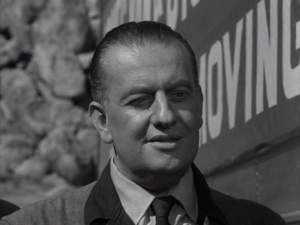
“The Rip Van Winkle Caper” is directed by Justus Addis. The teleplay is by Rod Serling. As for our cast, our man with the plan professor Farwell is played Oscar Beregi. And yes, we’ll be seeing him in a rather intense and moving episode in the future; Simon Oakland puts in a dynamite performance as Mr. DeCruz; Lew Gallo is our fine gentleman Brooks; and Erbie, poor, poor, Erbie, who is forever preserved in our memories but not in the glass container is played by John Mitchum. The episode first aired on April 21st, 1961.
Episode Tidbits
As for our tidbits, Martin Grams Jr. reminds me of something I had forgotten. Truth be told, it has been a very long time since I’ve watched the 1968 Planet of the Apes film. But, in the movie, three of the astronauts wake up only to find that their fourth companion, the female astronaut, has died in her stasis tube with a crack across the glass, leaving a skeletal structure–more mummified than in “The Rip Van Winkle Caper,” but still, given that Serling was one of the primary writers for movie and the teleplay writer for our Twilight Zone episode, I wonder if Serling was brought back to this episode in 1968? Now, I never read the book by Pierre Boulle that Planet of the Apes is based on, so I’m not sure if Serling put this scene in of his own accord, or if this actually happens to the astronaut in the book. If you know the answer, let us know in the comments below.
Question 1: Are there any connections to the story of “Rip Van Winkle” in addition to the falling asleep part?
Any time I get to stretch my early American literature muscles in the name of the Twilight Zone, I’m going to do just that. I’ve taught “Rip Van Winkle” by Washington Irving and published in 1819 a few times over the years, but not as often as other tales of early America. That being said, I do think there are some interesting parallels here to discuss that can help us better appreciate our episode. So, let’s get into it.
The “Rip Van Winkle” story proper begins prior to the American Revolutionary War. The narrator is telling us about a small village at the base of the Catskill mountains filled with people of Dutch descent, with beautiful little houses built with yellow bricks. Stop. I know what you’re thinking. Joe, Yellow bricks. The thieves in our Twilight Zone episode stole yellow bricks of gold. No. No. We will not taste of such low hanging fruit. And quite frankly, I’m shocked, shocked, I say, that you would even think such a thing. I’ll have none of it as a professionally trained interpreter of fine works of literature.
We’re told that our titular character is a descendent of a great family of Van Winkles–now of course we’ve all heard about the great Van Winkles in American history so I won’t bore you with that knowledge. Rip Van Winkle, however, is described as having…well..let’s just say, deviated from the family tree a bit. The narrator tells us, “The great error in Rip’s composition was an insuperable aversion to all kinds of profitable labour.” (link). In other words, he was lazy and wanted everything handed to him. And you’re thinking, just like our Twilight Zone characters, Joe.
Stop it! How many times do I have to tell you? We’re going for a higher, more refined interpretation of this connection. If you’re not going to take this seriously, well then I’ll just have to bid you good day–good day! Now, if you don’t mind, I’d like to finish this opening so that we can get to our episode.
Okay, one of our first real connections here that I would like to make is with a character in the story named Nicholas Vedder, considered a patriarch of the village. The thing about Vedder that is interesting is that he has followers. In fact, the narrator tells us “for every great man has his adherents” (link). This does remind me a bit of the relationship that both Brooks and Erbie seem to have in the Twilight Zone episode have with Farwell. You see, there is nothing particularly great or extraordinary about Vedder. Rather, the men, including Rip, tend to place a lot of extraordinary value on him for everything he does. They look at the way he reacts with head nods and believes that something deep is going on that should not be interrupted or questioned. Additionally, this idolizing of Vedder has the effect of the men in the room eschewing their duties at home. In fact, Rip’s wife, quote, “[charges Vedder] outright with encouraging her husband in habits of idleness” (link). Now, to be fair, Farwell does have extraordinary knowledge when it comes to physics, and his plan does work–somewhat, we’ll talk more about that in question 2. But, I’ve always found that the way that both Brooks and Erbie idolize Farwell is a bit odd. They’re too quick to give over all decisions to him, and I do think, in fact I’ll argue in question 2, that this has dire results for them both. And so, Farwell, to me, is a bit of a Nicholas Vedder figure, receiving a bit too much praise at the expense of those who are with him.
Now, I would also like to point out at least one more really integral parallel between the two stories. You can argue that the main point–or at least a main point–of “Rip Van Winkle” is that he sleeps through the Revolutionary War, and in doing so he misses not just the major event of the war but all of the precursor events that led to the war happening. And therefore, he also misses the chance to witness the shift in culture that happens between the emerging pre-war culture, the present war culture, and even a good part of the post-war culture itself until the moment he wakes up. Let me give you an example of why this is important by citing an amendment that we rarely use today in America, and thank goodness,: the 3rd amendment. The third amendment states: “No Soldier shall, in time of peace be quartered in any house, without the consent of the Owner, nor in time of war, but in a manner to be prescribed by law” (link)? Today, this might seem like an odd thing to some people, especially young people. So, why do we have it at all? Because, we went through a time period where colonists were forced to give quarter, to house, British troops. In the time that the Bill of Rights and the third amendment were ratified in 1791, we still had people who remembered why that language was so important. Joe, get to the episode or I will no longer give quarter to you in my ears and with my eyes!
Okay! Fair enough. You’ve been great hosts to this point. When we connect this with our episode, yes, Farwell is able to use time to his advantage in order for history to forget about them, but in doing so, they lost being able to experience how that culture came about the way that it did, and that certainly would have helped them better understand why gold ended up becoming useless. And it probably would have helped them shift their plan overall–maybe even allowed them enough time to sell off the gold while it was still worth some money, something we’ll also talk about in the second question. And so the parallel to the “Rip Van Winkle” story is that in both cases, the men wake up unprepared for this new world, showing the importance of not simply staying awake in life, but for actively being aware of how our culture and our world can shift not just through monumental events, but through the smaller events that set the stage for the larger ones.
So, we do have some interesting parallels with “Rip Van Winkle” that extend beyond just the sleep part of the story. If nothing else, when I bring in these great works of literature, I hope that it inspires some of you out there to get back into reading great works. I can’t tell you how many times I’ve gone back to a work like “Rip Van Winkle,” Moby-Dick, The Blithedale Romance, (Don’t know that last one? That’s a lesser discussed novel by Nathaniel Hawthorne, and it’s fantastic.) I can’t tell you how many times I’ve gone back to classic works and felt refreshed by them. And they also have the benefit of helping us appreciate the great works of art today.
Question 2: How good was Farwell’s plan really?
I mentioned this somewhat in passing in question one, but I’ll just come out and say it here explicitly: there’s something about the DeCruz character that I both abhor and yet kind of appreciate. [I knew it. You’re a monster, Joe.] Wait, wait…I just mean in one specific regard. Everyone else on the team is just so willing to follow Farwell as if he’s a god, but that’s actually quite a dangerous thing to do. Now, again, let’s give Farwell his due; his plan technically works, at least as far as we go in the episode. Whether or not society would have found a way to connect the men to the heist years later is not really something that we can figure out here, so let’s not hold that part against Farwell. Let’s just stick to the strategy itself and the implementation phases of it, and let’s try and see where this plan is successful and where we might have been able to see cracks in it–you know like the one we find in Erbie’s sleeping pod. [Boo!] Okay, that one was pretty low. But not as low as Brooks right now–he’s allllll the way down at the bottom of the canyon [boo!] All right, I’ll stop. Just Farwell kept stopping on the…
Let’s get the big fail out of the way right here, right now. Poor Mr. Erbie never left his chamber, a rock having fallen on the glass and cracking it just enough to let the preservation gas out. He probably should have just stayed…in an erbie and be. I’m only slightly ashamed by that one. Was Erbie’s death preventable? Well, let’s try to be fair to Farwell here. The question isn’t should he have built some kind of protective casing for the sleeping chambers; that answer is yes based upon our powers of hindsight. The real question is: should he have at least considered that this rock fall might have happened? I did some research on caves, and I came upon some interesting information that would have probably made for a good question on its own. Here is what I found. There are different types of caves, but the two most common to California are apparently lava tube caves and solution caves. Based on just an image search in Google, this one in the episode looks closer to a lava tube cave than a solution one, although the flooring doesn’t quite look right. If you happen to be a geologist or just a really experienced spelunker, definitely weigh in here and educate me and the rest of us. What kind of cave do you think it is? Either way, in both cases, it might be somewhat rare because these caves take a really long time to develop and settle, but you definitely do have rocks that fall, and given the amount of time that they were going to sleep–a hundred years–yes, I think they should have planned for this to occur. That’s a fail on Farwell’s part, if you ask me. And, I’ll go even a step further. Given that DeCruz’ speciality is in dynamite, my guess is that he’s probably had to clear out a rock or two in his lifetime, I wonder if Brooks and Erbie had listened to DeCruz’ concerns a bit more, might that have been the thing that prevents this from happening? I suppose we can’t say for certain.
Let’s hold on to the gold becoming worthless part for a moment. We’ll get to that. Instead, I want to talk about DeCruz’ actions. You have multiple times in the episode where Farwell says something like I’ve underestimated you, Mr. DeCruz. I guess my question here is when does underestimating someone become outright foolishness? I think the majority of people, including myself, would have probably had an extra eye on DeCruz the whole time, but especially after he kills Brooks. In fact, I would have probably gone my own way and let DeCruz do his own thing as far away from me as possible. Remember, DeCruz is not crazy or anything; he’s diabolically precise in everything that he does. And the fact that our good professor Farwell is continually one-upped by DeCruz, it somewhat validates DeCruz’ earlier concerns about Farwell’s planning capabilities, at least a little bit, doesn’t it? I think here we also run into a bit of failure on the part of Farwell’s plan. How to account for the possibility that one of these fine, distinguished gentlemen that he’s with might try a double cross. Again, not a good look for our professor here.
Okay, that leaves us with our big Twilight Zone twist moment: the gold. Is there any way for Farwell to know that this was going to happen to this precious metal? I could try and throw out a million lines of rhetoric here, but actually, I think that would be somewhat disingenuous on my part. I don’t think there is any way for Farwell to have known that gold was going to become worthless. So, I don’t place the blame on him for that. However, however…and this is really just us thinking out loud at this point, according to data from the National Mining Association, the price of gold was relatively flat and stable for a very long time during the history of the United States. In fact, “The official U.S. government gold price has changed only four times from 1792 to the present [, meaning 1971]. Starting at $19.75 per troy ounce, raised to $20.67 in 1834, and $35 in 1934” (link). This changes drastically in the early 70s for multiple reasons, but one of the more impactful ones is that in 1971 we stopped converting gold to the dollar–or we went off of the gold standard. Again, there’s more to it than just one moment, but President Nixon’s decision in 1971 is a significant one. Since then, the price of gold has gone up tremendously, which means, if Farwell and the boys had gone to sleep in 1961 and woke up just 50 years later in 2011, instead of 100 years, they would be living as the kings they envisioned in their dreams. But, and here’s the interesting part for us. That’s if they woke up in 2011. Who knows what gold will be worth in 2061? Could it be worth nothing like in this episode? I suppose so, which means all of those Thomas Jefferson gold coins my mom bought for me when I was younger, will likely not be worth what she paid for them. You know what? That’s okay. They made her happy, and that is worth the price of gold today.
So, how good was Farwell’s plan? Well, it was good enough to get them the gold. That is at least worth–it’s weight in gold. I wrote myself in a corner there. But, everything after the heist itself–the chambers, not planning for a double cross, not thinking about the environment of the desert a little more carefully, I do think there was plenty there that the good professor could have anticipated. As for this professor, at this point in my life, the only gold I plan on stealing are yellow cupcakes from the break room at work, and then yes, I will probably take a nap in my office like good old Rip Van Winkle himself.
Question 3: What are your moments of awe?
As for my moment of awe, I want to come back to something I mentioned briefly in my first question and expand on it a bit. I talked about the chief connection to “Rip Van Winkle” being the loss of experience of culture while it is shifting, only to emerge out the other end feeling completely disconnected to what has happened. The world can certainly be a turbulent place, and there are times when even I say, “Okay, I think I’ve had enough of the world today. I’m unplugging from life and getting a pizza.” Hey, fair enough. I do think some people are actually too connected to the minutiae of news and information, so that they’re shifting their views on life every hour based upon the latest episode of x podcast or y news channel. Guess what? That’s not particularly good, either. It can create a feeling of instability in life or give the impression that there is no such thing as a common vision between us as humans, which, you might think me naive to say, but yes, I still think, at base, we have commonalities that bind us as humans–good qualities about life. And yet, you can’t hide from the world, either. This is the time that you’ve been given to live; these are the moments in which you are alive to bear witness to history. You are here. You exist. You did not choose to be born in this time; you did not choose to be born where you are right now, but that is where you are so what are you going to make of it? The world around you might be storming, might be making your head spin. But, it’s your head. Sometimes, you have to shrink your vision in order to see just how much is really there. It’s okay to sometimes let the world be, and just have dinner with your family, or go out with a friend, or for god’s sake to smile. I’m not saying to ignore what is going on in the world. I’m saying you are also the world. Your family, your friends, your colleagues, your interests, your curiosity, your awe–these are also part of the world, part of this history. You are not burying your head in the sand when you choose to focus somewhere else at times. You’re acknowledging the truth of time. If you feel like your head has been on a swivel, or if you feel like you’ve been struggling to get some air in your lungs recently, then do yourself a favor: recognize that the world is more than you, and yet, you are the world at the same time. Give yourself permission to just enjoy the day.
My Rating.
As for my rating, this is a really good episode. Is it top tier? Not quite for me–but it is close. This is a Middle Upper-tier episode for me. Really good acting, especially between Farwell and DeCruz; a solid storyline; classic Twilight Zone twist at the end. Definitely worth remaining in your seat during a marathon run.
Next Episode
Next time, we’ll be taking a look at the “The Silence” and here are your questions to consider when watching the episode:
Question 1: It has been said that “The Silence” is loosely based on Anton Chekhov’s short story “The Bet.” How do the stories differ, and how do they produce vastly different results?
Question 2: What does this episode teach us about the cultures of clubs and
organizations?
Question 3: What are your moments of awe?
Announcements and Shout-outs
Quick announcement, as of me recording this episode, we’re about to start our Twilight Zone one-timers bracket challenge, where we determine who put in the best performance only one time in the classic Twilight Zone series. Okay, it’s not quite that serious, but I do want to highlight something. It’s definitely easy to get into either a rut or complacency. I am definitely guilty of this at times, which is why when this opportunity came up, I thought…this might take up too much time or energy, and I’ve still got this episode to finish writing, editing, and shooting, I don’t know if I want to do it. But, then I thought about my students, about the young adults I see today who are so afraid of trying something and failing. If you fall into that category, do something different today, just for you–it’s nobody else’s business by the way, but try something that you might fail at. And if you do fail at it, as long as you tried your best, who cares? We call that being human. Nothing worth succeeding at isn’t also worth the risk of failure. And so, maybe this bracket thing blows up in my face or maybe it will be a success? All I can do is put it out there to the best of my ability and hopeful it will generate a few extra smiles from you out there. That’s at least my intention going into it. And for those of you who are listening only through Spotify, Apple, Amazon…whatever, check out the link to the YouTube channel if you want to join in on the fun.
I’ve got a comment that I would like to highlight from the YouTube channel.
On my “Twenty Two” episode, steveneardley7541 offered the following: “Arlene Martell (Sax) played a stoned beatnik girl in an episode of Perry Mason. She is a boarder with Zasu Pitts, who has recently been ditched by her painter boyfriend. She calmly states, "Maybe I'll slit his gullet." It was not the kind of line you found in Perry Mason episodes. She's very charismatic, in a somewhat scary way.” Steve, you made my day. As I mentioned to you in my reply, my wife and I have gone through the entire original Perry Mason series multiple times. We love it. And I absolutely remember the episode you’re referring to. But, you made me think of something else. Arlene Martell (Sax) definitely had a unique look to her, and there is something charismatic about it, as you say. I think we need more actors like this, ones that offer a different look, a different energy. Maybe this is just the old man in me, but there’s something still so uniform about the actors today. I suppose that’s the pressure of the business and probably the pressures of society. Either way, I appreciate the comment, Steve, and the reminder that we haven’t watched through Perry Mason in a while.
How to Support the Show
Want to support the channel? Consider subscribing, liking, commenting, and sharing the show with a friend–you know all of the usual algorithmic gymnastics, that will help us expand our awesome community of Twilight Zone fans. Plus, you never know, I might just highlight your comment in an episode of the show–as long as it's family friendly. And if you want to be immortalized on our list of key KOI supporters, consider joining one of our membership tiers on YouTube or Patreon. 50% of all money taken through this channel, after the platform fees, is going to charity. 25% to the Rod Serling Memorial Foundation, and 25% to the Gary Sinise foundation. For more information about me, my scholarship, and the show, head over to the keyofimagination.com. That being said, even if you hated every minute of this, I’m still going to thank you for spending some time with me. Until next time, remember, all doors are open to those who possess the key of imagination.
Works Cited