
The Twilight Zone Season 2: Episode 61
"The Silence" Episode Transcript
Introduction
Welcome to the Key of Imagination. This week, we’re taking a look at the Twilight Zone episode “The Silence”. We’ll dive into how this episode compares with Anton Chekhov’s short story “The Bet;” we’ll get downright social in our discussion of club etiquette in this episode; and I’ll reveal my moment of awe, a deeper look into shame and its power to create and destroy. So, grab your keys and let’s open up this door to the fifth dimension.
Plot Summary
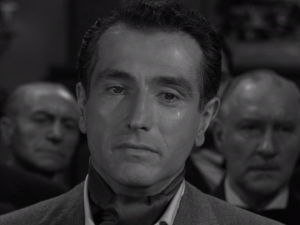
Colonel Archie Taylor sits in a chair in the corner, waiting for the arrival of his lawyer, and growing more and more upset with each moment–not because his lawyer is nowhere to be found, but because of the constant clucking that can be heard in the room. No, there are no chickens in this club, just the sound of a man’s tongue, as it harangues and harasses all those within earshot. The owner of said tongue is Jamie Tennyson, a young man with aspirations, a lovely wife who likes the finer things of life, and an empty wallet. But all this is about to change. When the colonel’s lawyer gives him the all clear on the legality, Archie can finally make his move. He offers a wager to Mr. Tennyson 500K if he can remain silent for one year. Understandably, Tennyson is first appalled by the idea, but he takes the colonel up on his wager, which includes a rather public living arrangement in a transparent room at the club, with microphones placed everywhere to catch even a murmur. As months go by, Archie begins to get nervous that our young man might actually do it, so he resorts to innuendos about Tennyson’s wife being seen with other men, but that doesn’t work. Attempts to buy out the young man to leave early also don’t work. One year to the minute that the two men made their bet, Tennyson emerges from his isolation, victorious, his hand stretched out waiting for his check of a half a million dollars. But, there is no check. You see, our noble colonel actually doesn’t have the money, and so he will simply resign from the club, his name forever besmirched. All the while, Tennyson remains silent–speak! The other men scream! All Tennyson does is scribble something on a pad. And when it’s read aloud it says, “I knew I could not keep my part of the bargain, so one year ago I had the nerves to my vocal cords severed.” As Tennyson removes the scarf from his throat, a great scar is revealed–and just like Tennyson, the room is left speechless.
Episode Details
“The Silence” is directed by Boris Sagal, and the teleplay is by Rod Serling. As for our cast, let’s start with Franchot Tone who plays our club curmudgeon Col. Archie Taylor; Liam Sullivan plays Jamie Tennyson; Jonathan Harris, whom we’ve seen already in “Twenty-Two” plays Archie’s lawyer George Alfred, and I’m just going to give Cyril Delevanti his props whenever he shows up. He plays our club butler. The episode first aired on April 28th, 1961.
Episode Tidbits
As for our tidbits, I’ve got an interesting little anecdote from actor Liam Sullivan who plays Tennyson. According to Martin Grams Jr.’s book, “Rod was a very quiet fellow on the set….”He let the director take over in most things. He was a terrific writer, and after that experience I was a Twilight Zone fan” (398). The more I read these quotations from the actors in the series, the more it sounds like being on the Twilight Zone was difficult work because of the schedule but the atmosphere on the set was quite good. I can see why actors were often eager to return.
Question 1: It has been said that “The Silence” is loosely based on Anton Chekhov’s short story “The Bet.” How do the stories differ, and how do they produce vastly different results?
I love Chekhov. No, not that Chekhov–although if this question were about nuclear wessels in space, then yes, I would certainly invite opinions from that Chekhov. This time, however, I am referring to the late 19th, early 20th century Russian playwright/author Anton Chekhov. Some of his more well-known works include “Uncle Vanya,” “The Seagull,” “The Cherry Orchard,” and yes, “The Bet.” What I particularly enjoy about Chekhov’s style is that it’s rather subdued in its approach–not very many great, emotional outbursts. Rather, his characters tend to be almost constrained by their freedoms, depressed by the state of existence in a world that seems void of meaning beyond the surface-level of our wants and desires. So, if you’re thinking about reading Chekhov to the little ones, you should probably stick with “Goodnight, Moon.” The Chekhov version would probably be titled something like “Goodnight, Moon, whose light only continues to highlight the meaninglessness of all material existence.” But, I suppose that’s not a very catchy title.
If you do some basic google searches regarding this Twilight Zone episode, one of the primary points discussed is the source material, specifically whether or not Serling plagiarized from Anton Chekhov’s “The Bet.” There are certainly plot points that are similar between the two. But, as I’ll show here, the characters and the story diverge rather drastically. Now, Serling has been accused before of plagiarism before, most notably by Ray Bradbury, but I do think that Amy Boyle Johnston in her book Unknown Serling actually puts forward a solid case for why Bradbury’s claims don’t really hold merit, so if you’re interested in this topic, I would go to Boyle Johnston and see if you find her arguments convincing as well.
I want to begin by briefly discussing what happens in Chekhov’s short story “The Bet” so that we can start to compare it with our episode. “The Bet” opens with the narrator telling us about an old banker in his study remembering how he had thrown a party 15 years prior with a whole bunch of interesting people, all arguing over whether or not capital punishment is proper in a Christian nation. As you can imagine, some argue yes; some say, no. The banker argues that life in prison is much worse than death on the grounds that it is a slow removal of one’s life. A young lawyer decides to let his opinions be known, arguing that both forms of punishment are terrible, but that it’s much better to live than die, so he would rather be imprisoned for life. That leads the banker to offer a wager: 2 million dollars if the lawyer can last five years in confinement. The lawyer counters and says that he would stay not 5 years but 15. Okay, let’s stop there for a moment. Tennyson, our Twilight Zone character, is also considered to be a young man, and Archie is clearly an older gentleman, like our banker in “The Bet.” so we have that surface-level connection of age and experience. But, let’s just focus on our young protagonists for a moment.
Archie provides us with a rather scathing summation of Tennyson. He calls him, “a shallow, talkative, empty-headed, nerdowell.” Yikes! Get out the ointment because someone just got burned. But, let’s actually think about this for a second. Our introduction to Tennyson is not really a favorable one. He’s clearly annoying the patrons at the club, many of whom just want to either read their papers or at least not be harangued with stories that go nowhere. And if you do listen to the story he’s telling, it actually speaks to Archie’s point. He’s talking about how some gentleman was asking him for 125 thousand dollars, which, if you’re keeping track, is also the sum Archie tells George, his lawyer, that Tennyson asks him for a couple of weeks earlier. Then, Tennyson does something that…well…people do sometimes. He just slides into the conversation that if someone were to give him 125 thousand, he could triple or even quadruple it with ease. In other words, he’s fishing for people to give him money. And that is the nerdowell part of Archie’s commentary. On the other side of this, you have the lawyer character from”The Bet.” The problem with this figure is not anything malicious or deceitful. Rather, he’s simply foolish. He should have either ignored the bet proposition, or at the very least, he didn’t need to up the amount of years from 5 to 15. That’s pride; that’s hubris; that’s the foolishness of a young man. And so, these characters are quite different in their backgrounds.
Now, I’m going to cut to the chase a bit here because I could easily spend an hour talking about these two stories, but we don’t have that. Both Tennyson and the lawyer accept the bets and are confined in strictly observable spaces; and just like in The Twilight Zone, our wealthy banker does not end up having the money he promises at the end, although a key difference is the banker actually has the 2 million at the start of the wager, and then he ends up losing it over some bad market investments over time. But, Archie knows from the beginning that he doesn’t have the money. And when it comes to Tennyson and the lawyer, there are some critical differences there as well.
Lets give Tennyson some credit. He knows himself well enough to have the nerves of his vocal chords cut. And, although we might feel bad for him in a Twilight Zone kind of way, what he does is actually cheating in the spirit of the wager, and you can make the argument that he gets a bit of comupins by his own hand. But, in the case of our young lawyer from “The Bet”, something very different happens. He goes through various cycles of learning over the 15 years: first, he reads light novels; then he reads classics; next, he studies philosophy; then, he learns languages; in his 10th year, he turns to the gospels and theology; and finally, in the last two years, he read whatever he essentially yearns for: books on medicine, chemistry, and Byron and Shakespeare. Hmm…Locked away in solitude with nothing to do but read a little Byron and Shakespeare–don’t threaten me with a good time, Chekhov.
Ultimately, the no-longer wealthy banker decides that he’s going to kill the lawyer before he loses the bet, but then something strange happens. He goes into the room, and the young man is still alive, but he is little more than skin and bones, emaciated, with white streaks in his hair as if he were a hundred years old, and not the mere 40 that he was. The banker then reads a note that the lawyer has left on the table. In this note, he essentially calls into question all of the things that we admire in this world: money, surface-level beauty, and even our idolatry of pure logic. And he closes the note with the following: “"To prove to you in action how I despise all that you live by, I renounce the two million of which I once dreamed as of paradise and which now I despise. To deprive myself of the right to the money I shall go out from here five hours before the time fixed, and so break the compact ..." The banker is of course ashamed by his actions and what he has done, and true to his word, the young lawyer leaves the next day with no money. But, the banker takes the note he found, and locks it away in his fire-proof safe. I’ll leave you to interpret that last line on your own.
So, let’s answer our question: yes, there are definitely parallels between the two stories, but I think even Chekhov himself would say that they diverge a lot, and particularly in matters of character and development. Tennyson learns a valuable lesson about himself, but the lawyer learns a valuable lesson about others. And, if you want to see for yourself, “The Bet” is actually really short. You can read it easily in one sitting. There are still a few little parallels and differences that you might find fun to discover on your own that I don’t mention here, so give “The Bet” a read if you love this TZ episode.
Question 2: What does this episode teach us about the cultures of clubs and
Organizations?
You might be thinking, oh no, Joe’s going to go off on how terrible clubs and organizations are, but actually I’m not. The impetus for this question actually came from two specific scenes in the episode that probably seem rather straightforward, but let’s be honest, who’s better at making the straightforward unnecessarily convoluted than me? [Joe, I don’t think that’s the compliment you think it is.] Yeah, well, that’s like your opinion, man.
There’s a part of the earlier exchange between Tennyson and Archie that I never really paid much attention to before, mostly because I dismissed it as simply Tennyson trying to show off or quickly move beyond his embarrassment. He says the following to Archie in front of everyone: “If this were Europe, Colonel, or the company a bit more sophisticated, I should be forced to invite you out for the things you’ve said to me. The ground rules here, however, are just a bit different. I can either ignore you or call your bluff.” There’s a phrase in there that is doing quite a bit of heavy lifting: “I should be forced to.” In other words, if this were a different place, with different men, and with different norms, our agreed upon cultural set of values would essentially force me into the action of fighting with you outside. We’ve seen this in movies; either the hero or the villain says something like, “care to step outside?” But in those cases, it’s usually still the choice of the individual. Whereas Tennyson here is saying that, given the proper environment, the choice would be out of my hands, dictated by the culture itself. And that got me thinking a bit.
One of the ways that you can interpret this episode beyond the plot is to think about the relationship between individuality and the collective in specific relation to the norms of that group and how we attempt to balance the two. One of the questions I started to think about was whether or not the other men actually have more of a responsibility to stick up for Tennyson than we might think. Let’s come back to Tennyson’s language for a moment from that scene with Archie. He says, if the gentlemen were “more sophisticated.” On the surface, this probably sounds like Tennyson is just making an excuse–at least that’s how I took it on the first watch. But, if you look at the reactions of the gentlemen carefully, there might be more to his argument than it appears.
When Archie mentions that he is essentially buying peace and quiet for the year, the men all laugh–and I’m not going to be too judgemental about this moment because sometimes people laugh when they’re nervous, and sometimes we can just flat-out miss the significance of a moment, and of course, maybe they just genuinely think Archie said something funny. But when you look at the reactions of the men in this scene, they aren’t all uniform. Archie says, “I’d be willing to offer a large sum of money just to have some quiet.” And the three men behind Tennyson all have different reactions: one is laughing, another looks to be in a bit of shock, and the third seems a bit dismayed by what is happening–in other words, he does not seem to be in complete agreement with what is happening before him. Could I be wrong about this? Only the actors, the director, and maybe Serling himself probably know for sure. But, if it is the case that there are at least some who disagree with what is happening, we have every right to at least query whether or not it is incumbent upon those who disagree to speak up on behalf of Tennyson and on behalf of the culture of the club. Not to be confused with on behalf of culture club, although I suppose you can argue Tennyson is bitten by a karma chameleon by the end. [boooo!] I apologize for nothing!
And so the question is should those who disagree with Archie’s tactics here speak up? Well, yes. The decisions we make when we’re building cultures are just as much about how we choose to handle ourselves within in-the-moment situations as much as it’s about whatever rules we write down in a charter or manifesto. The question that the gentlemen would have had to answer collectively is not whether or not Tennyson deserved correction for the way he is handling himself–given that he is clearly working the room for money to the point that he won’t leave them alone, I think a conversation and potential correction is certainly warranted. But, in allowing Archie to follow through on not just the wager, but to essentially dress Tennyson down in a way that, at least in my opinion, goes from correction to outright dismantling needs to be carefully considered as well because you’re setting precedent for that being the kind of thing that you’re okay with moving forward as a group. And that can have repercussions down the road that can potentially destroy the morale of a club, a group, a set of colleagues, and even sometimes family structures.
So, what does this episode teach us about social clubs and organizations? I actually think clubs and organizations are more important than ever today. I’m constantly trying to get my students to join clubs at school and to get out of their dorms and just be around other people, sharing in various hobbies and likes with each other–it can be incredibly good for our spirits and for our overall mental health. But, when it comes to preserving a way of being in those clubs, we have to be careful that we don’t sacrifice our humanity for the sake of cheap moments of entertainment or quick fixes that use bullying tactics to get what we want. Was Tennyson in the wrong in his behavior? Yes. Should he have been corrected? Yes. Did he need to be utterly destroyed in front of everyone like that? No. I don’t imagine that he did. And by the way, something else I try to get my students to learn, even at their young age. Destroying someone is easy, but getting someone to see that there is something greater within themselves and that they should aspire to that greatness–that’s very difficult. But, if you can make it happen, if you can get that person to want to correct themselves and work toward that greater image, you will not have simply improved the life of that individual, or of your social club; you will have also potentially improved the lives of all the people who interact with that person, and dare I say, the world we live in.
Question 3: What are your moments of awe?
As for my moment of awe, I want to talk about something that is actually quite complex: shame. Today, we tend to think of shame only in the negative sense, but actually shame does play an important role in our lives and even in how we can potentially better ourselves and strengthen our bonds with each other. At its most basic level, shame is a feeling, a neurobiological response to the belief that we acted in a way that is unbecoming of our character. The thing that we are ultimately ashamed of is the sudden realization that we are guilty of this. (And yes, we can definitely be ashamed of things that we never even did, and there’s a reason why we try and help people move away from that because it doesn’t actually carry any of the benefits of real shame.) Now, here’s where things get difficult. Real shame should be instructive, not destructive. In the case of Tennyson, when Archie is tearing him apart in front of the room, it quickly moves from instructive to destructive. There is definitely a way that the men could have informed Tennyson that his behavior is simply not welcomed, and at that point it then becomes on Tennyson to evaluate why he behaved the way that he did and to make a decision about correcting that pattern or choosing not to. Shame provides a window, albeit a really miserable one, for us to consider how change might help ourselves and others. But when Archie started to go into the fact that Tennyson has no sporting nature and all the rest of it, he crosses over into simply wanting to destroy the man. And at that point, very few humans would be able to take all of that and turn it into an opportunity for growth. Additionally, I’ll go a step further. Is it possible that Tennyson doesn’t go as far as to cut the nerves of the vocal chords if he isn’t so dressed down by Archie in front of everyone? I don’t know. The answer could definitely be yes that he still would have done it, but I do think there is at least some room to think about the question. And so, two things for us all to think about, including me: let’s think long and hard about whether or not shame is even the right vehicle for when we need to possibly correct someone; and second, let’s be very careful about whether or not what we have to say moves from shame to destruction. Because, to be honest, that line can be crossed really easily, and it’s not always easy for the other person to find their way back to you after it is crossed.
My Rating.
As for my rating, I’ve always loved this one. The acting is top notch, and the concept, even if the main part is taken from Chekhov, is fantastic. The twist is very much a classic Twilight Zone one, very strong. Particularly, I enjoy the way the actor playing Archie, Franchot Tone, starts to devolve a bit into something less put together than he portrays himself to be. This episode is actually Top Middle Tier for me. It’s just out of the Top Top Tier because I think you could squeeze even a bit more depth out of Archie’s use of Tennyson’s wife as a manipulating factor, but this is definitely top tier for me.
Next Episode
Next time, we’ll be taking a look at “Shadow Play” and here are your questions to consider when watching the episode:
Question 1: Can Adam beat the dream and survive?
Question 2: Is Adam lucid dreaming, or is something else going on here?
Question 3: What are your moments of awe?
Announcements and Shout-outs
I’ve got a comment to highlight from the YouTube channel.
@jimsannerud6254, on my “A Stop at Willoughby” episode says the following: “My favorite episode. The cut from the Willoughby conductor's watch to the Connecticut conductor's lantern swinging back and forth at the end, and then the reveal of the name of the funeral home were shocking the first time I saw it.” Jim, couldn’t agree more. That transition from the watch to the lantern swinging is one of my favorites in the series as well. It’s wonderfully done and quite jarring at the same time.
How to Support the Show
Want to support the channel? Consider subscribing, liking, commenting, and sharing the show with a friend–you know all of the usual algorithmic gymnastics, that will help us expand our awesome community of Twilight Zone fans. Plus, you never know, I might just highlight your comment in an episode of the show–as long as it's family friendly. And if you want to be immortalized on our list of key KOI supporters, consider joining one of our membership tiers on YouTube or Patreon. 50% of all money taken through this channel, after the platform fees, is going to charity. 25% to the Rod Serling Memorial Foundation, and 25% to the Gary Sinise foundation. For more information about me, my scholarship, and the show, head over to the keyofimagination.com. That being said, even if you hated every minute of this, I’m still going to thank you for spending some time with me. Until next time, remember, all doors are open to those who possess the key of imagination.
Works Cited