
The Twilight Zone Season 2: Episode 62
"Shadow Play" Episode Transcript
Introduction
Welcome to the Key of Imagination. This week, we’re taking a look at the Twilight Zone episode “Shadow Play”. We’ll explore whether or not Adam will be able to beat the dream and survive; we’ll dive into whether all of this is simply a lucid dream, or if something else is potentially happening here; and I’ll reveal my moment of awe, one that was inspired by an email that received from a friend of the show. So, grab your keys, and let’s open up this door to the fifth dimension.
Plot Summary
We the jury find the defendant Adam Grant–guilty of murder. The words ring out in the room, and the judge asks the defendant to rise for sentencing. The guilty shall be executed by electric chair, the judge states. And a slight laughter can be heard from the defendant. No, there is nothing funny about what is occurring, nor was it funny the other times that this same moment happened to Mr. Grant. You see, Adam is trapped in a horrifying recurring nightmare, one where the faces might change a bit, but the results are always the same: down the long corridor, to a cold chair, where volts of electricity are pumped into him, only to wake up and experience it all again. But, there are some who believe Adam’s story that this is all a dream: an editor named Carson; and even the DA himself, Mr. Richie, is starting to come around to the idea. All the while, Adam languishes in a prison cell, with mates of his own creation, based upon movies that he had seen. But a last-minute conversation with the DA puts this whole scenario in a new light, especially when Adam is somehow able to change the dinner in the DA’s own oven from steak to a roast. It’s almost midnight now, and the DA has already put in the request to the governor to stay the execution, but just as the phone can be heard ringing in the prison house, the lever comes down, and we’re back in the court room. We the jury find the defendant Adam Grant–guilty of murder.
Episode Details
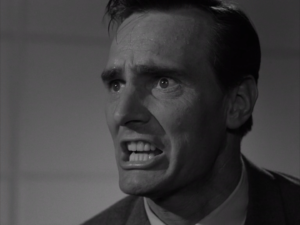
“Shadow Play” is directed by John Brahm; the teleplay is by the talented Mr. Charles Beaumont. And as for our cast, we’ve got quite a few here, but we have to start with what is a fantastic performance by Dennis Weaver as Adam Grant, particularly when it comes to the scenes where he is falling apart. Wright King plays Paul Carson, the editor; Harry Townes is our district attorney; William Edmonson plays Jiggs; Anne Barton is the DA’s wife Carol Richie; and Mack Williams is our priest. The episode first aired on May 5, 1961.
Episode Tidbits
As for our tidbits, I have a few quick ones courtesy of Martin Grams Jr.. According to fellow Twilight Zone writer George Clayton Johnson, “You know what I think is the best show, the one that has, for me, the greatest power? It’s the one with Dennis Weaver that Beaumont wrote” (400). Whoa! High praise coming from another wonderfully talented writer. The second tidbit is just a popular culture one: apparently you can see a clip of “Shadow Play” playing in Times Square in the movie Vanilla Sky from 2001. So, I went to the video tape, and sure enough, there it is. It’s the scene where Adam is refusing his sentence in the courtroom. I actually haven’t seen that movie since the early 2000s, so I don’t remember if that’s like a hidden little easter egg in there or not. If it is, let us know in the comments below.
Question 1: Can Adam beat the dream and survive?
Okay, strap in and grab your favorite beverage of choice. We’re going to go on a bit of a quest with this one. I thought long and hard about whether or not this would be a viable question for us. And, if I’m being honest, I still don’t know. But, let’s give it a shot.
First, we have to establish some parameters for this. What do I mean by beating the dream? Essentially, I simply mean can Adam enter into his recurring nightmare and make it so that at the end he is not executed. Is it possible? In order to really explore this idea, we have to get a sense of how much control Adam really has and aspects of the dream that he seems to not control.
There are two scenes or events in the dream that I find to be really interesting for our discussion. The first one is actually just a line–a nuanced passing comment that is made, but it’s an important one. Adam is in his prison cell and he’s waiting for the district attorney to arrive. He then asks his fellow prisoner, Jigs, what time it is. Jigs looks at his watch and responds, “9:05.” And after Jigs ribs him a bit with a sarcastic comment about having a date somewhere, Adam says the following: the district attorney, and I quote, “usually comes around about 9.” Now, what that tells us is that there is variation in time in this world. And variation means that, although some things might be determined, they are not determined with precision, which means, we at least have an opening for our discussion here. Hold on to that for a second. We’re going to continue to build our case to better understand just how much things can vary.
Let’s move forward a bit in our previous scene to when the DA actually arrives at the cell. Adam says to him, “you always come. I mean the district attorney always comes. It isn’t always you.” We of course get this point directly at the end of the episode when Jigs is suddenly sitting in the judges chair as the dream restarts again. But, this variation brings with it a new wrinkle: personalities. Do the various people bring personalities with them? This is a tougher question, but it’s not impossible. I think the key here is the scene where Adam is talking with the priest. Two important things happen in this scene: one, we learn that Adam can critically analyze within his dreams. He admits that the priest’s face is always almost recognizeable, but that he can never seem to quite get it–and then, it finally hits him: Father Beamon, a priest that Adam remembers who passed away when he was 10 years old. This is important because it means that Adam can make decisions within the dream and even change his mind based upon what is happening in front of him. Thus, variations in the dreamscape, along with a dynamic mind, can produce potentially different results. That’s one important part of this scene; let’s talk about another.
Adam tells the priest, “oh, everybody came to your funeral.” Now, why am I mentioning this line? It’s said with a kind of reverence of truth, meaning that Father Beamon must have been a good man, a good spiritual guide–and I think we can say that about the priest in the dream as well. He seems caring; he wants to make sure that Adam is granted his right to confession. So, although it’s not 100% a fact in any way–it seems plausible that characters do bring a kind of personality to their dream versions based on how Adam interpreted them in reality. He also mentions that Carson is the editor. Just as a reminder, the editor is the guy who is trying to convince the DA to stave off Adam’s execution. And why is Carson so concerned? Because he has been genuinely and intently listening to Adam–hearing his story. Now, in the same scene with the priest we learn that Carson is actually the priest who took over for Father Beamon in reality. Now, just a funny little moment that I only caught after starting to write this section. During the first lengthy conversation that Carson and the DA have, the DA asks his friend, “you mean you believe that crazy story?” And the DA calls it “ridiculous.” Now, Carson responds, “I know it is.’ And he adds, “God help me, Hank, but I do. At least, I believe it’s possible.” Ritchie, the DA, is trying to stick to the facts, to logic–like a good educator, which is who Adam believes Richie originally was, an old teacher or a friend of his father’s. But, Carson…Carson is using language of faith. He believes that this dreamworld thing is possible. He feels it in his soul. Again, not 100%, but I think it’s an interesting connection that helps us move toward the conclusion that people bring their unique traits–as Adam interpreted them–that’s an important aspect of this as well–to their characters in the dream world. Okay, let’s pace ourselves here, we still have something else to discuss here, a bombshell moment: when is a steak not a steak? Answer? When it’s a roast or when it’s in the Twilight Zone.
As the DA leaves the prison, Adam screams for him to check his oven at home, and that when he does he will find a roast there instead of the steak that his wife had originally prepared. And, sure enough, there as plain as day is a roast. Now, it would have been nicer if Adam said go home and check your piggy bank, but I suppose a roast gets the job done. What this means is that Adam does have at least some control over what is happening here–or at the very least, he has some control over the micro aspects of the dream, but not the macro. The timeline is always moving toward execution, but how it gets there…well, that’s a different story. It seems to me that Adam has only some control over key parts of the story, but not over everything. His frustration at the constant patterns repeating is testament to that, take for example his mouthing of the words back to the DA in the prison cell. There’s a kind of boring frustration from him, as if he has to get past that part in order to once again have a moment where there can be some variation.
So, let’s answer our question based upon all of the stuff that we’ve discussed here. Can Adam beat the dream? Carson as the editor seems to get Adam pretty close, but the truth is you need someone who is more easily convinced in the role as the DA. So, it might be that Carson needs to be the DA in order to come to the decision much more quickly, and how about Coolie, the guy with the harmonica at the beginning as the editor. When Grant tells him to knock off the playing, Coolie is really apologetically thoughtful about it. Between the variations in patterns, the ability to control certain aspects of the dreamsequence, and the unique personalities that are brought to the roles of the actors in the dream, yes, I do believe that one night, Adam will be able to beat this dream and receive his pardon from the governor before midnight.
Question 2: Is Adam lucid dreaming, or is something else going on here?
Many of you are probably at least somewhat familiar with the term lucid dreaming. But, let’s just take a moment to define it and clarify it. In its simplest form, lucid dreaming occurs when the person is aware that they are dreaming from within the dream itself. Additionally, agency is also often attached to lucid dreaming, meaning how much control an individual has over the dream itself, the plot for example. And if you’re already thinking….[well, that was quick, Joe. Yes, Adam is clearly lucid dreaming.] I’m going to once again, bring in the great poet warrior Quick Draw McGraw and give you a now hooooooold on there. Like The Carpenters, we’ve only just begun.
I found a fascinating peer-reviewed article titled “Lucid Dreaming: Not Just Awareness, but Agency” by Ableidinger et al. In this article, they’re trying to look at the connections between lucid dreaming, both with and without the agency to make changes, in relation to the quality of one’s sleep and overall mental health. They’re doing this in relation to the effects of the pandemic, but the findings themselves go beyond just that time frame. Here is what they had to say in the literature review section of their paper: “ We therefore hypothesize that only dreams, in which one is aware of dreaming and able to influence the dream, are associated with positive mental health and better sleep quality. This [indicates] that solely realising that one is dreaming, without being able to influence the dream, will not be associated with positive mental health and increased sleep quality” (2). What’s interesting about this for us is that, yes, we can at least start the surface-level part of this conversation by saying that Adam is lucid dreaming, but as we discussed in the first question, his agency is a mixed bag. In fact, this research, which was published in 2026, kinda corroborates Adam’s answer to everyone when they keep saying that he should just relax because it’s only a dream. The problem is that his inability to fully have agency over what is happening is indicative of something else, a distressful period in his life and maybe something much worse. I’m going to take this question to a weird place, so bear with me.
What I’m about to discuss is not about plot–this isn’t an interpretation of the story; it’s a thought exercise, a kind of what if. A question that never quite hit me on the many times that I’ve seen this episode is well…did he do it? Every night the dream begins with him standing trial for the murder of someone. So, did he do it? Let’s see if this one has some legs to it.
First and foremost, when Adam lunges at the judge, he says, “you can’t make me die again.” On a second watch, we likely interpret this as his raging against reliving the dream sequence. But, what if he did murder someone, and what if he did stand trial, and the biggest what if of them all, what if he was actually executed. That would mean that even on the very first occurrence of his dream, he would still be able to say to the judge, “you can’t make me die again.” Now, dead men don’t dream, right? But, again, I ask you to bear with me. Think about it. Adam is really clear about the fact that there are aspects of his dream that are only interpretations of things from movies. The biggest one, in my opinion, and the biggest point against my argument is when he’s telling Jigs about the prison house. He says, “Real death houses aren’t like that, but you see I’ve never been in a real death house, so that’s my impression of it.” If we take Adam at his word here, then there are still a couple of ways that we can read this moment: one, all of this–including the trial and everything, is all just some dream, a lucid nightmare and nothing else. Or, if we want to take him at his word, maybe he was on trial, and maybe he did murder someone, but he got away with it. And these half-lucid nightmares are his mind’s way of punishing him for getting away with it. Oh…I think we might be on to something here.
Think about this: what is Adam’s main argument for staying alive? What is the reason that he continually gives the people in the dream? If I die, you all die with me. It’s never really about his innocence. In fact, when the DA and Carson are talking the first time, the DA says, “This guy killed a man in cold blood. Those are the facts.” Why doesn’t Adam ever pursue innocence? I suppose you could say that it’s because the dream always begins with the trial scene, after the arguments have already been laid out and the jury comes to its decision, but my point is Adam never pursues it. And then, there is this line: when the priest says to Adam, “there’s always need for prayer.” Adam responds, “only in the real world, Father. Not in a nightmare.” There’s something different in the way that Weaver plays this part of the episode. It’s like Adam is having this moment of realization, that he, perhaps, could have sought a kind of reconciliation in the real world, but here there’s no point. You might even recall that when he’s getting dragged away from the judge’s bench at the beginning, he screams out “God, please!” Can you see where I’m going with this?
Again, I’m not saying this is what actually happened in the story. I’m perfectly fine with saying that the answer to our question is that Adam is lucid dreaming with limited agency. That’s fine. But, I do think that another interesting possibility, one that has already been explored before in The Twilight Zone, is that Adam might be in a kind of hell–a recurring nightmare like Nehemiah Persoff in “Judgment Night.” Because he did not receive true judgment for his crime of killing a man on earth, he will receive it a thousand times over in the next life. And, just as a bit of icing on this cake with no file in it, Serling in his opening monologue does call Grant a “criminal” who is “caught in the wheels of justice.”
I don’t know, my KOI friends. I’m actually kinda partial to the something else is going on here beyond lucid dreaming part of our question.
Question 3: What are your moments of awe?
My moment of awe is actually tied to a special message I received regarding this episode. It came in the form of an email from a person that we’ll call Ishmael (and yes, that’s a nod to my Moby-Dick background)–and I want to say upfront that I received permission to talk about this from Ishmael. This person was kind enough to reach out and share a rather personal story about their journey to sobriety and specifically how this Twilight Zone episode provided some context into how it feels. What Ishmael sent me came from someone he knows who was also struggling with sobriety: Ishmael writes, “They explained it like they felt that they were someone who woke up every morning supposed to be hooked up to the electric chair (aka start drinking) But by doing the healthy life practices that got them sober and keep them sober they are petitioning to the governor for a stay of execution. The big book of AA states that what we have is "a daily reprieve contingent on the maintenance of our spiritual condition".
First and foremost, Ishmael, thank you for sending that. Stories are how we still best learn from each other, and so I’m grateful for and humbled by your decision to share. Something I just want to add to Ishmael’s story: if you’re currently struggling with an addiction, what I just read might sound somewhat intimidating or difficult: the constant worrying, the intense responsibility of a moment–but that’s not really Ishmael’s point here. The point is by establishing healthy patterns of living, you are continually offered this opportunity to live another day of clarity, of meaning beyond what the substance can offer you, of true agency–so that each day of sobriety becomes truly your own to do with as you wish. I’ve mentioned this on the show before, the idea being that you should make the decision today to give yourself that gift of your life back. But, in truth, I think you need to make two decisions, not just one: yes, the first is to decide that you want your life back, but I think the second decision needs to be to reach out to someone and start to build the platform from which you can stand on your own feet again. This can, and in some cases most likely should, be a professional; going off certain substances can be physically dangerous. But, this first reach out can also absolutely be a friend or a family member. It doesn’t matter how old you are, 16 or 86–it’s not too early or too late. There is no better day than today; there is no better time than now. And no one would be happier than me if you decided to just shut this video off right here and go take those first two steps. We’ll all be here when you get back.
My Rating.
As for my rating, I watched this episode five full times for this KOI episode: yes, five full times, not including the handful of times that I just went back to check something, and you know what, I enjoyed it each time. Dennis Weaver’s acting; an amazing premise; a legit Twilight Zone ending…oh, can you feel it coming…this is a Top Top-Tier episode for me. And so, it gets the Twilight Zone Tower of Terror Bell. [ring]. Tt’s just filled with too many fantastic what-ifs to think about, and if you don’t want to think about the what-ifs, you can still just turn your brain off and be carried away by the world that is created here. It’s a well-deserved Top Top-Tier for me, a must watch when it comes on during a marathon tv run.
Next Episode
Next time, we’ll be taking a look at “The Mind and the Matter” and here are your questions to consider when watching the episode:
Question 1: What are we supposed to take away from the mind over matter concept in this episode?
Question 2: Why does Beachcroft start to experience visions of himself?
Question 3: What are your moments of awe?
Announcements and Shout-outs
I have a couple of announcements actually.
First and foremost, I had a lot of fun doing the Twilight Zone one-timers bracket challenge with all of you, and I thank you for participating in the votes, and to those of you who filled out brackets, particularly PHXDOG and Zephyrcat7, both of whom had more successful brackets than my own, which was completely busted by the end of the first week–just like my March Madness brackets. I have to say, I was not expecting Art Carney to come out on top, especially when you think about the fact that he had to beat James Daly from “A Stop at Willoughby” on his own side of the bracket and then he had to beat none other than Mr. Death himself in Robert Redford. It’s a cinderella story. I hope you all had as much fun as I did.
Secondly, I will once again be attending Serlingfest this year, which is taking place on Friday, August 21st and Saturday August 22nd in Binghamton, NY. And just to clarify, people usually gather on the Sunday as well in Memorial Park over by Serling’s statue for some music, a couple of speeches, and to essentially close out the festivities. Twilight Zone royalty Bill Mumy will be Zooming in for a live conversation, along with Chris Beaumont and Richard Christian Matheson–now those are some heavy names. As you know, I give 25% of every dollar taken on this channel, after the platform fees, to the Rod Serling Memorial Foundation to help support the work that they do. Well, that hard work is never more present than it is in how much thought they put into Serlingfest. It’s a rather intimate affair, not particularly big, but that’s the charm of it. You’ll see Ann Serling walking about; Rod Serling’s nephew Jeff Serling, and they’re all incredibly kind. So, if you’re interested in going to Serlingfest this year and would like to meet up to say hello, head over to Rodserling.com to take a look. I always enjoy seeing people there.
How to Support the Show
Want to support the channel? Consider subscribing, liking, commenting, and sharing the show with a friend–you know all of the usual algorithmic gymnastics, that will help us expand our awesome community of Twilight Zone fans. Plus, you never know, I might just highlight your comment in an episode of the show–as long as it's family friendly. And if you want to be immortalized on our list of key KOI supporters, consider joining one of our membership tiers on YouTube or Patreon. 50% of all money taken through this channel, after the platform fees, is going to charity. 25% to the Rod Serling Memorial Foundation, and 25% to the Gary Sinise foundation. For more information about me, my scholarship, and the show, head over to the keyofimagination.com. That being said, even if you hated every minute of this, I’m still going to thank you for spending some time with me. Until next time, remember, all doors are open to those who possess the key of imagination.
Works Cited
Ableidinger, Severin, et al. “Lucid Dreaming: Not Just Awareness, but Agency.” Journal of Sleep
Research [England], vol. 35, no. 2, April 2026, pp. e70181-n/a,
https://doi.org/10.1111/jsr.70181.