
The Twilight Zone Season 2: Episode 63
"The Mind and the Matter" Episode Transcript
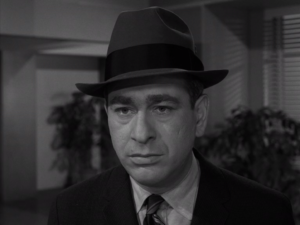
Introduction
Welcome to the Key of Imagination. This week, we’re taking a look at the Twilight Zone episode “The Mind and the Matter”. We’ll try and figure out what we can take away from this whole mind over matter concept; we’ll explore why Beechcroft is seeing those mirror manifestations of himself; and I’ll reveal my moment of awe, a rationale for why we sometimes need to be okay with being a pain in the butt. So, grab your keys, and let’s open up this door to the fifth dimension.
Plot Summary
Archibald Beechcroft hustles his way on to the subway train, exiting for a brief moment only to get jammed into an elevator with others, and ending up in an office with the never-ending din of clicks, clacks, and clods. To sum up Beechcroft’s problem in one word: people. People everywhere, making noise, taking up space, and getting in the way. If he had it his way, why there would be no people, just pure, quiet, unobstructed solitude. Henry, a young man who works at the company, as a token of apology for spilling coffee on Archibald earlier, gives Beechcroft a book over lunch: The Mind and the Matter. In this book, it talks about how concentration is the greatest power in the universe. And when the landlord begins to incessantly knock on Archibald’s door, it provides him with his first chance to put it to use. As he focuses his thoughts, suddenly there is no more knocking, for there is no more landlord. She’s gone, vanished. The next morning, so too are the people on the subway, and in the elevators, and even his coworkers at his job–everyone, gone. He finally has the solitude he always wanted. But, with it comes boredom, and an inner monologue questioning if this is really what he wants. After a few days of trying to manufacture interest in the world, including creating a bevy of Beachcrofts, who seem just as annoying as everyone else, it finally hits him: people, the hustle and bustle, the variety of personalities, it may not be perfect, but it beats the alternatives. And so, after a brief I told you so from his inner self, Beachcroft brings everyone back, just the way it was.
Episode Details
“The Mind and the Matter” is directed by Buzz Kulik. The teleplay is by Rod Serling. As for our cast, let’s start with our leading man, Archibald Beechcroft played by Shelley Berman. Henry is played by Jack Grinnage; and Chester Stratton is our Mr. Rodgers, the office manager, not to be confused with either your friendly neighbor or one of the Avengers. The episode first aired on May 12th, 1961.
Episode Tidbits
As for tidbits, there is surprisingly quite a bit of extra information on this episode in Martin Grams Jr.’s Unlocking the Door to a Television Classic, so I’ll once again pitch that if you love the Twilight Zone, you should definitely snag a copy. I’ll just mention one that I think is interesting here. Originally, the episode was going to feature Joey Bishop, the comedian, in the role of Archibald Beechcroft. For some of the younger viewers out there, Joey Bishop is probably mostly known for the days when he was a part of the rat pack. No, not the brat pack, which is the group from my generation. I mean the rat pack, as in Frank Sinatra, Sammy Davis Jr., Dean Martin, Peter Lawford, and Joey Bishop. I find this interesting because at the time that this episode was shooting, Bishop was pretty much at the top of his career. Later, he would have a falling out with Sinatra after old blue eyes asked Bishop to cover some performance dates for him in 1964. Now, reading this made my mind wander a bit, and I’m glad it did. Check this out. I initially wondered if Bishop had done the episode and had a good time, if maybe, just maybe, Serling could have gotten Sinatra to be on the Twilight Zone. And that led me to look up if the two had ever collaborated, and it turns out, they did. Right after the Twilight Zone wrapped its final season in 1964, Serling was asked to fix a troublesome movie script based on the Jack Finney novel Assault on a Queen. Apparently, quite a few writers tried to adapt the novel into a screenplay for Sinatra, and it just wasn’t working. So, Serling stepped in and rewrote the script (link). And…here is a quotation from Serling himself regarding the Chairman of the Board. Serling states, “"It had been tried several ways," he said. "But I decided to make it a straight adventure film and it seems to have worked out pretty well. At least, Sinatra tells me he's happy with it” (link). I don’t really want to take out anyone from the Twilight Zone and replace them with Sinatra, but it would have been cool to see him in one. I’ve never read Assault on a Queen nor have I seen the film, so I’ll have to add that to my list of Serling stuff to check out at some point.
Question 1: What are we supposed to take away from the mind over matter concept in this episode?
Well, I suppose the message is that people are terrible, but we need them. [Goodnight, everyone. Don’t forget to tip your waitress.] All joking aside, this is somewhat the message that we leave with, but my dear KOI friends, we simply cannot accept this. No. I won’t. Yes, as a species, we can be difficult; we can be annoying; we can be selfish–all of those things. But, you know what else we can be? Lazy. I forgot lazy. But, darn it, we can also be creative and enthusiastic. One of the main problems with Archibald Beechcroft is that he lacks imagination. Luckily for all of you out there. I don’t. In fact, you could say, I hold the key of imagination. [Boo!] Oh, stop it. It’s my show. I apologize for nothing! There are definitely things for us to learn here through this episode, starting with this mind over matter concept, which, I have to admit, is a bit more complex than I had originally thought. Let’s begin by using our episode to set the context for our conversation.
We should recall that it is Young Master Henry who gifts the Mind and the Matter book to Beechcroft, and Archibald devours it seemingly in one day, which is quite an act of concentration itself. This of course leads to our first real test case for Beechcroft: the landlord. And with some intense focus, Beechcroft is able to make her disappear, essentially either removing, or at least moving, her atoms from their current positions. Now, we do have a term for the belief that our minds are capable of removing objects or disturbing the force around things without touching them. It's called psychokinesis. When I read about psychokinesis, the first thing I thought of was the Force from Star Wars, which I suppose, thanks to the prequel trilogies, we now know is due to little intelligent biological entities within Jedi cells known as midichlorians. Now, just as a quick aside, I remember hearing this explanation in the movie theater the first time and thinking, what? Why are we making this so complex? Why can’t it just continue to be this really cool mysterious thing? But, to be fair, I learned that good old George Lucas actually developed this idea back in 1977. It just wasn’t introduced into the films until 1999. Fair enough, Mr. Lucas–Fair, enough. But, I still hate Jar Jar Binks, so…there.
The other famous popular culture moment that I think of is the famous bending of the spoon scene from The Matrix, which, as we all learned from the little philosopher kid, is more about that there is no spoon. It is us who bend. [Whoa]
Now, I remember being in the theater for this one as well and thinking it was a pretty cool little scene, but I do have one, tiny philosophical difference of opinion with this scene that I think can actually help us better understand our protagonist Archibald. However, I want you to just keep this in the back of your mind for a brief time. We need to develop a parallel conversation that we can then merge with it toward the end of our discussion. We’re told time and time again that Beechcroft hates people. Okay, but that’s actually just where the hate is directed. A question that we need to develop is what exactly is it that he hates about people? And, I do believe we have a pretty straightforward answer to this one.
The episode begins with a montage of Beechcroft’s morning routine. We see a bunch of people all over the screen, scurrying about; then jammed up together on the subway, bumping into each other; then, just post Rod Serling’s monologue, we have a wide angle view of the office and get a feast for our ears of clicks and murmurs. And we know that these vignettes of his morning routine are on Archibald’s mind because later in the restroom, he complains to his boss about all of them. What do all of these have in common? If you said, people–you’re thinking like Archibald. We have to go a bit deeper than that. It’s not so much the people; it’s what they produce: constant sensory experiences. I think Beechcroft’s main problem is not so much people as it is a feeling of sensory overload.
You know, I can somewhat sympathize with this. There are times when I feel like I really just need to be in a quiet room with nothing on tv, streaming–-I don’t even want to hear the sound of my own inner monologue voice–and I’m not joking about that. Thank goodness it’s not something that paralyzes me, which for some people it can actually get that bad. But, if I don’t get a chance to at least experience some calmness to my senses, particularly my hearing, I essentially become a bit grouchy–my wife can vouch for that one, although she’s probably too kind to admit it. Now, let’s go even a level deeper here.
There is a branch of philosophy known as phenomenology, and I’m going to actually rely on an old friend, the Stanford online dictionary of philosophy, to explain it more succinctly than I could. “Phenomenology is the study of structures of consciousness as experienced from the first-person point of view. The central structure of an experience is its intentionality, its being directed toward something, as it is an experience of or about some object (link). Now, there are a couple of key terms in that definition that we want to hold on to: consciousness, experience, direction, and objects. Let’s put this into action. Take a minute and either look at something in front of you or key in on a particular sound for a moment. Why is that there? Why is it in existence? More importantly, why are you experiencing it? Phenomenology is not about whether or not something exists as a collection of atoms so that if you were to look away from that item or stop listening for it, the object would simply cease to exist. That’s not the point. Phenomenology has to do with how WE specifically, experience the world around us. Velvet is soft; lemons are tangy. But why? What does that even mean? The brain orchestrates an experience of the senses, and we use language to then coordinate that experience with each other. It’s why sometimes people with traumatic brain injuries can lose their sense of taste. The taste buds might be still sending the signals, but the brain can no longer coordinate them. Okay, stay with me. We’re coming in for a landing.
I mentioned a little while ago that scene in the Matrix with the spoon and that I had one slight philosophical difference that I wanted to explore. The little philosopher child says that there is no spoon–okay, if you know the story of the movie, you also know why he’s saying that. I won’t spoil it, but just know that it makes sense. But, I would actually add one little difference here as well that we and Neo for that matter also need to contend with. The mind’s orchestration of its experience of the spoon is also really important: ie the phenomenological aspect of it, which, again, is not about an object's existence, but how we experience that object within our consciousness. It seems to me that Neo could have taken the little philosopher child’s words even more literally and simply chose to not acknowledge the spoon existed at all. And that, my friends, takes me to what I think is an interesting alternative reading here.
What if Archibald never actually makes the people disappear. What if he simply found a way to force his mind to no longer experience the people on a sensory level? In other words, the landlord never stopped knocking; he just simply didn’t listen to her–refused to see her. The same with the people on the subway and at work. He just completely shuts off his brain’s way of interacting with these people in any sensorial capacity. In doing so, he would be able to still achieve what he wishes in the episode. Think about it. People go into sensory deprivation tanks and they practice Yoga and mediation to the point that they can withdraw inward and reduce sensory overload. So, what should we take away from this whole mind over matter aspect of this episode? I think it’s far more terrifying to think that Beecroft was simply ignoring the presence of physical objects and people and simply walking through them or over them, but I also think it would have been kind of a funny concept. I’m sure that we are meant to believe that he actually does make the world disappear, which is fine. But, I will say that pursuing this question reminded me of just how weird our brains really are. They definitely are their own little Twilight Zone spaces.
Question 2: Why does Beachcroft start to experience visions of himself?
The origin of this question has to do with an initial response that I had when I rewatched this episode the first time. I wasn’t really sure if these reflective manifestations of Beechcroft were really adding anything to the episode. I guess what I mean is, do we really need them, and if so, what are they actually providing in terms of the plot? Beachcroft can make matter appear and disappear, which means that it’s fair for us to question why he doesn’t simply manifest additional friends, or why he can’t just make bodied versions of these reflected selves? We know that he can; he replicates himself later in the episode. So, why are they here at all? That is what led me to this question, so let’s try and figure this out a bit together.
Let’s do our best to first contextualize their initial appearance. When Beechcroft first experiences his desired solitude, he loves it. He’s able to get a bunch of work done, and he even does so with time to spare. And it’s this extra time that actually starts to introduce some problems for our protagonist. In fact, he openly says out loud at one point, “how does one occupy his time?” Occupying time–now that’s an interesting phrase for us. Something really strange about this moment is that did you ever notice it doesn’t take Archibald long at all for him to just become bored. No, really. He starts work at 9am and by 4pm he is bored with life. Now, you might get bored on a given day at work; I’m not faulting anyone for that. But, remember, this is a rather unique day and scenario. He essentially has all of the city to himself, and he can think of nothing to do? That’s insane to me. I would be running around the building having chariot races with the boss’ chair and running crude highly unscientific experiments growing new organisms with the food left over in the fridge, but you would never catch me being bored. Lonely–absolutely. Bored? No. So, what gives? Well, in order to better understand this, we’re going to have to get boring. [Joe, we’re already there.] Excellent!
The peer-reviewed literature on boredom is actually quite stimulating. There are positives and negatives to boredom that I think directly relate to our man Archibald. First, the positives: according to a study by Ndetei et al, “Boredom can…prompt [us] to reflect on values, goals, and aspirations, and motivate [us] to make changes in [our] lives. In this sense, boredom can be seen as an opportunity for self-awareness and self-improvement” (link). Well, that sounds great. So, why does it seem like we hate boredom so much? Well…here’s the other side of that coin. According to the same study, boredom can also lead to “decreased productivity, poor mental health, and even physical health problems. In one study a significant percentage of participants−67% of men and 25% of women—preferred to administer electric shocks to themselves rather than experience boredom while sitting alone with their thoughts (Wilson et al., 2014)” (link). I don’t know which is worse there: the fact that people would rather be shocked or that I’m not shocked that people would choose that option over being bored. The article adds, “Boredom has also been associated with various negative behaviors, such as self-harm, substance use, and engaging in distractions like watching movies during work (Havermans et al., 2015; Weybright et al., 2015; Nederkoorn et al., 2016)” (link). Watching movies during work hours? Why that’s outrageous. If you simply make the theme of your class The Twilight Zone then it becomes my job to watch Twilight Zone episodes, and so it’s not unethical–exactly.
What does this mean for Beechcroft? Let’s come back to his phrase occupying time. The truth of the matter is that Archibald spends a good amount of his day occupied in the age old pastime of complaining. And actually, I’m a big believer in allowing people to vent. It can help strengthen bonds between coworkers and allow someone the opportunity to let a particular idea escape into the either, which often leads to the person feeling better and letting go of this thing that has been bothering them. The problem is when complaining becomes your hobby, your sole means of occupying your brain, instead of doing what we should be doing when we’re bored, which is reflect on ourselves, our goals, or honestly, just being quiet and resetting ourselves to later reengage the world. Beechcroft is one of these people. He just never quite realized how much of his day is spent complaining and being annoyed. And that is where the reflective versions of himself come into play.
Did you ever wonder why these reflections are so antagonistic? They could have been comforting, supportive little jiminy crickets to help guide Beechcroft. Instead, they’re often snarky, sarcastic, and way too happy to see Archibald fail. Why? In one of their interactions, the reflection says, “solitude is one thing, but loneliness…loneliness is quite another.” To this, Beechcroft fires back, “Loneliness nothing. I despise people. I loathe them.” Through this interaction, he is able to do what? Complain. To don his usual voice of disapproval once more. And so, I think it’s fair for us to look at these reflections as his mind manifesting antagonistic others from which he can then use as fodder for his complaining hobby, in other words to avoid not just being bored but having to reflect on his own realization that people are quite necessary, if for no other reason than to provide him with something to complain about.
And so, to answer our question: why are these manifestations here, I’m going to offer a straight answer and a what-if. I think these manifestations provide Beechcroft with an outlet for his need to complain, at least on the surface. But, what if we go a little deeper than that. What if these manifestations are doing this as a kind of self-preservation mechanism. Think about it. Beechcroft is actually quite a stubborn guy. He might have tried to remain alone on pure principle. And yet, it’s clear from the episode that he’s not actually that good at being alone, or at least being lonely, as the manifestation states. I think there’s a legitimate reading here that we can make that these reflections may actually be trying to save Beechcroft’s life, to help him avoid what could become a rather deep, dark depressive state. I suppose I’ll land on the answer that these reflections are necessary to the episode, and perhaps more important than I had originally realized.
Question 3: What are your moments of awe?
As for my moment of awe, I want to talk about a character in this episode that I really like. No, not Beechcroft, Henry, the young man. Yes, he routinely spills coffee on Archibald, and yes, he seems like he might even get a little tiresome after spending a couple of hours with him, but you know what else he is? Thoughtful. When the cafeteria is all full of people and Beechcroft is looking for a place to sit, it’s Henry who waves him down and offers a seat, without any apprehensions or hesitation. And the enthusiastic way that he talks to Beechcroft, as if nothing bad had ever happened between them. You know something? Henry is a pain in the butt. And you’re thinking, sheesh, Joe, you just said all of these nice things about him and now you’re going to tear him down. Well, no. Actually, I mean that as a compliment. I’m a bit of a pain in the butt myself. When I see someone who looks like they might be going through a difficult time–not a one-off bad day; we all have those, but if I see someone whom I think is just going through a bad phase, I’ll often just stop by and say, “hey, how you’re doing?” Or, I’ll try and involve them in a project that I’m doing just to give them an outlet for their minds to be somewhere else, even if I don’t need any help on the project. And yes, sometimes I’ll realize that they might need to be alone, and I’ll back off–for a time, but if they seem to be getting worse, I’ll be a pain in the butt again. These days, we’re quite afraid of bothering people, of having others be annoyed or angry with us. But, we have to be okay with that sometimes, especially when we think that someone is potentially going down a dark pathway. It’s okay for people to be annoyed with you sometimes; and it’s okay to reach out to someone and say, “hey, you seem off. Is everything okay?” Or even just invite them for a cup of coffee under the auspices that you are the one who needs help with something–I use that one quite a bit. It works really well. What can I say, I like this Henry character. I would gladly trade the occasional coffee being thrown at me for a few more Henrys in the world, a few more pains in the butt like him.
My Rating.
As for my rating, I mean…I don’t particularly love this one. However, this is a good example of where I couldn’t put this episode in the lower tier in good faith because it absolutely delivers on its premise–no doubt about that. That being said, there is something unsatisfying about it for me. It almost feels like an unfinished episode. It might be because Serling adapted the story from something he had previously written, and maybe it was just a good old fashioned time crunch. That Twilight Zone schedule was grueling. I don’t dislike Shelley’s performance here. I think it’s perfectly competent, but I also don’t think it stands out. I’m fluctuating a bit between Middle Lower-tier and Middle Middle-tier. Now, I’m going to be honest and say that I likely would get up if this came on during a marathon in order to freshen my drink or get a plate of nachos or something, so I suppose that places it in the middle lower-tier for me. But, anything in the middle tier is watchable to me in the right mindset, so being in the middle lower-tier is not really as bad as it sounds.
Next Episode
Next time, we’ll be taking a look at “Will the Real Martian Please Stand Up” and here are your questions to consider when watching the episode:
Question 1: What parts of this episode help us build a profile of this martian figure?
Question 2: Does Grandpa play a significant role in this episode or not?
Question 3: What are your moments of awe?
Announcements and Shout-outs
Just wanted to take a quick moment to thank our newest member of the Key KOI Partner group, MrTatyumi. Thank you for your support of not only the show but of the charity work as well. It is greatly appreciated.
I do have a couple of comments to mention from the YouTube channel. On my “Third from the Sun” episode, @johnbarber9417 had the following to say: “Excellent analysis! Subbed and liked. Some people have a theory this TZ episode is a precursor to the current Apple+ show, “Plur1bus”.” First, John, thank you for the kind words. I’m always humbled by how thoughtful this community is. Now, secondly, others have mentioned this show Pluribus in relation to this episode, and I’ve got it on my summer list of things to check out, so I’ll be curious to see how the “Third from the Sun” episode connects.
On my “The Silence” episode, TJones-zw9mw had the following to say: “IIf Tennyson was willing to sever his vocal cords to win the bet then he should have made that the original bet in the first place. That way he could have been paid instantly and not spent a year of his life in a box.” TJones, that’s actually a good point. I suppose Tennyson could have offered the bet upfront. I wonder if Archie would have still been able to get away with not having a certified check? Either way, I like it. I like the thinking here.
How to Support the Show.”
Want to support the channel? Consider subscribing, liking, commenting, and sharing the show with a friend–you know all of the usual algorithmic gymnastics, that will help us expand our awesome community of Twilight Zone fans. Plus, you never know, I might just highlight your comment in an episode of the show–as long as it's family friendly. And if you want to be immortalized on our list of key KOI supporters, consider joining one of our membership tiers on YouTube or Patreon. 50% of all money taken through this channel, after the platform fees, is going to charity. 25% to the Rod Serling Memorial Foundation, and 25% to the Gary Sinise foundation. For more information about me, my scholarship, and the show, head over to the keyofimagination.com. That being said, even if you hated every minute of this, I’m still going to thank you for spending some time with me. Until next time, remember, all doors are open to those who possess the key of imagination.
Works Cited
Ndetei, David M et al. “Boredom-understanding the emotion and its impact on our lives: an
African perspective.” Frontiers in sociology vol. 8 1213190. 29 Jun. 2023,
doi:10.3389/fsoc.2023.1213190 https://doi.org/10.1111/jsr.70181.