
The Twilight Zone Season 2: Episode 64
"Will the Real Martian Please Stand Up" Episode Transcript
Introduction
Welcome to the Key of Imagination. This week, we’re taking a look at the Twilight Zone episode “Will the Real Martian Please Stand Up”. We’ll try and build some kind of profile for better understanding our martian friend; we’ll break down the importance of grandpa in this episode; and I’ll reveal my moment of awe, a quick anecdote about a true moment of awe I experienced bringing this episode into my classes this past semester. So, grab your keys, and let’s open up this door to the fifth dimension.
Plot Summary
A phone call to the police department in the middle of a snowy night from a concerned citizen. Seems pretty straightforward. However, the complaint is anything but usual. It seems that something strange has landed in Tracy’s pond, and when the police arrive to check it out, they find odd tracks leading to a cafe/diner, with a bus parked outside. Upon entering the establishment, the police officers are greeted by a collection of people: couples and singles of all varieties and ages. As the officers begin to question the bus driver regarding how many passengers he had on the bus originally, we learn that the numbers simply don’t add up. There should be six passengers, plus the driver. And yet, there are 8 people in the diner–and the owner of the establishment, Haley, swears that no one has come in since 11am. A mystery is afoot. One of our passengers is NOT who they claim to be, and in fact, might be someone from another planet. As the people go back and forth trying to uncover who was on the bus and who wasn’t, we start to see various personalities emerge: the bus driver, just trying to make a living; a cantankerous businessman named Ross; Ethel, a lovely dancer; a young newlywed couple, the Princes; a married couple with more experience, the Kramers; and an eccentric old man named Avery. With time on their hands until the county engineer can clear the bridge for crossing, they begin to bicker with each other: and while this is happening, strange events keep occurring: the lights flashing on and off, the jukebox playing on its own, and containers of sugar exploding right in front of them. A phone call from the engineer breaks up the tension–the bridge is safe to pass. And with no grounds to hold them, the police have to let them all go. Flash forward a bit: beautiful music playing on the juke box. Another visitor enters the diner: the businessman, as he saddles up to the counter, he begins to talk about all the wonderful things we humans have, and how his martian friends who are on their way to colonize, are really going to like it here, as he calmly displays a third arm under his coat. Mr. Haley agrees; there are wonderful things about earth. He and his venetian friends found this out as well, which is why they will be colonizing the planet, having already dispatched the martians. As he laughs at his extraterrestrial brother from another–um…other…at the counter, the venetian’s eyes, all three of them, glimmer with delight.
Episode Details
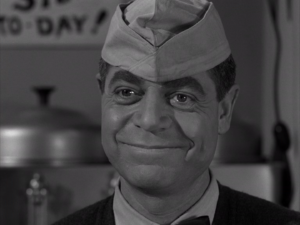
“Will the Real Martian Please Stand Up” is directed by Montgomery Pittman. The teleplay is by Rod Serling. And as for our cast, grab a beverage. We’ve got a few to name here: let’s start with our martian, Ross, played by John Hoyt; our venetian friend, Haley, the diner/cafe owner is played by Barney Phillips; our eccentric friend, Avery is played by Jack Elam; Jean Willes is our dancer, Ethel McConnell; Willam Kendis is our bus driver; trooper Bill is played by John Archer; trooper Dan is played by Morgan Jones; Bill Erwin plays Peter Kramer; Gertrude Flynn is his wife Rose; and our young couple, Connie and George Prince are played by Jill Ellis and Ron Kipling respectively. The episode first aired on May 26th, 1961.
Episode Tidbits
As for tidbits, I’ve got just a couple I’ll mention: one I figured out on my own, the other comes from Martin Grams Jr’s. Unlocking the Door. On the bus, you can see the company name “Cayuga.” This is of course an inside joke, referring to Serling’s own production company: Cayuga Studios. I knew that one. However, the other little tidbit, and there are a few interesting ones in the book, is that Haley the cafe owner was supposed to originally have four eyes–-two extra ones, not just the one extra, but the person doing the makeup could only finish one (408). I prefer Haley having only one extra eye, so I think it all worked out well in the end.
Question 1: What parts of this episode help us build a profile of this martian figure?
I’ve seen this episode countless times, and I’ve always found the martian to be an interesting character: the way he talks, his mannerism, even just the way he holds himself in front of others. In writing for this question, I was led down a particular pathway that I was not expecting. As I rewatched the episode and really focused on Ross as a character, I started to key in on something specific: his disposition. There’s no doubt: Ross is a grumpy bugger and a bully at that. But why? Why employ this facade–and yes, I do think it’s a facade. That was the muse for this question, and so let’s start to build an understanding of Ross’ cantankery together.
Let’s start at the beginning of the episode. When the police officers tell the group that they are trapped until morning, the martian says, “I’ve got to be in Boston at 9am.” This provides a very specific goal, a place to be, at a specific time–and it simultaneously builds additional stress into the other people, especially the police officers and the bus driver. Now, the driver fires back, “then you better start walking, Mr. Cuz that bus stays out there until they fix that bridge.” Now, even though Ross got his answer, he’s not done with the bus driver. He physically walks over to the table of the driver, sits across from him, and says, “that’s a fine little bus line you work for, isn’t it? They care so much about their schedules, don’t they?” Now, why am I bringing this scene up? It helps to establish that Ross is not only selfish but aggressively difficult to deal with–a bully, which is not only all-too human, but it makes it so that people will naturally want to leave him alone, which means he can control his space, control who is around him and thus better hide in plain site. In other words, people are going to avoid him when they can unless he wishes to be noticed. Let’s get a little deeper into how he does this.
The martian has a couple of really intense exchanges throughout. At one point, grandpa says, “well if somebody was to ask me,” and then the martian interrupts and says, “well no one did ask you and no one will.” The camera cuts back to grandpa and he clearly looks like the response threw him off of his thoughts a bit. And then the dancer chimes in and says, “why don’t you leave the old man alone.” She’s clearly agitated, to which the the martian continues the moment by answering back, “who invited you into this,” which is, again, brilliant because of course no one invited Ross to say what he did, and we as humans, the little justice machines that we are, we would have absolutely recognized that little bit of irony, and someone in that room was likely, even if just by pure statistical likelihood, someone was going to take that bait that the martian lays out. And the dancer is the one who takes it. She says, “Well, I didn’t realize we were waiting for invitations, but you’ve got this big thing about bossing people around.” And you can see the bus driver next to her is also starting to get angry. What is the martian doing, and what purpose does it serve for his mission?
He’s agitating people, putting them more on edge, and in doing so he is able to amplify the effects of the illusions–the lights going on and off, the jukebox playing, the exploding sugar containers–if you put people on edge they are more likely to have their nerves fray, and when our nerves start to fray, more than anything, we want whatever is doing that to stop, to bring it to an end. That’s biologically within us; nervousness is a way for our bodies to bring about an action or at least to bring an awareness to something potentially dangerous or deleterious–it’s not meant to stay with us for long periods of time. Remember, right after this intense exchange, the husband of the older couple intervenes. He says, “Look, it’s tough enough just sitting here without…” and then the lights start flashing. He was trying to bring the intensity down, a perfectly wonderful thing for a human to want to do–to de-escalate. Now, this character, Mr. Kramer, can also be a bit intense, but you might recall that earlier in the episode he pointed out that they were going to eventually start to eat each other alive, to pull a phrase from Claude Aikins in “The Monsters are Due on Maple Street.” And so he might be a bit intense, but he clearly understands that escalation is something that will only hurt their collective predicament. Whew! We’re cooking now. Let’s keep going.
The lights flashing on and off, interrupting Mr. Kramer, puts the people in the room back into a heightened state of nervousness, and then Ross doubles down by making the sugar explode, a giant hit to the nerves of everyone, so that the passengers, the police, and, until later on, the diner owner are all together at their maximum point of agitation–the police officer even pulls out his gun. And just as everyone is about to explode like the sugar containers, the phone rings and provides what? Not just information but a way out of the current anxiety, a deus ex county engineerus. Is that latin? No. But it’s slightly better than the pig latin I was going to use.
Ross raises the anxiety to its highest point and then provides them with an easy, ready-made solution to run away from it. And just as a side note, and I absolutely welcome anyone to comment below on this: a question that I always had about this episode is whether or not the engineer really called and gave the go-ahead for the bridge to be crossed, or if the martian orchestrated the whole thing, both the phone call and the voice of the engineer. For a long time, I always thought the engineer actually did call, which is why the tone of the martian is somewhat surprised at the end when he says to the diner owner, “you know what? That bridge wasn’t safe.” But, now, I’m not so sure. He points out that the phone ringing is an illusion, but I honestly don’t know. That one is a bit of a mystery to me. Let me know if you have a take on that one way or the other.
Okay, so what kind of a profile can we build of our martian friend? Writing about this was really fun, and it does make me see the martian in somewhat of a new light. Of course through the reveal itself at the end, you realize that he has been manipulating things left and right, but I never quite understood just how much that agitated grumpiness that he displays is probably part of the whole illusion. I called it a facade earlier, and I stick by that. If you rewatch this episode with this new focus that we’ve uncovered here, it makes the ending even more interesting because he’s actually quite affable with the diner owner–much more relaxed and even open to enjoying the creature comforts that we have to offer: like music and…well…out of respect for the youth and for Mr. Serling himself, we won’t repeat what else the martian loves about earth. But, I encourage you all out there to watch this episode again and pay attention to his agitation and his use of it as a weapon. It’s quite something to behold.
Question 2: Does Grandpa play a significant role in this episode or not?
I’m just going to come out and say it: this grandpa character, Avery, is one of my favorite figures in the whole Twilight Zone series–he might even be my favorite. I love his energy, his humor, his absolute Loki like disposition of bringing chaos to the moment. And so on my second viewing of this episode, I decided to study him a little bit more, beyond the jokes–trying to see if there was more to the character that gets masked by the humor, and I do think there is some meat on this bone, so let’s get into it.
There’s a surface-level usefulness to the character for the plot. He’s an eccentric figure, an obvious red herring for the people in the room who aren’t really paying attention all that well. In other words, he’s a bit odd, which makes him different, which means he’s clearly the martian, right? But, of course, that line of thinking is not only ridiculous, it takes you down the wrong path. That being said, his eccentricity is the first thing I want to focus on here. I think it throws the martian for a loop–it’s something that can’t be controlled, can’t be easily accounted for. Let’s take for example when grandpa says to Ross, “you wouldn’t happen to have an eye in the back of your head, now would you?” The driver laughs at the joke, but the martian says, “I find you offensive.” That’s an interesting term: offensive. When something is offensive, it prompts us to stay away from it. And so by calling grandpa offensive, you can make the argument that the martian wants to keep grandpa at a distance and maybe even signal to others that they should keep him at a distance as well. Now, why might you need to keep this figure at a distance if you’re Ross, well…because he’s on to something, of course.
I talked about the martian’s use of aggression in the first question, and I’ll bring it back here just for a second to make a point. Essentially, the martian is a bully, and often times the best way to deal with a bully is to stand your ground and let them know you’re not afraid of them, but you’re also not interested in giving them your precious time. Now, the bus driver fits this category. He fires back at the martian with no problem at all, but you can tell from the driver’s demeanor that he wants nothing to do with engaging Ross, and understandably so. But, grandpa, oh…grandpa does something quite different. He uses the chaos of the moment to somewhat bully the martian back. You see, the fascinating thing about Avery is he doesn’t much care if people think he’s the martian because he’s comfortable in his own skin. And so he doesn’t just push back against our extraterrestrial friend, he goes on the attack. That’s right. Avery at one point says we’ve got a regular Ray Bradbury here, but I’m seeing a little HG Wells here as well–only instead of a war of the worlds, we’ve got a war of the words. [Nothing? I was sure that I was going to get the booing crowd sound for that one. Well, all right. Let’s keep going.]
At one point, the martian says, “I don’t remember seeing you on the bus” and Avery responds, “that’s funny, cuz I don’t remember seeing you, neither. Makes one of us a liar, don’t it?” The battle is on. And do you see the brilliance in our eccentric friends' approach? He concedes ground against himself in order to further expose Ross. In other words, he doesn’t say, well…you’re clearly a liar because I didn’t see you. He knows that this does absolutely nothing to move the case forward. Instead, he essentially says, we didn’t see each other, so one of us is clearly a liar. He exposes himself to the group in order to simultaneously drag Ross out into the light–and as we talked about in question 1, the martian wants nothing more than to control his space, to control every aspect of his performance. It’s brilliant. Because now the people in the room no longer have to look for a martian; they just have to find the liar. And that is something that we as humans have been doing for a long time. He does this again later on when Avery says that no one in the room has been exonerated yet. He’s including himself, always including himself. Whereas the others tend to be trying to disprove that they are the martian. It’s a great tactic.
So, what kind of a conclusion are we coming to here? There’s a kind of chaotic brilliance to Avery. He clearly uses humor as his vehicle for delivery, but what is particularly fascinating for us is his tactic of ceding personal ground in order to gain a strategic global position within the crowd. I absolutely do think the grandpa figure plays an important role in this episode if you just focus on him. It’s quite a master class on how an eccentric figure can easily become not only the most trusted character, or the most honest character, but also in some ways, the most rational character of the entire mystery. Again, if you have some time on your hands, watch this episode again and just focus on grandpa. It’s quite an experience to see what is going on through his eyes.
Question 3: What are your moments of awe?
My moment of awe has to do with this past semester of teaching. Although I’ve been bringing Twilight Zone episodes into my classes since literally the first semester I taught college in 2006–wow, 20 years ago–anyway, this past semester was really the first time that I actually built the entire course around the theme of the Twilight Zone, more specifically artificial intelligence in the Twilight Zone, and at some point, I’ll talk more about how the students reacted to the episodes that I brought in. Now, on the last day of class, I decided to bring in one final episode for us to watch together, one that wasn’t connected to AI, and I brought in this episode “Will the Real Martian Please Stand Up.” Like I usually did in class, I paused the episode at the halfway mark, and asked the students to discuss the episode with each other: anything from a particular character, plot point, or whether or not they were enjoying it. As I sat there at the front of the room and watched my students, I had this great feeling: they were happy; they were just enjoying themselves, talking about the episode. A little more than half of the students were screaming about how they thought the martian was the diner owner, which of course made me laugh because I knew what was coming. And so when the third arm came out from the gentleman from Boston, I could see that some of them were disappointed that they were wrong–until the diner owner showed off his third eye, and then those students let out a silent yell of “I knew it; I told you.” It was absolutely a true moment of awe for me, a reminder about how we are a species built for these moments, these times when we can be in a room together, feel the energy of each other, experience something together–something that in the back of our minds we know will never happen again. Yes, they can certainly watch the episode again at some point, but they will never have that first time watch again, with all of these other people in the room. And that made it special, and not just for them. They didn’t know it–and probably couldn’t have–but it was a lovely parting gift for their teacher as well.
My Rating.
As for my rating: yeah, I’m not going to even pretend like this isn’t getting a coveted Top Top-tier from me, and so it gets a bell ring. This is an absolutely amazing episode: the acting, the pacing, the suspense, the use of sound…it’s practically perfect. And it’s one of those episodes that somehow almost gets more enjoyable as you watch it and start to try and look for different details. Oh yes…this is Top Top-tier.
Next Episode
Next time, we’ll be taking a look at “The Obsolete Man” and here are your questions to consider when watching the episode:
Question 1: Are we moving toward the age of the obsolete man?
Question 2: Why is Wordsworth’s occupation as a librarian such a big deal?
Question 3: What are your moments of awe?
Announcements and Shout-outs
I’ve got a couple of comments from the YouTube channel to highlight. On my “The After Hours” episode, @charleshays5407 offers the following: “I wonder if other department stores also had mannequins that also left the store for a month.” Charles, I’ve seen that episode more times than I care to admit, and I have honestly never thought about this question. I love it. I always assumed, which is never a great thing to do, that Marsha’s department store was the only magical one, but you’re right. I don’t think there’s any reason to actually believe that to be true, at least i can’t think of anything off the top of my head. Fantastic comment.
On my “The Silence” episode, @wdytwh made the following comment: “I grew up [in] the 1970s when Twilight Zone was in syndication daily. But this is the first episode I can remember actually watching attentively, and being shocked by the twist.” First, thanks for the comment. As I mentioned in my response to you, this is one of the episodes that I remember watching with one of my older sisters. The memory of her being genuinely shocked by it is stuck in my brain. It’s a great memory. I appreciate you bringing that back up to my mind.
How to Support the Show
Want to support the channel? Consider subscribing, liking, commenting, and sharing the show with a friend–you know all of the usual algorithmic gymnastics, that will help us expand our awesome community of Twilight Zone fans. Plus, you never know, I might just highlight your comment in an episode of the show–as long as it's family friendly. And if you want to be immortalized on our list of key KOI supporters, consider joining one of our membership tiers on YouTube or Patreon. 50% of all money taken through this channel, after the platform fees, is going to charity. 25% to the Rod Serling Memorial Foundation, and 25% to the Gary Sinise foundation. For more information about me, my scholarship, and the show, head over to the keyofimagination.com. That being said, even if you hated every minute of this, I’m still going to thank you for spending some time with me. Until next time, remember, all doors are open to those who possess the key of imagination.
Works Cited