
The Twilight Zone Season 2: Episode 65
"The Obsolete Man" Episode Transcript
Introduction
Welcome to the Key of Imagination. This week, we’re taking a look at the Twilight Zone episode “The Obsolete Man”. We’ll mull over whether or not we are heading into an age of the obsolete man; we’ll dive into why it matters that Romney is a librarian; and I’ll reveal my moment of awe, some thoughts on why I don’t tell my students what to think. So, grab your keys, and let’s open up this door to the fifth dimension.
Plot Summary
Romney Wordsworth enters a cold, barren room and makes his way to a long table that separates him from two men on the other side, men who will try Mr. Wordsworth for the very serious accusation of being obsolete in the eyes of the state. “Step into the light!” the Chancellor commands. “What is your profession?” he adds. “A librarian,” Wordsworth answers–and the people in the room uncomfortably begin to murmur. With the banning of books, there is no need for a librarian, just as there is no God and therefore no need of men of faith. And so, by a jury of his peers and by proclamation of the Chancellor, Romney Wordsworth shall be liquidated, but never let it be said that the state offers no benevolence. Wordsworth shall have his choice in how he is to be dispatched, and when Romney decides to have his execution televised, the state is more than happy to oblige. That the method of his liquidation remains a secret, that’s a bit more uncharacteristic. But, neither the Chancellor nor the state have need to fear a librarian, and so the liquidation shall be at midnight in Wordsworth’s apartment. It is now close to midnight, and Wordsworth receives a visit from the Chancellor. After the two banter back and forth, playing up to the camera that carries a live feed of the event to come, Wordsworth decides to divulge the method of his execution: a bomb–quick and painless. And as the Chancellor attempts to leave the apartment, he now realizes that it is locked. Will the State help their charismatic leader? LIkely not. And so, the two men sit. One making peace with his maker, the other, slowly losing his nerve. “In the name of God, let me out!” the Chancellor cries. “Yes, in the name of God, I will” Romney responds, and he hands the Chancellor the key. Only a few steps from the door, the bomb explodes. As the Chancellor returns to the cold courtroom, he is stopped when he reaches the long table. He has been found to be wanting in his representation of the State, and his services will no longer be needed. As the jury of his peers surround him, and carry him away, likely to never be seen again.
Episode Details
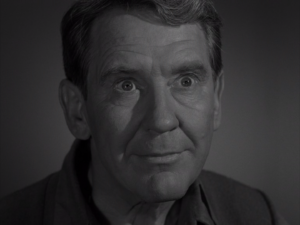
“The Obsolete Man” is directed by Elliot Silverstein. The teleplay is by Rod Serling. As for our cast, we have two powerhouse actors, legends in their own rights in theater, and legends by their performances in the fifth dimension. The great Burgess Meredith in what I believe is his best performance of his four episodes plays Romney Wordsworth. And Fritz Weaver is our thundering Chancellor, played to absolute perfection. The episode first aired on June 2nd, 1961.
Episode Tidbits
As for tidbits, the section in Martin Grams Jr.’s Unlocking the Door for this episode is worth the price to pay for the entire book. There are some great quotations from the public regarding how they reacted to this episode. I will only highlight one that I think is interesting because it prompted Serling to respond. “Rita Krich of North Hollywood, California, found the episode to be ‘garbage’.” To this Serling responded, “‘The Obsolete Man’,” had a very simple premise. It was simply that you cannot destroy truth by destroying the printed word. You cannot indignify man by destroying him. You cannot wipe away a belief in God by an edict. And sooner or later every dictatorship must of necessity fall because sooner or later thinking people with courage will overthrow it. This, Mrs. Krich, was the statement explicit in ‘The Obsolete Man’” (413). Well said. Mr. Serling. Well said.
Question 1: Are we moving toward the age of the obsolete man?
I’m actually going to begin by answering the question straight away and then build my case. The answer is yes I do feel a bit like we are moving toward a kind of age of obsolescence …but, we won’t stay there, quite simply because we can’t; we’re not built for obsolescence. It doesn’t sit well with us. I’ve been teasing the past couple of episodes wanting to discuss how my semester went in the spring teaching an AI in the Twilight Zone themed course, and actually this episode, although not about AI directly, is really the best suited for the discussion because obsolescence is one of the major themes that my students wanted to discuss, as they continually hear that all of their jobs will be replaced by AI anyway. And as for me, a non-tenured instructor of writing of all things, well…do I need to say more? I have been hearing nothing but how students no longer write anyway; they simply ChatGPT everything, and we don’t need writing instruction because AI will write everything for us. In some ways, I am the obsolete man. And yet, I can say the following with confidence: for the past few years I have had very few–not 100% mind you, but very few cases of students handing in AI papers. In fact, this past semester, I had three students come into my office and tell me some form of the following: “Dr. Meyer, I just want you to know that I came into this class planning on using AI to write all of my papers, but I’m proud to say that I wrote these myself.” So, why are my students, the same kinds of college students as everywhere else in the country, why am I having such a seemingly better time getting my students to write? One word: value.
After Romney informs the Chancellor that he is also playing a part in this televised liquidation, he takes his Bible out of its hiding place and says, “it’s the only possession that I have that has any value at all to me.” And why? Why is it the only possession of value? On the surface, it’s because it represents his faith, his belief in God. But, there is, dare I say, more to it than that. When Romney is being tried, the Chancellor goes out of his way to remind Wordsworth that it has proven that there is no God, but does the state really care about whether or not God exists? No. What the state cares about is eliminating all of the things in existence that cannot be touched, cannot be grasped, and especially cannot be taken from you: faith, love, hope, and toward the end of the episode, as Mr. Wordsworth so eloquently reminds the chancellor of, mercy. In these neomodern times of ours, the question that should matter most to us is what do we value?
On the first day of class for the past four or five years, when we get to the part of the syllabus where we talk about AI usage and honor codes and whatnot, I tell my students a personal story–and I think I genuinely blow their minds with what I say at the end. I’m going to share the story with you now. And my apologies to those of you who are listening only. I’ll do my best here to describe it in a way that hopefully makes you feel included. This painting that I’m holding up is of a whale’s tale emerging out of the sea. The whale is somewhat whitish, a nod to my love of Herman Melville’s classic tale Moby-Dick. Now, I am incredibly blessed. I have two of the best older sisters any brother could ask for. My oldest sister happens to be an artist and a wonderful art teacher. When I was about 21 or 22 years old, I sat with my oldest sister and we painted this picture side-by-side for a couple of hours. She taught me how to layer paint, how to mix colors. All of that. Now, I fed this painting into an AI image generator and asked it to improve my work. Here is the picture that it produced. Is it better than mine? (This is the part of the story where students don’t really know what to say. Some of them try to be kind and say no it isn’t, Dr. Meyer.) That’s very kind of you, but look at my terrible ocean back there. Water doesn’t look like that. The AI image generator picture is better. There’s no doubt in my mind. But, and here’s the thing: I don’t value the better picture. It means nothing to me, even though it’s better in so many ways. It is absolutely worthless in my eyes. For hours, I worked with my sister on this choppy, and in some places, borderline ridiculous painting of a whale’s tail. And yet, with all of its faults, it has infinitely more value to me. That is how I feel about your writing in this class. I don’t care about your comma splices, your fumbling of words here and there, your sentences that run so long you might as well call them marathons. I don’t care. What I value is that we have 15 weeks to exist together. 15 weeks for me to hear what you actually think about something. 15 weeks for you to tell me an enthusiastic listener what you believe. Okay, now are you ready? Here is where I blow their minds. I am not going to accuse you of using AI in this class. What I will simply do is give you the grade that you’ve earned. And I know that if you come to class, do the work, and practice, there’s not a single one of you that can’t do better than what ChatGPT can produce. And, you will have produced something of actual value in this brief time that we have together, a time that will never happen again in history.
And you see, my KOI friends, I think my point gets across to those wonderful young minds: they know that I’m being honest and sincere with them. What I value most about them is not perfection of some product. I value our time together, our struggle toward improvement, toward saying something. Coming back to our episode, during the trial Wordsworth says the following: “ I’m a human being. I exist. And if I speak one thought aloud, that thought lives, even after I’m shoveled into my grave.” Now, more than anything, my students were concerned about blurring the lines between reality and fantasy, and the majority of them wanted there to be a very clear line between what it meant to exist as a human vs to exist as a machine. We watched 6 episodes together: “The Lonely;” “The Lateness of the Hour;” “Elegy;” “I Sing the Body Electric;” “The Old Man in the Cave:” and “The Brain Center at Whipples.” Now, the episode that they rated the highest was “The Lonely;” They genuinely felt bad for Correy’s predicament and they liked Alicia as a companion. But, and here is what was interesting. They liked Alicia, but they wanted her to be viewed as a kind of companion tool to Corry, not as a being all her own, which I was not expecting. I thought it was going to be the opposite. And the reason they felt this way was because they did not want to devalue the experience of being human, to inadvertently or advertently make what it means to be human obsolete. But, the episode they hated the most was also one they wrote about the most: “I Sing the Body Electric.” They thought it was not only boring, but they legitimately had an ethical problem with it. They wanted to know what happened to the father in the episode, and why he wasn’t playing a more prominent role in the family–especially after the kids had grown up. He just disappears. So, to sum it up as neatly as possible: what my students were worried about was that we might potentially render not the flesh of the human but the value of the human obsolete. And just to be clear; they didn’t hate AI or want to make it go away. They just wanted to make sure that we, as humans, could place it within a proper context of usefulness to humanity, not in replacement of it. I was incredibly proud of them for working through those thoughts on their own.
Okay, so let’s start to bring all of this information together for our question. Why did I say that I believe that we are moving potentially toward an age of the obsolete man? As we continue to test what AI can do, can produce. And look, I just saw a video on YouTube of the late great Chuck Norris literally kicking the T-Rex from Jurrassic Park. The 12-year-old boy inside of me has literally never been more happy. But, the more we test what these tools can do, the more we need to counter balance that testing with a more precise vision of what we want to value when it comes to being human. And I don’t think we’re prepared to do that just yet. We are, as Wordsworth’s poetical namesake William Wordsworth famously said in his poem,
The world is too much with us; late and soon,Getting and spending, we lay waste our powers;—Little we see in Nature that is ours;
And yet, I have hope–or rather faith. I believe that once we start to realize as a people that we must protect and guard the value of humanity of quite literally what it means to be human, all the rest of this will fall naturally into place. And we can go back to reading run-on-sentences and painting terrible whales. And in truth, I wouldn’t want it any other way.
Question 2: Why is Wordsworth’s occupation as a librarian such a big deal?
Now, I’m going to do a rather blasphemous thing here in a moment. I’m going to disagree with our TV founding father, Mr. Rod Serling. In his opening monologue, he says, “but like every other of the superstates that preceded it, it has one iron rule: logic is an enemy and truth is a menace.” I understand what Serling is trying to say here, meaning I get the spirit of it. However, one of the ways that dictatorships and superstates are able to rise in power is because they are quite logical–and only logical, but they aren’t necessarily truthful. And that’s the key difference. They use the tautologies of our everyday existence against us until they make us feel out of place and illogical for not following along. And there is a fantastic example of what I mean only a few minutes after Serling says these words.
After Romney professes one more time to being a librarian by profession, the Chancellor says this: “a librarian…having to do with books….And since there are no more books, Mr. Wordsworth, there are no more libraries. And so it follows that there is very little call for the services of a librarian.” Do you see my point? There is nothing illogical about what the Chancellor says here; in fact, it is 100% pure logic, the kind of proof that would render even Plato silent. In my class, I talk about logic through a particular dialogue from Plato’s Republic book II. Specifically the section where he is talking about the Greek gods and shapeshifting. I’ll read it to you here. It begins with Plato speaking:
But surely God and the things of God are in every way perfect?Of course they are.Then he can hardly be compelled by external influence to take many shapes?He cannot.But may he not change and transform himself?Clearly, he said, that must be the case if he is changed at all.And will he then change himself for the better and fairer, or for the worse and more unsightly?If he change at all he can only change for the worse, for we cannot suppose him to be deficient either in virtue or beauty.Very true, Adeimantus; but then, would any one, whether God or man, desire to make himself worse?Impossible.Then it is impossible that God should ever be willing to change; being, as is supposed, the fairest and best that is conceivable, every god remains absolutely and for ever in his own form.
Do you see the logic? If you take a thing and it changes it is no longer that thing. If you take a god and he’s perfect, if he changes, he is no longer what? Perfect because he’s something else. That’s logical, but underneath Plato’s logic is an incredibly clever trap.
It begins with an inarguable assumption of civic stress: the assumption is are the gods perfect? Now, as a citizen of this Greek state, are you going to challenge that assumption? No. And so, if you accept the initial assumption, it’s already too late for you. Because once you get inside solid Platonic rhetoric, there really isn’t a lot of room to get out because the person can always retreat retreat back to the assumption and start the loop all over again.
This is also what the Chancellor is doing. He’s applying the same kind of pressure and Platonic rhetoric. He does the same thing with the minister example and the fact that the State proved there is no God. Once you’re inside the logic part, you have no argument; there are no books, and so we don’t need librarians. There is no God, and so we do not need ministers. Are you getting the trick? At the point that we’re debating the logic, we’ve already lost, given up our right to make up our own minds. Now, I want to be clear; logic is incredibly important. It’s how we make many life-or-death decisions, and 9 times out of 10, if you need to make a choice, go with the logical one. But, make no mistake about there are times in life when logic does not produce the greater good, does not create meaningful value to the human condition. And so although we should be mostly logical in our way of life, we have to be careful of when logic is weaponized in order to move us away from valuing the human being, from making us feel silly about caring for the person next to us. That is the greatest trick the state will ever play, to make us feel that kindness is silly and empathy is outdated.
Now, where does Wordsworth’s vocation as a librarian fit into this? Well, listen to the Chancellor’s railing against him: “delusions, Mr. Wordsworth, delusions that you inject into your veins with printer’s ink, the narcotics that you call literature–the Bible, poetry, essays of all kind, all of it an opiate, to make you think you have a strength, when you have no strength at all. You have nothing but spindly limbs and a dream.” Let’s stop there. I’ve taught the “Learning to Read” section from Frederick Douglas’ autobiography. I don't know how many times at this point in my career. And my focus for the students is often on the section where Douglas admits that there is a kind of sadness in his learning to read. Why? Because in learning to read, and ingesting the great speeches from Irish Catholics seeking emancipation and rights within Great Britain, he fully realized the dimension of his enslavement, even beyond the physical. We often say knowledge is power, but that’s not quite right in my opinion–not quite accurate enough. You see the true nature of power is that it can be used to change something, to alter what once was something, into something else. In short, knowledge is not so much power; knowledge is potentially transformative. It changes people, reorienting angles of perception. Like the previous example of Plato: what once was, when altered even slightly, is no more. And the state must control the angles of perception and the depths with which we perceive our position from within in order to maintain its power, its sense of control.
Librarians are not simply people in a “musty language factory” as the Chancellor states in the episode. A good librarian curates the histories of the best of us, and openly displays the worst, reminding us all that both humanity and democracy require vigilance, require work. The Chancellor is right to fear the librarian, to fear books, to fear any place or item that might transform us, might remind us, might even chastise us for forgetting that each human is born with integrity, and that even self-evident truths such as all men being created equal require us to not simply mumble the words under our breath but to breathe them into our communities, to actually believe them.
Oh, my friends, the Chancellor and the state are right to fear libraries and librarians. Good librarians do not tell you what to think; they offer you a tool, often with great precision, to help you get there on your own; they remind us that we as humans have a legacy, have been through horrific wars and great triumphs and that this legacy is carried by both the oldest of us and those who have just taken their first breaths. And that legacy is chronicled and preserved within the walls of our libraries.
Question 3: What are your moments of awe?
As for my moment of awe, I’m going to address something that a friend brought up to me. When I mentioned that I was going to be discussing this episode, he asked me if I was going to talk about the state of politics today. My response was unnecessarily complicated and overthought, as is usually the case when speaking with me about matters of politics–or really just about anything. But, I will answer the question here in the most honest and true to my nature way possible. I often tell my students, I’m not here to tell you what to think; I’m here to try and teach you how to think, how to evaluate problems and break them down into three basic forms of analyses: exploratory analysis, learning about the parts of a problem; critical analysis, learning how to evaluate proximities of success; and rhetorical analysis, how we evaluate persuasiveness and create appropriate language to express our thoughts. That's the skeletal structure of my course. By the end, my goal is for students to be able to meet a difficult problem head on and develop various solutions or approaches of engagement.
You see, by showing my students how to think and not what to think, and how to value something but not what to value and letting the great works of art speak for themselves, in this case, The Twilight Zone, I hardly need to say anything at all. Because if you tell someone what to think today, you’ll have to tell them what to think tomorrow as well, and the next day, and a week from now, a month, a year…and so on. And your legacy will not be as a teacher but a prophet–and a false one at that. No, I care for my students far too much to tell them what to think. But, if I do my job well, which I always try to do, and if I’m genuinely able to help them learn to think and to value that which is important, especially to value that which resides within the experiences of the human condition, I have all the trust in the world that when such a difficult moment makes itself manifest to them, they will truly make the decision they believe is best for both themselves and their fellow man, and in many ways, that’s the best we can all hope for.
My Rating.
As for my rating, this is top top-tier, and so it gets the coveted ringing of the bell. By the way, this bell comes from the Disney MGM studios old Tower of Terror ride, which was a wonderful attraction that I believe they got rid of a few years back. It’s a shame. But the spirit lives on through our show and whenever an episode receives a Top Top-tier rating. “The Obsolete Man” can easily be adapted into a play, and it’s certainly one that I would do if I had my choice. Superb writing, great speeches, and plenty for us to chew on. Simply marvelous.
Next Episode
Next time, we’ll be starting our trek into season 3, and we’re kicking it off by taking a look at the episode “Two,” and here are your questions to consider when watching the episode:
Question 1: How does gender particularly highlight the loss of humanity in this episode?
Question 2: Where is Serling’s personal voice within this episode?
Question 3: What are your moments of awe?
Announcements and Shout-outs
I’ve got a comment to highlight from the YouTube channel. @tomfarrell455 had the following to say on my “Shadow Play” episode: “One of my all-time favorite episodes. I really think you might be onto something with the Nehemiah Persoff “judgment night“ comparison. Eluding real life punishment he should have received , but being punished eternally in a guilt-driven, never-ending nightmare.Great job on the overall analysis 👍👍” Tom, I appreciate the time and the kind words. The Persoff connection came to me late in the writing process, and I couldn’t quite shake it. It added an additional layer of interest for me when watching the episode again, but it all started with just questioning whether or not Adam actually commits a murder, and thinking about how little information we’re actually given about that part of the story. Sometimes it’s best to just let your mind wander a bit when you watch these episodes. It can produce some really interesting questions.
How to Support the Show
Want to support the channel? Consider subscribing, liking, commenting, and sharing the show with a friend–you know all of the usual algorithmic gymnastics, that will help us expand our awesome community of Twilight Zone fans. Plus, you never know, I might just highlight your comment in an episode of the show–as long as it's family friendly. And if you want to be immortalized on our list of key KOI supporters, consider joining one of our membership tiers on YouTube or Patreon. I’ve got additional content videos that analyze Twilight Zone episodes from the 1980s, the early 2000s series, and the Jordan Peele 2019 series. Additionally, 50% of all money taken through this channel, after the platform fees, is going to charity. 25% to the Rod Serling Memorial Foundation, and 25% to the Gary Sinise foundation. For more information about me, my scholarship, and the show, head over to the keyofimagination.com. That being said, even if you hated every minute of this, I’m still going to thank you for spending some time with me. Until next time, remember, all doors are open to those who possess the key of imagination.
Works Cited