
The Twilight Zone Season 3: Episode 67
"The Arrival" Episode Transcript
Introduction
Welcome to the Key of Imagination. This week, we’re taking a look at the Twilight Zone episode “The Arrival”. We’ll try and answer whether or not Sheckly’s theory about mass hypnosis makes sense; we’ll dive into, perhaps, why we have so much trouble with the unknown; and I’ll reveal my moment of awe, a brief thought about the energetic nature of inquiry. So, grab your keys, and let’s open up this door to the fifth dimension.
Plot Summary
Flight 107 is coming in for a routine landing on the tarmac. As it comes to a stop, the airport crew steps in to do their routine arrival protocol. However, the ramp agent discovers there is no luggage in the compartment. But that’s the least of their worries. It turns out there are no passengers on board the flight, and just when you thought it could not get more odd, no one can find a single member of the flight crew, not even the pilots. This plane has somehow come in for a perfect landing, all on its own. A flight log out of Buffalo lists that there should be passengers on board, but none of them appear to be in existence. With such a mystery as this, there’s only one man to call: Grant Sheckly. He’ll get to the bottom of this; he ain’t been licked yet on a case. And so when Mr. When Sheckly arrives, he immediately starts his investigation. But, odd things start to happen. People are seeing different colored seats, and even different numbers on the tail of the plane. And he can’t shake this feeling like all of this seems familiar. Finally, he theorizes that this plane in the hangar is not really there, and that everyone, including himself, are part of a large mass hypnosis. And he’s willing to put his life on the line to prove it. He asks for someone to start the plane engines, and with the propellers whirring at top speed, he puts his hand out and makes his way toward them. And just as his hand is about to touch the blades, the plane disappears. He was right. But, then the other men in the hanger disappear as well. Sheckly is at a loss. He runs to the control room where he sees two of the men from the hangar, and as he starts to yell to them about the mystery of flight 107, they have no idea what he’s talking about. And then it hits the airline executive Bengston. He does recall a flight going missing, and it was flight 107, but that was almost two decades ago. He also now recalls that Mr. Sheckly was the investigator on that case, and he was never able to solve the mystery of flight 107. Some say, if you’re quiet enough, you can hear Sheckley roaming the airport, asking “what happened to you, Flight 107. Where did you go?”
Episode Details
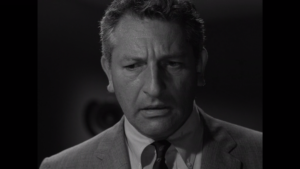
“The Arrival” is directed by Boris Segal. The teleplay is by Rod Serling. As for our cast, let’s start with our wandering detective, Grant Sheckly, played by Harold J. Stone; Mr. Bengston is played by Noah Keane; Fredd Wayne is our PR man, Paul Malloy; Robert Karnes is our Robbins; and Bing Russell is our ramp attendant, Cousins. The episode first aired on September 22nd, 1961.
Episode Tidbits
As for our tidbits, I’ve got some criticism to read here from a review out of Variety magazine from 1961. According to the author, “The show now seems to be feeding itself. In three seasons, it has created its own set of plot cliches, and writer Rod Serling now appears to be weaving them together in multiples with no profounder purpose in mind than to manufacture a provocative show…The outing was slick, pat and extravagantly contrived, wholly unworthy of the provent talents of a dramatist like Serling” (Grams Jr. 420). You know, if they hadn’t mentioned Serling’s name at the end, I would have sworn they were talking about my own show. Something I’ve learned over the years, it’s actually pretty easy to be critical of something. Don’t get me wrong; there’s a space for good criticism, and it can many times lead to a better product, but this particular take seems a bit…petty to me. I don’t find this episode to be contrived or cliche. I actually think it’s quite good, with maybe one piece of criticism that I’ll hold for my rating section.
Question 1: Does Sheckly’s Theory about Hypnosis make sense?
I’ve heard people talk about mass hypnosis before, but I admittedly didn’t really know much about it, and then it came up in this episode, and I thought, hey–this is one of those times when something I don’t really know about converges with a Twilight Zone episode, and I get to do a deep dive and learn something new. And that is the beauty of being a curious person. So, where to begin? I suppose we should first try and learn what the heck mass hypnosis actually is and whether or not it’s a real thing?
Before we even begin with a definition, let’s make sure that we’re categorizing this correctly. Let’s revisit what Sheckley actually says in the episode. He looks at the other three men in the hanger and he says the following: “Any one of you ever hear of mass suggestion?” To which, the PR guy responds, “so?” And Sheckly continues, “I think that’s what we’re dealing with now, a kind of hypnosis.” Okay, we’ve got our parameters. We’re looking for mass suggestions of the hypnosis variety. Quick, to the library! [do a transition to show a change in time.]
And that was not helpful. I’ll be honest, all I found when I went into the library archives is a lot of stuff about using hypnosis for weight loss, and some books about how to use hypnosis to get the life that you want. Well, we’re going to have to go a bit to the left before we can go forward. Let’s break up our question into pieces and see if we can put an answer together. Quick, to the internet! I was able to find a very recent peer-reviewed article by Rizzo and Jensen on the connection between hypnosis and chronic pain, and they’ve provided a nice, distilled definition for us to use for hypnosis. They write, “Hypnosis can be described as an experience of focused attention and reduced peripheral awareness, during which
some individuals show increased responsiveness to suggestions” (1498). Okay, that tracks, and more importantly, I think none of that sounds like mumbo, jumbo, or even hooey. What I find interesting about this is that, we tend to think of hypnosis through a popular culture vision of men with pointy mustaches making unaware people the victims of some crime. But, that kind of magic element has somewhat passed out of favor–except for maybe the occasional theater performance. Instead, I get the impression that it’s more about creating a type of focused state that is then responsive to various suggestions. That makes sense to me and seems quite legitimate given what we know about the human brain. And so, as we think about our Twilight Zone episode, I’m not so sure that this is really connecting yet. However, let’s not give up hope. We’re just getting going. We need to talk about the potential of inducing visuals in multiple people, ie on a mass scale.
Sheckly’s actually quite a smart guy, I think, or at the very least, he’s incredibly observant. And being observant does a lot of work in making someone look smart. As he’s listening to the three men talk in the hangar, he realizes something: He turns to Robbins one of the engineers, and he says, “you said something before….You said you looked inside the plane and you saw the blue seats.” Robbins confirms this. And then Sheckly says this: “They are blue, but when I first looked in the plane the seats were brown.” There’s actually more to this answer than I had originally thought. Prior to making this comment, Sheckly does go back on the plane, and he looks at the seats. So, when he says to Robbins, “they are blue.” He’s saying that he is now seeing the seats as blue himself. Watching this episode a few times over the years, I had thought that Sheckly was still seeing brown seats when he made his comment to Robbins, but I don’t think that’s the case anymore. I think he now sees the seats as blue, which means Robbins’ observation has fundamentally altered what Sheckly is seeing in reality–yes, we know from the ending that this is a loaded term, but let’s stay in the moment with the plot. This is important because it does mean that there might be something to this concept of suggestions manifesting reality. Would he have seen the seats in blue if Robbins had never offered that? I don’t think so. And Bengston says that he saw the color red, but the problem is we never get the confirmation that Bengston now sees them as blue, so that doesn’t really help. The next example, however, might.
Something I love about Sheckley is that he creates hypotheses and then he wants to test them. That’s perfect. When I do this I usually add an additional layer to the process. I’ll create my hypothesis about something and before I test it, I’ll usually do a simulation in my brain, so that I can start to play out potential scenarios for outcomes. But, Sheckley, he just goes for it, man. He brings the other people toward the tail of the plane and has them read out the aircraft number as they see it, and sure enough, everyone sees something different. What that means to me is that each person is bringing local knowledge to a global event, and that made me think about game programming. When you’re programming a video game that takes place online, you’re oftentimes utilizing local assets, meaning pictures, that are stored on each person’s individual computer. The online portion is essentially coordinating where to place those assets on the screen. And so, if you mess with the local assets on your computer and change up the information, your own computer might show a different image than what others are seeing. Now, game programming has come a long way, at this point, if you mess with your local assets, it just throws an error and stops you from even starting the program, but the process is the same thing here: you’re bringing local assets in order to render or create a globally shared moment, which is why everyone is seeing something different. But, actually, this only somewhat makes things more complex for our question. Nonetheless, we’re going to have to land this plane soon, or we’ll all come crashing down.
The idea that everyone is simply rendering their own reality from local information is an intriguing one for me, and to some degree that’s actually what we do in reality anyway. However, it would stand to reason that if there was a mass hypnotic event, not a magic show moment, but a genuine mass hallucination event, it would mean that the object being rendered before everyone would have to be uniform–ie, the plane itself is a plane. It’s not like Sheckly sees a B-2 bomber and Bengston is seeing a world war I prop propeller plane. The plane is uniform; it’s the details that are different. My friends, I’m a bit stumped here. I’m not sure how to call this one. I’ll answer the question in a more straightforward manner: I do think Sheckly’s idea makes sense and has merit, but I’m not sure the execution of it makes sense, if that makes sense. I’ll be curious to see where others might land on this one in the comments.
Question 2: How does this episode showcase our difficulty handling the unknown?
It occurred to me as I started writing for this question, this is one of those rare Twilight Zone episodes that doesn’t really have a supernatural component–or at least a component that needs a supernatural explanation. Someone absolutely can have the kind of experience that Sheckly has due to a moment of ill health–and yes, I’m even including the parts where he’s in the hangar talking to people and seemingly interacting with them. The only difference is his mind, I suppose, updated the person who was the PR guy back when he was on the case with the new one, which he could have done from seeing a photo of Malloy in the newspaper. I’ll come back to this point in my rating actually. But, that doesn’t mean that it doesn’t have a sufficient ending that is worthy of the fifth dimension. No, in some ways, it has an even darker ending than many of the episodes with villains, monsters, and supernatural beings. Let’s get into it, and I think you’ll see what I mean.
I’m going to open this up by quoting a rare poet, at least I don’t know of many people who quote from his works. The poet is Thomas Gray and the poem is “Ode on a Distant Prospect of Eton College” from 1742. These verses come from the very end of the poem: “where ignorance is bliss, / 'Tis folly to be wise (link). Now, we might be quick to read this as Gray saying that if we want to remain happy, we should remain ignorant, but that’s not really his point, and if you read the rest of the poem, you can kind of get the sense of it better. In fact, he’s really just lamenting the fact that as we grow older and accumulate more knowledge, we also accumulate more understanding about life, things that we would consider to be not quite so wonderful: death, evil, destruction, the unfairness of the world at times. It’s about the loss of the ability to simply move from one moment to the next without having to contemplate the full nature of existence. For at the end of our contemplations on life, there are almost always additional questions, and those lead to more questions, and before we know it, we have spent our entire life pursuing answers to questions for which there are either no answers or no answers that will sufficiently quench our thirst. And what’s worse, we will have hemorrhaged the most important resource of all : time. And so, one way that you can interpret Gray’s line about the folly of wisdom is that sometimes it’s best to be a bit like a child, sometimes a shrugging of the shoulders, and a quick pivot to something else that is more worthy of our precious time on this planet, is actually the wisest thing you can do.
In the final scene of episode, Sheckly is just walking around what looks like is the runway or close to it, and he’s just calling out “hey, flight 107, where did you go down? Why didn’t you leave a clue?” I love this scene exactly the way that they shot it, because there’s very little that you can see outside of Sheckly himself, and of course, that’s the kind of monomaniacism that made him in one sense, incredibly good at his job. As he is quick to remind everyone whenever he can, “he has never been licked on a case.” But, here’s the part that’s even a bit more disturbing, and it’s a little bit dark, so forgive me. Did you notice, at no point does Sheckly really make any kind genuine connection with the people who seemingly passed away on the flight? In other words, there is no sense of those poor people or even we lost those poor souls. No. For Sheckly, it’s about losing the case. I say this not so much to judge him as a human; I say this because in some ways that’s also what made him good at his job. He is able to distance himself just enough from the human part of this to simply see what’s in front him. You might recall that when we’re introduced to Sheckly, he enters the room and immediately tells everyone that he’s not interested in their theories or their stories. That’s his job. He’s only interested in the facts. And herein potentially lies one of his biggest problems with this unknown case.
Because he tends to keep a bit of a distance between himself, the facts, and the emotions of a problem, he is also most likely, not all that experienced with the very human concept of forgiveness. Toward the end of the episode, when Sheckly is talking to Bengston, and he’s reminded of the fact that this case is 18 or 19 years old at this point, Bengston starts to realize just how bad of a shape Sheckly is in, and he offers to drive him home. This is the act of someone who understands that there is a person in front of him. Bengston stops laying out the facts and switches over to the humanity part. But Sheckly doesn’t seem to be able to do this. Because it’s his job to know; knowing is tied to his very state of being, to his identity as a meaningful person. He is the man who has never been beaten by a case yet. This means that if even one case goes unknown, he is no longer the man he thought he was or even still claims to be, as he laments in Bengston’s office at the end, on the verge of tears. We’ve mentioned on this show before but it’s worth saying it again: we take for granted sometimes how important it is for people to identify themselves as or with something. Such an act of identification helps to drive us forward, to create points of progression and even helps stabilize ourselves in a world that is constantly shifting. But, when that identity is removed, those points of progress disappear; those stilts on which we built the house of our being are swept away, and we are once again left in a seemingly chaotic world, with no sense of direction: ie, the unknown.
So, what does this question reveal about our difficulty with the unknown? Well, it can certainly be a bit of a person-by-person question, but in general, I do think being in a state of unknown tends to make us as a species a bit uncomfortable, and so what do we do? We fill the empty spaces with guesses and stories. Look at what Sheckly does, he essentially creates an entire play in his mind, and that’s somewhat the best way that I can describe it: it’s a kind of play, with actors, speeches, and dialogue, and highs and lows, and plenty of drama–and what’s even better. It has an ending, a known. And this is really what Sheckly’s mind is looking for an ending to this ongoing story of flight 107. What he doesn’t realize is that there is already an ending in front of him, and it’s been there the whole time. He simply has to accept that he doesn’t know, and that he likely will never know, and that this is okay. Come back to the humanity of the situation. Be sorry for the lives that were lost, for the loved ones who grew up without a mother, father, sons, daughters…all of the people. Come back to the point where the human beings are more important than the lack of knowledge, than the puzzle. If he can do that,...let me correct myself, if we can do that, if we can keep the human at the center of the unknown, I think we will probably all be just a tad bit healthier.
Question 3: What are your moments of awe?
For my moment of awe, I want to talk about the play part of this, meaning the middle portion where Sheckly is in the hanger and putting together this entire puzzle piece by piece. When he emerges from the plane and starts to talk about the color of the seats, he perks up a bit in his energy. Then when he brings the men over to the number on the tail and they start to stay all of the different numbers, he’s downright giddy. This is kind of a wonderful moment for me for a different reason. When I teach my students about research and trying to connect various ideas to test their theories, I try and tell them about this feeling–the great energy of when ideas connect and your thesis starts to come into focus. It’s a wonderful feeling. Now, this feeling can also emerge when you’re trapped in confirmation bias and simply looking at the information that supports your view and nothing else. That’s why it’s important to try and break your own thesis or even disprove it sometimes. Boy, students hate that. But, let’s be honest: not many people love to see their hard work or their great ideas suddenly go out the window. We have a rather distorted view of research and time today. We think that if an experiment doesn’t work, we’ve failed, or if an idea that we laid out is suddenly proven to not be as strong as we originally thought that we’ve wasted our time, but that just isn’t true. The human experience is a collection of a few triumphs and a whole lot of failure. And it’s because of those failures that we have the triumphs. And so, if you’re working on something, something that’s important to you, and you suddenly get a sensation in your stomach that maybe your project is not working out as you hoped it would, don’t you dare say it’s a failure. What it is is more information; it’s foundation; it’s the history of our great species. And you have just played your part in the tale. Be proud of that, and don’t be so quick to label things as successes and failures. The truth is we don’t always know when a failure today will breed the greatest of successes tomorrow.
My Rating.
As for my rating, you know what: I’m going to be a bit biased here. I have always really liked this episode. I love the acting, the plot, the energy of it. And the ending, although not supernatural in the traditional sense, gives you the feeling almost like Sheckly will be doing this forever somehow, like it will follow him even in the next life, and that is pretty horrifying. So, I’m going to give this one an Middle Upper-tier rating. The one piece of criticism that I have can probably just be explained because of a lack of time and options. There is a time element to this episode that doesn’t really get explored much. The appearances of Sheckly, Bengston, and Malloy are exactly the same as almost two decades prior. So, what’s the deal? Is it that Sheckly just updates the appearances to the present-day versions in his mind? I don’t know. That’s just something that I think needed a passing comment at least. But, it’s a thoroughly enjoyable episode for me. And I’ll just add, some Twilight Zone episodes, I kind’a know what the general consensus is going to be in the voting from all of you out there, but with this one: I have no idea. So, make sure you leave a vote in the rating section of the YouTube posts. I want to know what you all think.
Next Episode
Next time,we’ll be taking a look at the Twilight Zone episode “The Shelter,” and here are your questions to consider when watching the episode:
Question 1: Would the Stocktons, meaning the good Dr.; his wife; and son, Paul have survived the nuclear blast?
Question 2: Do you think things will go back to the way they were before this event ever took place?
Question 3: What are your moments of awe?
Announcements and Shout-outs
I’ve got a couple of comments to highlight from the YouTube channel. On my “Long Distance Call” episode, Steveross2851 made the following connection:
“I suppose in Night Call S5E19 aired February 7, 1964 the Alva Keene character (played by Gladys Cooper, 75 years old when the episode aired) in a way had “the tables turned on her” from what occurred to a similar character in Long Distance Call S2E22 aired March 31, 1961.” Steve, I appreciate the thoughtful comment and the interesting connection here. We obviously haven’t gotten to “Night Call” yet on the show, but I’m of course familiar with that episode, and I like the connection here between the two older characters. It’s a fun little parallel and just adds a new dimension for appreciating the Twilight Zone universe.
Friend of the show Anthony from over at the FeverDreamLand theater channel, which I always highly recommend if you love all things Serling and horror, had the following to say on my “The Obsolete Man” episode: “An all-time favorite! Sadly still just as relevant as ever. I think even beyond the poignant lessons and social commentary Rod Serling interwove here, this is another one of those episodes we can discuss endlessly. It's brilliant. Great review Joe, I liked hearing your take on this classic and I especially enjoyed your unique perspective as a teacher. AI in the Twilight Zone and the notions of obsolescence ties into the themes of this tale very well. Where do I stand on the AI topic? Lets just say I'll take your painting any day of the week over the AI image. All the best this weekend!” Thanks, Anthony. As always, I appreciate your time and thoughts. Regarding AI and my painting, I do think one potential outcome of AI usage in the arts is that it create an even greater appreciation for human art: because the speed of AI is putting time as a finite resource back into the equation of artistic appreciation. I think that’s a wonderful thing.
How to Support the Show
Want to support the channel? Consider subscribing, liking, commenting, and sharing the show with a friend–you know all of the usual algorithmic gymnastics, that will help us expand our awesome community of Twilight Zone fans. Plus, you never know, I might just highlight your comment in an episode of the show–as long as it's family friendly. And if you want to be immortalized on our list of key KOI supporters, consider joining one of our membership tiers on YouTube or Patreon. I’ve got additional content videos that analyze Twilight Zone episodes from the 1980s, the early 2000s series, and the Jordan Peele 2019 series. Additionally, 50% of all money taken through this channel, after the platform fees, is going to charity. 25% to the Rod Serling Memorial Foundation, and 25% to the Gary Sinise foundation. For more information about me, my scholarship, and the show, head over to the keyofimagination.com. That being said, even if you hated every minute of this, I’m still going to thank you for spending some time with me. Until next time, remember, all doors are open to those who possess the key of imagination.
Bibliography
Martin Grams. The Twilight Zone : Unlocking the Door to a Television Classic. OTR Publishing,
2008.
Rizzo, Rodrigo R. N., and Mark P. Jensen. “Hypnosis in Chronic Pain: From New Hope to
Emerging Standard?” Pain (Amsterdam) [Philadelphia, PA], vol. 167, no. 7, July 2026, pp. 1498–507, https://doi.org/10.1097/j.pain.0000000000003944.
Zicree, Marc Scott. The Twilight Zone Companion. Second edition, First Silman-James Press
edition., Silman-James Press, 1992.