
The Twilight Zone Season 3: Episode 70
"A Game of Pool" Episode Transcript
Introduction
Welcome to the Key of Imagination. This week, we’re taking a look at the Twilight Zone episode “A Game of Pool”. We’ll try and see what we can learn about greatness from this episode; we’ll attempt to determine whether Fats is good, evil, or neutral; and I’ll reveal my moment of awe, a quick note about a missing scene from Nolan’s Odyssey film. So, grab your keys, and let’s open up this door to the fifth dimension.
Plot Summary
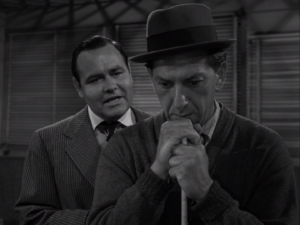
Jesse Cardiff–perhaps you’ve heard the name floating around poolhalls. When it comes to the game of billiards, he’s one of the best. But for all of his victories, there is one competitor who has eluded him: James Howard Brown, affectionately known to his friends as Fats, no longer with us on earth. When people talk about the greats, it’s Fats Brown this and Fats Brown that. And it’s driving Jesse crazy because he knows he could have beaten him. But, you can’t defeat a ghost. Or can you? A shadow suddenly emerges from the corner of the hall, it’s none other than the legend himself in the flesh, and he’s looking to call Jesse out on his bluster. But if Fats is going to come all this way from beyond the temporal realm for a game of pool, there needs to be stakes involved: if Jesse wins, he becomes the best; if Fats wins, Jesse loses his life. The wager is accepted and the men start to play, feeling each other out first. Back and forth they go, until finally it comes down to the last few shots.
When Fats utilizes a little gamesmanship to throw Jesse off of his focus, causing him to miss, the legend is set up to run the rest of the table. But, he doesn’t. With his last shot, he sets up Jesse for an easy pocket hanger, a tap in. There’s an odd mixture of profuse sweat, worry, and a kind of hope mixed all together into the visage of Fats, and with the winning shot seemingly in hand, Jesse takes a moment to let Fats know what he thinks of him–why life or death, why not a friendly game? Because, Fats replies, to you, Jesse, pool isn’t a friendly game. And although it may only be a game, I’m the best at it. You were the best, Jesse coldly replies, as he proceeds to sink the final shot. Fats has never looked happier, as he disappears back into the shadows, leaving Jesse to his victory, and practicing the sound of people chanting his name–Jesse Cardiff, Jesse Cardiff. The chant slowly morphs into a voice over a PA, calling Jesse down from the clouds on high, to face his next opponent, another person who believes they are the best. Jesse shuffles off to greet them, exhausted, and having learned that being the best at something carries responsibilities that stretch beyond a lifetime.
Episode Details
“A Game of Pool” is directed by Buzz Kulik. The teleplay is by George Clayton Johnson. And as for our cast, we’ve got a great one here. Jesse Cardiff is played by Twilight Zone royalty, Jack Klugman. We’ve already seen Mr. Klugman in a “Passage for Trumpet,” and we’ve got a couple more episodes beyond “A Game of Pool” to enjoy him in as well. The great comedian Jonathan Winters is our James Fats Howard Brown. He was a bit older when I got to see him, but I always found Jonathan Winters really funny when he was playing off of other people in the room, and his appearances on Johnny Carson are the stuff of legends. So, if you don’t know anything about him or aren’t familiar with his work, he’s definitely worth a random stroll on YouTube. The episode first aired on October 13, 1961.
Episode Tidbits
As for our tidbits, I have one here and then I’m actually going to bring in one in my rating section. The one that I want to mention here is quite short. It’s simply that, according to Martin Grams Jr.’s Unlocking the Door to a Television Classic, Jonathan Winters had reached out to Rod Serling directly about wanting to be in a Twilight Zone episode, and Serling sat on the request waiting for just the right one. When this script came up, Serling reached out to involve Winters (429). That must be a wonderful feeling to know that people want to work with you like that. Klugman and Burgess Meredith both openly stated that they would basically accept any role that Serling wrote sight-unseen because they just trusted his work. What a testament to a person’s craft.
Question 1: What can we actually take away from the message about greatness in this episode?
The timing of this episode is really quite perfect. A couple of weeks ago, I went to the movies with my wife to see Christopher Nolan’s The Odyssey. Now, one of my areas of interest happens to be the heroic narrative, and I’ve taught epic poetry at the college level a couple of times in my career, so this is a nice treat for me. I will say, my expectations were pretty tempered going into Nolan’s film. The Odyssey is a difficult work to put to screen, whether it be tv, film, or even just an Iphone. And yet, I thought Nolan did an excellent job. I liked it. Yes, I do think both Penelope and Telemachus were a bit too weak by the end of the movie, but Nolan’s job is to sculpt a vision of the story, and he did just that, and he should be proud of what he accomplished. And, on top of all of that, audiences have largely responded well to it, and one of the reasons I think people find this tale still so appealing is the complex conversation it creates around this notion of the burden of greatness. Let’s start there and make our way into the episode.
Odysseus is a true epic hero, and that comes with certain responsibilities and burdens. Achilles sits out for much of the Trojan war in The Iliad and thousands of his Greek comrades are killed because of it, including his beloved Patroclus; Beowulf’s decision to fight the dragon at the end ultimately leaves his kingdom vulnerable to attack from outside tribes. And, as we saw even in Nolan’s version, Odysseus displays the brilliance to create the Trojan horse, and a level of hubris that leads to the death of his men. And so, for the epic hero, a complex question emerges: how do we decide or define the balance between personal agency and glory, with public responsibility when it comes to one’s greatness. And make no mistake about it: this is an important question at the center of our Twilight Zone episode as well.
First things first, there is a wonderful little nuance in this episode that establishes not only Fats’ greatness, but it exposes something in Jesse as well. Fats says, “the hunter, he has his elephant gun. And the fencer, he uses a blade from Lima.” And then, and this is absolutely wonderful, Fats says, “this cue is made for me, special, from St. Louis.” This is the equivalent of the cosmically unique weapon that was either directly forged or seemingly created just for the hero: it’s King Arthur’s Excalibur; Thor’s hammer Mjolnir; and even Roy Hobbes’ bat Wonderboy from The Natural. Now, why am I bringing this up? It’s not just an anecdote. We should note Jesse’s face here when Fats is talking about his cue. What Fats is doing is putting on display the role that mastery and theater play in the creation of one’s ethos of greatness. It’s a heroic boast; a barbaric yawp; intimidation. Jesse had to learn to be good enough to wield the pool cue in his hands; but the cue that Fats holds, the very wood within it, needed to be good enough for him. But, that’s just one part of the story.
Every hero has a beginning, and Jesse is no different. He relays the first time he walked into the pool hall: “It was cool and dark, like being under water.” Think about what this actually means. As humans, we tend to not like being under water; it isn’t natural, and so Jesse’s description about immediately being comfortable in this environment is a kind of heroic boast of his own–mastering the environment. And then he tells us he beat the very first person he ever played. Let’s give Jesse credit. That’s a good story–don’t get me wrong. But, Fats’ has something even better, doesn’t he? Remember, Jesse says to Fats, “I heard a man in this very pool room swear that he saw you make a 9-cushion bank,” meaning that the ball hits the rails 9 times before it goes where you say it’s going to go. Fats fires back, “and you don’t believe him.” To which Jesse responds, “it’s impossible.” This! This my friends is the epic feat! It’s Odysseus stringing the bow, Hercules and his labors. This is legend; this is lore; this is Sparta! Whoops! To many this is’s. I mean this is mythology.
[I mean…that’s great, Joe, but Fats loses. Jesse is the better man.] Ummm…is he really? I’ll be honest, this bugged me even as a kid when I would watch this episode–I don’t see any evidence that Jesse is actually better than Fats. Don’t get me wrong; Jesse is quite skilled, but I don’t think his skills are superior to Fats’. I’m going to talk more about the final shot of the game in my next question, but can we just be factual about something: Fats lays up the final shot for Jesse. He just places the ball in the position for Jesse to take the win. Why? That seems almost antithetical to greatness, or does it? Here is where we make a hard right turn toward answering our question.
On the surface, we might be tempted to say that Fats sets up Jesse to win because he doesn’t want to do this anymore. He wants to go fishing. But, that just seems wrong to me. And then something hit me as I wrote and rewrote this episode script. As Jesse finishes his haranguing of Fats about why they had to make the game life or death, Fats says, “You wouldn’t believe this, Jesse. But, personally, I’d like to see you win.” Now, I don’t think Fats means because he wants to stop defending his crown. I think he means it for a different reason. Fats understands something that Jesse doesn’t–at least not yet. Built into greatness is also one more vastly important responsibility: the proliferation and protection of the institution in which one is great. In other words, those who are truly special should also pave the way for others to come after them, to be better than them, and to further the enjoyment of the institution for future generations. One of my favorite memories I have and will ever have is talking baseball with my father when I was a child. He would talk about seeing Willie Mays, Mickey Mantle, and Duke Snyder. And I would watch Darryl Strawberry, Keith Hernandez, and Gary Carter and wonder how they would have faired against a young Sandy Koufax or a Bob Gibson in his prime. What we learn about greatness from this episode is not necessarily about wins and losses or even just about skill alone. What Fats is doing is actually the next level up from the epic hero, whose pursuit of glory often leads to the destruction of their respective institutions. Instead, Fats wants to remind us that greatness in the modern world is about pursuing story in the name of preserving the institutions that provide us the opportunity to sit down with someone and marvel over the greatness of our fellow humans, of what we can accomplish. Jesse need only embrace it.
Question 2: Is there a way for us to determine if Fats Brown is a good, evil, or neutral entity in this episode?
In order to approach this question, I want to look at two specific instances that take place during the actual game. The first moment is something Fats calls gamesmanship. As Jesse is about to take his shot toward the end of the game, Fats drops his pool cue and the sound makes Jesse miss. Fats waves off Jesse’s anger by essentially telling him that it’s “kids stuff, things to make you break your concentration and you go wild.” This is another one of those moments that I struggled with as a kid for years. He’s too good for this kind of nonsense. Fats is really nothing more than a jerk, a cheating bully. Even a month ago, I would still be saying these very sentiments. But, then I started to write for this question. And again, the muses began to speak to me.
The relevant question here is why does Fats resort to this tactic? He calls it gamesmanship and then mentions later on that he wants to test Jesse’s mettle. Okay, that certainly makes sense. I don’t buy it, but it does make sense. I think something else is going on here. I think Fats knows that Jesse is about to run the table, i.e., win the game. [Wait, doesn’t that just prove that he’s kind of a cheating jerk, Joe.] Well, yes, if you believe that all of this is simply about winning and losing, which I don’t. I Fats does this specifically to make sure that he can set up that easy game-winning shot. Now, I’m about to go into more detail about that pocket-hanger, but first I want to give a little pretext into why I think he does it this way. Think back on Jesse’s reaction when he sees the ball line up so beautifully. His demeanor switches a bit. He no longer has to worry about the game, which is why he can start to berate Fats. I think Fats wanted to make sure that Jesse would have a moment where he could just think and just talk and not worry about whether or not he was going to win or lose the game, which also frees up Fats ability to offer an interesting proposal.
Let’s take a closer look at Fats’s last minute warning. Just before Jesse is about to hit the game-winning shot, he says, “shoot that ball and you might win more than you bargained for.” My friends, look at that language more carefully. This is where a study of rhetoric is actually quite useful. Embedded within that line is, perhaps, a way out of the situation. Did you catch it? “Shoot that shot” implies that there is a binary choice here: do the action or don’t do the action. Is it possible that Jesse could have simply said, I don’t want to make this last shot; I take you at your warning. I’d like to walk away. There’s obviously no way for us to know, but I do think the language used potentially does give Jesse a way out of this predicament, if he would just listen carefully. And now let’s take it even further. Let’s say Jesse does walk away. Be realistic for a moment. Does Jesse deep down know that he can make that final shot 10 times out of 10? Yes. So, he could have walked away right there knowing that he legitimately beat Fats Brown in a contest. To be fair to our boy, Jesse. If our rhetorical reading is correct here, the implication of a choice also means that Jesse walks away having not won, but also having not lost, which means he should walk away with his life. Does this offer from Fats make him a good entity? I think it’s time we rack these thoughts and play our final game.
Having thought about Fats’ use of gamesmanship and his purposefully lining up an easy shot for Jesse to be able to think clearly about his decisions, I would have to say that yes, I think we do have enough information to make a determination. And I think that determination for me is that Fats is a neutral entity. I don’t think he’s really either good or evil. He’s not there to reward or punish but to test, to offer a choice, and then to leave. That actually makes me want to go watch the episode again and look for more instances where we might see Fats act as either a purely neutral figure or one that levels out to neutral over the entirety of the episode.
Question 3: What are your moments of awe?
As for my moment of awe, I want to once again bring in a connection between The Odyssey and our Twilight Zone episode. In the episode, Fats says the following to Jesse: “I’ve been to places where they’ve never heard of billiards. I may not look the part, Jesse. But I’ve made love, walked up hill, swam in the ocean. When I think of the wonderful things there are to see and to do, it hurts me. Yeah, to see you rotting your life away in this miserable dark hall.” Now, this part is wrapped up in the section of the episode that we might call the gamesmanship section. And so, this little monologue can easily get lost and overlooked, but I challenge you to look at Fats’ face again when he says this: he means it; he’s being genuine here. We talked about Nolan’s Odyssey in question one, and actually there is one scene that I wished Nolan found the time to keep from the original poem. It involves Odysseus speaking with Achilles in the Underworld. Remember: Achilles was the greatest hero of the Iliad, and actually was probably the greatest warrior of the entire Trojan War really. When he sees Achilles, Odysseus tells him that he was the best, and that he is clearly still the best, even among the shades of the Underworld. And here is what Achilles replies,
“Let me hear no smooth talk of death from you, Odysseus, light of councils. Better, I say, to break sod as a farm hand for some poor country man, on iron rations, than lord it over all the exhausted dead. Tell me, what news of the prince my son” (359-60). He doesn’t want to hear about his greatness. He wants to know about his son? And the cats in the cradle and the silver spoon. We should all strive for greatness at something. As Fats says, it’s a proud thing to be great at something. But, we have to remember: time is and always will be the greatest, most precious resource we will ever have, and it doesn’t care about how much money you have, how much power you wield, or how great you are at something. I’m going to make an odd statement, a request really. When you carve out your path of greatness, when you define what greatness is in whichever field or arena you’re pursuing, make one of your requirements of greatness to be not taking for granted your loved ones, your ability to experience joy and even pain with others, and your health as well, be it physical or mental. True human greatness is not simply the mastery of a skill; it’s the mastery of a skill within the structure of a rich, fulfilling human experience. We love a good romantic story of the individual who goes at it alone and gives up everything to become the best. But that’s only because we don’t really want to think about the people along the way who were denied that person’s time and love. And so, If you can be great while also maintaining at least a pinky’s touch of those around you who love you, well, then you are truly great in my book of epic heroes. And I should know I’ve published on this stuff. Oh, and just to close out our Achilles story: Odysseus tells us: “[Achilles] had gone off striding the field of asphodel, the host of our great runner,...glorying in what I told him of his son” (361).
My Rating.
As for my rating, you might recall I mentioned earlier that I wanted to bring in another tidbit for my ratings section. Well, here it is. Writer George Clayton Johnson is quoted in Martin Grams Jr.’s work as having written that originally Jesse loses the match, and Fats lets him live. And Jesse promises to keep getting better, and that he’ll call upon Fats again when the time is right. But, Serling decided that the ending needed to be changed, adding the whole part about the smokey pool room in the sky and the “gone fishing” joke. Why am I bringing this in here? Because, I sooooo badly want to ring the bell of Top Top-Tier for this episode. But, I actually have a bit of a problem with Serling’s ending. Don’t get me wrong. I love the idea that Jesse is in a kind of state of suffering in the Twilight Zone. That fits well. No, what I hate is the Fats went fishing line. I think Serling was probably trying to play to the ethos of Jonathan Winters as a comedian, but it wasn’t really necessary, and it takes a bit of lustre off of the weight of the ending for Jesse. No, my friends, I had to knock some points off for that. My rating is Top Middle-tier. But, I absolutely love this episode it’s one that I love to show in class when I can.
Next Episode
Next time,we’ll be taking a look at the Twilight Zone episode “The Mirror” and here are your questions to consider when watching the episode:
Question 1: What would the American audience in 1961 have keyed in on when this episode aired?
Question 2: Is the mirror actually supernatural or not?
Question 3: What are your moments of awe?
Announcements and Shout-outs
Quick announcement. I once again had a blast going to Serlingfest. I learn something new each time I go. Bill Mumy, you know Anthony Freemont from “It’s A Good Life” and Pip from “In Praise of Pip,” told a wonderful story about Jack Klugman introducing himself to Mumy’s parents and letting them know how important it was that he hug and hold Billy in the “In Praise of Pip” episode, but he wanted to ask their permission to do that to their son. They said yes, and thanked him for asking. It’s a sweet story I hadn’t heard before. And as always, it’s also great to meet people as well. I’m always happy to see Rob A Gabor, Jamili[ah], and I got to meet quite a Twilight Zone rockstar in Mikyla from the “Make That Magic” show. She covers more content than just the Twilight Zone, but she gave a great panel and is a talented bundle of energy, so make sure you check her work out when you can. And thank you to the Rod Serling Memorial Foundation for their hard work. I’m already looking forward to next year.
I’ve got a comment I’d like to highlight from the YouTube channel. This one comes from my “Mr. Bevis” episode. @victoriafitzgerald8637 writes, “as a HSP I can relate to [Bevis] in a way that it is difficult to live in a world where you must [compromise] your most deep-seated sense of morals, ethics and individuality in a job where it is difficult to find any satisfaction in conformity and maybe losing integrity to yourself.” Victoria, thank you for the comment. This is one of our great battles as modern humans. And I’m no different. I struggle with this sometimes myself. But, as difficult as it can be, we have to think of our lives as a body of work. What do you want that body of work to reflect when the time has come for the work to end? That usually gets my perspective back at least in the right direction. Thank you for the comment.
How to Support the Show
Want to support the channel? Consider subscribing, liking, commenting, and sharing the show with a friend–you know all of the usual algorithmic gymnastics, that will help us expand our awesome community of Twilight Zone fans. Plus, you never know, I might just highlight your comment in an episode of the show–as long as it's family friendly. And if you want to be immortalized on our list of key KOI supporters, consider joining one of our membership tiers on YouTube or Patreon. I’ve got additional content videos that analyze Twilight Zone episodes from the 1980s, the early 2000s series, and the Jordan Peele 2019 series. Additionally, 50% of all money taken through this channel, after the platform fees, is going to charity. 25% to the Rod Serling Memorial Foundation, and 25% to the Gary Sinise foundation. For more information about me, my scholarship, and the show, head over to the keyofimagination.com. That being said, even if you hated every minute of this, I’m still going to thank you for spending some time with me. Until next time, remember, all doors are open to those who possess the key of imagination.
Works Cited/and Consulted
Martin Grams. The Twilight Zone : Unlocking the Door to a Television Classic. OTR Publishing,
2008.
Zicree, Marc Scott. The Twilight Zone Companion. Second edition, First Silman-James Press
edition., Silman-James Press, 1992.