
Twilight Zone Season 1: Episode 4
"The Sixteen-Millimeter Shrine"
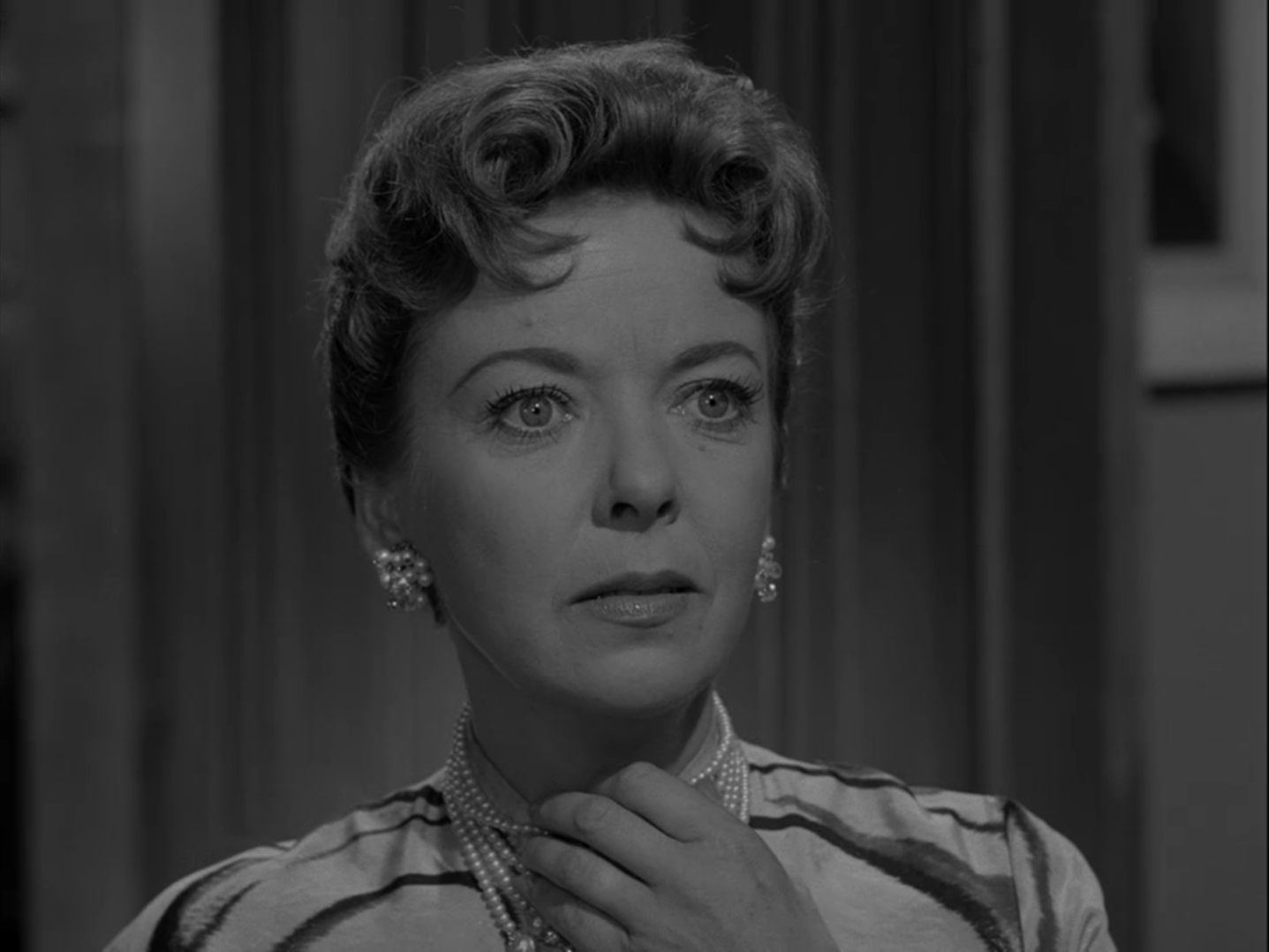
Can you imagine seeing your name in lights, on the big screen? These days, we can pretty much put our faces everywhere. This handsome mug is on various platforms right now. But, let’s go back in time a bit, not even that far back really. Let’s go to 1959. Television, for my younger audience members, that was a box that we used to gather around at specific moments in time where we could see people moving on the screen–television was still a fairly new medium. And if people really wanted to see a film, you had to go out to the movie theaters. Can you imagine the feeling of people having to make dates and set times to go see you act on a big screen? Now, that feeling can go one of two ways, generally. You can think to yourself, “wow, people are spending their time and money to go see me. I’m honored.” Or, you can think, “That’s right, people are coming to see me. I must be something pretty special.” While I think just from a purely human interaction perspective, the first way is the most healthiest perspective, I can completely understand how people could easily become led into the second one. In some ways, the problem is data–you’re probably thinking, whoa, that took a hard left turn. Hear me out. When we talk about actors and films, we tend to judge them on box office returns. How much money a film brought in, in relation to its overall budget, equates to a kind of success or failure. It’s about as easy of a business formula as you can get. But, I think if we’re really pushed hard enough, we know that this equation is not absolute. There have been films that we consider to be classics or cult hits that did not do well at the box office. One that immediately comes to mind is It’s a Wonderful Life. Another, is one of my favorites; “Office Space.” But, when your films are all hitting big, and for a moment in time you are the greatest show on earth, it must feel a bit strange and exhilarating. And then, when it suddenly ends because the tastes of the people and the culture have shifted, it must feel odd, sad, and probably a bit like you’ve been abandoned. Such is the case for our heroine in today’s Twilight Zone episode: The Sixteen Millimeter Shrine.” Barbara Jean has been at the top; she’s worked with the best of the best; but that time has passed. And instead of building a new life for herself, she has crafted a special kind of prison: one where she sits in a dark room, simply watching the films of her past. Even when friends like her agent/business manager Danny Weis try to shake her out of her nostalgic stupor, it proves futile. There is no place for Barbara Jean in the present, which leaves her with only one solution: living in the past. Oh, not with some time machine–that is ridiculous sci fi mumbo jumbo. She will simply have to exist on film–or in film. In the end, Barbara Jean gets her wish, she is, as most actors dream, immortalized on film–quite literally.
Sixteen Millimeter Shrine” is directed by Mitchell Leisen, teleplay by Rod Serling, and starring Ida Lupino as Barbara Jean Trenton and Martin Balsam as agent/manager Danny Weiss(The episode first aired on October 23rd, 1959.
This might be the first episode of our show where I will find myself sent into the cornfields by my audience, and even in disagreement with the man, the myth, the legend, himself: Mr. Rod Serling. In Martin Grams Jr.’s The Twilight Zone: Unlocking the Door to a Television Classic, he quotes some of Serling’s less-than-enthusiastic comments for this episode. But, one pretty much sums it all up. When someone asked Serling where he got the idea for the episode, Grams Jr. quotes Serling as saying, “I don’t know where the hell I got the idea, but I wish I’d never gotten it (180).
But, when I consulted Zicree’s The Twilight Zone Companion, I learned that I was not alone in liking this episode. The other man, myth, and legend–someone we have not talked about much on this show, producing legend Buck Houghton had this to say about it: “I thought it was very well directed…largely because Mitch (the director) had a feeling for how people could get that way. He undoubtedly reminisced about situations that he’d been in when he was on top” (82). Well, it’s one thing if Serling doesn’t like his own creation, but if both Serling and Houghton dislike it and you do, that’s grounds for recalibrating your taste meter. I”m going to try and explain why I like it as much as I do.
This is a really odd episode in that it almost demands that you look at it from two different perspectives. There’s the production of the story, as in the creative aspects that make it come to life, and then there’s the story that we see on the screen, as in what is delivered to us.. Martin Balsam’s acting as Danny is perfectly fine–Danny shows some genuine care for Barbara Jean when he defends her against the studio exec. But, Ida Lupino is absolutely masterful in this. If you think that she’s overthetop and too flamboyant, that’s the point. She is “acting” while outside of the stage, in real life. Her characters have become the reality, and Barbara Jean, the woman, has become the fantasy. I want to give a special nod to the art directors George W. Davis and William Ferrari. For any problems that this episode might have, it is not because of the visual artistic vision. I’ll talk more about this in my moments of awe section, but the camera angles, the lighting, the pushing in when needed (bringing the camera closer) the artistic vision, as laid out by director Mitchell Leisen and carried about by the two men I just named, is nothing short of masterful. Even the sound, the projector flapping, the silence in between the scenes, beautifully orchestrated. So, we’ve got three of the four main elements of a show done, at worst, competently, between the acting, the sound, and the visuals. That leaves the writing. The theme is quite good–human nostalgia. Let’s get etymological up in here for a moment. The word nostalgia comes from the Greek Nostos (a return) and Algos (a pain). Therefore, nostalgia in the original sense of the word is a painful return to the past. We tend to think of nostalgia in positive terms today, but actually, there is a painful element to nostalgia in the recognition that it can never be again–time moves on, but, sometimes, we don’t. It’s actually quite easy to become trapped in nostalgia, and our memories don’t always help the situation–not because we are necessarily lying or misremembering but because we activate nostalgia for the express purpose of finding something good. The goal is baked into the process itself.
We’re not going to take Julie Andrews’ advice by starting our discussion at the very beginning. Instead, let’s move to the ending. What did you think of it? In Grams’ book, he includes a story of Serling agreeing with a reviewer who basically said the acting is good; the dialogue is good; but the ending was a bit disappointing. I could see someone in 1959, perhaps, looking at the ending and wondering, “what is this guy Serling doing?” But, today, I think we are a lot more comfortable in the sci-fi/fantasy genre. The ending isn’t as jarring to us, but is it good? I think so. I actually like it. Today, so much of our entertainment media tries to remind us of what is, but it does a terrible job of inspiring us to think of what can be. What the Twilight Zone provides so well are these moments of narrative breaches that challenge us to try and accommodate what we just saw on the screen. What would we think if a friend of ours who was trapped in nostalgia actually ended up on the screen? How would we react? Would you be happy for them, or saddened by the loss of a friend? That’s part of why I like this episode. It refuses to be what it should be, which is a story that has to move a woman from sadness to acceptance. For that reason, I kinda’ like this episode. If you’re going to wish me to the cornfields for it, at least choose a nice spot.
Dive into question 1: Could you see yourself getting trapped in the past like Barbara Jean? Yes. I think nostalgia has a role to play in life. It reminds us that there are, potentially at least, moments in our past that retain value. And, if there are moments in the past that retain value, there can be more in the present and in the future. The problem is that we tend to do a terrible job of valuing our present times. According to the American Psychological Association website, “Historical nostalgia…suggests is more likely triggered by dissatisfaction with the present. If people are unhappy for any reason with how things are today, they're more likely then to experience this sense that things must have been better in the past.” (Link). Nostalgia is a part of a healthy life, but it can certainly become problematic if we obsess over the past. How do we keep ourselves from being trapped? Well, I think a healthy understanding of the present.
You’d be surprised at how long it takes me to create these episodes. Now, over time, I’ll likely get better and maybe streamline my creative process even more, but it takes time–and time is precious to me. But, I suspect that, if I make it all the way to the end of the show, I’ll look back on these early times, these struggles, the times when I doubt that anyone is even listening as I type this, I’ll look back at these times as being the most enjoyable–because, they are the most pure in terms of intention, creativity, and personal connection. Undoubtedly, there will be times when I have to discuss an episode that I don’t particularly like–and yes, there are a handful, I have little doubt that writing up those episodes will feel a bit more laborious than others. But, that’s why I wanted to make this show about awe and ideas. Already, I’m seeing this Sixteen Millimeter Shrine” differently than I had in the past, so I’m even excited about seeing that handful of episodes with new eyes. So, and stay with me, this might sound a little–out of the fifth dimension. I think it’s possible to develop a kind of nostalgia for the present, as in recognition that this present moment will become a source of strength as a past moment in the future. Are you still with me? In other words, if you love a present moment that you’re in and can reflect on what makes it so good for you–how it helps you become a better version of yourself, I think you can essentially cement it as a point of nostalgia for the future. This way, you’re not always just looking to the past, you’re recognizing that the present has value as well.
Returning to our episode, I can completely understand how Barbara Jean can be pulled into the past, especially in the entertainment industry. Undoubtedly, many of you probably connected this immediately with the ongoing conversations about how leading women tend to not get the same kind of roles they once had much earlier than leading men. That’s certainly a valid way into discussing this episode. But, I do think there is a broader human problem here as well. Barbara Jean does not seem to value anything other than her career. She has no family, no friends, no other hobbies, no work of any kind. Therefore, if you take away the one thing that has defined her life, you essentially take away her life.
This episode reminded me of an interesting article in “The Atlantic” by Derek Thompson titled “Your Career is just 1/8th of your Life.” and although I don’t agree with everything it has to say, I find the math that it offers early in the essay to be intriguing. Let me read a little bit of it.
According to the website 80,000 Hours, the typical career is just that: 80,000 hours long. That’s an almost unfathomable amount of time. But life is long too. The typical person is alive for slightly more than 4,000 weeks, and awake and conscious for the equivalent of 3,000 weeks. When you do the basic math on 80,000 hours, you discover that the average career is roughly the equivalent of 480 sleepless weeks of labor. A little bit more math, and you realize that the typical person has five waking hours of not working for every one hour of their career. Work is too big a thing to not take seriously. But it is too small a thing to take too seriously. Your work is one-sixth of your waking existence. Your career is not your life. Behave accordingly. (link)
I remember a teacher once telling me when I was younger, “do you want to dig ditches for a living when you get older?” I thought about it for a moment trying to figure out what the point was. My grandfather worked at a cemetery; he dug ditches. But, he also brought food home for his family and supplied a beautiful home for them. I didn’t care what he did for a living; I cared about who he was as a human. I’m a college instructor, and I’d like to think I’m pretty good at it, but I’m also a son, a brother, a husband, a friend, a colleague, and a mentor to some of those kids in the classroom who need one. I have a tremendous amount of value outside of what I do, though I still love it.
Dive into question 2: Is there an entertainment nostalgia push? If so, has it failed or succeeded? If you’ve been paying attention to entertainment media at all, you might have noticed that Hollywood keeps trying to force reconceptualizations of older shows and movies on us. You don’t need a film degree to see that, they are trying to bait us in to watch through nostalgia. But, I don’t think it works. You see nostalgia tends to be, as we see even through Barbara Jean, quite personal. Yes, you can probably create a bit of communal nostalgia, but it is nowhere near as powerful as our personal nostalgia. I’m a Gen Xer. I grew up watching shows like “The Fresh Prince” “The Wonder Years”, and I remember when the Disney Renaissance, with The Little Mermaid, Aladdin, Lion King, and Mulan came out and captivated people all over the world. I have no interest in any of these being remade, and to be fair, it has nothing to do with how good they are or any of the actors playing the various roles. Each of these remakes could be top-notch quality–but, I appreciate my memories. I value them. I don’t want to see them remade. In short, get off my nostalgic lawn. That’s a bit much even for me. The real problem that I have is that, I think you’re inhibiting memory making for young people today. And that, to me, is a crime.
But, that might be a bit too harsh and too rash of a conclusion. An article by Tim Wulf, et all, studied the use of nostalgia inducing media during the COVID-19 lockdowns in Germany, and what they found was quite interesting. I’ll just read the conclusion part: “Altogether, our findings indicate that an increase in the use of nostalgia-inducing media during the COVID-19 lockdown might be associated with the fear of isolation due to the lockdown measures and that people turn to nostalgic media consumption as a coping mechanism and to escape from the current emotionally unpleasant situation, a strategy which likely has both functional and dysfunctional aspects” (264). Now, if you read through the study, it actually appears much more positive than the conclusion makes it seem. Nostalgia-inducing media (a fantastic term that I will use from now on, by the way) can be used as a coping mechanism to get through difficult times. Sometimes, when you’re going through a rough mental stretch, you don’t have the luxury of talking about cures and fixes; you just need to make it through the day. If watching a movie or a show can move you enough to get through the day–trust me, that is a huge win, because it gives you another day to fight, another day when you can move toward a more long-term positive solution.
However, we can see the dysfunction side of this in “The Sixteen-Millimeter Shrine.” Barbara Jean has no intention of working toward a long-term positive outcome. She only wants to live in the nostalgia. So, I don’t want to make it seem like I’m disagreeing with the study I mentioned; I don’t. I find the study to be balanced and really fascinating. I’m simply saying that, sometimes you only need to live to fight another day. I’m not sure if any of these nostalgia remakes that are being pumped out have any benefit for people. I sincerely hope they do. But, I can’t help but anecdotally feel like they are having the opposite effect.
Where did you find your moment of awe, something that moved you or inspired you to think beyond the surface? At the 2:25ish mark, not long after Serling’s monologue, the servant enters the room and looks for Barbara Jeanne. When Ida Lupino comes out from behind the projector screen, with the light continually wrapping around her face from the projector–that’s a million dollar shot right there and genuinely creepy. I dabble in a little bit videography/cinematography–and I think I could die a happy man, if I composed a scene as magically captured as that moment. Plus, you can’t help but wonder, what was she doing there behind the screen? Was she so desperate that she was hoping that there was a world behind it where she could return to–the nostalgia for her greatest moments? For those of you who are like me and sometimes can just appreciate a single shot or scene, this is it for me. This is the shot and scene. It’s just about perfect–and Lupino is masterful in it.
As for my rating, I give this one a another middle-middle-tier. Let me know if you want to wish me to the corn fields. I’m sure it won’t be the last time.
Next time, we’ll be discussing “Walking Distance” Here are your questions to consider as you watch.
Question 1: Does society take our child-like happiness away, or is it simply a part of growing up?
Question 2: Can we bring the past with us into the present in a healthy way, or does it always have to remain outside of the present?
Question 3: What are your moments of awe here?
Head over to thekeyofimagination.com to continue our conversation. You can rate this episode, learn more about me, watch previous episodes of the show, and check out my curios page where I showcase some of the Twilight Zone trinkets I’ve bought over the years. I encourage people to email me thoughts and comments, whether it’s about a particular Twilight Zone episode, your ranking for an episode, or about the Key of Imagination Show. You can get those to me as a text email, an audio clip, or even a video clip of roughly no more than 5 minutes to keyofimaginationshow@gmail.com. Keep in mind, we’re trying to maintain a family-friendly atmosphere. If you would rather I not use your comments on the show, please indicate that so I can respect your decision. If you enjoyed the show, I ask that you please take a moment and do one of the following to help build our community. Rate the show, review the podcast, leave comments, thumbs up, all of the usual algorithmic gymnastics. That will help get the show in front of more people and help us build our community of Twilight Zone fans. However, even if you do none of that and absolutely hated every minute of this, I would still like to thank you for spending some time with me. Until next time, remember, all doors are open to those who possess the key of imagination.
Works cited
Wulf, Tim, Johannes S. Breuer, and Josephine B. Schmitt. “Escaping the Pandemic Present: The Relationship Between Nostalgic Media Use, Escapism, and Well-Being During the COVID-19 Pandemic.” Psychology of popular media 11.3 (2022): 258–265. Web.