
The Twilight Zone Season 1: Episode 6
"Escape Clause"
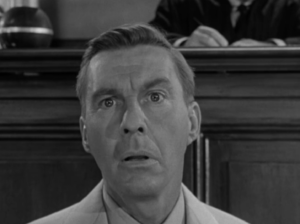
Benjamin Franklin astutely commented, “Our new Constitution is now established, everything seems to promise it will be durable; but, in this world, nothing is certain except death and taxes." But what if we could remove one of those nasty assurances? No, not taxes–even the Devil must pay his dues. But, what about death? How different would our lives be without the grim reaper looking over our shoulder? In order to secure such a scenario, Mr. Bedekker will engage CadWallader, also known as The Devil, in a little bargain. Immortality in the hereafter for immortality in the here and now–in short, his soul for his life. For hypochondriac, Walter Beddeker, there can be no greater gift than to know that nothing can ever get the better of his health–and that with nothing but eons ahead of him, he can now live the life he–and all men–were truly meant to live. Mr. Beddeker, however, soon finds that with the removal of death comes the removal of risk and the removal of the impetus for creating meaning. Already a difficult man to love, Bedekker only becomes worse with time–and his poor wife, Ethel, a saint on earth, will become nothing more than a prop for Bedekker’s search for excitement. He lies to the police about killing his wife so that he can take a seat on the electric chair. Oh, Bedekker is in for a shock all right, but it isn’t the one that he thinks. He receives a life sentence with no hope for parole. As he waits to be transferred to the penitentiary CadWallader reminds Bedekker of his escape clause, which immediately grants him death. Bedekker uses the clause, and the rest is…well…let’s just say, his afterlife was likely a lot like his life: a hot mess.
“Escape Clause” is directed by Mitchell Leisen. Teleplay by Rod Serling. And starring David Wayne as Walter Bedekker; Thomas Gomez as Cadwallader or The Devil; and Virginia Christine as Ethel Bedeker. It originally aired on November 5, 1959.
A funny anecdote on the episode. According to Grams Jr. in Unlocking the Door, the part where Cadwalleder (played by Gomez) wipes his brow and tells Bedeker that he keeps it hot in here was ad libbed and very much the truth. Gomez states, “It was hot on that stage. I’m not kidding when I say I felt like the Devil” (189). In Zicree’s Companion, he includes a review of the episode from The Daily Variety in which the reviewer says it is, “ranked with the best that has ever been accomplished in half-hour filmed television” (41). High praise indeed. Will I rank the episode so highly? Well, we shall see, but I’ll probably tip my hand a bit right now, as we go into my initial thoughts.
This is the first episode I’ve reviewed where I feel like I have to be careful. The revelation at the end of Bedeker getting a life sentence is a really good one. Upon first viewing, you’re delighted by the little wrinkle that takes place. So, I want to try and maintain a balance between my subjectivity and some objectivity as well. Objectively, I think it’s a fine episode–one of the best? No. Not for me, at least. I was not surprised when I read that there were a lot of revisions to the script for this one. It feels a bit rushed. The characters are not as fleshed out as they could be for me, especially Ethel, his wife. I would have also loved some more time with Thomas Gomez (the devil). We’ll see Mr. Gomez again in one of my favorite Twilight Zone episodes at a later time. His presence on the screen is absolutely magnetic. And I don’t say this to take away from the work that David Wayne does as the lead. He is 100% despicable–exactly as he should be. But, it lacks delicate purpose. We jump so quickly from his receiving immortality to his trying to hurt himself. But, why? Something in between those two scenes could have helped us better anticipate his frustration–we could have experienced a bit of schadenfraude–and delight in Bedeker’s frustration. And so while the writing of the ending is quite good, the lead up for me does not allow us to experience that great ending to its fullest. Now, I’m only going to say this one time because I don’t want to belabor it. I created this show because I am absolutely enamored with the Twilight Zone and Rod Serling’s creative vision. Any time I have something negative to say, it in no way should be taken as me thinking that I could do better. I can’t. Nor is it meant to be nitpicky. It’s meant to question how we could have experienced the awe or the best that the story has to offer. It’s also meant to spark discussion of creative works. If you want to push back against any of my criticisms, I encourage you to do so through comments, emails, or even recorded voice messages. But, I ask that you maintain the etiquette of our community. We want to build the kind of place where people can vehemently disagree and then have a beer together all within the same day. Honestly, if you make a really good point, I’ll use it on the show. I have no problems admitting where I think I’m wrong, or where I think someone has a valid opinion.
Let’s dive into question 1. If you were offered immortality, would you take it? In my
episode on “One for the Angels”, we talked about John Milton’s epic poem, Paradise Lost. And we brought that text in to discuss how much providential knowledge angels actually have access to, and how such a quest has led to the fall of angels like Lucifer. Well, it isn’t just the angels who have sought forbidden divine knowledge. In the book of Genesis from the Bible, we read, “And out of the ground made the LORD God to grow every tree that is pleasant to the sight, and good for food; the tree of life also in the midst of the garden, and the tree of knowledge of good and evil.” These two trees are listed separately but we learn that they are bound together. Continuing, “And the LORD God commanded the man, saying, Of every tree of the garden thou mayest freely eat: But of the tree of the knowledge of good and evil, thou shalt not eat of it: for in the day that thou eatest thereof thou shalt surely die.”
The subject of the relationship between knowledge and mortality has been explored in story for quite a long time. In 1588, Christopher Marlowe’s famous play Dr. Faustus is first performed. It would later be published in 1604, posthumously. There are two versions of the text: the A-text and the B-text. Now, there is a long scholarly history there between the two that we won’t go into, but if you’re at all interested, I highly suggest making a brief rabbit hole run to learn about the history of the two texts. The play is about a German scholar who has reached the limits of his academic pursuits, so he turns to magic. Faustus makes a pact with Mephistopheles and sells his soul to the devil in exchange for 24 years of power, divine knowledge, and access to Mephistopheles. As you might guess, the bargain never really lives up to its billing, and after the 24 years are up, Faustus is dragged away to Hell.
In one of my favorite films, Groundhog Day, Bill Murray remarks, “Maybe God is not omnipotent. Maybe he’s just been around so long He just knows everything.” Groundhog Day is a comedy–and a great one at that, but it does touch upon a couple of interesting points. Bill Murray’s character uses his immortality to build up knowledge, which at first gives him a sense of power. However, it’s only when he begins to use the days to get to know his colleague played by Andi McDowell that he begins to gain an appreciation for his mortality. It is an old answer to the dark British romantics of the 18th and 19th century, writers like Lord Byron, Samuel Coleridge, and William Blake: unlimited mortality and unlimited knowledge equals unlimited suffering.
Coming back to our episode, Bedeker clearly has no interest in using his immortality to amass knowledge. He is a wholly uninteresting man, petty, complaining–and downright cruel in the way that he treats his wife. Had he been more connected, more empathetic to human beings, he might have figured out all of the good that he could have done to help humanity. It seems to me that, with even more time, Bedeker would have only become more of a monster, delighting only in the misery and misfortune of others. I’d like to think that Bedeker had a moment to reflect on what he was and had become and had a chance for redemption, but that’s not up to me–and that’s a good thing for us all. To answer our question more directly, no, I would never take immortality if it were offered to me.
Dive into question 2: Is there a part of us that is more comfortable in misery than in happiness? I used to have a lecture that I would do a long time ago for a college literature class–I honestly can’t remember what text it was in relation to, but one of the themes that I would discuss in that lecture is how we are surprisingly more comfortable in misery than happiness. My students would look at me at first in disbelief, probably a lot like the way some of you are looking at me through the screen or listening through your headphones. Why would we be more comfortable in misery? We look at happiness and misery in very different ways as a species. We innately know that happiness is fleeting, and that it can end rather badly. But, there is something about misery that makes us see it as an everflowing fountain of discontent filled with the bitter gall of life’s intended and unintended consequences. There is, in my opinion, a large percentage of the population who when they experience happiness find it to be uncomfortable because they know that it will not last, and eventually it must give way to something worse, even if only contentment. Whereas there is a bit of hope that is built into misery–the belief that things can get better, even if only marginally. It’s why the great poet Dante has the following inscribed in the gate of hell : abandon hope all ye who enter. Dante knew that it wasn’t any of the tortures in hell that were the source of the most suffering; it was the loss of hope. It’s why people who are suffering often say, “I’m in hell.” It’s also why it’s so important that you guard your hope in yourself and in those you love.
Returning to Mr. Bedeker’s precarious posthumous position–say that three times fast. Can hope survive in immortality? What is one hoping for? I suppose you can hope to create a world without suffering, without war, without famine. But, let’s say you actually achieve this monumental task. You’re still there, just living. Eventually, hope will give way to despair.
Like many people, I enjoyed watching the show “The Good Place”--I actually really enjoyed it a lot. There are some really good philosophical ideas to wrestle with in that show. However, I did not like the ending, but I understood it. If you’ve never seen the show and want to, I’m issuing a spoiler alert here. By the end of the series, each of the characters were living in an infinity of purposeless existence–although they tried to create a kind of meaning through jobs, tasks, and even earthly relationships. But, if I’m letting my philosophical flag fly, I knew rather quickly what was eventually going to happen to our main protagonists in the show because it’s something we’ve known as a species for a very long time. I knew that, eventually, the characters were going to have to end their purposeless existence and go somewhere else. The problem is that there was no space for hope or meaningful engagement with anything, not really. One of them takes on a new kind of career, but even that character, I believe, would eventually have to join the rest in nonexistence. By the end of the last episode, I was both sincerely moved and destroyed by this ending. What we don’t often realize is that hope is actually intricately connected with mortality. Why do we hope at all? It’s because we know that our time is precious; we know that we only have a finite amount; and so suffering takes away the precious time that we have–moments that we would much rather fill with joy and meaningful engagement with the rest of humanity.
What this episode of the Twilight Zone did that was actually somewhat unique is that it secretly conveyed a kind of problem that we have today, one that has been around forever. We sometimes misconstrue misery with purpose. Bedeker was happier as a hypochondriac because it gave him something to always fight against; it gave him an antagonist from which he could play his role as the protagonist. Once he no longer felt that need to push back against sickness, he was left with nothing but trying to create opposition in his many attempts to destroy himself. But, you mustn't let anger, opposition, and even worse cynicism become the fuel that spurs you on to action. It always leads to suffering and an eventual complete separation from humanity and woeful resignation.
Let empathy, connection, and a love of humanity burn within you. When you do, you’ll realize how much more special the time that we have on this planet truly is. Where did you find your moment of awe, something that moved you or inspired you to think beyond the surface?
This was a tough one for me. I love Thomas Gomez in this episode, and I love the way he plays with language, the cadence of it. My moment of awe is when Cadwalleder talks about the malleability of language. It’s something that we do as human beings so often to justify all of the terrible things we want to do. We are a poetic species, and we love to be moved by a good speech. But, we have to remain vigilant about the fact that language is persuasive; it creates movement and can spur emotional reactions. If you think that you’re too smart or too strong to ever be moved by the words of another, I hate to break it to you, but you’re probably one of the easiest ones to manipulate. It’s better to admit that you possibly could be moved toward negative actions by language. Such a mindset, I think, makes one more likely to see a potentially bad situation occurring.
Okay, so, where do I rank this episode? I actually rate this one as lower-upper tier. I already talked a bit about why toward the beginning of the episode, but it just feels rushed and we don’t get enough fleshing out of the characters. I’ll remind people, me placing it in the lower tier is not a slight against Serling. His worst work is light-years better than what I could produce, but he was under a lot of pressure to produce weekly, and I think this one shows that.
Next time, we’ll be discussing a pop cultural classic: “The Lonely.” Here are your questions to consider as you watch.
Question 1: Should we ever grant robots human rights?
Question 2: “The Lonely” proposes an unorthodox punishment for crime. Would you be okay with the government trying something new like VR prisons?
Question 3: What are your moments of awe?
Head over to thekeyofimagination.com to continue our conversation. You can rate this episode, learn more about me, watch previous episodes of the show, and check out my curios page where I showcase some of the Twilight Zone trinkets I’ve bought over the years. I encourage people to email me thoughts and comments, whether it’s about a particular Twilight Zone episode, your ranking for an episode, or about the Key of Imagination Show. You can send your thoughts to me via email, an audio clip, or even a video clip of roughly no more than 5 minutes to keyofimaginationshow@gmail.com. Keep in mind, we’re trying to maintain a family-friendly atmosphere. If you would rather I not use your comments on the show, please indicate that so I can respect your decision.
If you enjoyed the show, I ask that you please take a moment and do one of the following to help build our community. Rate the show, review the podcast, leave comments, thumbs up, all of the usual algorithmic gymnastics. That will help get the show in front of more people and help us build our community of Twilight Zone fans. However, even if you do none of that and absolutely hate every minute of this, I would still like to thank you for spending some time with me. Until next time, remember, all doors are open to those who possess the key of imagination.