
The Twilight Zone Season 1: Episode 11
"And When the Sky was Opened"
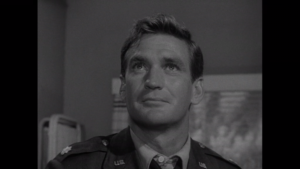
Introduction
Welcome to the Key of Imagination. This week we’re talking about the Twilight Zone episode “And When the Sky was Opened.” We’ll discuss whether or not one can actually feel out of place in the world, what to make of multiverses and parallel universes today vs in Serling’s time, and we’ll talk about super secret spaceships. So, grab your keys and let’s open up this door to the fifth dimension.
Plot exposition
Did you ever get that eerie feeling inside, like you’re not supposed to be here–like you shouldn’t exist. Well, stop it. Of course you’re supposed to be here, and by the way you’ve got important work to do on this planet, so the sooner you get over whatever the heck it is that you’re actually feeling, the sooner you can be the best version of you. Have you seen the world out there? We can use all the help we can get. On a serious note, there are times when even the most grounded of us can feel a bit like we don’t belong, but that’s certainly not the same thing as what our three intrepid astronauts are going through in this week’s episode. No, for Colonel Ed Harrington, Lt. Colonel Clegg Forbes, and Major William Gart, they quite literally are experiencing the feeling that they don’t belong, that, perhaps they haven’t reached their final destination–pun intended for those of you who get the joke. Three brave men having just returned from a flight aboard a very secret project of the airforce, and one by one each begins to get this gnawing sensation that some thing wants to pull them out of existence, and so when Forbes first witnesses his best friend Harrington simply disappear, with no one claiming to have ever known of such a man, all Forbes can do is return to the hospital where all three men were last seen together–except Gart doesn’t seem to remember Harrington, either. It isn’t long before the entire world no longer remembers Ed Harrington, Clegg Forbes, and William Gart. Three men; three disappearing acts, and no records of their existence. No one knows where they went, and no one cares. If that doesn’t make the hairs on your neck stand up, you’re a stronger person than me.
Episode Details
“And When the Sky was Opened” is directed by Douglas Heyes. Teleplay by Rod Serling and based on the short story by Richard Matheson. Now, that’s a dynamic duo that will have some legs in this series: Serling and Matheson. Something tells me those two young men are gonna go places. Oh, right. We’re looking at this from the future. They already accomplished great things. Never mind. The episode originally aired on December 10th, 1959. As for our cast, there are quite a few people who deserve attention, but I will limit it for now to our three main protagonists: Ed Harrington is played by Charles Aidman; Clegg Forbes is played by Rod Tayler; and James Hutton plays William Gart. All three men do a fantastic job.
Episode Tidbits
Grams Jr. has a great tidbit where he relays a quotation about the episode from the February 27th, 1960 issue of TV Guide. The author states, “Serling’s gifts as a narrator are easily recognizable. Serling’s point of view here is a little obscure, but as pure horror the episode can stand right up there with the best of Poe, Bierce, and Sheridan LeFanu” (211). I think today we would probably want to classify this episode as more sci-fi, but I think the TV Guide writer here makes a good point; we can lose sight of the fact that there is something quite horrific going on here. Maybe it’s my own early American literary background, but I certainly took it as a horror story as well.
In Zicree’s Companion he includes a wonderful quotation from Serling about fear. “The worst fear of all is the fear of the unknown working on you, which you cannot share with others. To me, that’s the most nightmarish of the stimuli” (62). It’s a great quote, and of course he’s right. Think about a moment when you were trying to get a point across to people, and no one could understand what you were trying to say, the absolute frustration. Now, raise the stakes of that moment to life or death–to the point of trying to explain to people that someone who was important to you and to others no longer exists, and all records of that person no longer exist–and soon, neither will you. That is terrifying. Something else I just want to point out that Zicree discusses is how director Heyes wanted to play the disappearing as a kind of euphoric moment. You can see this when Harrington disappears, but then when it came time for Rod Taylor to do his disappearing act, the actor convinced Heyes to let him do it his own way, with this kind of defiance. If I had to choose only one reaction for the entire episode, I prefer the euphoric reaction because I think it does add an additional layer to the despair. Although, I did enjoy seeing Rod Tayler go Incredible Hulk through the bar door. Rod Tayler smash! I believe that was a decision that occurred on the spot; it wasn’t really pre-planned. You can kind of see that in the hard cutaway that happens just prior to his plowing through the glass.
My Initial Reaction
I know I sound like a broken record with these early episodes, but you have to admit, most of these early season 1 episodes are actually quite good. I promise, we’ll get to ones that won’t receive glowing reactions from me. But, I enjoy this episode. There’s a philosophical element to it that draws me in. I like the fact that by the end of the show, we’ve figured out nothing. We have no idea what the heck happened to these men. We’re left thinking about all of the various possibilities, some scientific, some divine, some downright maddening. I love episodes where you have to put in work, and this is certainly one of those.
Question 1 We may not actually disappear, but do we, as humans, have a kind of phenomenon where we feel as though we’ve been removed from the world?
When I dove into the research, I didn’t really find exactly this phenomenon–thank goodness– but I think I came pretty close. There is a type of dissociative disorder known as Depersonalization-derealization disorder. According to the Mayo Clinic, “Depersonalization-derealization disorder occurs when you always or often feel that you're seeing yourself from outside your body or you sense that things around you are not real — or both. Feelings of depersonalization and derealization can be very disturbing. You may feel like you're living in a dream” (Link). I think there are probably certain times when many of us might get this sensation in our lives, but it most likely goes by so quickly that it barely registers a blip on our radars. However, for someone who actually is struggling with this on a daily basis, it must be quite overwhelming and in most times just plain terrible. Philosophers have long known that having a grounded sense of reality is important for our overall wellbeing, our ability to situate ourselves within a community and thrive. Let’s actually move over to the philosophical side of the conversation for a moment.
As a species, we’ve been struggling for a long time with the question of who am I, but that query is predicated on the idea that we can have a grounded sense of self to begin with and that we can then construct an identity out of that locus. But, if we can never truly plant our feet on solid ground, how can we begin to even think about who we are. It’s for this reason that it’s so important to establish a strong foundation first from which we can begin to construct a realistic identity. It’s one of the reasons we continue to write, to read, to construct stories with characters. These are ways that we can experience life without having to experience the consequences, and there is a great benefit to this. Even though Captain Ahab from Moby-Dick doesn’t exist, when I close the book on the story, he doesn’t go away. He stays with me as a reminder to not monomaniacally obsess over things that are beyond my control. That’s the magic behind reading or consuming great works of literature; you carry the characters and stories with you as personal guides, like Vergil in Dante’s Divine Comedy. My ultimate point here is actually that it’s important to be able to construct a grounded sense of self within the context of not simply one’s personal existence, but within a framework of civilization as well. Great stories tend to help us better understand who we are and our place within humanity. If you feel as though you’re starting to lose yourself within the context of the world around you, ground yourself with the great stories of our species and breathe a fresh reminder that within humanity is courage, suffering, joy, despair, and triumph–and that you are a part of that rich tradition.
To bring this back to our episode, I alluded to this a bit in my tidbits section, but two of the three men play their disappearance with a sense of horror: Clegg Forbs and William Gart. Ed Herrington has a kind of peaceful resignation, but that’s only after he experiences the terror of slowly fading into oblivion. Certainly, the horror seems more realistic, but I could see where someone might experience this sudden urge to simply let go. In fact, Harrington even explicitly states, he feels like if he lets go, he’ll simply disappear. I want to pull up here for a moment and think about Harrington’s resignation a little bit more because there might be another reason why Harrington is able to go so peacefully, and the other two cannot.
When Harrington disappears, Clegg is left behind as the only person who has a record of his friend’s existence. Think about this for a moment. Maybe you have a spouse or sibling or friend. Just take a minute and think about if they disappeared, and everyone you spoke with about that person legitimately never heard of them. How long would it take for you to simply lose your mind and start to question the very nature of time and existence. Not only that, but, and here is where the philosopher starts to kick in, so buckle up zoneheads, there is also the realization for both Clegg and Gart that if they disappear like their friends, there will be zero record of their existence left behind on earth–all the people who loved them will have no sense of their having lived. Human beings have been struggling with the question of mortality forever. Heck one of the most important themes in the Iliad is Achilles thinking about who will tell the stories of him when he is gone. Death is built into life, but there is always at least the scientific hard truth that we existed; we took up matter and space within a time on earth. Could you imagine if we didn’t just die, but that when we left, all traces of our existence were wiped away with it? Whoo! That’s some horror right there.
And so, I could see where with that additional knowledge of what they believe is also going to happen to them, meaning both Forbes and Gart–that it would add an additional layer of horror to know that all records of their existence go with them. To tie up our question in a bow, we might not have a perfect feeling that relates to disappearing in real life, like in the episode, but when you put the dissociation together with our long-standing anxiety of who will remember us when we leave our mortal husks, you get pretty close to what the astronauts experience.
Question 2 We now have so many movies and shows that talk about time and multiverses, does our knowledge today impact how we look at the way Rod Serling handled this episode?
Now, before we dive into multiverses, time, and space–an area in which I am absolutely professionally qualified to discuss because of my extensive research into 80s and early 90s cinema and the Marvel Cinematic Universe, let’s get a quick reminder of what actually happens in our Twilight Zone episode: the three astronauts go up in the mysterious X-20 aircraft; they black out about 4 hours into the trip, disappear completely for 24 hours, and then reappear in a dented aircraft in the Mojave Desert. Now, the astronauts themselves don’t even know where they were or what happened in that 24 hour period. All we know is that it seems like time is trying to correct itself and remove the three men from existence. So, where were they in those 24 hours? Is it possible that they were in another dimension, or that they returned to another dimension? Let’s go to the science! Or at least as much of the science as I can actually understand, and yes, I’m giving a disclaimer: I’m doing my best to give a good-faith reading of the science, but I’m definitely out of my depths here. So, this is just for-fun conversational purposes.
Let’s talk about time itself. I’m going to read a section from a really interesting article from Scientific America.com about real, no-nonsense time travel.
Time traveling to the near future is easy: you’re doing it right now at a rate of one second per second, and physicists say that rate can change. According to Einstein’s special theory of relativity, time’s flow depends on how fast you’re moving. The quicker you travel, the slower seconds pass. And according to Einstein’s general theory of relativity, gravity also affects clocks: the more forceful the gravity nearby, the slower time goes.
“Near massive bodies—near the surface of neutron stars or even at the surface of the Earth, although it’s a tiny effect—time runs slower than it does far away,” says Dave Goldberg, a cosmologist at Drexel University.
If a person were to hang out near the edge of a black hole, where gravity is prodigious, Goldberg says, only a few hours might pass for them while 1,000 years went by for someone on Earth. If the person who was near the black hole returned to this planet, they would have effectively traveled to the future. “That is a real effect,” he says. “That is completely uncontroversial.” (link)
Isn’t that cool? It reminds me of that scene from the Nolan film Interstellar where the astronauts were on that planet and when they got back on the main ship, the one guy who was left behind was significantly older than they were. Doing this research made me better appreciate that film, so that is a nice little added bonus.
It seems to me that gravity could have some kind of effect here where you can lose that 24 hours like it was nothing in space versus on earth. Look, if you happen to either be a physicist, cosmologist, or just really knowledgeable about this stuff, go ahead and step in and explain it better than me in the comments section. I would actually be interested in reading it myself.
If that’s the time part, what about the disappearance aspect?
Thank god for Dr. Sean Carroll and his video on Quantum Particles and parallel universes (link). When I was trying to read actual peer-reviewed literature on this, I got lost pretty quickly, but thanks to his video, which I’ll hopefully remember to post a link to in the episode description notes, I think I have a better idea of what physicists are actually trying to say about multiverses and parallel universes. Let’s get the fun stuff out of the way. According to pure physics, science doesn’t care about the fact that you chose the chicken when you went out to dinner last night. It doesn’t automatically create another universe where you chose steak or a veggie burger. The only thing that science cares about is the fact that we are made up of quantum particles just like the chicken, steak, and veggie burger. Equations in physics are able to demonstrate, however, that on a quantum level, parallel universes do exist. The example that Carroll gives in the video is that if an electron is spinning clockwise, there is also the probability that there is one spinning counterclockwise. This is not magic; it’s simply based on the fact that it CAN spin both ways. When you add that something CAN scientifically happen, and you give it enough time and chances to happen, it likely eventually WILL happen. Therefore, you could have a body, a person, who is made up of protons, electrons, etc in the same configuration as you right now but in a different universe billions of lightyears away who is virtually identical to you right now. Okay, I think I was able to hold that together well enough. I hope so. Just don’t ask me to say it again.
So, how should we think about this other version of us? According to Carroll, he thinks we should treat them like twins. Twins on earth can look very similar, but they are different on a quantum particle level, and therefore, we are different from each other.
So, there does seem to be truth to the idea of the multiverse/parallel universe theory, but it both is and isn’t as cool as we might think. I still think it’s pretty cool, but I don’t like the fact that science doesn’t acknowledge the weight of my decisions in a more serious way. I want infinite versions of me that chose different Gi Joe figures when I was like 7 years old. (I obviously wasn’t one of the versions who was able to get the Chicago Bears William Refrigerator Perry special GI Joe figure). <Sigh> I’m still upset about that.
Okay, that ends the science portion of this discussion. Now, we can begin the theorizing just for fun part of our Twilight Zone episode. What if these astronauts are parallel versions of themselves? What if there is a mechanism for removing matter that is simply not supposed to exist? It would seem to me that only something like God could do what actually happens in the episode because you have to remove all of the connected synapses that fired within the brains of I don’t even know how many people to make sure that no one will ever have a record that can draw a memory of those three men. Unless someone can think of a scientific way of doing this, it would have to be an act of God. I don’t think pure science would be able to do that on such a grand scale.
With all of this in mind, let’s answer our question: does our knowledge today impact our interpretation or enjoyment of this episode, I would say it’s a bit of a mixed bag. I know some people have a problem with this episode because there is no clean understanding of what actually happens. Where did they go? Are there three versions of the astronauts that exist somewhere else? However, I think having a better understanding of physics can actually aid in our enjoyment of the episode, but it will only take us so far before we end up in this place where we’re simply forced to accept that we don’t know what happened to them and how it’s even possible that no one knows them. So, perhaps, the coolest thing of all for me is that, this episode, and the mystery that it creates, still holds up for me in 2024 because we still can’t really explain what happened to them even with our best science. I don’t find that to be a problem; I think it’s pretty awesome.
Question 3 What are your moments of awe?
When I was doing my initial research for the episode, I stumbled upon how Serling got the name for the jet. I believe Grams Jr. also talks a bit about this in Unlocking the Door. It seems that Serling took The X-20 name from a very real project at the time in America that ran from 1957 to 1963. The goal of this project, code named “Dyna-soar” shortened from Dynamic Soarer, was to create a single-seat hypersonic jet that could deliver a devastating bomb. There’s actually quite an interesting history behind the project, too much for me to do more than a brief once-over. Essentially, the design idea came to America via German engineers/scientists through Project Paperclip–and there’s a whole interesting history behind that project as well. Boeing took up the project in the late 1950s and although it didn’t really fully work the way that they wanted it to, all of the research on the X-20 helped pave the way for future space travel. My awe here emerges from a point of view of history and humanity. At the time that Serling was putting this episode on tv, we were right in the middle of the X-20 project. As in, people were seeing, albeit through a fictional representation, a kind of real-time anxiety unfolding through a technological advancement that was actually being worked on. I wonder if this episode caused some people to genuinely become afraid of what America was doing behind the scenes? In some ways, times haven’t changed. People today are often wondering, what do governments all over the world actually have available to them now in terms of technology, and will it be something that is potentially devastating to the species, or maybe salvific. That’s right; we don’t always have to go negative. I guess my awe is in the fact that the more things change, the more they stay the same.
My Rating
Rating time: I think it’s probably fairly obvious that I like this episode. I enjoy the fact that you have to struggle with this unanswered phenomenon of the erasure of three men from existence. I find that endlessly fascinating. I would rate this a hearty middle-upper tier. It’s probably just outside of my upper-tier episodes. Why just outside? There are a few moments where the episode seems to be rushed in the beginning and toward the end, but that’s nitpicky stuff. It’s a great episode that I would absolutely stop what I’m doing and watch if it were on tv during a marathon.
Next Episode
Next time, we’re looking at “What You Need,” and here are your questions to consider while watching the episode:
Question 1: If you could bestow this gift of foresight upon someone other than yourself, would you?
Question 2: Is a lack of humor a genuine problem for Renard? In other words, is a healthy sense of humor an important part of a healthy life?
Question 3: What are your moments of awe?
Announcements and Shout-outs
No announcements, but I do have some shout-outs from YouTube comments:
Thomas Hugus commented on my “Where is Everybody?” episode, “Not a bad first episode. Dialogue was a little weak, but interesting anyway!” Thomas, I appreciate the kind words and the encouragement to get better. I hope people realize that we’re on this journey together. I’m evolving with the show and hopefully getting better each time.
Rob Sheehan commented on my “Walking Distance” episode, “Young Goodman Brown is one of my favorite works of Nathaniel Hawthorne…who’s probably my favorite author.” Rob, you and me and both. I’m an early Americanist by trade, and although I’ve worked on the long early America, meaning from roughly Jamestown 1607 through the start of World War I, my focus tends to be on what we would call the American Renaissance: that’s Herman Melville, Edgar Allan Poe, Whitman, Dickinson, and certainly Nathaniel Hawthorne. That American Renaissance period from roughly the 1830s until the Civil War is VERY much in a similar vein as The Twilight Zone, so I totally get it.
Roderick Mehringer, on my “The Lonely” episode, commented, “Downward inflection perfect.” Thanks, Roderick. I’ve been teaching college students since 2006. And I’m actually quite boisterous in the classroom–I may have been yelled at a few times for being too loud over the years–I learned that if you don’t use every rhetorical tool in your toolbox to grab your students’ attention, you run the risk of losing them. Thanks for the note and the reminder of the importance of proper inflection. And welcome to our community.
How to Support the Show
Head over to thekeyofimagination.com to continue our conversation. You can rate this episode, learn more about me, watch previous episodes of the show, and check out my curios page where I showcase some of the Twilight Zone trinkets I’ve bought over the years. I encourage people to email me thoughts and comments, whether it’s about a particular Twilight Zone episode, your ranking for an episode, or about the Key of Imagination Show. You can get those to me as a text email, an audio clip, or even a video clip of roughly no more than 5 minutes to keyofimaginationshow@gmail.com. Keep in mind, even though we talk about some serious topics, we’re trying to maintain as family-friendly of an atmosphere as we can. If you would rather I not use your comments on the show, please indicate that so I can respect your decision.
If you enjoyed the show, I ask that you please take a moment and do one of the following to help build our community. Rate the show, review the podcast, leave comments, thumbs up, all of the usual algorithmic gymnastics. That will help get the show in front of more people and help us build our community of Twilight Zone fans. However, even if you do none of that and absolutely hated every minute of this, I would still like to thank you for spending some time with me. Until next time, remember, all doors are open to those who possess the key of imagination.