
The Twilight Zone Season 1: Episode 12
"What You Need"
Introduction
Welcome to the Key of Imagination: allow me to be so bold as to tell you I know what you need: you need to hear a discussion on this week’s Twilight Zone episode entitled, “What you need.” We’ll talk about whether or not foresight is a gift or a curse; we’ll discuss the importance of humor in life, and I’ll tell you what left me in awe about this episode. So, grab your keys and let’s open this door to the fifth dimension.
Plot exposition
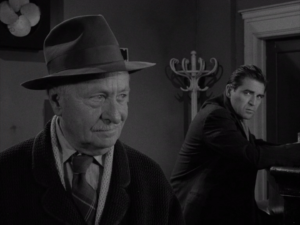
There are these special little moments in life when we hold a piece of knowledge or an item that is needed by another individual. And when we can supply that necessity, We get the satisfaction of having done some good in the world–even if it’s just for a moment. But, what if you always knew what everyone needed? What if every person you glanced at or were standing next to in a room could transmit their truly greatest needs to you? Would you feel blessed or cursed to have this knowledge? In this week’s episode, we meet a man with this very talent. You see Pedott is more than a seller of wares; he’s a provider of hope. And when he tells you that you need socks that say, “please do not disturb; I’m watching the Twilight Zone,” you should probably just take them. You might not want them, but you’ll need them. Most of the time, Pedott is able to draw very little attention to himself, until a down-on-his-luck individual named Fred Renard becomes wise to Pedott’s gifts. Quickly, Renard realizes that this is his opportunity to get back at all of the circumstances and people who kicked him on the way down. It’s finally his turn to get what he needs, or rather, what he feels he is owed. Scissors, a pen that can reveal winners from horse races–these are the items that Renard needs, but they aren’t enough. Pedottt’s final gift to Renard are some shoes, special footwear that will carry him right into oncoming traffic. It turns out, the shoes were actually what Pedott needed to avoid being murdered.
Episode Details
“What you need” is directed by Alvin Ganzer. The Teleplay was written by Rod Serling, but based on the short story “We Have What you Need” by Lewis Padget. (I just so happen to have an original copy of the first printing of this story from the October, 1945 issue of Astounding Science Fiction. For those of you who are watching this as opposed to just listening to it.Lou and Zim are over here checking it out. The episode first aired on December 25, 1959. In addition to be Christmas, it’s also the birthday of our man, myth, and legend, Rod Serling. As for our cast, we’ve got two major players involved here: Steve Cochran plays our down-on-his-luck protagonist, Fred Renard. And Ernest Truex plays our man who has just what you need, Pedott. And yes, we’ll see mr. Truex again in the fifth dimension in the “Kick the can” episode.
Episode Tidbits
In Grams’ Jr.’s Unlocking the Door, he exposes a wonderful little easter egg that prompted me to actually fire up the episode a third time to confirm it with my own eyes. “The Newspaper brought to Fred Renard’s room features the same front-page headline (“H Bomb Capable of Total Destruction” from the episode “Time Enough at Last.” Now, although I wasn’t the biggest fan of the 2019-20 Twilight Zone reboot by Jordan Peel, I did love the easter eggs that they took the time to scatter around the episodes. It established a kind of multi connected Twilight Zone universe. This newspaper in “What you Need” is probably not functioning that way; it’s likely just a prop that they needed. But, I like to think that Henry Bemis is somewhere reading his newspaper, about to get the shock of his life. Perhaps if Pedott had been there in the room with Bemis, he could have given him some bee’s wax, an opti-grip, or even some chords to tie around his glasses–anything to prevent you know what from happening.
In Steven Jay Rubin’s Twilight Zone Encyclopedia, he highlights that the jockeys from Renard’s paper are all named after people connected with the show. Most notably, you’ve got the horse Leffendi being ridden by Houghton, and Tropicana is being steered by Serling–although Serling isn’t even listed with the best odds to win. How about that? The poor guy writes the episode and he’s not even the odds-on-favorite to win in his own fake horserace; it’s tough out there in Hollywood.
My Initial Reaction
My initial reaction to this one is lukewarm. I can say that I did appreciate the ending the first time that I watched it; however, I do have some ethical concerns with this one that I’ll also talk more about in my rating section. The acting is fine. None of the performances particularly stand out to me. Pedott is a perfectly likable character, and Renard is certainly imposing, so all of that works fine enough. The concept is good, but for some reason it just doesn’t deliver a strong connection with me. I think some of it has to do with wanting Pedott to exhibit a little more forcefulness at times. The mousiness of him at times reads a little less-than-genuine, if that makes sense. Of course, this is simply my gut reaction; I know that it’s a fairly well received episode by others, so I’m fully prepared to be wished into the cornfield if necessary.
Question 1 If you could bestow this gift of foresight upon someone other than yourself, would you?
In order to better understand this question, we’ll need to go back to ancient Greece, and a wager. Warning, things are about to get a little racy. If you recall any of your Greek mythology, you’ll probably remember that Zeus and Hera are often depicted as being married, but it’s quite a volatile relationship. At one point the two companions get into a debate regarding which of the sexes enjoys physically intimacy more. When they find themselves in a bit of a stalemate, they turn to Tiresias. Why Tiresias, well, because he happened to have lived at one point as a male and at another point as a female. There’s an entire story behind that in Hesiod. For now, just know that Tiresias has had life experiences as both. When Tiresias says that women enjoy physical intimacy more, Hera immediately curses him and blinds him because she bet the opposite. However, Zeus didn’t want him to walk away with just a curse for his troubles, so he also gave Tiresias the gift of prophecy. He could now see into the future. Now, I don’t know about you, but to me that’s one of those things that sounds great on the surface. I mean, you could easily be the first trillionaire with this power. But, you’ll also have to live with the knowledge of the darkness of humanity, of the terrible things that will happen. I’m not sure that our minds are equipped for such things.
There’s usually a wrinkle involved with the gift of foresight. People tend to still have a problem when it comes to trying to interpret or believe what the prophets are saying. in Oedipus, Tiresias tells King Oedipus the truth, you know, that he’ll kill his father and marry his mother, and of course, the king doesn’t believe him. In fact, if I’m correct, this also happens with Cassandra who is blessed by Apollo with the gift of foresight. Her prophecies are always being misunderstood. Could you imagine the burden of KNOWING that something terrible is going to happen. I mean knowing it as a fact, and having no one believe you or not being able to get the truth across to people accurately. How long would it be before you just lose your mind?
Let’s bring this back to the Twilight Zone for a moment. I’ll talk about contentment a few times in this episode because to me that’s the word that sticks out the most. It makes sense that your biggest goal in life if you’re Pedott would be to keep things as balanced as possible. Never get too high or too low. Help people as you can, and accept the fact that you can’t help everyone. Is that selfish? I mean, shouldn’t you try to help as many people as possible? Well, yes and no. At some point, you will recognize your own limitations as a human being. You are still limited by your psychological health and your physical form. Therefore, you would have to be, somewhat, in a state of mind of accepting that there are people in this world that you could have helped, but you didn’t–and you have to find a way to not feel guilty about that; you have to be willing to accept that and move forward in order to help the next person who is in front of you. If you think about it that way, don’t we all have a bit of Pedott’s curse at times even without his foresight?
To bring this back to our question, it certainly seems like Pedott does not believe that what he can do is something that should be celebrated and used all the time. He appears to be content with helping his local community. The bartender even mentions at the beginning of the episode that Pedott is a frequent visitor. I would say that our prophetic friend is probably on to something here. If you keep things local, you probably have a better chance of maintaining your sanity because you won’t always be reminded of the billions of people in the world that you’re not helping every second of the day. So, would I bestow this gift of foresight on someone I know? Absolutely not. I don’t think it’s something that the human mind can truly balance–but that might just be the dark romantic philosopher in me speaking.
Question 2: Is a lack of humor a genuine problem for Renard? In other words, is a healthy sense of humor an important part of a healthy life?
Renard seems to have had a genuinely bad life up until now. Even Pedott recognizes this to be true when he says, “I feel sorry for you.” But, what do we do with this? How sorry should we feel for Renard? Pedott tries to tell him what he needs most are serenity and humor, the ability to laugh at himself. But, what do we do with someone who has only known laughter at their own expense? This is a tough one for us to talk about, but we’re going to, because we don’t shy away from difficult conversations because they’re difficult. Okay, so let’s find our way in here.
If we’re going to really take this question seriously, we should probably start with one of the earliest scholars to take humor rather seriously: Plato, the famed student of Socrates and the instructor to Aristotle. That’s right. We’re heading back to ancient Greece. You know, the funny thing about Plato is, nothing. He doesn’t really seem to appreciate what humor has to offer. In fact, he’s got a problem with laughter.
Bear with me as I make a connection here. Have you ever seen someone who is really ticklish get tickled? There is usually big loud laughing and smiling galore, that is until someone gets kicked or punched in the mouth. But, why? The person is laughing and smiling–and those are positive things, right? So, why is it that when adults are tickled it can often devolve into screaming, a violent physical outburst, and hard feelings when it’s taken too far? That’s actually quite easy to answer: it comes down to power and agency. A ticklish person, when past the point of humor, often feels a genuine sense of powerlessness, as in, I can’t stop laughing even though I want to, and I think that actually triggers a kind of primal sensation of realizing that someone is exerting physical authority over my body, and I don’t like it. Often times, the person being tickled will kick or punch the other person to force them to stop. Usually, the tickler will want to know, why did you do that? And the person who was being tickled will either angrily reply, because you wouldn’t stop, or they’ll say something like, sorry, I didn’t mean to hit you so hard. It’s actually a really interesting social scenario. So, what does this have to do with Plato? Well,...
Plato essentially argued that laughter was a kind of loss of rational control. Now, think about this for a second, is he wrong? Have you ever been in a situation where you were trying to hold yourself from laughing? It takes a tremendous amount of resolve to not laugh at something. One of my guilty pleasures is to watch blooper reels from tv shows. And one of the best moments in these blooper reels is seeing actors trying not to laugh and deliver their lines. Plato was very much a believer in discipline, and because it takes more discipline to NOT laugh than to laugh, it makes sense that he would value not laughing over laughing.
I had never made the connection before until I was writing for this episode, but remember the movie Who Framed Roger Rabbit? Remember when the main bad guy played by Christopher Lloyd, Judge Doom, kept telling his group of weasels not to laugh because it would be their death, and then Eddie, the main character, uses laughter to actually kill the weasels. That is exactly Plato’s point in a nutshell. The weasels could no longer control themselves; they were too undisciplined and they died because of it. So, Who Framed Roger Rabbit is really nothing more than a PLatonic interpretation of humor in cartoon form. Yeah.
Okay, but that’s like Plato’s take. What about self humor; what about the ability to laugh at one’s self?
When I was researching the connections between humor and psychological well-being, I came across a fascinating article by Tsukawaki and Imura entitled, “The Light and Dark Side of Self-directed humor.” What I liked about this article is that it does a fantastic job in its literature review of discussing the background of how we measure self-directed humor through different scales, namely: deleterious and benign. The deleterious type focuses on self-deprecation as a means to “ingratiate themselves with and/or gain approval from others.” I think most of us have probably come across this person a time or two–or maybe even played the part ourselves, and although it might initially help us better connect emotionally with other people to talk negatively about ourselves, it isn’t long before we actually grow tired of being around this individual and hearing these self-directed negative comments. Part of the reason for this is that when we like this person, it actually starts to hurt our feelings when we hear them say negative things about themselves, so it’s interesting to see in the article that Tsukawaki and Imura acknowledge that this approach is ultimately not a really good one because it has negative implications on the individual’s psychological well-being. In a nutshell, here is the major difference between the two: deleterious is about recognizing the flaws in the individual; whereas, benign is about recognizing the flaws in a situation or result. With the benign version, the laughter is not an attack on the individual, thus the person’s well-being is, for the most part, fine, and they still get to reap the benefits of pulling people toward them by using humor to show a kind of humility and through the experience of communal bonding over a funny moment or event.
Okay, let’s come back to our Twilight Zone episode. Let’s talk about the initial bar scene for a moment when Pedott gives the young woman a bottle of cleaning solution and Lefty gets his bus ticket. I want to highlight how both react to Pedott’s appearance and actions. You can see that the young woman is in distress when Pedott gets there, and she tries to buy matches from him, but he gives her a bottle of cleaning solution instead. You can envision how most people would likely react to this situation in real life; they would get upset; they might say, “I asked for matches. That’s what I want.” But, she goes with the scenario, and if you look closely, you can see this wonderful grin on her face when Pedott starts to walk away from her. She can appreciate the humor of the absurdity of the situation. The case of Lefty is even more specific. He’s actually laughing at Pedott, but not in a mean way. If you watch the episode, you’ll know what I mean. Again, it’s about being confronted with an absurd situation in life and being able to grin at it, to be an actor in a scene in which there are no directors. Both the young woman and Lefty are rewarded for their humor and patience with life. However, Renard is neither patient nor humorous. He is proactively seeking to control the scene around him, likely because he has never had the opportunity to do so in his life. I agree with Pedott; I actually do feel somewhat sorry for Renard. However, you have to be able to sometimes let life happen around you, accept the absurdity of a moment–dare I say embrace the chaos of what it means to be human, and recognize that it’s actually quite funny sometimes to see just how little control we actually have.
Question 3 What are your moments of awe?
When Renard breaks into Pedott’s home and starts to ask him why he doesn’t use the gift to make a bunch of money, he responds, “I’m content.” That is a word that I have been fighting for for a long time now. When people ask me how I’m doing, and I respond, “i’m fine.” People almost always look at me like there’s something wrong. “Just fine, “ they’ll say. Yes. I’m fine. I’m content. Being content seems to have taken on a negative connotation these days. When, in reality, contentment should really be what we’re striving for. We don’t always have to be in a state of being upset or joyful. Contentment is really where we should be sitting most of the time. This episode reminded me that it’s important to continue the good fight for contentment. So, help me out, next time someone asks you how you’re doing, maybe instead of saying, “i’m fine,” just say, I’m content, and then report back to us what happens. Together, my Twilight Zone friends, we can start a movement of contentment. What do we want, “nothing really” When do we want it, “whenever it’s convenient.” I think we’ve got something here.
My Rating
I rate this episode as middle-lower tier. There is something interesting about it that you can spend some time really pondering, but there are questions that pop up in my head that I almost wish were addressed in the episode. For example, there are ethical concerns here. Yes, Pedott can see events in the future, but are they events that HAVE to happen, or are they events that simply can happen? Renard is a bully and he clearly seems violent, but if he isn’t redeemable then why try to help him at all at the beginning? Now, I did go back and reread Padgett’s original short story because I wanted to just see if this question comes up, and actually it directly comes up: Talley, that’s the Pedott equivalent in the short story, when asked if the future is changeable responds, “There are innumerable possible variants to the future. Different lines of probability. All depending on the outcome of various crises as they arise.” To be honest, I don’t really like to go to the source material; I like to take our episodes as they are, and the short story is VERY different from the episode. But, I’m actually glad that Padgett acknowledges this in the story. This reminds me a bit of the movie Minority Report with Tom Cruise. Is it ethical to punish someone for a crime they WILL commit in the future based off of someone’s reading of the future? I understand that it seems like Pedott is in immediate danger at the end of the episode when Rendard is running after him in the shoes, but even that doesn’t make sense? Why is Renard trying to kill him? Kidnapping? Sure. Kill him? Why? You’ve got the proverbial golden goose. Does it make sense for Renard to actually murder Pedott? And even on Pedott’s end, why not get the police involved, or have some guys just beat him up and force him to leave. I don’t know. There just seems to be a big leap for both Renard to WANT to kill him, and for Pedott to ACTUALLY kill him. Maybe that’s just me.
Next time, we’ll be taking a look at “The Four of us are Dying,” and here are your questions to consider as you watch.
Question 1: Is it really so farfetched to think that this type of shapeshifting could be in our future?
Question 2: Would you be able to tell if you were in a relationship with someone
impersonating your loved one?
Question 3: What were your moments of awe?
Another episode in the books. You know I…. I…um…sorry, I’m a bit distracted. My feet are really cold, and I…my wife has the gift.
Announcements and Shout-outs
The Rod Serling Memorial Foundation asked for people to talk about how Rod Serling influenced them, so being a writer, I sent one in. I received a lovely email from them thanking me and telling me that it is up on the website for others to see. I’ll put a link in the description of the episode if anyone is interested in reading it. It’s entitled, “Teaching the Awe in the Twilight Zone.” I talk about how I’ve been sneaking the Twilight Zone into my classrooms since roughly 2006, and I still do it. Don’t tell my bosses. Actually, my boss is pretty cool. I’m very fortunate that I love my job.
I’ve got some X/Twitter shout-outs. I want to give a shout-out to @kazuki_fans_usa for some great reactions to the hypothetical trivia questions that I post over on X and the YouTube channel. MY X handle is @keyofishow. To the hypothetical about whether or not you would allow a robot companion to take care of a loved one, @kazuki_fans_usa replied: “I would’ve appreciated that kind of help! But I would not have relied on one for everything.” Thanks for taking the time. I think most people probably agree with you. I imagine with enough time, I would probably fall that way as well, although it still makes me nervous to think that we might give over that much of our humanity to robots, but as purely a helping hand, that makes a lot of sense.
On the YouTube Channel I want to give a shout-out to Funwithsportscards for not only correctly guessing the Twilight Zone episode in the Community posts section of the channel, but I want to thank you for the kind words: Funwithsportscards wrote, “Also, great content! Love the channel. TZ is the greatest” I agree. TZ is the best, or at least certainly one of the best shows ever on television. And thank you for the kind words. Much appreciated, friend.
How to Support the Show
Head over to thekeyofimagination.com to continue our conversation. You can rate this episode, learn more about me, watch previous episodes of the show, and check out my curios page where I showcase some of the Twilight Zone trinkets I’ve bought over the years. I encourage people to email me thoughts and comments, whether it’s about a particular Twilight Zone episode, your rating for an episode, or about the Key of Imagination Show. You can get those to me as a text email, an audio clip, or even a video clip of roughly no more than 5 minutes to keyofimaginationshow@gmail.com. Keep in mind, even though we talk about some serious topics, we’re trying to maintain as family-friendly of an atmosphere as we can. If you would rather I not use your comments on the show, please indicate that so I can respect your decision.
If you enjoyed the show, I ask that you please take a moment and do one of the following to help build our community. Rate the show, review the podcast, leave comments, thumbs up, all of the usual algorithmic gymnastics. That will help get the show in front of more people and help us build our community of Twilight Zone fans. However, even if you do none of that and absolutely hated every minute of this, I would still like to thank you for spending some time with me. Until next time, remember, all doors are open to those who possess the key of imagination.
Tsukawaki, Ryota, and Tomoya Imura. “The Light and Dark Side of Self-Directed Humor: The
Development and Initial Validation of the Dual Self-Directed Humor Scale (DSDHS).” Personality and individual differences 157 (2020): 109835-. Web.