
The Twilight Zone Season 1: Episode 14
"Third from the Sun"
Introduction
Welcome to the Key of Imagination. I hope you’ve packed your bags, preflight, because we’re getting out of dodge; we’re shaking the dust off our feet and heading to a whole new planet: the Third from the Sun. Wait, (my very educated mother)oh, I think that’s still just earth. Okay, nevermind. Let’s just get comfortable and wait for the inevitable destruction. In the meantime, we can talk about this week’s Twilight Zone episode, “Third from the Sun.” We’ll look over some newspaper clippings from the 1940s, 50s, and 60s to better understand Serling’s audience; we’ll dive into whether or not William Sturka’s profession as a scientist changes the way we read his character; and I’ll reveal to you my moment of awe, so grab your keys, and let’s open this door to the fifth dimension.
Plot exposition
For people who are a bit on the younger side, it might be a little more difficult to grasp the true sense of terror that loomed over the United States and the Soviet Union during the Cold War era. We watch the old duck and cover videos that were produced in the 1950s and laugh at the concept of a school desk somehow preventing the destruction of the initial flash wave, the massive amount of heat dispersed, or the radiation that follows. But, ask anyone older than about 40-45 today, and they’ll tell you that this threat was very real, and there wasn’t really anything funny about it. Two large nations in an arms race, a war of production. But, in order for these weapons to be produced, there needed to be workers, people like William Sturka from our Twilight Zone episode “Third from the Sun.” Sturka appears in many respects to be a fairly average and boring individual: a job, a family, friends. However, his employment at a top-secret government facility where atomic weapons and secret airplanes are produced offers him important insights into the present predicament of his time: namely, that the war is about to move from production to execution, and that millions of lives will be lost. All he can do is everything that he can to save his family, his wife, Eve; and his daughter, Jodi. He collaborates with a friend, Jerry Riden, and his wife, Ann to steal an aircraft capable of leaving the planet. But, someone is on to the plan, Carling, a figure straight out of the shadows of a Shakespearean tragedy, a man who wants to make sure that no one is leaving. Carling does all that he can to bring Sturka and Riden to the authorities, but the two men are able to overcome Carling’s attempts to thwart their plans. Sturka and his crew are able to leave the planet. Where will they go? A place that we are all familiar with, a little planet known as earth, the third from the sun.
Episode Details
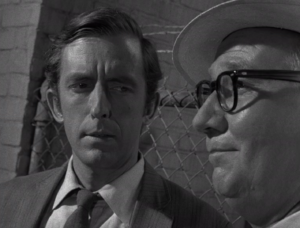
“Third from the Sun” is directed by Richard L. Bare. The teleplay is written by Rod Serling, but it’s based on a short story with the same title by Richard Matheson. As for our cast, we have quite a few worthy of mention, all doing a phenomenal job to maintain that constant sense of oppressive, impending doom. William Sturka is played by the great Fritz Weaver; Eve Sturka is played by Lori March, and Jody Sturka is played by Denise Alexander. The actor Joe Maross plays Jerry Riden, and Ann Riden is brought to life by Jeanne Evans. Finally, our man in the shadows, Carling, is portrayed by Edward Andrews.. The episode first aired on January 8, 1960.
Episode Tidbits
I mentioned that I like the cinematography. Well there were some interesting notes about that in Zicree’s Twilight Zone companion. He quotes Buck Houghton as saying, “He [meaning the director] used wide-angle lenses all the time on the theory that if you were going to tell people in the end that they weren’t on Earth, you should have a peculiar feeling while you’re getting there, you should have been made a little restless or uncomfortable” (73).
To add to this idea, Grams Jr. brought up something that actually made me fire up the episode one more time. It has to do with one of the ways that director Richard L. Bare, wanted to both preserve a kind of sense of earth and yet make it different enough to arouse some suspicion through the art that is displayed around the Sturka house. Now, I went back and looked at it, and I initially thought it was simply just a kind of modern art taste. However, and this is me just playing around a bit, so if you are an art historian or something, chime in.The lack of structure in the sculptures and even in the music that plays in the background when Jodi wants to dance, is oddly flat–and without a sense of life: it does feel a bit foreign to me. Again, I could just be reading too much into it and trying too hard to find a difference (224-5).
My Initial Reaction
As for my reaction, this is one of my favorite episodes. First, I find the cinematography to be fantastic. At first you think the distorted camera views are because of the heightened moments of tension, but you find out it's because there is something just slightly off about the place in which these people inhabit. It’s earth-adjacent, kind of. Something else that I believe I talked a little bit about in the “Judgment Night” episode: I find that many shows/films today really struggle with how to maintain tension within a work. It’s not that every scene must be intense; it’s about creating a mindset where the audience is never brought out of tension, unless that’s what you want to happen. So many times today, artists use humor to break tension, and although that’s a legitimate approach, it’s overused today, and in many ways, quite detrimental to the audience’s experience. Finally, it’s a good example of an episode that’s bigger than its twist. There is a tremendous amount of rewatchability here.
Question 1: How pessimistic was Serling’s audience regarding atomic destruction around the time that this episode aired?
There are quite a few Twilight Zone episodes that are built upon or around the topic of atomic anxieties, belief that mutual nuclear destruction between the United States and the Soviet Union was imminent. “Time Enough at Last,” which we talked about not too long ago, also has this theme in the background, of course, but anxiety does not really play a strong role in that episode, which is why I didn’t really talk about it too much. However, given that it is of primary concern in this episode, I want to talk about it here so that this can also serve as a kind of primer for future episodes with this theme.
I sat for a day or two and really thought about how I wanted to approach this question because it’s easy to go into the professional databases and bring in academic articles that talk about this topic. However, that somehow seemed to not really get to the heart of what I wanted to bring into this question, so, instead, I decided that I would spend a few hours diving into newspapers to get a better overall sense of what types of information people had access to through newspapers. Here are just a few things that I found that I thought painted quite a picture.
First, let’s go to The Gettysburg Times, September 24, 1946. Why start here? Well, there’s a fascinating interview that was published regarding atomic weapons. The person being interviewed? Joseph Stalin.
When asked by the reporter if he believes that “virtual monopoly by the USA of the atomic bomb constitutes one of the main threats to peace,” Stalin replied, “I do not believe the atomic bomb to be as serious a force as certain politicians are inclined to regard it. Atomic bombs are intended for intimidating weak nerves, but they cannot decide the outcome of war, since atomic bombs are by no means sufficient for this purpose. Certain monopolistic possession of the secret of the atomic bomb does create a threat, but at least two remedies exist against it” (link).
I bring this up because it somewhat introduces an important timeline in Soviet history regarding the discussion of an atomic weapons program. Additionally, this conversation was happening on the public stage. According to the United States Department of State website, the Soviet Union successfully detonated its first atomic bomb in 1949 (link), but undoubtedly, the Soviets were already well underway in terms of their research in 1946 when Stalin gave that interview. According to the Nuclear Heritage Foundation: “Following the bombings of Hiroshima and Nagasaki, Stalin called for an all-out crash program in atomic research and development. In 1946 Yuli Khariton was appointed by Kurchatov as the program’s lead scientist. He was tasked with directing atomic research, development, design, and weapons assembly, and helped select and establish the site of the secret Soviet nuclear weapons facility, known as Arzamas-16 and nicknamed “Los Arzamas” (link). So, it’s almost for certain that Stalin knew when he did this interview that he was going to put every bit of resources he could into developing an atomic weapons program to match the USA. So, at least as early as 1946, people were starting to become aware of the beginnings of a possible arms race. Let’s try and push up in time a bit, a little closer to our Twilight Zone.
In April 16, 1954, just five short years away from the birth of the Twilight Zone, I found this interesting column in The Prescott Evening Courier out of Arizona. In the column, it revisits an important hydrogen bomb debate that took place on January 23rd, 1950. Many of the scientists who worked on the Manhattan Project, which produced the bombs that were dropped on Hiroshima and Nagasaki, were apparently in attendance. I’m going to read just a little bit of it because I think it can help us continue to build our picture of the growing anxiety in Serling’s audience.
“At a secret meeting with General Bradly, atomic energy Chairman Lilienthal made a last-ditch, emotional plea against the hydrogen bomb. In effect, he said: ‘We must exhaust every means of reaching an agreement with Russia to outlaw atomic warfare before we make this bomb. We should appeal over the heads of the Kremlin to the Russian people. They will force Stalin to come to terms”
It wasn’t just politicians speaking. It says that that the scientists who were in attendance, broke down into three groups:
“One did not want the bomb used at all. They urged that the President announce that we had the bomb and would use it unless the enemy surrendered. Group No. 2 wanted the atomic bomb dropped over an uninhabited area as a warning. Group No. 3 approved the action taken at Hiroshima.” Now, listen to this and tell me that it doesn’t sound like a Rod Serling opening or closing narration: “But when the photographs of seared flesh and the medical reports from Nagasaki and Hiroshima came back, these scientists went through the tortures of the damned. Their souls were on fire, and they started a burning private crusade against the hydrogen bomb that has divided the Atomic Energy Commission'' (link).
So, if people didn’t quite understand what was at stake with these conversations when the original bombs were dropped in WWII, through the news and well-publicized debates, they were now starting to grasp just how much damage these even newer weapons could possibly do, and in the 1960s, the same decade as this Twilight Zone episode, audiences also had to deal with the potential threat of a new kind of a new kind of atomic bomb, an ERW or enhanced radiation weapon, known as the neutron bomb. What’s the difference? “The neutron bomb is a small hydrogen bomb. [It] differs from standard nuclear weapons insofar as its primary lethal effects come from the radiation damage caused by the neutrons it emits.” (link).
The conversations around the neutron bomb were also being had on the public stage. February 11th, 1962, in an article titled, “Doomsday Machines: Destruction Ideas are Spine-Chilling” in the Reading Eagle, they discuss the possibility of the creation of the neutron bomb and the fear over who will get it first .
The article states, “The feasibility and stats of the neutron bomb are things the AEC is determined to say nothing about. We may not be able to keep the secret, but we are going to give it the old college try.” To this, legislatures in Congress responded, “what if Russia had obtained the H-bomb first? What if Russia gets the neutron bomb first?” (link).
You can hear the hysterics in the reactions of Congress, but in many ways, they were probably mirroring the thoughts of millions of their constituents as well. So, there were plenty of reasons for people to feel anxious about what could potentially be happening behind closed doors, and what could potentially be on the horizon in terms of total destruction.
Let’s bring this information to our episode. In the episode, Jodi says to her parents, “everyone I’ve talked to lately, they’ve been noticing…that something’s wrong…–that something’s in the air. That something is going to happen. And everybody’s afraid.” What’s particularly great about this scene is who it’s coming from…it’s coming from a young adult. You see young adults are old enough to understand when the culture of the world shifts into a state of fear, but they might not quite have the full picture for why we should be afraid, and that’s the part that makes this scene so fascinating for me. Sturka is somewhat trapped here. Jodi is old enough to feel what is happening, but there’s a part of him that doesn’t want to burden her with the information; we can certainly have conversations around whether or not this is the right or wrong approach, but I think we can agree that there is a kind of parental love here that is struggling to try and maintain a childhood for Jodi, while not lying to her about the potential evils that we can unleash. As someone who deals with a lot of young adults, they can be challenging in a really good way sometimes. They force you to clarify the why of really complex questions, questions that we sometimes push aside as simply a part of life as adults. I appreciate the struggle that Fritz Weaver is putting into this moment trying to figure out how to act as a father. I think parents and guardians might have felt a kind of kinship with Sturka in this moment as well.
To pull this all together, Serling’s audience was not only aware of these conversations, but they might have even been almost too aware. Let me explain. Today, with the internet, we often talk about feeling overwhelmed at times by the sheer amount of information we have to sift through–47 thousand reviews to buy a usb cable that won’t break in a day, but I think this probably happened a bit during Serling’s time as well. If you look through the archives, there are so many articles written about warfare and atomic destruction and all of the different technologies involved. I’m sure there were people who experienced the anxiety of overconsumption of information and even some who became anxious when there wasn’t enough on a particular day. After researching this question, I now want to try and find some reactions to this episode from 1960, if I can. That will be a separate project, probably.
Question 2: How does Sturka’s profession as a scientist impact our reading of him as a character?
At the very beginning of the episode, when the workers are coming through the line, the security guard tells us that Sturka is in the Hydrogen armament division, so he’s really got his hands deeply embedded in this atomic world; he is at the frontline of all the action.
When Jodi asks him if he likes his job, and she tries to get a sense of how working on bombs affects him, Sturka responds, “I’m just a cog in a wheel, Jodi.” He then tries to explain to her that “in one bomb there are, perhaps, a thousand pieces. And, every piece requires a team of 50, 60, 70 people. Looking at it like that I’m not quite as responsible as if I’ve…” and then he trails off.
The Calutron Girls, dubbed as such because they were a group of women who monitored the Calutron machine that separated enriched uranium isotopes for nuclear weapons, played an integral role in the production of the bombs dropped on Hiroshima and Nagasaki. One Calutron Girl, Ruth Hiddleston, recalled her feelings after learning that the bombs were used: "I was at work and they announced it, you know. At first you were glad to think the war was over. The first thing I thought was 'my boyfriend will be home.' Then I got to thinking, they start telling all the people that were killed over there. It made you think of something else, that I had a part in it, because that’s what they told us. They said it’s been dropped there, and then they said so many thousands or a million or whatever—I don’t remember. Anyway, I didn’t much like that idea that I had a part in it. But you know, war is war. Ain’t nothing you can do about it but try to stop it. I still don’t like the idea, you know. But you’ve got to do it. Somebody does” (NPR).
Ruth sounds an awful lot like Sturka in the idea that she sees herself as a cog in the wheel, but she also sounds like Sturka in that there are two sides pulling at her: she thinks of her boyfriend, and wanting the war to end, and she thinks of the people in Hiroshima and Nagasaki, the death and destruction. Just like Sturka is thinking of his family and their safety above all. This is the complexity of being human; this is why we must exhaust as many options as possible before going into a war, because, and feel free to push back against what I’m about to say, when we’re at the point that we have to make these difficult decisions where lives are in the balance, it’s often too late, the machine is running, and we are left as mere cogs, swept up in something that seems difficult to process when it’s right in front of us.
Let’s come back to the question of how we view Sturka. You know, Carling actually says something interesting about Sturka at the very beginning. He accuses Sturka of being a “defeatist.” Now, in proper context, Carling seems to be referring to how dedicated Sturka is to the cause of winning the war; however, if we dive a bit deeper into it, is there a little bit of truth to this on a broader scale?
Many of the scientists who were a part of the Manhattan project went on to try and prevent the proliferation of nuclear and atomic weapons; they were trying to take responsibility for the children of destruction they created. Sturka, however, seems bent on simply taking the information and running as fast as he can. He reinforces this to Eve when they are in the bedroom and he tells her that they can’t tell anyone what is about to happen. We certainly understand the part of him that is a husband, a father, a friend, that wants to make sure that his loved ones are alive, but do we hold him more accountable to society because he’s a scientist who helped create the very thing that he now knows will be the end of his species? I waffle on this one. As I write this today, I feel like he does owe his species more of a fight; he owes it to Jodi and the future that she will not have. But, ask me tomorrow, and I might say that parents owe their children opportunities to live, and that would mean escape.
My ultimate answer to our question as to whether or not Sturka’s profession as a scientist impacts our reading of him is that it absolutely does. Whether or not we believe him to be right or wrong for fleeing would probably take a lot more time to ethically and philosophically unravel, but his profession does make the conversation more complex.
Question 3 What are your moments of awe?
Well, my moment of awe is a bit of a negative one. I’m old enough to remember Cold War speeches and tensions in the 80s. And there is obviously a lot of strife and conflict around the world right now–I suppose to a degree there always is. But, as Jodi says in the episode, there is a feeling out there. I’m sure I’m not the only one who is experiencing this. Often times, in retrospect, we talk about being pulled into a war. But, today, it feels more like we’re just walking straight into one. Carling represents an interesting character. He doesn’t seem to think much about the fact that he is just as likely to die in this scenario as everyone else. And that’s my moment of awe–or rather an awful moment. My grandfather served in WW2; my father served in the Navy, and I’m incredibly proud of them both. As a species, war does seem to be somewhat embedded within our dna. But, what bothers me today is this feeling that we almost want to be destroyed, that we are yearning for destruction, that there is a bit more of Carlings out there than we might realize. Forget the politics. I’m not a particularly political person. I’m just someone who is a bit worried about the overall health of us as a species. And I don’t know anyone who can fly an aircraft that can leave earth’s atmosphere.
My Rating
As for my rating, this is it. This is our first top-top-tier episode. There won’t be many, but for me, this is one of them. When you mix in the acting, the methodical approach to subject matter, the ending, the rewatchability of it even after knowing the ending, it’s just a fantastic example of a great episode that is as relevant today, as it was in 1960.
Next time, we’ll be taking a look at “I Shot an Arrow into the Air” and here are your questions to consider as you watch.
Question 1: Can we land on an asteroid within our belt and survive, like the astronauts in the episode hypothesize?
Question 2: Is there something more than just survival behind Corry’s intense connection
with water?
Question 3: What are your moments of awe?
Closing
Another episode in the books. Wow, that one got a bit depressing toward the end. I’m a pretty optimistic person, honestly, so let’s leave this on a high note. Never forget that you’re not simply a cog in anything; you’re a human; you have the ability to enact great positive change in the world, but, and there’s no way around this, it has to start with you. Make a small positive change in your own life and then branch out from there. You’d be surprised how much more effective it is to witness someone doing good or living a good life than it is to tell everyone that they need to be good or should be good. Be a beacon of hope unto others.
Announcements and Shout-outs
I got a wonderful welcoming message from over at the Fever Dreamland Theater channel on my “what you need” episode: “Hey Joe, so first of all, I have the same socks because of course I would. Great vid man, I'm enjoying catching up with your work and I dig your approach to this classic series. On the topic of humor (your second question) in my view it is absolutely necessary, I actually would not be able to survive if not for my ability to laugh at most things, including myself. Anyway, its great to hear your thoughts on this one, particularly in regards to the ethical dilemma presented in the story. A pleasure to meet another traveler in the 5th dimension! Be well!” Let me first say, if you love the Twilight Zone, head over to the Fever Dreamland Theater channel and enjoy some wonderful breakdowns of the episodes. It’s a great channel. And thank you for taking the time to send such a welcoming message. As you all know, one of my goals is to simply do my part to build an enjoyable community where we can discuss this amazing show from Rod Serling and feel like we’re a part of something as a group. We need more of that today, so thank you.
How to Support the Show
Head over to thekeyofimagination.com to continue our conversation. You can rate this episode, learn more about me, watch previous episodes of the show, and check out my curios page where I showcase some of the Twilight Zone trinkets I’ve bought over the years. I encourage people to email me thoughts and comments, whether it’s about a particular Twilight Zone episode, your ranking for an episode, or about the Key of Imagination Show. You can get those to me as a text email, an audio clip, or even a video clip of roughly no more than 5 minutes to keyofimaginationshow@gmail.com. Keep in mind, even though we talk about some serious topics, we’re trying to maintain as family-friendly of an atmosphere as we can. If you would rather I not use your comments on the show, please indicate that so I can respect your decision.
If you enjoyed the show, I ask that you please take a moment and do one of the following to help build our community. Rate the show, review the podcast, leave comments, thumbs up, all of the usual algorithmic gymnastics. That will help get the show in front of more people and help us build our community of Twilight Zone fans. However, even if you do none of that and absolutely hated every minute of this, I would still like to thank you for spending some time with me. Until next time, remember, all doors are open to those who possess the key of imagination.