
The Twilight Zone Season 1: Episode 15
"I Shot an Arrow into the Air" Episode Transcript
Introduction
Welcome to the Key of Imagination. I hope you haven’t unpacked from last time because we’re once-again heading out into the unknown, a place where no man has gone before–or are we? This week, we’re talking about the Twilight Zone episode “I Shot an Arrow into the Air.” We’ll discuss whether or not we can actually land on an asteroid and survive; we’ll dive into why Officer Correy seems so obsessed with water, and I’ll reveal to you my moment of awe. So, grab your keys and let’s open up this door to the fifth dimension.
Plot exposition
I shot an arrow into the air,
It fell to earth, I knew not where;
For, so swiftly it flew, the sight
Could not follow it in its flight.
I breathed a song into the air,
It fell to earth, I knew not where;
For who has sight so keen and strong,
That it can follow the flight of song?
Long, long afterward, in an oak
I found the arrow, still unbroke;
And the song, from beginning to end,
I found again in the heart of a friend.
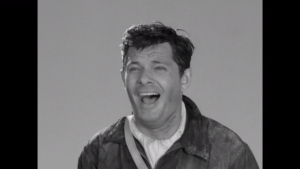
That poem was written by Henry Wadsworth Longfellow, and it is the muse for the title of our episode, and even the plot, to a degree. A crew of astronauts heading off on a bold voyage to stretch the footprint of humanity to new places, only to find that they’ve crash landed somewhere unexpected, an unforgiving, rocky, sweltering place–certainly not conducive to human life. With some crewmembers already resting in peace and three remaining who wish to survive, tensions begin to run high, especially when it comes to preserving that all-too important resource for life: water. For officer Corey, securing as much water as possible for himself is all that matters anymore. When Corey goes out on a scouting mission with his crewmate Pearson, only one comes back–and with twice the amount of water that he left with. You can guess who the one is here. Colonel Donlin forces Corey to show him the remains of their lost crewmate, and what they find is a man barely alive, and desperately trying to tell them something, to reveal something important. Some sticks in the sand is all Pearson can get out before he finally gives up the ghost. When Donlin suggests that the two men go over a mountainous ridge to see what Pearson was trying to tell them, all that the Colonel gets is a slew of bullets. Corey finally has all of the remaining water–and the weight of being responsible for the deaths of at least two men. But, there’s laughter in the air, as Corey finally ascends the mountains. What’s so funny to officer Corey? The sticks in the sand, Pearson’s warning, telephone polls. The very kind that you’ll find all over human civilization, on a little place called Earth.
Episode Details
“I Shot an Arrow into the Air” was directed by Stuart Rosenberg with a teleplay by Rod Serling, but based on an original concept by Madeline Champion. We’ll come back to that term “original concept” in a moment. As for our cast, we’ve got our three space adventurers. Dewey Martin plays our anxious officer Corey, Ted Otis plays the role of Pearson, and Edward Binns is our Colonel Donlin. The episode first aired on January 15, 1960.
Episode Tidbits
Grams’ Jr in Unlocking the Door, relays a story from Rod Serling about how he received the concept for this story. “This was one of the few stories I bought from a story suggestion of a non-professional….The wife of a friend of mine got a basic idea of how incredibly bizarre it would be to have some spacemen land on what they assumed was an asteroid, only to find that they were just a few miles from civilization” (228).
Zicree’s Twilight Zone Companion gives us the actual amount that was paid for the idea: “I paid five hundred dollars for that one on the spot. But it never happened again.” Five hundred bucks is still a lot of money to me, so that’s awesome that she got $500 for her idea back in the late 50s. According to various inflation calculators, that would be worth approximately 5,368 dollars today. No one’s paying me $5000 bucks for one of my ideas any time soon–and I can’t blame them.
My Initial Reaction
My initial reaction to this episode is just so-so. I don’t think it’s a bad episode. I like the acting, the pacing is fine, the big reveal at the end is certainly not one of the strongest of the series, but it probably hit a lot harder in1960, so we shouldn’t necessarily hold that against it. However, there are some odd things about it that just don’t seem to add up. I think that just about anyone who goes through flight school and all of the math and science courses to become an astronaut, probably would have been able to realize that they were still on earth. But, then again, I don’t think the episode is really about that anyway. The episode is really about exploring the human being in crisis. What happens when pressure is applied to us? Do we crumble and immediately go for each others’ throats, or do we come together and do our best to make sure as many people survive as possible? In short, it’s not an episode about space; it’s about humans. But, that being said, and this is again why I love doing this show. When the astronauts mention that they might have landed on an asteroid, I laughed at their primitive thinking: how can there be human beings on an asteroid. That’s silly, right? Well…let’s just get into our first question and learn a bit more about how silly or serious this question might be.
Question 1: Can we land on an asteroid within our belt and survive?
If you’re a Boomer, Gen Xer, or older Millennial, your minds probably went right to this: that’s right. This is a picture from the movie Armageddon, from 1998, although, I actually preferred Deep Impact from the same year. Armageddon is a movie about a crew of professional drillers who are transported on to an astronaut to save the world, and…well, I’ll leave it at that for those of you who have not seen that film. It’s one of those great, cheesy summer blockbuster films. All that to say, my generation grew up with this as their entrypoint into the science behind humans and asteroids. But, as I quickly learned, it seems that the conversation has evolved since then.
The first thing I had to do was actually get a better understanding of what the asteroid belt is and why the astronauts in the episode would think that they landed there? This comes directly from Nasa’s own website:
The asteroid belt in our solar system, located between Mars and Jupiter, is a
region of millions of space rocks that sits near the “snow line," which marks the border of a cold region where volatile materials such as water and ice are far enough from the sun to remain intact. At the time when the giant planets in our solar system were forming, the region just beyond the snow line contained a dense mix of ices, rock and metals that provided enough material to build giant planets like Jupiter.
When Jupiter formed just beyond the snow line, its powerful gravity prevented nearby material inside its orbit from coalescing and building planets. Instead, Jupiter's influence caused the material to collide and break apart. These fragmented rocks settled into an asteroid belt around the sun. (link)
Armed with a better understanding of what asteroids are, I started searching the question of whether or not we actually could land on one. So, the short answer to this question is I think yes, but there are problems regarding gravity and our bodies–we’ll get to that problem a little later. Here’s the cool thing: in September 2016, NASA launched a space probe dubbed OSIRIS-REx. This probe was to land on an asteroid named BENNU, collect samples and then return. Well, it took two years, but it reached BENNU and spent its first two years just navigating around the asteroid, mapping its surfaces. Then, in 2020, it successfully landed, collected its samples, and it returned to us in September of 2023. Pretty cool. To me, that means that we can land on an asteroid. So, Twilight Zone 1; barely science literate me; 0. I’ll include a link to a cool little video from NASA that talks about this mission in the notes below. If I forget, just remind me in a comment, but I shouldn’t. The mission for the OSIRIS-REx is over, but ours is still just getting warmed up. Okay, so maybe we can land on an asteroid, but what about living on one?
I came across an easily digestible article from Popular Mechanics that laid out some of the theoretical logistics for how this living on an asteroid might happen. It turns out that we do have some ideas for how we can make this happen, and it starts with a device known as an O’Neill cylinder, named after physicist Gerard K. O’Neill. What began as a joke for O’Neil, actually became fuel for an interesting inquiry into whether or not we actually could live on–or rather in–an asteroid. The O’Neill cylinder is pretty much what it sounds like. It’s a cylinder that is spinning in order to replicate the gravity that our bodies have become used to (link). Thus, if you hollow out an asteroid and place an O’Neill cylinder in the middle, add a little bit of oxygen and some other important materials that we need for survival, you can theoretically place a human within an asteroid–and within 3 months, you’ll probably have a Starbucks there as well.
Now, that sounds pretty cool in theory, but could it actually happen? For that, we needed to consult the people who try and make theory into reality: the engineers. The University of Rochester engineering department took this question of living in an asteroid a bit further and started working out the logistics of having an entire city within an asteroid. And again, what started out as somewhat of a joke, turned into something quite intriguing. The engineers at Rochester took on this project during the Pandemic, when most things were shut down, and here is what they found in their analysis: (link) First, an important positive to living in an asteroid:
Besides their abundance in the solar system, asteroids have many other advantages for human habitation, including their rock layers, which provide a natural shield against deadly cosmic radiation from the sun. (link)
That’s great. We don’t want a bunch of cosmically radiated superheroes walking around our brand new asteroid city. Yes, I know that that’s not likely to happen, but the twelve-year-old boy in me can dream, can’t I?
Of course, there are drawbacks to the idea. The main problem that the engineers found was that the rock on asteroids is not really strong enough to be spun and still hold everything together. Additionally, much of the rock is really just scattered rubble. But, engineers are problem solvers, not problem whiners. So, what is their engineering solution? Quote:
“A very big, very flexible bag.”
Houston, we’re gonna’ need to get the good people at Ziplock on this one right away. I mean, come on. How could you not love engineers? I love the idea that we could be saved one day by a bag. My wife loves collecting shopping bags in a big box to reuse them when necessary, so we’re ready to do our part.
In all seriousness, I had no idea that any of this was even a real conversation. That’s what’s so awesome about this show, and I have once again been put in my place for laughing at the Twilight Zone. That Serling guy…he was…he was pretty smart.
So, let’s relate this back to our episode for a moment. I’m pretty sure that astronauts, whether from the 1950s or today would have been able to figure out that they were still on earth; however, we once again see how science fiction and creativity is a wonderful feeder into science proper. I’m certainly grateful for how we’ve progressed in science, but I think if I were a scientist, I would also be grateful to creative communities as well for thinking about things in ways that stretch our minds. The two worlds do not have to be antagonistic to each other, and, in fact, it seems to me that they both work best, when they work together. Who would have guessed that humans can produce great things when they work together? Crazy, isn’t it?
Question 2: Is there something more than just survival behind Corry’s intense connection with
water?
I need to preemptively explain why this question seems so ridiculous. It’s water, Joe. We need water to survive. That’s why Corey wants the water. Listen, I’m not going to dispute any of that. The reason why I created this question, however, is because I do believe that Serling, through his teleplay, is trying to show us that something else is going on here that is directly connected to or running parallel to Corey’s yearning for the water. Serling is quite adept at exploring deeper psychological and philosophical problems, and this episode is a good example of one of those. I’m going to try and build a case for why the water is not actually the direct obsession for Corey but rather a proxy for something else. Let’s see if I can bring any of you over to my side. Find a long couch, get your bifocals, and prepare your best mmmmm….we’re about to take a visit to Sigmund Freaud’s house.
We’ll begin our conversation with two important definitions. According to the American Psychological Association, the reality principle is “the regulatory mechanism that represents the demands of the external world and requires the individual to forgo or modify instinctual gratification or to postpone it to a more appropriate time” (link). Let’s say you see a child dangerously hanging from a tree, but you’re also really quite thirsty. The reality principle essentially signals to you that you need to repress your desire to satiate your thirst and acknowledge that an external moment is happening that is more pressing, that requires your particular attention. In other words, be thirsty, stupid, and go help the kid. The pleasure principle, however, is a great song from 1986 by Janet Jackson. I mean that’s how I first heard the term. Maybe that’s just me. Okay, “the pleasure principle is the psychic force that motivates people to seek immediate gratification of instinctual, or libidinal, impulses, such as sex, hunger, thirst, and elimination. It dominates the id and operates most strongly during childhood. Later, in adulthood, it is opposed by the reality principle of the ego” (link).
In our child hanging from a tree example, the pleasure principle tells you, I’d like to help the kid, but I’m more interested in my thirst, so, sorry, Billy. As we get older, the reality principle is supposed to kick in and give us a better view of the world around us and to help us create a more appropriate hierarchical vision of needs. You might already be seeing where I’m going with this with our officer Corey from the episode, but slow down and let’s get there together and build our case.
The trouble with Corey begins when he sees the Colonel giving water to one of the survivors who is hurt. Corey, asks, “how much water is there?” After Donlin tells him that they have a 5 gallon jug and what’s in their canteens, Corey responds rather aggressively, “then why waste it?” Again, this is important. On the surface, it’s just a thoughtless comment about what he thinks of his hurt crewmate. However, here is where I’m going to make a nuanced argument for why I don’t think the water is completely about survival. As humans, we understand that in this situation, water is the most precious thing in the world. Literally, every drop must fall into the mouths of these men. So, why is it that Corey is literally the worst one when it comes to wasting the water?
There’s a scene at 8:03 in the episode, just after Donlin has told the men that there is no second ship that can come rescue them. And that it will take quite some time for another one to be built to get them. Donlin looks over at Corey, who opens his canteen and takes a loooooong sip from it. And Donlin gives us this look, like that’s a bad idea, because it is; It’s wasteful. Then, at roughly 8:55 in the episode, Corey fights Donlin to prevent the Colonel from giving any more water to their injured crewmate, and plenty of water just falls right on the ground. The crewmember dies, and Corey immediately goes over to take his canteen. Then, at 12 minutes in, and this is the one that kills me. When he returns without Pearson, he’s talking to the Colonel and takes out his canteen, and as he’s drinking it, just floods of water come streaming down both sides of his mouth, hitting the ground. So, what’s my point?
This is not about water in the true sense. It’s not about water as a biological resource for survival. If it were, every drop would be carefully planned out and preserved like gold. Instead, it’s about a psychological gratification of a present need to feel alive. Does that make sense? That’s not the same as trying to preserve life. If Corey truly wanted to preserve his life and survive, he would not waste as much water as he does. The water is a proxy for Corey’s continuing need to confirm he is alive. With each swig from the canteen, he imbibes his fears, swallows them whole, like Cronus swallowing his children in Greek mythology. But, if you know your Cronus and Greek mythology, you know that things have a way of returning all at once and sometimes rather violently. When Corey finally sees the telephone pole and he starts laughing, that, to me, is a true psychotic break. He no longer needs the water to confirm that he’s alive; the water returns to simply being water. His mind no longer needs its proxy, and so, all he is left with is this sudden return to reality, this sudden realization that he has done something truly terrible. Whereas Donlon and Pearson exhibited states of the reality principle, placing their own immediate gratification in the background for more pressing concerns, Corey seems to be trapped in the pleasure principle. He simply cannot see anything beyond the immediate gratification of the reminder that he exists.
I want to end this section by actually going back to the very beginning of the episode. In a moment when Pearson and the Colonel are alone, the Colonel asks the following question: “Pearson, you were with Corey during the crash. What happened to him?” To this, Pearson replies, “nothing that I know of, Sir.” Serling did not need this exchange here. Think about it. If we never heard those words, would we have thought any differently about the situation on the surface? Not really. We would have simply chalked Corey’s actions up to the yearning to survive at all costs. The episode becomes a kind of earlier version of my absolute favorite episodes, “The Shelter.” But, Serling did include it. That means he wanted us to look at this character from a psychological perspective. Additionally, and think about this carefully, do the characters ever really talk about the other problems that they have besides water: food, shelter, medicine? Not really. So, why focus on just the water? Serling did quite a wonderful thing here by having us look at the water as something more–to see it beyond its biological role in the episode.
Question 3 What are your moments of awe?
My moment of awe here comes from thinking about if I were in their situation, what would I do? I suppose my first thought would be to try and establish makeshift basecamp, but you have to keep in mind that every laborious act requires calories and water, so your best bet is to see if the landscape provides ready-made shelter for you. After that, my mind likely would go to the water situation: take stock of our rations, and set a schedule for how much each person can have. At some point, you have to take the risk of heading out and seeing what is out there that you can use. Would we likely die, probably. But, I am the kind of person that I would rather try and see what can be done, than sit back passively and wait. Let’s be clear; that can also be foolish sometimes as well. Sometimes the best thing you can do is wait; the movie The Cube is a great example of this point. I’ll just leave it at that for anyone who wants a fun Sci-fi movie recommendation.
My Rating
As for my rating, I’ll give a middle-middle tier rating. I enjoy psychological, multi-human episodes where we’re placed in a situation in order to see how we respond. I could probably be persuaded down to middle-lower tier, but you couldn’t get me to go to middle-upper tier on this one.
Next time, we’ll be taking a look at “The Hitch-Hiker” and here are your questions to consider as you watch.
Question 1: Is there more to the hitch-hiker character than we might think?
Question 2: What is the purpose of the sailor in this episode?
Question 3: What are your moments of awe?
Closing
That’s one more episode in the books. We’re really chugging along here and making our way through season 1. I hope I’m getting better along the way. I’m sure I’ll have my episodes where I seem a bit off, but my overall goal here is to create a body of work, and to bring as many of you along with me as I can. So that it almost becomes our body of work.
Announcements and Shout-outs
I’ve got some YouTube comments I would like to highlight. On my “Where is Everybody?” episode, Nikorena comments, “The episode is definitely in my favorites! I think a lot of people can relate to the fear of loneliness.” I agree. It’s a fantastic first episode for the series because it draws us in with something so human. When you add all of the psychological elements of seeing remnants of civilization, it’s actually one of the most terrifying episodes of the series. Thanks for the comment.
Adam commented on my “Time Enough at Last Episode,” "i love this channel ♥️ your analysis is so thoughtful and honestly sometimes emotional. thank you for your obvious passion and love for this show.” Thank you, Adam. Sometimes I have absolutely no idea where I want to go on an episode. I think something that I will always have to be careful of is leaning too much on the scientific or academic and forgetting that the heart of Serling’s show is humanity. And that’s really what I want this show to be as well. We use the science and philosophy to highlight how the episode speaks to our human nature. So, thank you for the kind words and the important reminder for me.
How to Support the Show
Head over to thekeyofimagination.com to continue our conversation. You can rate this episode, learn more about me, watch previous episodes of the show, and check out my curios page where I showcase some of the Twilight Zone trinkets I’ve bought over the years. I encourage people to email me thoughts and comments, whether it’s about a particular Twilight Zone episode, your rating for an episode, or about the Key of Imagination Show. You can get those to me as a text email, an audio clip, or even a video clip of roughly no more than 5 minutes to keyofimaginationshow@gmail.com. Keep in mind, even though we talk about some serious topics, we’re trying to maintain as family-friendly of an atmosphere as we can. If you would rather I not use your comments on the show, please indicate that so I can respect your decision.
If you enjoyed the show, I ask that you please take a moment and do one of the following to help build our community. Rate the show, review the podcast, leave comments, thumbs up, all of the usual algorithmic gymnastics. That will help get the show in front of more people and help us build our community of Twilight Zone fans. However, even if you do none of that and absolutely hated every minute of this, I would still like to thank you for spending some time with me. Until next time, remember, all doors are open to those who possess the key of imagination.