
The Twilight Zone Season 1: Episode 16
"The Hitch-Hiker"
Introduction
Welcome to the Key of Imagination. We’re thumbing it across the fifth dimension this week and taking a look at the episode “The Hitch-Hiker.” We’ll talk about what’s really going on with this hitch-hiker character; we’ll try and figure out who’s chasing whom between our sailor boy and Nan; and I’ll give you my moment of awe. So, grab your keys, and let’s open up this door to the fifth dimension.
Plot exposition
Pattern recognition is one of the many characteristics that we have as human beings, and it’s quite an important one. Think about where you are right now as you listen to my voice. Are you focusing on every single construct of your surroundings? Are you consciously taking it all in at every second, or are you allowing your brown to do a quick sweep of the room to make sure that everything looks as it should, that everything fits the pattern you had in mind previously, and by doing so, allowing your mind to focus on something else? However, what happens to us when we walk into a room that we’re familiar with and see something outside of the pattern, at best we become curious; at worst, we spiral into distress. How much worse is our distress if we believe that there is no scientific or logical reason for this pattern to repeat itself? That’s where we enter our tale today. Nan Adams, a young woman with places to go, is on a cross-country trip through the United States. She’s slowed down only for a moment by a tire blow-out, but that doesn’t stop her. No. What is slowing her down is this repeated image of a man on the side of the road, on every highway, and at every stop, a hitch-hiker–but not just any hitch-hiker: the very same one each time. How is he doing it? She doesn’t know. All that she does know is that there’s something menacing about his presence. She meets people along the way, hoping to get help, but no one comes to her aid. Finally, she turns to a person who has always been there for her, her mother. But, her mother isn’t available. She’s in a mental health recovery center, trying to deal with the death of her daughter, Nan, who lost her life from a tire blowout accident on a highway, just days prior. Suddenly, it all makes sense to Nan; she understands why the hitch-hiker has been following her this whole time.
Episode Details
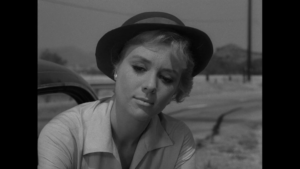
“The Hitch-Hiker” is directed by Alvin Ganzer. The teleplay was written by Rod Serling, but it’s based on the radio play of the same name by Lucille Fletcher. As for our cast, we’ve got the lovely Inger Stevens playing our main character, Nan Adams; Leonard Strong is our hitch-hiker; and Adam Williams is our young sailor. It first aired on January 22nd, 1960.
Episode Tidbits
In Unlocking the Door, Martin Grams Jr. highlights actress Inger Stevens’ approach to choosing parts. Stevens believed in “refusing to accept roles of ‘artistic mediocrity,’ insisting that theatrical performers had the right and obligation to stand up for their personal and artistic convictions” (232). I think that’s a wonderful mantra to live by in just about any creative field. There are, of course, bills to pay, and mouths to feed, however, so compromising your integrity today seems to almost come with the territory, but what I would say is, if you can turn down something that does not really merit your being involved, it’s probably something worth genuinely considering.
In Zicree’s Twilight Zone Companion, he relays the story behind the character’s name: “Serling named the character after his daughter, Anne, whose family nickname is Nan” (64). Zicree then quotes Anne as saying, “That one always bothered me….I thought, why did he have to use that name” (64)? I suppose I can see Anne’s point. This is probably as good a spot as any to also throw in a quick plug for Anne Serling’s book, My Father as I knew Him. It’s an enjoyable read and really does give a different picture of Rod Serling than we’re used to seeing. It’s definitely worth picking up a copy if you would like to learn more about Serling, the man.
My Initial Reaction
My reaction to this episode is of course quite positive. It’s beautifully staged and Inger Stevens is her usual charming self here. There’s genuine moments of intense fear and anxiety that draw in the viewer, and Leanard Strong presents quite a menacing figure at times. I could probably nitpick about some pacing of the episode during the middle traveling scenes, but it’s a classic episode for a reason.
Question 1: Is there more to the hitch-hiker character than we might think?
Like probably many of you out there, I’ve seen this episode a few times over the years, and I’ve always categorized it as a kind of spooky tale of a woman who has to come to terms with the fact that she’s dead. When you label the story as such, it colors the way that you view the hitch-hiker character as well. He becomes either death or an emissary of death of sorts. He has a purpose–to move Nan on to the afterlife. However, I watched this episode my usual two times before I started writing, and something really stood out to me on both of my watches this time: not spookiness, but malevolence. I don’t think Nan simply moves on; I think she’s been captured by something evil. Let me explain.
In order to get a better understanding of the argument I’m going to make, we need to meet an old friend: Dante, as in the Italian poet. We’ve talked about Dante before in relation to hell and purgatory through the episode “Judgment Night,” but now, let’s take a trip to Paradiso. I’ll fight back the temptation to sing that I’ve got “Two Tickets to Paradise.”
Dante is our main protagonist in The Divine Comedy. He is led through both the Inferno and the Purgatorio by fellow poet Virgil. Now, when it comes time for Dante to ascend into the Paradiso, Virgil can no longer accompany him, so he will need a new guide. It just so happens that the greatest love of his life, Beatrice, happens to be available for the job. Now, I’m skipping a lot of information here, really great stuff, so I encourage anyone to read about the relationship between Dante and Beatrice; however, I want to stay on track and get back to our episode.
Why is this important? Beatrice is the source of Dante’s understanding of earthly love. And although earthly love is a beautiful thing and can teach us lessons for how to love on a spiritual level, on a purely theological level, it’s still not the same as godly love. And so, one of Beatrice’s jobs as Dante’s guide is to get him to understand that his devotion to her must now be shifted toward a devotion to God. What I’m about to read is a little section from Dante’s Paradiso, Canto X, verses 55-63. This is Dante speaking:
Never was heart of mortal so disposed
To worship, nor to give itself to God
With all its gratitude was it so ready,
As at those words did I myself become;
And all my love was so absorbed in Him,
That in oblivion Beatrice was eclipsed.
Nor this displeased her; but she smiled at it
So that the splendor of her laughing eyes
M y single mind on many things divided. (link)
Did you see it? Did you see what happened to Dante in that brief exchange? He shifts his devotion from Beatrice to God, and he has this moment where he thinks that Beatrice is going to be jealous. Instead, she smiles. She knows that Dante, the more he ascends Paradiso, the more he begins to understand the shift that must take place from earthly love to a divine one, a place with no jealousy, frustration, and anger. But, there is relief; there is devotion; there is joy. In short, there are still feelings in Dante’s vision of Paradise, a vision that Serling was likely aware of as someone who read Dante.
Now, let’s move over to our Twilight Zone episode.
When Nan is stopped at the construction site, the hitch-hiker walks over to her with a smile. But, then after about a beat or two, his smile morphs into a look of frustrated disappointment. This is actually the creepiest moment in the episode for me. If you want to see what I mean it’s at roughly the 6:53 mark of the episode. Now, we’re going to pull up anchor here for a moment because there is so much in just this one scene to unpack. The smile to me indicates the hitch-hiker believes that Nan is finally ready to move on to the afterlife, but her body language is that of a prey animal that knows it cannot avoid the confrontation with the predator. She is shaking violently; she can’t bear to look at him. Once the hitch-hiker sees that she is still very much taken by the trappings of mortal existence, namely fear, avoidance, and repression, that look of disappointment in him is absolutely horrifying, because it is clearly a look of judgment as well, as in, why can’t you see this already?
To me, this scene is a kind of inverted version of the one I read from Dante. The hitch-hiker is clearly a kind of guide, but a guide to where? It certainly doesn’t seem like anywhere good. Additionally, as I mentioned in our Dante reading, there are emotions in Dante’s vision of Paradise. However, the hitch-hiker seems to be all about the removal of all emotions, both good and bad. Nan tries to understand it early in the episode. She says,
“I don’t know why it is, but I’m frightened, a fear just about as vague as its object.
Maybe it isn’t a fear, more just a sense of disquiet, a feeling that things are a little
wrong. It’s vague because that’s what that hitch-hiker is; he’s vague.
The vagueness here is interesting because if we can’t attribute a motivation to something, we often try to simply sweep it away as a crossed wire from an evolutionary past. We simply “try not to think about it or move on past it–to not care about it.” This happens again later on when Nan is knocking on the window of the man at the gas station. She tries to tell him that there’s a frightening man near her car, and when the attendant asks, “well, what’s he doing?” Nan immediately reverts to a frightened, anxious, and even embarrassed child. She plays with the window sill to indicate feeling silly in the moment and tells the attendant, “well, he isn’t doing anything.” To this, the attendant shuts the window and basically tells her to go away. The problem is that if Nan doesn’t simply move on and can’t settle on her emotional reactions to the problem of the hitch-hiker, she will begin to look mentally unwell to the outside world. She learns this lesson when the sailor comes in the car and for the first minute or two when the sailor is trying to flirt with her, she’s completely out of it. We’ll come back to this important scene in the question 2 section.
In the final scene, when Nan calls her mother, she leaves the phone booth and tells us: “The fear has left me now. I’m numb. I have no feeling….And now I’m a cold shell.” This cold shell is akin to a computer that is waiting to have a new operating system loaded. It’s a blank screen, from which any emotional software may be loaded up.
So, what the heck do we do with all of this, Joe? Good question, fellow Twilight Zone fan. It seems to me that the purpose of the hitch-hiker is to make her prepared for some afterlife by removing all emotions from Nan. The problem is, what afterlife is this? It certainly does not seem like a heaven, and in some ways it doesn’t even seem like a hell because there would be some sense of gnashing of teeth by Nan if that were the case. Additionally, as we talked about in “Judgment Night,” hell is more about the removal hope, and an important component of hope and hopelessness is emotion, the drive to want something or want the removal of something, so it’s not really hell.
Then what is it? The closest that I can think of, and it’s not a perfect guess, is the Underworld in Greek mythology, particularly in the Odyssean sense. Nan is becoming a shade. There are some shades in the Underworld, the great Achilles himself even, who walk around with very little emotion, and even less satisfaction. They seem to have neither hope nor hopelessness. You do, however, see resentment, however, pop up now and again. Again, it’s not a perfect guess because there is emotion in this version of the Underworld, but it’s pretty close.
If that’s the case, then our Hitch-Hiker becomes a kind of Charon, the boatman of the Underworld, more a navigator than a guide. He’s taking Nan to her final resting place with the rest of the shades.
Okay, so you’re probably pretty bummed out right now. Nan seems like a nice woman. Joe, you’re a monster. Now wait, wait, give me a minute to pull this back up toward something positive.
When Nan calls home, the woman on the phone tells her that she died on the road six days ago. Her mother had a nervous breakdown, which is terrible, but it means that Nan was likely already buried and grieved. She would have been given funeral rites, which would mean that the Hitch-Hiker is taking Nan to the place for those who were given proper burial rites. This is a very big deal in Odyssean mythology. Ask Elpinore how he knows this, am I right? Wait, you don’t know the epic story of Elpinore? Oh, we’ll have to get into that at some point with one of our episodes. It’s a fun one. All you need to know is that Elpinore has not been properly buried, and he is in endless cosmic misery because of it. That is not the fate of Nan. She will not wander endlessly. I mean it still sucks, but in the Greek mythology world, it ain’t the worst. Still, I’m reminded of something the illustrious philosopher W.C. Fields once said, “all things considered, I’d rather be in Philadelphia.”
Question 2: What is the purpose of the sailor in this episode?
I’m going to put forth a fairly nuanced argument here about the sailor, but in order to do so, you’re going to have to grant me a little bit of a sandbox from which we can have some fun with this one.
Whenever I’ve watched this episode in the past, I’ve always just taken the sailor section of this with a bit of the old grain of salt. It’s a young man, looking for a ride, finds a beautiful young woman, in need of a companion; she spooks him with her erratic driving, and he gets cold feet and leaves. That’s it, right? Well, if not for randomly seeing a picture online, I don’t think I would have made the connection I’m about to make: the picture? A medium shot, angled upwards, from Hitchcock’s Psycho. It’s Norman Bates, played by Anthony Perkins, sitting in a chair, with a terrifying looking owl above him, looking like he’s about to strike. I’ve actually delivered a conference paper on this scene over a decade ago now. In that paper, I talked about the influence that Edgar Allan Poe had on Hitchcock. So, when this picture popped up rather randomly for me, it triggered something inside of me in connection with this sailor scene from “The Hitch-Hiker.” So, let’s get into it.
The sailor enters the picture just as the gas attendant shuts the window on our Nan. At this point, she is reduced to a screaming, out of sorts woman, who is clearly frightened by something–who says chivalry is dead? When the sailor taps nan on the shoulder, he says, “lady?” And she has this fascinating response. She says, “Yes. That's what I am. I’m a lady.” I think if we’re not careful, we dismiss this line as something just, kinda’ odd. But, what is she really saying? To me, this response is indicative of the moments when we stray so far from the realm of our base understanding of what it means to be human, that we can no longer see ourselves as anything but avatars of our present mental health. In other words, this is Nan going from being nothing more than a physical manifestation of anxiety to once again a human being, but more than that, specifically a lady. This is important.
When the sailor enters the car, he asks if he can take off his shoes. Now, why is that interesting? What does it mean? On the surface, he’s been traveling a lot and his feet probably hurt, but let’s have some fun and go beyond that a bit. Shoes, of course, can be a form of fashion, but in terms of their utility, they protect the feet. They allow us to travel through multiple terrains and for longer distances than if we simply had to rely on the skin, although skin can definitely toughen up with a lot of use and almost become naturally like shoes, but let’s stick with our thought pattern here. There’s also potentially better escapability with shoes because we no longer have to take into consideration every step that we take on a hyper microcosmic level; we can rely on heuristics, shortened thoughts that allow us to make quicker decisions. What I mean is, if we’re running with shoes on in the forest, a pile of twigs on the ground is heuristically shortened to be a surface that is safe for stepping down upon. Whereas, without shoes, our brains have to add into account the physical make up of those twigs before we can decide if it is safe to step on them. Are they sharp? Do they have something on them that would be problematic for our skin? So, it’s not farfetched to think that the sailor taking off his shoes is also an indication of his belief that he doesn’t need to escape; that he’s safe. That he does not need to process this moment or scene on a hyper microcosmic level. Now, that’s just his taking off his shoes. Buckle up. We’ve got more.
It’s clear from the beginning that he is smitten with Nan. But, it’s more than that, you have to look at his body language, the way he looks her up and down at one point. He shifts his entire body toward her; he stares at her so hard that it’s like he’s looking through her. Now, listen, people flirt, that’s often how we meet each other and develop relationships, but there is something slightly menacing about the way he stares at her and the camera angle in the car. This could be an accident by the director/director of photography, or it could be the actor’s choice to play this part of the scene a bit aggressively. But, this scene, the way that it is structured, reminds me of the scene in the lobby from Psycho. Now, I’m not trying to say that the sailor would have done anything bad. I’m saying that there is an aggressive feeling in the air in that moment, a sexual tension. Additionally, you have to ask yourself, why a sailor? Why not another woman? Why not a businessman, or any other type of figure? Of all the characters to have here, why that one, why one that has become a pop-cultural reference for sexual conquest? People often make comments that someone is like a sailor on shore leave.And just to be clear: I have plenty of love for the navy. My dad was in the navy; my father-in-law was in the navy. So, why a sailor? Well, I think there is a reason, but it might not be what you think?
All along the ride, the sailor believes that he is the dominant force, that he is pursuing Nan, and that he is in complete control of the situation. There are old stories about sailors in many different cultures. Stories involving either beautiful women or women-like creatures with beautiful voices who lure sailors to their death through song. In The Odyssey for example, the sirens would lure sailors to a rocky shore and the ships would dash into the rocks, killing everyone on board. Up to this point, we’ve been looking at the sailor in the car as the aggressive one, but about halfway through the scene that dynamic completely shifts. Think about it. Twice Nan tries to slam the car into the hitch-hiker, but what is really there? Nothing but trees and rocks. Then, when the sailor decides he wants to leave, what does Nan do. She gives him a beautiful song: she says to him as he’s about to escape: “I like you. I like you very much. In fact, that’s why I picked you up because I liked you. I thought that we could be friends, and I’d kind ‘ve like for you to take me out.” This is the siren song. And if you look really closely, the sailor considers staying with her in the car. And if he does stay, he will probably be dashed into the rocks. But, the sailor holds firm, leaves, and lives to fight another day. So, what’s the purpose of the sailor in this episode? Well, perhaps, it’s a bit of a reminder of two things: 1. Just cause you think you’re in control of a situation, it doesn’t mean you are. 2. Be careful of sirens, and in our modern day there are sirens of all types, shapes, and sizes that try to lure us in, only for us to be dashed against a rocky shore.
Question 3 What are your moments of awe?
My moment of awe for this episode has to do with all the living people involved with Nan’s ghostly run. Could you actually imagine being involved in a situation where you later found out that the person you were talking with, sharing time with, was actually deceased, and you didn’t know it? That would change the way that we view just about everyone. If it happened once, it could happen again. I could see someone losing their grip on reality quite easily from this. Then again, we’re pretty desensitized today. I could see someone just being like, “Oh, that’s Reggie. He’s dead. You want Chinese food or pizza tonight?” We are a weird species.
My Rating
As for my rating, I rate this one quite highly: it’s top middle-tier for me, just a hair out of top top-tier. I love the story, the acting is good, especially from Strong and Stevens–although the gas attendant seems oddly forceful in a way that doesn’t quite make sense to me, but that’s a small thing for what is a great episode.
Next time, we’ll be taking a look at “The Fever” and here are your questions to consider as you watch.
Question 1: Is Franklin a tragic figure in the Aristotelian sense?
Question 2: What is psychologically happening to Franklin in this episode?
Question 3: What are your moments of awe?
Closing
Throw another episode in the books. You don’t see many hitch-hikers out there anymore. I wonder if it’s because there is more distrust from drivers or more distrust from the people on the side of the road. That data would probably not be very useful, but I would still be interested in reading it. I’m grateful for all of you Twilight Zone hitch-hikers out there who are going my way. Speaking of gratitude…
Announcements and Shout-outs
I’ve got a few comments that I would like to highlight from the YouTube channel.
ThomasHugus5686 commented on my “Third from the Sun” episode, “Thanks for your reflections and intelligence. I’m 73 and lived through those times. You are on point with your thoughts on this episode. Thank you sir!” No, thank you, sir, for taking the time. I try and do my best think about these episodes from simply a human perspective, and that’s not always easy, and I’m sure I’m sure I’m going to fail miserably at some point, but I can always promise that I will do my best.
TheSeraphNetwork offered the following thought: "Third from the Sun" is an excellent episode. I like how you delve into the nihilism of humanity's urge to destroy (things, people, etc.) through this episode. Another great video.” I appreciate it, friend. We are definitely still in a Nietzsche renaissance when it comes to discussing our nihilistic tendencies. I’ll often have students say that they’re nihilists, but when we actually talk about what nihilism entails, most of them say, “oh, nevermind, that’s not what I think.” But, it’s a very important state of mind for us to continue to study because it certainly has alluring parts to it that speak to how people feel today.
On the same episode, Paul-ou1rx had the following to say, “It
seems the arms race ended once two countries had nuclear capabilities. Before that, the race was to gain a marginal lead with slightly better tanks, planes missiles and espionage. After that, it just feels like two people standing on a cliff and when the starter pistol goes off it will become a race to the bottom.” Thanks, Paul. I like the imagery of the two people standing on a cliff. We always have to consider what winning actually looks like when we think of war.
If I didn’t get to your comment, know that I greatly appreciate you taking the time.
How to Support the Show
Head over to thekeyofimagination.com to continue our conversation. You can rate this episode, learn more about me, watch previous episodes of the show, and check out my curios page where I showcase some of the Twilight Zone trinkets I’ve bought over the years. I encourage people to email me thoughts and comments, whether it’s about a particular Twilight Zone episode, your rating for an episode, or about the Key of Imagination Show. You can get those to me as a text email, an audio clip, or even a video clip of roughly no more than 5 minutes to keyofimaginationshow@gmail.com. Keep in mind, even though we talk about some serious topics, we’re trying to maintain as family-friendly of an atmosphere as we can. If you would rather I not use your comments on the show, please indicate that so I can respect your decision.
If you enjoyed the show, I ask that you please take a moment and do one of the following to help build our community. Rate the show, review the podcast, leave comments, thumbs up, all of the usual algorithmic gymnastics. That will help get the show in front of more people and help us build our community of Twilight Zone fans. However, even if you do none of that and absolutely hated every minute of this, I would still like to thank you for spending some time with me. Until next time, remember, all doors are open to those who possess the key of imagination.