
The Twilight Zone Season 1: Episode 22
"The Monsters are Due on Maple Street" Episode Transcript
Introduction
Welcome to the Key of Imagination. This week we’re going to be looking at the Twilight Zone episode, “The Monsters are Due on Maple Street.” We’ll discuss whether or not Steve is a failed just man; we’ll see if there is someone who is more to blame for this fiasco; and I’ll reveal my moment of awe. So, grab your keys, and let’s open up this door to the fifth dimension.
Plot exposition
A beautiful, serene day on Maple St., USA. Kids having fun; people washing cars–the perfect scene–that is, until something mysterious flies over head. What was it? No one knows, and life seemingly goes on. But, when the creature comforts of modern civilization no longer provide their comforts, the minds of the people on Maple St. turn to the creatures. When young Tommy implores respected citizen Steve to not go anywhere because “They” probably won’t want him to, a dangerous theory begins to form: perhaps, one of the good people on Maple St. is not actually a person at all, but an invader from another world. As cars, lawnmowers, and lights begin to act on their own, the accusations begin to fly; this one stares at the sky; the other one listens to strange things on his ham radio. It isn’t long before the entire neighborhood is at each others’ throats. Oh, and Tommy was correct: they did not want people to leave, nor did they want people to work together, to not resort to mob-mentalities and violence, they being extraterrestrials, beings from another world, exposing how easy it is to rile up the beings from this one.
Episode Details
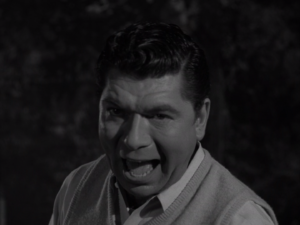
“The Monsters are Due on Maple Street” was directed by Ronald Winston. The teleplay was written by Rod Serling. As for our cast, everyone does a nice job in this, but I’m going to just highlight a few here: Claude Akins plays Steve Brand; Jack Weston brings Charlie to life; Barry Atwater plays Les Goodman; Jan Handzlik is our young Tommy; Amzie Strickland plays “woman,” although she’s really important in this episode; and my personal favorite, Ben Erway as the unfortunate man with the hammer, Pete Van Horn. The episode first aired on March 4th, 1960.
Episode Tidbits
For our tidbits section, I’m going to quote from a different source: a book entitled, The Monsters on Maple Street: The Twilight Zone and the Postwar American Dream by David J. Brokaw. It was published in 2023, so it’s still fairly new. I thought Brokaw made a good point when states:
In “The Monsters are Due on Maple Street,” the tide of suspicions, accusations, and presumptions of guilt rather than innocence is clearly already setting in. Any unusual behaviors, such as Les’s insomnia-driven star-gazing, are suddenly cause for major concern. But also…evident is the dangerous, simplistic completeness of Tommy’s explanation, coupled with its uncritical acceptance by the neighborhood. That the explanation for the outage came from a comic book, yet not given much more thought by anyone, further symbolizes some of the troubling aspects of anti-Communist scapegoating–the way it arrested critical thinking. (129)
I like this point because it highlights something I see today that bothers me. Young people, including young adults, have to play with language–they have to play with ideas in order to stretch their minds and prepare for adulthood, but it is our jobs as adults to stabilize that world for them, to show them the importance of humility, rationality, love, imagination, civic duty, and creating good in the world. If we don’t model that for them, why should they value anything we say?
Additionally, I want to give a shout-out to Victor over at The Outer Limits podcast. He reached out to me on X and suggested that I watch the Outer Limits episode “A Feasibility Study,” which is from season 1 episode 29. It shares a similar theme to “The Monsters are Due on Maple St.,” but it approaches it differently. I hadn’t seen it before, or at least I didn’t remember it. It has one of my favorite underappreciated actors from the Twilight Zone: Joyce Van Patton. I appreciate the suggestion Victor, and I encourage people to not only check out the Outer Limits episode, but to give a listen to Victor’s Outer Limits podcast, especially if you love Sci Fi and the Outer Limits show.
My initial Thoughts
Of course my initial thoughts on this episode are positive. This one sticks with you. What always stood out to me, even from a first viewing when I was young, is the character of Steve. He certainly tries to stabilize things in the neighborhood, but it doesn’t work, which actually takes us to our first question for the episode.
Question 1: Is Steve a failed Just Man?
On the surface, this might seem like an unfair question, but it comes out of a place of good intentions. Steve is a really interesting figure in this episode: strong, commanding, charismatic, but not without his own flaws and problems in this episode, as I’ll show. My question is not really meant to pass judgment, per se; it’s more about our being able to recognize when we’re in a situation that requires someone to stand up and be just, whether man, woman, or even child. It’s predicated on a kind of figure that emerges a lot in hero studies–yes, that’s a real branch of research, mostly in literature and classical studies. It’s something that I’ve been reading and researching for a long time. Before we can compare the one just man figure to Steve, we need to construct a model of the one just man. Our first stop is Ancient Greece and Plato’s Republic.
In Book I of Plato’s Republic Socrates and Thrasymachus are in a dialogue about the nature of justice versus injustice. They begin to touch upon how just and unjust individuals interact with others. Socrates says, “injustice creates divisions and hatreds and fighting, and justice imparts harmony and friendship; is not that true, Thrasymachus?.” This sets the table for his eventual move from the public to the private. Socrates questions, “And is not injustice equally fatal when existing in a single person; in the first place rendering him incapable of action because he is not at unity with himself, and in the second place making him an enemy to himself and the just?” (link).
So, one important element of the Just Man in Plato is the ability to stand within the public and the self without being or creating a state of division: a house divided cannot stand on its own. Now, think about a time when you did something that you are not particularly proud of. You are essentially in a state of division at this point, attempting to come to terms with the part of you that believes in being just, and yet acting in a way that is unjust. So, from Plato, we take away the notion that the Just Man preserves unity within the self and the community.
Next, we travel to the land of Uz, no, not Oz. There are no yellow-brick roads where we’re going. We’re heading over to the Old Testament and paying a visit to one of my favorite figures: Job. When Job’s friends attempt to convince him that his troubles–the destruction, death, and personal sickness–must be because he has upset God, there’s a clear sense of logic there. I mean, it seems perfectly logical to say that God would not punish those who do not deserve it, right? So, if the Book of Job had gone that route and left it as Job was punished because he deserved it, most people would probably accept that and simply let it stand as is, but if you’ve ever read the Book of Job, you know that this is not the case. Remember, we’re told that Job is perfect and upright. So, what does perfect and upright logic tell us in times of great calamity and chaos? The Just Man understands that there is a difference between reason and blame, and that sometimes things happen, and it’s not always necessary to blame others. In other words, Job’s uprightness is in his understanding that God simply chose to do what he did; whereas, his friends feel that that blame for a horrible moment must fall somewhere–I.E. Job. So, we come away from Job with the understanding that the Just Man does not need to ascribe blame where reason serves the better purpose.
And Finally, we’re going to make a quick visit to Book 6 of John Milton’s epic poem Paradise Lost. For this one, I’m going to simply paint a picture for you. At this point, Satan is already starting to build his case for taking over the throne of heaven. He is surrounded in this area by angels who will eventually follow him on his attempt to usurp the throne of God, all except one: Abdiel, a Seraph. Abdiel stands alone in a room full of angels who hate him for his standing up to evil. He alone confronts Satan and attempts to expose the folly of his ways to the other angels, but none follow him. He says his peace and then proceeds to walk through the gauntlet of hatred that is now spewing from the other angels who wish to follow Satan. In essence, he stands firm in good, and walks through this kind of valley of the shadow of death, with no fear. Now, what is interesting about this moment is actually what God himself says to Abdiel when he returns to heaven. This I will quote. God says,
“Servant of God, well done, well hast thou fought
The better fight, who single hast maintaind [ 30 ]
Against revolted multitudes the Cause
Of Truth, in word mightier then they in Armes;
And for the testimonie of Truth hast born
Universal reproach, far worse to beare
Then violence:” (link)
What I want to point out is the last part. God recognizes that it must have been difficult to stand in that room alone, and bear the weight of everyone hating you. From this section of Paradise Lost, we learn the final part that I want to highlight of the Just Man: you must be willing to stand alone, to walk through the gauntlet of hate, the valley of the shadow death, but if you are truly on the side of good and right, you will be able to bear it. From this we learn the value of resiliency in the Just man.
Okay, we have our three parts that we will apply now to Steve: preservation of unity from Plato; reason over blame in Job; and resiliency from Abdiel. Let’s start with preservation of unity.
Does Steve attempt to preserve unity? Yes. When nighttime comes and people are still trying to accuse Les of being an extraterrestrial, Steve approaches Les’s porch as a way of trying to stop it from being so much about Les versus the neighbors. In other words, he tries to incorporate Les into the neighborhood again. However, when Les starts to address the neighbors and he takes a step toward them at the 11:49 mark, Steve moves back with the group. He’s in unity with the mob.
In terms of reason vs blame, we have two examples to look at, one negative and one positive. Early in the episode, when Tommy is telling Steve and Charlie not to leave because the extraterrestrials might not let them, it’s Steve who actually prompts Tommy to continue his story at the 6:36 mark of the episode, even after Mr. Goodman tries to dissuade everyone from falling further into the narrative. That might have been the last moment where Steve could have stopped the whole thing. However, on the positive side, we do have Steve’s great speech to the neighbors. The group turns on him and talks about his ham radio usage. Steve then delivers a monologue that is worth repeating here: “Charlie, don’t tell me what I can afford! And stop telling me who’s dangerous and who isn’t and who’s safe and who’s a menace. [He turns to the group and shouts.] And you’re with him, too—all of you! You’re standing here all set to crucify—all set to find a scapegoat—all desperate to point some kind of finger at a neighbor! Well now look, friends, the only thing that’s gonna happen is that we’ll eat each other up alive—”
As for resiliency, there is a problematic moment here we have to address. When Charlie gets the shotgun, Steve has this moment where he says, “A shotgun? What good is a shotgun…” In other words, Steve is actually admitting that the figure approaching them, which we learn is Pete Van Horn, is a monster, and that a shotgun is simply not the right weapon. Now, why is this resiliency and not reason? I put it here because he has been building up resiliency against all of the blaming to this point, and rather than stopping Don and Charlie outright, he is essentially critiquing the choice of weapon. In this particular instance, he is no better than anyone else.
So, let’s answer our question: Is Steve a failed Just Man? Well, I think if you hold firm to the concept, the answer is yes. Now, hold on, I know that seems really judgy and harsh of me. But, hear me out for a moment. Steve is absolutely the most level-headed of the group, and I think it’s clear that he is probably a good person–something we would all like to be considered. And that is my point. That is why this Just Man figure is considered heroic. Many of my friends would likely say that I’m a good guy, but I have absolutely failed in moments in my life where I could have stood up for a greater good. What I’ll say is this: it’s almost impossible to BE the Just Man figure, as in to encompass it at all times, but when a moment is before you where you can create unity in a moment of chaos, can you be that Just person that one time? I hope you can.
Question 2: Is there one person who bears more blame for this descent into chaos more
than others? If so, who is it?
Now, I’ll go ahead and admit up front that everyone plays a part in the destruction of Maple Street. That’s the obvious answer. However, I do think that social psychology points out an interesting approach to thinking about this situation, and when you follow through with it, you do end up pointing a finger at one person more than others. Let’s see if I can win you over to my opinion on this one or not. Either way, we’re just having fun with this one.
Often times when people discuss this episode they do so from the perspective of McCarthyism and the search for ways to scapegoat individuals and find enemies. However, I’m going to go a bit of a different route here. I want to talk about the psychology of how we get to that frenetic state of scapegoating. I’m going to set up this section with a quotation from social psychiatrist Bertram F. Malle’s book How the Mind Explains Behavior. In the book, Malle states, “When people search for meaning, they strive for an understanding of one thing in its relationship to other things. Searching for meaning restores the coherence within a ‘knowledge structure,’ a network of representation. People search for meaning when a link is missing in their representation of reality or when various elements in this representation contradict each other” (64). Okay, so what Malle is saying here is that we create meaning in order to establish coherent narratives that can move us out of a state of confusion. Let’s take this to our episode.
When everyone loses power and people start to gather together around the 4 minute mark, there are a few key things that are said that start their burgeoning need for meaning through narrative coherence. People throw out ideas like electrical storms and the suggestions are discredited through reason and they are left in a state of confusion because the need for coherence has overtaken the actual loss of electricity. Then, it happens, at the 4:24 mark of the episode, after Steve fails to start his car, the “Woman” played by Amzie Strickland, (we’ll just call her Strickland at this point) screams, “what does it mean?” Not what is going on or why doesn’t it start. She says, “what does it mean?” It’s Strickland who really starts the ball rolling because while everyone else at this point is looking for reasons, she wants meaning. These are not the same thing, ladies and gentlemen. And herein is where we start our descent into madness. Because we, as a species, do not do well without understanding the meaning behind something, this kind of event is all-too-easy to predict. It continues to happen throughout the episode. After Pete Van Horn is killed and Charlie’s lights go on at his house, it’s Strickland again who asks, “why did the lights go on in your house?” Then, finally, when Charlie blames Tommy, it’s Strickland one final time who says, “How did he know? How could he have known?” Again, a search for meaning. In my humble opinion, it is Strickland or “woman” who is most to blame for riling people up and prompting them to always think about the meaning behind something instead of the reasons for it. Let me know in the comments if you have your own person that you blame the most or if I’ve won you over at all to my side.
I wanted to write about this because in some ways, I see the opposite happening today, while still causing many of the same problems. We value winning debates and arguing today so much that we’ve completely lost sight of what, well to put it clunkily–we’ve lost sight of what meaning means. As someone who teaches rhetoric, and I use the term in the classically Greek sense, as in persuasive speech, as someone who teaches rhetoric, I see people constantly construct rhetorical towers of babel that touch the stratosphere, all perfectly rational, leading to the specific argument or outcome that they desire to achieve, but when I ask people, “so, what do you want people to do with this, I.E. what does it mean,” I find more often than not people have no clue how to answer such a simple question. Whereas in “The Monsters are Due on Maple Street,” people search for meaning to the detriment of reason, today, we search for reason to the detriment of meaning. We will not always know the reasons behind an outcome, and we have to be okay with that. And not every outcome has real meaning. We need to be okay with that as well. Find your balance. I think that should be the goal for all of us.
Question 3 What are your moments of awe?
My moment of awe is a rather simple one: we cannot allow such a simple thing as technology to continually divide us. Social media itself is a form of technology–access to everyone everywhere, and yet we often use it as a means of creating divisions and echo chambers. I’m going to be as blunt and honest with you as I have ever been: truth be told, I don’t have the emotional, psychological, nor the physical energy to waste on petty arguments–or conversations that are not entered in good faith. I’m not saying that things that I read or things that people say to me don’t rile me up sometimes; what I’m saying is that if someone says something that is simply with the intention of causing me anger and frustration, I don’t engage. I don’t feed it. I think that’s where we have to get to as a people. We have to learn to not engage in things that were created to separate us, to divide us. We keep blaming politicians, companies, and celebrities–until we realize that we are the ones who are empowering them with our clicks, our money, and our time, they will continue to do it. I use the term “they” here, but I don’t want to make them monsters. They are human; they have fears; they have families, loved ones. As Commodore Oliver Hazard Perry stated, "We have met the enemy and they are ours.” So, although on one hand I’m saying don’t engage them when they attempt to rile us up, on the other hand, l am also saying we need to promote and encourage kindness, understanding, empathy, and a clear belief in the power of the unity of the human spirit.
My Rating
This is a top middle-tier episode for me, just a hair out of the top top-tier. The themes very much still hold up for today–in fact, it’s only becoming more relevant as we become more easily divided by ridiculous things. “Billy, why does your whopper jr have a pickle? Mine doesn’t have a pickle!” There are certain points where the sound seems to be mixed a bit oddly, and I have to take a point away for Tommy’s mere existence.
Next Episode
Next time, we’ll be taking a look at “A World of Difference,” and here are your questions to consider when watching the episode:
Question 1: Who is the real person here? Is it Arthur Curtis or Gerald Raigan?
Question 2: Is there a common theme that links the lives of both Gerald Raigan and
Arthur Curtis?
Question 3: What are your moments of awe?
Closing
Another episode in the books, and another classic. I hope I’ve given us all, me included, some additional pause to consider the ways in which we might be being manipulated by our technology. And just to be clear: I am as susceptible to this stuff as anyone else out there, but I try to take note of when something I read or see creates a physical change in my body, and then I try to think about what that change is producing: excitement, anger, hate. That at least helps to keep me in check, at least most of the time.
Announcements and Shout-outs
I’ve got a comment from the YouTube channel that I’d like to highlight.
BobbiCodes commented on my “Time Enough at Last” episode:
“I find it hard to be too critical of Henry Bemis, because the premise of this episode is that it is a dystopia. If society ever loses its way so much that I was ridiculed for reading, I wouldn't want anything to do with anyone either. And what happens? Society destroys itself, and he was serendipitously saved only because of his isolation.” I think that’s a good point. At the end of the day, his terrible vice is that he is a “Readah” and there are certainly worse. Additionally, it’s easy to lose the true level of horror and despair that he’s in as the only person left. I think that can get overshadowed a bit by the twist. These are good reminders. Thanks.
How to Support the Show
Head over to thekeyofimagination.com to continue our conversation. You can rate this episode, learn more about me, watch previous episodes of the show, and check out my curios page where I showcase some of the Twilight Zone trinkets I’ve bought over the years. I encourage people to email me thoughts and comments, whether it’s about a particular Twilight Zone episode, your rating for an episode, or about the Key of Imagination Show. You can get those to me as a text email, an audio clip, or even a video clip of roughly no more than 5 minutes to keyofimaginationshow@gmail.com. Keep in mind, even though we talk about some serious topics, we’re trying to maintain as family-friendly of an atmosphere as we can. If you would rather I not use your comments on the show, please indicate that so I can respect your decision.
If you enjoyed the show, I ask that you please take a moment and do one of the following to help build our community. Rate the show, review the podcast, leave comments, thumbs up, all of the usual algorithmic gymnastics. That will help get the show in front of more people and help us build our community of Twilight Zone fans. However, even if you do none of that and absolutely hated every minute of this, I would still like to thank you for spending some time with me. Until next time, remember, all doors are open to those who possess the key of imagination.
Works Cited
Malle, Bertram F.. “Attribution theories: How people make sense of behavior.” (2011).