
The Twilight Zone Season 3: Episode 66
"Two" Episode Transcript
Introduction
Welcome to the Key of Imagination. This week, we’re taking a look at the Twilight Zone episode “Two”. We’ll think about how gender is revealing the loss of humanity to us; we’ll dive into where we might find Rod Serling’s voice in all of this; and I’ll reveal my moment of awe, an ode to our resiliency. So, grab your keys, and let’s open up this door to the fifth dimension.
Plot Summary
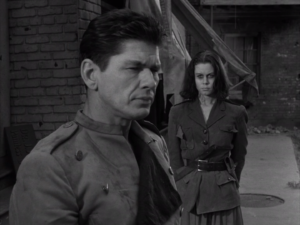
An eerily quiet neighborhood with abandoned cars and dilapidated buildings paints a picture of the aftermath of a collection of decisions that has led to the near destruction of the human race. On this day, however, the streets are reminded of an unfamiliar sound: footsteps. A young woman in a soldier’s uniform makes her way up and down the streets, with no sign of another human being. In the periferee, a beautiful dress shimmers through the remains of a broken window of a clothing store, a reminder of the years before the conflict. But this isn’t her goal; what she needs is food, and when she finds some in another building, she is startled by the sudden appearance of a man, and not just any man, a soldier from the other side: the enemy. After a tussle that leaves the woman the worse for wear, the gentleman soldier decides that there is enough food to share, and so he wakes up the woman and offers her a meal. He also tries to explain to her that there are no more enemies and sides; the war took care of that. There are only decisions, only people, unified by the goal of survival. As you can imagine, our female friend is not immediately convinced. And not simply because they do not speak the same language. And so, she keeps her distance from him, not too far away but not too close, either. Both now, staring at the beautiful dress from before, admiring its beauty. He retrieves the garment and presents it to her. But, perhaps, things have become too comfortable between the two; she fires her weapon to let him know that she has not forgotten that they are combatants, and so he leaves. The next morning, our gentleman, freshly shaved and no longer wearing his uniform, comes out of his shelter for the night to find that he is not the only one who has changed: his female companion now dons the beautiful dress from the display window, and with rifles still slung over their shoulders, the two walk as a pair to face this new world together.
Episode Details
“Two” is directed by Montgomery Pittman. The teleplay is by…Montgomery Pittman. So, we’ve got someone pulling double duty here. As for our cast, this is pretty straightforward. Our leading lady is played by none other than Elizabeth Montgomery, and in quite a bewitching performance, I might add. And our dashing gentleman is played by Charles Bronson…a man who at times seems like he has a bit of a death wish? Okay, fair enough, I mean…I might have forced that last one a bit, but if you think that was bad, I was trying to fit in a dirty dozen reference, but that did not go well. The episode first aired on September 15th, 1961
Episode Tidbits
As for our tidbits, Martin Grams Jr. has a good one here. The empty streets, with the dilapidated spaces, and wild greenery growing everywhere had a genuine effect on Elizabeth Montgomery. She states, “I couldn’t help thinking what it would be like If I went around the corner and there actually wasn’t anyone there – nothing but rubble, grass growing in the streets, the debris of a dead human race” (417). I have to admit; the street does look awesome, and I could see where it could create this kind of potential future vibe when you consider the Cold War implications of the time.
Question 1: How does gender particularly highlight the loss of humanity in this episode?
Confession time: I’ve always had a bit of a love-hate relationship with this episode. What I mean is that it’s one of those episodes that I really have to be in the right mindset to enjoy it. Otherwise, I just find it a bit slow-paced, but that has more to do with my level of focus at the time than anything else. Well, it just so happens I was in a pretty focused state of mind when I watched this one the first time through, and I noticed something…something interesting…that I hadn’t really thought about in previous viewings of the episode having to do with gender.
Now, saying that this episode has a gendered aspect to it is certainly not going to win me any scholarly awards. [play the graduation theme, and look proud of yourself.] I mean it’s pretty much baked into the storyline. However, I do think there are some interesting nuances here to discuss in relation to how gender manifests or amplifies the loss–and perhaps–regaining of humanity in this post war world–with a bit of a twist. Particularly, I want to look at three aspects of this episode. So, let’s start by talking a bit about fashion. No, not mine. I’ll grant you that I always look like I’m at least a little bit in the wake of an apocalypse. Rather, I want to talk about this dress in the window.
We could make a really surface-level reading here and say that the dress represents femininity and thus our leading lady donning the lovely dress speaks to the reacquisition or rebuilding of femininity and simply call it a day, right? Well, I mean we could, but you know me better than that, friends. We’ve got to get down to the nitty gritty here. Let’s look at this garment more closely. The dress is sleeveless. What does that mean? It means bear arms. What is our leading lady always bearing, arms? As in her weapon. What does she not bear, arms, as in her appendages. They’re covered by a uniform coat. We’ve got a little double entendre here, don’t we? And so there is seemingly this choice regarding women in this episode about which arms they choose to bear–although, in wartime, there certainly aren’t many choices available, especially in this Twilight Zone world that seems like it enveloped the lives of every individual. You know what, we’ll come back to this arms thing a little later with a more refined point.
When I was looking up some tidbits for this episode, I came upon an interesting quotation about Elizabeth Montgomery regarding her interpretation of the role. In Marc Scott Zicree’s Twilight Zone Companion, he quotes the widow of director/writer Montgomery Pittman, Maurita, as saying the following: “Most girls want to look really pretty for the camera. Monty had to fight her [Elizabeth Montgomery], really, because she wanted to make her eyes really black. She got too much makeup on[;] she was making herself too haggard” (217). But, this is a really fascinating question. Why does Montgomery want more makeup? If you look at her eyes, they are quite dark even in the final version, which was presumably a kind of compromise between the two interested parties. When we combine the comment from Pittman’s widow with Elizabeth Montgomery’s preference, it actually opens up for us one way to interpret this. Yes, traditionally speaking, women tend to wear more makeup, and that includes areas around the eyes: eyeliners, eye shadows, and I’m sure much more. And this is a choice, a way to cultivate the image of how they would like the external world to see them, but they create that image themselves through self agency.
However, in the case of Montgomery here, you can make the argument that the eye blackness is more about the lack of agency that she faced during the war. Her eyes are darkening likely because of a combination of dirt, smoke, and let’s throw in a lack of sleep. And so it actually highlights how war has taken away her ability to control how the world sees her. And when you consider that Bronson’s character’s eyes are actually fairly normal looking, with maybe a little bit of soot or something, I think I’m actually on team Elizabeth Montgomery here: the exaggeration of the eyeblack on her creates a really interesting statement about her experience as a soldier here, especially since it’s likely that she was a civilian just five or so years prior.
Finally, I want to talk about the ending here, particularly the walking away scene. Undoubtedly, you’ve noticed that for the majority of the episode, when our leading lady walks, she stays roughly three feet behind our dashing fellow–always behind. Why? In some ways, both parties are able to clearly send signals. By walking in front, with his back to Montgomery’s character, our soldier boy is able to send the message that he’s not threatened by her–although he really should be if you think about it logically. I’m just saying, she shows that she can pull a trigger with the best of them. Nonetheless, he is able to try and help her see that he has no interest in continuing this war. Now, she stays behind because there’s a kind of controlling advantage–she’s still very much in the mind of a soldier for much of the episode. By keeping him in front, he can never get the drop on her from behind. Additionally, she can see the field of view that’s in front of him, which is another advantage. Now, at the end, of course, it’s a lovely little scene to see them walking side-by-side–a kind of nod to the fact that they recognize they will have to be able to trust each other, to equally survey the field in front of them, and face whatever comes their way together. It’s beautiful; it’s downright prekrasny. But, there’s still something for us to address here at the end.
You’ll recall in my dress breakdown, I talked about the whole bear arms and bearing arms theme regarding the dress. Well, one way that the writers could have written this scene is to have our lady give up her gun: to choose to simply bear her actual arms. But, that doesn’t happen here, does it? No. They both walk off with their rifles or whatever kind of weapon these are slung over their shoulders. And I like this; I prefer this idea. It not only continues to empower our leading lady, but it empowers our gentleman as well. Because, let’s be honest here: he is going to need her help; he’s going to need to have a partner who can likely continue to fight and face the terrible things that potentially lay ahead of them. I give Montgomery Pittman and of course Rod Serling some credit here for being even more realistic than some might have wanted them to be at the time. And so how does gender in this episode manifest the loss of humanity? Well, through the dress and the eye blackening, I think it demonstrates a kind of stripping away of options that women had to cultivate who they want to be, but the final image of the two walking together with their weapons side-by-side I do think restores this somewhat and creates more space for the two to define themselves both individually and together, and that makes this ending better and more interesting than I had originally remembered.
Question 2: Where is Serling’s personal voice within this episode?
On the surface, this seems an odd question. The episode is written by Montgomery Pittman, not Serling. So why am I talking about Serling’s personal voice here? In truth, it has more to do with the fact that we’re talking about a war episode, and whenever I can I try to highlight the fact that Serling was a veteran of WWII, and he spent a good amount of his remaining years in life trying to talk to young people about why war should only be the absolute last resort, until all diplomacy has been completely exhausted. But more than anything, I also want to highlight the ways in which he hoped to balance out how we present war as a kind of entertainment medium. Essentially, he didn’t want people to only show the grand triumphs, the parades, etc.; he wanted people to see the destruction, the dirt, the suffering of the soldiers marching through the mud and baking in the hot sun. And I always try to remember to clarify this: I don’t think Serling was anti war and he was certainly not anti his country. What I think he was is a man who simply wanted people to understand that war has very real casualties, and not all of them happen on a battlefield. And so, although Serling might not have written this episode; he did have to put his stamp of approval on it, and I do think that he would be especially protective of showcasing media during a time of potential unrest: ie, the Cold War. So, let’s talk a little bit about what Serling might have approved of in this episode and why.
Serling does give us some information in his opening monologue that is worth revisiting. “Hardly an important battle, not a Gettysburg or a Marne or an Iwojima. More like one insignificant corner patch in the crazy quilt of combat.” Let’s pause for a second. First, what a line! I know that I’m somewhat biased here, but I genuinely do think that Serling is underappreciated in his writing ability. To create a line like a “corner patch in a crazy quilt of combat” is an absolutely fantastic metaphor, and it’s the kind of line that is a joy to say out loud; it has a melody to it. Okay, but the thing that I want to point out is this notion that this battle was not “an important” one. Now, you might be thinking, “sheesh, Rod. That’s kind of a terrible thing to say, especially from someone who fought in battles like Leyte( Lay-Tee) and Luzon in WWII. But, actually, that’s his point. Certain battles in American history live on almost into mythology, becoming, for Serling, potential monuments that cast a long shadow upon the “smaller” ones that aren’t talked about as much, thus rendering them out of sight from the public. And yet, these smaller battles still carry the burdens of death and destruction, and they certainly have earned the right to be remembered. And I think that is where Serling’s savviness comes into play even more here.
There are numerous reasons why Serling was so successful in television, but one of the primary ones is that he knew his audience. His viewers were not people solely living in Gettysbergs–in places of great battles with monuments; they were people who lived all over the country, in small, relatively happy communities–the ones that might reside in the shadows of the Gettysburgs. And so to see this neighborhood in this episode, which has not heard the footsteps of a human for five years, would be potentially traumatic. And yes, again, for some of my younger viewers. During this time in 1961, this was considered a very real possibility. You might recall that I mentioned that this episode first aired on September 15th, 1961. Well, less than a month later on October 6th, 1961, President John F. Kennedy issued a statement to the Civil Defense Committee, in the hopes of creating better coordination with the state governors regarding this very topic. President Kennedy writes, “There is need for a nationwide understanding of what each level of government, each private organization and each citizen can do to bring about and maintain the best attainable protection for the civilian population against the major effects of a thermonuclear attack….In simple terms, this goal is to reach for fallout protection for every American as rapidly as possible….Protection against this threat is within reach of an informed America willing to face the facts and act”(JFK Library). Again, for perhaps my younger audience members, the United States was worried about this threat potentially coming from the Soviet Union–although there are certainly other players involved here as well, namely, Cuba. We’re not that far away at this point from the Cuban Missile Crisis. But, we’ll stick with the Soviet Union for a moment.
Now, Marting Grams Jr. and others have made mention of the fact that although this Twilight Zone episode is not a direct telling of the relationship between the United States and the Soviet Union, there is a rather key moment that at least puts it into our minds: the only word that Montgomery says in the entire episode: prekrasny, which is Russian for pretty. Let’s put the question about whether or not this is really a Cold War tale aside for just a moment and try to take the episode more at face value. It’s an undetermined future where we’ve clearly unleashed atomic war on each other to the point of almost total annihilation; and there are undefined human combatants consisting of at least two different sides, represented by our leading actors. You don’t need to know Russian to get a sense of what that word prekrasny means, and that’s what makes it quite a brilliant little bit of work by our director Pittman and our director of photography (DP) George T. Clemens. They could have just as easily used a made up word and the effect, I think, would have been the same. And that’s something worth noting here. It’s not necessarily what is being said; it’s what is trying to be communicated: beauty. And that’s human. In doing so, people like Serling who want to avoid atomic conflict as much as possible are able to showcase that whether the people on the other side of the battle line are Russian or anyone else, there are universals that bind us together: the awe that we feel when we are confronted by something beautiful. And that to me is very much a Serling kind of move. And so, I do think we see some aspects of Serling’s personality or even his own slight touches throughout this episode, even if they are not directly created by him and are attributable to Montgomery Pittman. I have no doubt that Serling was probably pleased with the way Pittman was able to find that kind of balance of warning of destruction with a slight nod toward hope.
Question 3: What are your moments of awe?
My moment of awe has to do with our resiliency as a species, and I don’t just mean the physical resilience of biologically surviving a catastrophic event such as total nuclear warfare. I actually mean more in regards to our emotional resilience. This is a really easy episode to take for granted–and I’m probably guilty of that as much or even more as anyone else. But, the crux of the story is laid out by Serling in his closing monologue: “this has been a love story.” And I suppose it is, isn’t it? I hear how difficult it is for people, especially young people today when it comes to dating–so much data and information flying about, and not to mention that we are inundated with stories online on every possible platform about how terrible women are and how terrible men are. And I have to imagine that when you read these stories constantly, it starts to paint a pretty bleak picture of how people are out there. But, don’t believe it. Yes, you might have your own story of someone who did you wrong, but that’s not the bulk of humanity. If it were, we would have destroyed ourselves a long time ago. No, the majority of people–and I do believe this,maybe naively, that the majority of people would love nothing more than to find someone with whom they can share a meaningful life. Now, is there anything of value that we can learn from this episode, from this love story? Yes. I do think so. I think we have made things so complex at this point, so hyperfocused on the details of every thought, every tick of the body, every beat of the heart that is a millisecond out of rhythm, every item of the human experience that we can place on a graph and then critically analyze it against another, and we’ve made this idea of relationships about as unpalatable as we possibly can, which is quite sad and in its own way a kind of apocalyptic story. Serling is right; this is a love story. And it’s a beautiful one. Beautiful in its simplicity: two imperfect people, in an imperfect relationship; trodding the path of an imperfect world, but doing it together. And that, my friends, makes it a perfect ending.
My Rating.
As for my rating, I do think this episode is acted well. I like Bronson; I like Elizabeth Montgomery. I do wish that there could have been just something extra to it. This is one of those episodes that might have actually benefitted from being an hour long episode in the fourth season. But, don’t get me wrong. Even though I may not particularly love it, I have to recognize that it is well done. And so, I’m actually going to give it a Middle Upper-tier rating. And if you had asked me six months ago if I would give it that high of a rating, I would have said, no way. This episode is boring. But, writing about it really made me enjoy it more.
Next Episode
Next time,we’ll be taking a look at the Twilight Zone episode “The Arrival,” and here are your questions to consider when watching the episode:
Question 1: Does Sheckly’s Theory about Hypnosis make sense?
Question 2: How does this episode showcase our difficulty handling the unknown?
Question 3: What are your moments of awe?
Announcements and Shout-outs
I’ve got a comment to highlight from the YouTube channel. Friend of the Show PHXDOG had the following note regarding the “Will the Real Martian Please Stand Up” episode that is worth sharing: “Will the Real Martian Please Stand Up, on the surface is a story about the "Red Scare". Rod loved the address McCarthyism and all its false accusations, rumors and life destroying actions, especially in Hollywood. As you know in the 40s and 50s Hollywood and the US Govt were best friends. Then in the Mid 50s The relationship between Hollywood and the US government turned confrontational primarily because of the Hollywood Blacklist (due to things like McCarthyism), aggressive congressional investigations, and a rapidly changing youth culture. This was right up Rod's alley to address and attack this type of Censorship and Govt.” Bill, thanks for bringing that up. You’re absolutely right that this is comfortable territory for Serling. And I’ll actually admit that, for whatever reason, I hadn’t really thought about it as a kind of McCarthyism story, but it makes perfect sense, and I think I’ll keep that in the back of my mind on further viewings.
On that same episode, @AbrasiousProductions had the following comment, “it's a good rule of thumb for mystery stories that the character dismissing everything as "nonsense" is more often than not the one you're looking for.” Oh, poppycock, AbrasiousProductions, that’s utter nonsense. Note to self: stop telling my wife that her cookies going missing is nonsense.
How to Support the Show
Want to support the channel? Consider subscribing, liking, commenting, and sharing the show with a friend–you know all of the usual algorithmic gymnastics, that will help us expand our awesome community of Twilight Zone fans. Plus, you never know, I might just highlight your comment in an episode of the show–as long as it's family friendly. And if you want to be immortalized on our list of key KOI supporters, consider joining one of our membership tiers on YouTube or Patreon. I’ve got additional content videos that analyze Twilight Zone episodes from the 1980s, the early 2000s series, and the Jordan Peele 2019 series. Additionally, 50% of all money taken through this channel, after the platform fees, is going to charity. 25% to the Rod Serling Memorial Foundation, and 25% to the Gary Sinise foundation. For more information about me, my scholarship, and the show, head over to the keyofimagination.com. That being said, even if you hated every minute of this, I’m still going to thank you for spending some time with me. Until next time, remember, all doors are open to those who possess the key of imagination.
Works Cited
Martin Grams. The Twilight Zone : Unlocking the Door to a Television Classic. OTR Publishing,
2008.
Zicree, Marc Scott. The Twilight Zone Companion. Second edition, First Silman-James Press
edition., Silman-James Press, 1992.