
The Twilight Zone Season 2: Episode 46
"A Most Unusual Camera" Episode Transcript
Introduction
Welcome to the Key of Imagination. This week we’re going to be looking at the Twilight Zone episode “A Most Unusual Camera.” We’ll talk about the role of humanity in this episode; we’ll try and figure out why the language on the camera is in French; and I’ll reveal my moment of awe, a bit of a self-reflection on the roles that we play in helping others. So, grab your keys and let’s open up this door to the fifth dimension.
Plot Summary
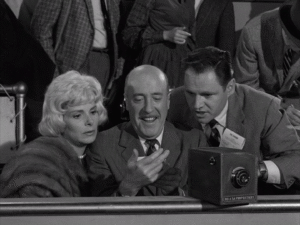
Chester and Paula Dietrich are a couple of swindlers who just got swindled. It turns out the fancy curios shop that they burglarized had nothing but knockoff junk–how do you like the nerve of some people? As if fake ming vases and poorly copied Picassos weren’t enough, they are also the proud owners of a camera that doesn’t even have any place to add more film. But, there is one thing about this camera, an unusual characteristic–it can foresee the future. The pictures that develop from this camera show what will happen five minutes into the future. For example, it said that Paula’s brother Woodrow was going to show up at the hotel door, and even though the Dietrichs thought he was in prison, there he is. Now, what to do with this amazing new gadget? Why, what everyone would do, of course. Give it to humanity and take your place as one of the greatest humanitarians of all time. Or, you can take it to the horsetrack, take pictures of the winning board, and go make a lot of money. I think you know which one won out. But, when a French waiter translates the words on the camera as being 10 per owner, things get a bit testy. As Chester and Woodrow tussle over a miscommunication about a picture of Paula, the two men fall right out of the window–leaving poor, defenseless Paula all alone, with all of the money. A final picture of her two favorite guys on the concrete pavement is all she has left of them. But, when the waiter comes back into the room and persuades Paula to give him the money, she realizes that there are actually three bodies in the picture. And as she runs over to check, a trip and fall reunites her with her favorite two guys. That’s right; the camera never lies. You can clearly see four bodies on the pavement: Chester, Woodward, Paula, and the waiter? Well…se la vie, my French friend.
Episode Details
“A Most Unusual Camera” is directed by John Rich. The teleplay is by Rod Serling. As for our cast, we’ve got Fred Clark as Chester; Jean Carson as Paula; Marcel Hillaire is our French waiter; and okay, special shoutout goes to actor Adam Williams who plays Paula’s brother, Woodward. Why? In all of my years watching the Twilight Zone, I never really noticed that this is the same actor who plays the sailor in “The Hitch-Hiker.” Why? Because the two characters are so different from each other. I have to give Williams credit for creating these two totally different characters. Very nice, Mr. Williams. The episode first aired on December 16th, 1960.
Episode Tidbits
As for our tidbits, Martin Grams Jr. has a really interesting quotation from actress Jean Carson regarding her unique voice. She says, “With my crazy voice I could never be a leading lady, so why should I kill myself trying?” She then adds, however, that Serling had seen her in Mrs. Gibbon’s Boys. When he met her briefly at a party he mentioned that he wanted to cast her as a lead in one of his Twilight Zone episodes, and two years later he made good on that promise and asked her to be one of the leads for this story (348). Look at Rod–keeping his word.I like it.
Question 1: Is there anything genuine about Chester’s speech regarding giving to humanity?
There’s something actually kinda’ interesting about the Dietrechs. They are obviously fairly unlikeable characters, but they have their limits, their lines in the sand. And more than that, they have their hopes and dreams. We have examples of virtually unredeemable characters in the Twilight Zone, Walter Bedeker from “Escape Clause” is the easy one that comes to my mind, but as I was watching “A Most Unusual Camera” the second time through, there was a part of me that started to see something different in these characters, something redeemable, given the right state of mind, and then it hit me: they are constantly concerned about their status, about where they stand on the rungs of society. And for me, that was the key to this question. This episode exposes something that I think we still don’t really balance well today: the difference between society and humanity. Let’s get into our episode and I think it will make more sense.
I want to begin by setting up the Dietrechs’ views on society. When the episode begins, we see Paula reading over the newspaper report about a burglary that took place at a curios shop. This is not to be confused with the curios page on the keyofimagination.com website that I have been talking about for over a year and have yet to finish. I will finish it some day. Anyway, as Paula is reading the report on the burglary that they themselves committed, we are let in on a bit of a funny little joke. The owner of the shop that was burglarized is essentially lying about what was stolen: Picasso paintings, a Louis the 14th candelabra, and an antique serving set. The problem is none of that is really accurate; they’re mostly knock-offs. Now, just as a quick aside. I found a wonderfully fascinating peer-reviewed research experiment by Sharon Leal et al that sought to test the validity of two concepts in relation to this topic of insurance and lying: the first concept was the use of an honesty declaration, as in forcing people to say out loud that they are being honest about their insurance claims; and it also tested the timing of where to put these honesty claims. And here is what they found: “Asking claimants before starting to complete the form to read out a statement that they will be honest, actually made them more honest, a finding also obtained by Shu et al” (773). So, they found more truth could be obtained both in having an honesty statement and by placing the honesty statement toward the beginning of their interviews. It’s interesting because it makes me think about our justice system: we have people affirm that they will swear to tell the truth, the whole truth, and nothing but the truth, so help me God. In the case of our Twilight Zone insurer, they must not asked for an honesty statement up front.
Chester responds to these fakeries by saying, “It’s plain larceny. He’s just padding that list for his insurance. How do you like a crook like that?” Although it’s a joke, there is something interesting about this. It begins to break down the facade that is often connected with high society, the idea that It’s more important to be perceived as high faluten than it is to actually be faluten high. And I should know. Both of my sisters played the falute in school.
What I want to point out here is how disappointed Chester is in being conned by someone else. The Dietrichs have this really odd relationship with high society; they hate it, but they want it to remain static long enough that they can become a part of it. But, they can’t seem to figure out how to access it, how to join it and that’s where the camera comes in.
Just prior to Chester getting his amazing, colossal, stupendous idea to take the camera to the racetrack, he gives this speech about giving the camera over to science to study, for the sake of humanity. This is a fascinating scene for me. He says to Paula and Woodward, “What are we?...We’re three small-time heisters. Well now we finally got something that might do something good for somebody else….We’ve got something here for humanity.” Paula reacts with “What’s humanity ever done for us?” The scene is hammed up a bit by the actor Fred Clark, but that’s on purpose. It adds another dimension to Chester. We have the old saying, fake it ‘til you make it. In some ways, I think that’s going on here. I think Chester actually does want to be a net positive to humanity here, but he is faking that yearning a bit, as if he knows that he should want to give the camera to humanity, but he knows that he has to simply roleplay the part first. I know for a lot of people that makes this moment seem quite insincere; however, I’m not one of those people. I think there is something to the idea that sometimes the acting of sincerity can become genuine once we realize how much good sincerity can do in the world–now, don’t get me wrong. If it never becomes an act of sincerity then that’s a problem. But, at least it gives people a chance to make their way into the process itself. But, Chester doesn’t stay in this mindset long. He sees Woodward watching the horses race and realizes that this camera is actually their best way into society. So, again we see this tugging and pulling between society and humanity.
I want to start drawing this question to a close by mentioning something I don’t particularly like about this episode, how quickly Chester turns on Woodward toward the end. He’s awfully quick to pull out that knife and tussle with him. In a lot of ways, the humanity scene that we just referenced is the reason why I don’t like this sudden tussle scene. If you give Chester something more concrete to hate about Woodward, something that makes a bit more sense for him to fly off the handle so easily, then it can remove some of the memories of how, in a brief moment of time, Chester and Paula–and Woodward, yes…and Woodward, wanted to give something to humanity. It’s actually quite a sad story in that respect. The Dietrichs never quite see that you can meld society and humanity together; instead, it’s as if, for them, the two must always remain separate, which is why it becomes a choice for them instead of simply a way of living.
Question 2: Why is the writing on the camera French?
I want to begin by taking a quick look at the French waiter at the Dietrichs’ hotel.
This character is interesting to me because he serves a couple of purposes here. The most important one being that he is able to translate the French on the camera, which he does so as being “Diez a la proprietor”I took half a semester of French in Jr. High–can you tell? Diez a la proprietor means 10 to an owner.” At first, the waiter seems to represent a kind of line of demarcation for us. He seems refined and elegant compared to the Dietrichs’ rather uncouth American ways. But, of course, the waiter turns out to be no better than the unrefined Americans in the end. He’s also simply a crook; he just happens to have a lovely accent.
Now, as for the language and why French, I’ll be honest: I never really gave it much thought until my second time watching the episode, but when I did start to think about it, I realized that there is a whole cultural history here that connects nicely with the theme of this episode, so let’s take a bit of an interesting historical detour into the history of France, prophecy, and cameras. I definitely learned a couple of things I didn’t know.
Okay, so the first theme that we have here is this concept of being able to see the future, and of course we’re going to begin with the grandaddy of all seers…no not the mystic seer from “Nick of Time,” I mean none other than the mysterious Nostradamus.
Nostradamus started to get his reputation as a man who could see into the future because of his 1555 publication of 353 quatrains, or four lines of rhyming poetry. These quatrains were grouped by the 100s and each 100 was referred to as a century, which is why he called the body of work Centuries. Something I didn’t know about Nostradamus was that, prior to becoming this man of prophecy, he was actually a healer practicing medicine. Now, Nostradamus benefited from something that not many prophets do, that being achieving a bit of notoriety in his own time, which led him to receive an invitation to the court of Catherine de’ Medici of France (link). Today, people still read his prophecies and find interesting connections between his words and the rise of figures like Napoleon and the beginning of the French Revolution. In one of his more famous predictions, he writes:
Courts of long and rackets bent.
Legs that find no rest be sent.
To shorter fields where we may find
Balls of pickles but not in brine.
He totally saw the rise of Pickleball. Okay, that one might have been me. However, people still do enjoy reading and interpreting Nostradamus’ predictions, but he’s only part of the story.
There’s actually quite an interesting history regarding France and female mysticism/prophecy. I’ll only mention one here for us: Catherine of Theot. She gained notoriety in the late 18th century because of a combination of her declaring herself to be the new “Mother of God” and because of the political cache she was building through her followers during the French Revolution and her support for Robspierre. However, her favor only garnered Robspierre contempt, and according to many, this connection was apparently not reciprocated by him, and was one factor that led to Robspierre’s downfall and eventual execution. I read a fascinating peer-reviewed article by Ramon Salons on Theot that I will link in the episode transcript notes. I want to just highlight one line from the article because I find it to be incredibly pithy and will help us connect back to our episode. The author writes, “Théot's success reveals the need for comfort felt by a population that had seen its sacred reference points disappear” (link). I like this line because it speaks to something that I used to lecture on in class, this idea that the destruction of cultural reference points within a body of people often leads to not feelings of freedom but feelings of isolation and loss of purpose. Thus, a prophet who can offer anchor points within history can provide a sense of purposeful movement toward a perceived meaningful goal that will attract many. And that is where we connect back with our episode.
Think about it for a second. Normally, when it comes to these kinds of pop cultural storylines, we have a bit of leeway to question whether or not the device, in this case the camera, is actually seeing the future or if the people are manifesting that future through their actions and choices. In other words, Paula hears about there being more than two bodies on the pavement at the end and she runs over to the window to confirm it. Did her hearing about this move her toward the window, or was she always going to go there? Now, in this instance it seems as if the camera is seeing the future because of the racetrack scene. Taking a picture of the winners on the board doesn’t seem likely to manifest the horse racing more quickly. But, there is still something at play here that is fair for us to discuss.
Just a few moments ago I mentioned that one of the reasons people are fascinated by prophecy and mysticism is because it can provide some people with a sense of purposeful movement toward an anchor point in time. However, think about the picture of Paula that leads to Chester and Woodward’s demise. There’s really not much to it. Paula looks surprised, dare I say upset. But, so what? That doesn’t mean anything bad happened. And yet, they both interpret it at its worst because that seems to be where they are most comfortable in life. I think this speaks to the way some people are. They walk into every situation not prepared for the worst but expecting the worst, and so happiness and joy is actually the thing that makes them feel the most uncomfortable. All the Dietrichs and Woodward had to do was nothing. Leave the camera alone or give it away to humanity. And that leads me to one final thought. I wonder if the camera does not have an omniscient sense of the future but only a determined one. In other words, had they handled the situation of the Paula picture differently, would it have changed the final two pictures of everyone on the pavement? I think there’s room for us to potentially wonder about that.
Now, the last thing I want to discuss here is that, in addition to the connection between mysticism and prophecy within France, there is also an interesting history regarding cameras. In fact, in 1826, Joseph Nicéphore Niépce–there’s that semester of French being put to good use–is credited with producing the first fixed photograph. For those of you who are only listening to the show through audio, it’s a picture of Chuck Norris kicking a Pokemon through a TJ Max Window. Okay, it’s not that. It’s a view from the window at Le Gras (link). Although, and I’m not joking here, the first time I saw this 1826 picture I thought it was a frustrated man on a balcony. Am I the only one who sees the frustrated guy? Do you see it? Dead serious–comment on the video if you see the man. I don’t want to give away where I think he is.
So, are these the reasons why they use the French language on the camera for this episode? Probably not. But, I think there is a fascinating history there that might have played a role in the background for some of the reasons we mentioned here. If nothing else, I hope I’ve provided some interesting information for us to continue to think about and maybe even a few chuckles for the rest of your day.
Question 3: What are your moments of awe?
My moment of awe connects a bit with something we’ve already discussed, Chester’s speech about giving to humanity. I think I’ve always heard his monologue in almost a tongue-in-cheek fashion, like it’s a bit of a joke. But, for whatever reason, this time, it hit me differently. I thought about if there were someone or some thing in his life that could have fulfilled that feeling within him of giving something to humanity, would he have never gone down this pathway to crime. Then I thought about if Paula or Woodward were a bit stronger, they could have really pushed that Chester was on to something. It made me think about the potential opportunities I might have missed with people that could have been the one thing that they needed to hear from someone to help them realize that there is such a thing as the common good of mankind, and that there is something wonderful about helping to build it. I know perfectly well that none of us are perfect, and we often do our best. But, it just made me a little sad for them, maybe even pity them and their inability to see the potential that they had right in front of them. [sigh]...as the great philosopher troubadour Doris Day used to say, Que Sera, sera. Keep doing your best out there to help others see the value in humanity, and I’ll try to do the same.
My Rating
As for my rating, I don’t particularly love this one, but it does meet the goals that it sets out for itself in terms plot. And that always gets an episode at the very least in the middle tier for me. I do like the hammy acting of the main players, which just bumps it up for me into Middle Middle-tier. I can certainly give it a watch during a marathon run, but if I’m feeling a bit snacky, I could also leave during the episode to get some chips or a drink, so it goes no higher for me than Middle Middle-tier.
Next Episode
Next time, we’ll be taking a look at “The Night of the Meek” and here are your questions to consider when watching the episode:
Question 1: Does this episode actually provide us with a way of reconciling the relationship between consumerism and gift-giving?
Question 2: What is this episode trying to say about the relationship between substance
abuse and the larger culture of humanity?
Question 3: What are your moments of awe?
Announcements and Shout-outs
I’ve got a quick announcement before I get into a couple of comments. I need to have a relatively light procedure on my left eye this week, so it’s going to be a little difficult to get the usual episode out on time. That being said, I have some big news about the show coming your way. That whole doing good thing I’m always talking about…well, let’s just say, I’m about to put my money where my mouth is. Be on the lookout for a video about this very soon.
I’ve got a comment to highlight from the Spotify platform. On the “Judgement Night” episode, Chuckilishus D writes, “I Can’t tell you how much I love this podcast. I love how in depth you go and how you bring the audience into the show. This is truly fantastic and I’m so glad this podcast exists” Chuckillishus D, thank you so much. That’s incredibly kind of you. And yes, I do like to have some fun bringing all of you along with me. I tend to really think of this as a quest that we’re all on together.
On my “Nervous Man in a Four Dollar Room” episode on YouTube, @juanguerrero1468 commented: "Love this podcast. I feel like I'm back in college. Keep it 💯" What a great comment, and much appreciated. Something I try–and I don’t always succeed at doing–with my college students is to show them how inquiry is fun. It doesn’t always have to be about finding the answer; it can be about thinking and exploring. And that’s what I try to do here.
How to Support the Show
If you enjoyed the show and want to support our journey through the Twilight Zone, consider subscribing, liking, and sharing the show with a friend. And if you would like to share your thoughts on the Twilight Zone or the KOI episode, leave a comment. I just might highlight it and give you a shoutout in a future episode. If you don’t want me to use your comment, make sure you indicate that. You can also head over to thekeyofimagination.com to learn more about me, my work, and various academic projects that I might be working on in relation to the Twilight Zone and Rod Serling. That being said, even if you hated every minute of this, I’m still going to thank you for spending some time with me. Until next time, remember, all doors are open to those who possess the key of imagination.
Works Cited
Leal, Sharon et al. “Please be Honest and Provide Evidence: Deterrents of Deception in an
Online Insurance Fraud Context.” Applied cognitive psychology vol. 30,5 (2016): 768-774.
doi:10.1002/acp.3252
Ramón Solans, Francisco Javier. “Being Immortal in Paris: Violence and Prophecy during the
French Revolution.” Annales (English ed.) 71.2 (2016): 217–245. Web.