
The Twilight Zone Season 1: Episode 28
"A Nice Place to Visit" Episode Transcript
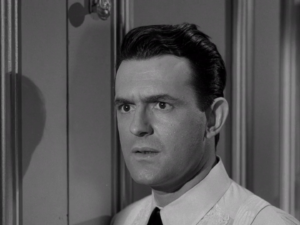
Introduction
Welcome to the Key of Imagination. This week we’re going to be looking at the Twilight Zone episode, “A Nice Place to Visit.” We’ll talk about the role that drives play in creating Rocky’s particular version of hell; we’ll discuss the need for the unideal; and I’ll reveal to you my moment of awe. So grab your keys, and let’s open up this door to the fifth dimension.
Plot exposition
Rocky Valentine is about to finally get what he deserves. With a fistful of freshly burgled jewels and a smile as wide as the Rio Grande, nothing can dampen the exhilarating sensation he is getting from taking what was once someone else’s and making it his own. Well, I suppose the ever-growing sound of a police siren does pose problems. Rocky makes a run for it. But, he can’t escape either the police nor the bullet that is waiting for him at the end. He wakes up to find a rather dapper gentleman named Pip, a man whose only job is to make sure that Mr. Valentine gets anything and everything he wants. It’s as if Rocky has died and gone to…well, let’s just say for a man with a hole in his head, he’s doing better than most. Money, women, and respect–he can’t lose! And that’s the problem. He can’t seem to lose at anything in his new home. And it’s driving him crazy. When Rocky tries to explain to his ethereal guide, Mr. Pip, that maybe he just isn’t cut out for such a boring place as heaven, that maybe he would be a lot happier if he were in the other place, Pip informs our criminal friend, that he’s in the other place.
Episode Details
“A Nice Place to Visit” is directed by John Brahm. The teleplay is by Charles Beaumont. As for our cast, we’ve got Larry Blydon as our man Rocky Valentine; Sebastian Cabot plays Mr. Pip, and by the way, he gives my second favorite end-screen laugh in the series, only behind Elen Willard as Ione Sykes from “The Grave.” It’s a great laugh. The episode first aired on April 15, 1960.
Episode Tidbits
I’ve got a pretty funny tidbit courtesy of Grams Jr.’s Unlocking the Door. Apparently, Mickey Rooney was originally considered for the Rocky Valentine role. I think Larry Blyden does a great job here, especially with his almost Daffy Duck type of energy, so I’m glad he got the role. However, there was one other person whose name was being bantered about. In a letter from Charles Beaumont to Rod Serling, the teleplay script author writes, “I’ve had an absolutely screwball idea. Your first reaction will be one of dumb astonishment, followed by rapid blinking and fantods. If for any reason we can’t get Mickey Rooney for ‘The Other Place,’ [which was the original title of the script], why don’t you essay the role of Rocky yourself?” (279). I love Charles Beaumont, and I have to admit that it would be fun to think about this scenario, but I don’t think Serling would be great for this particular role. Mostly, because I see Serling as a character within the structure of the series, both a part of the Twilight Zone universe and outside of it at the same time. Still, I give Beaumont a lot of credit; if you’re going to swing away, give it all you got.
My initial Thoughts
As for my initial thoughts, this is a classic episode, one that is often spoofed by shows like Futurama, etc. I tried to see if I could recall my first time watching it when I was a kid, but I can’t get there. I’m sure I was probably taken in by the twist ending like everyone else. In terms of the acting, I will say this. I mentioned that Larry Blyden has a kind of Daffy Duck energy–for those of you who are younger, I mean the old Loony Tunes Daffy Duck–the one who was basically all energy and no drive for success. At first, I thought Blyden could have given the character a bit more depth, but that would take away from the point. He’s a shallow, self-centered man who is completely led by his drives and wants, so it makes sense that he would be played with surface-level reactions. I like Cabot’s simultaneous engagement and distance as Mr. Pip. He has a really great presence in his scenes and I almost think he could have stolen the show if he wanted to. I do have one piece of petty criticism that I’ll talk about in my rating section. But, my reaction to seeing this episode again is quite positive.
Question 1: How are Rocky’s drives connected with his particular version of hell?
Throughout the episode Rocky continually yearns for things, for the acquisition of both items and power. The word that came to my mind was that he is driven. That immediately made me think of our friend Frederich Nietzsche. And then I remembered trying to read Nietzsche’s thoughts on drives, and I realized…this question is going to get interesting.
You see, Nietzsche does not really interpret drives in the usual ways that we do, nor are scholars of the German philosopher unified in what Nietzsche even means by drives. So, where does that leave us? Well, not quite on our own.
Now, I will say that I do find Paul Katsafanas’ book, The Nietzschean Self, to express its ideas in a really cogent way that can help us better understand Rocky. In the book, Katsafanas writes:
Many commentators assume that Nietzsche has the same understanding of drives, and consequently treat drives either as simple urges and cravings or as physiological states.
But these interpretations cannot be correct. Nietzsche does not identify drives with physiological states or mere causal forces. On the contrary, he explicitly contrasts his drive psychology with certain crudely “materialistic” explanations of human behavior (BGE 12).2 Moreover, he tells us that drives “adopt perspectives,” “interpret the world,” and “evaluate.”3 Clearly, physiological states and urges do not do that. (78)
So, when we’re thinking about drives and Nietzsche, we’re not talking about primordial urges, like hunger or thirst. We’re almost thinking of them as agents with distinct dispositions that seek to manifest their wills into the world. Well that should clarify everything. Goodnight, ladies and gentlemen. Let’s bring in our main man Rocky to help us break this down a bit more. Rocky is actually a fairly interesting character. In some ways, he’s no different than your average burglar. He wants things; he wants nice things. But, the question that I had as I was watching the episode the second time was “does he really care about the things themselves?” I don’t think so. I think Rocky likes the drive itself, the act of acquiring, and more than that, he likes the power dynamic that is created by his drive. Let’s bring in some examples from the show.
At one point, in the episode, Rocky says to Pip, “being a big guy with a chick, it don’t mean nothing if it’s set up in advance.” I’m particularly happy with this episode because I get to try on my mother’s authentic Brooklyn accent. Then, when Rocky is talking to Pip about doing another burglary somewhere, he doesn’t really care what it’s for: money, jewelry, ect. He just wants the action; he wants to remove the power from one place and subsume it into himself, and Nietzsche, I think, would say that this is Rocky’s will to power, the drive manifesting itself into reality. Something that I think Nietzsche is a bit cloudy on is the level of awareness of our drives. Does Rocky really know what he’s doing? But, let me clarify that a bit, because I’m sure many of you out there are saying, Joe, you’re driving me crazy with this. Fair enough. The point of contention when it comes to awareness is not so much whether or not Rocky is consciously aware of his choice to rob a bank or start a youth gang. It has more to do with whether or not he, or any of us, are truly aware of the motivation behind the drive. If we do not or cannot truly grasp the motivation itself behind the drive it becomes quite difficult for us to ever really create meaningful changes to that drive, which I think is part of Nietzsche’s point about why drives are so important–they act upon us, dictating to a large degree, choices and actions. And that makes them powerful.
Let’s pull all of this together and start making our descent toward answering our question. If Rocky’s drives are Nietzschean in the sense that they are almost agents that are seeking out ways in which they can manifest themselves in the world, then the whole beginning half of the episode is truly a kind of heaven. Every single one of his drives are able to lead him and make themselves real in the world through actions and decisions that move toward satiating that particular drive. However, once Rocky becomes consciously aware of the fact that his drives are actually NOT being met, once he finally starts to see that the drives are not, in reality, manifesting in this world of their own free will, but rather they are being led by pre-written scripts, Rocky can no longer find any way to let his drives become fulfilled, and since he lacks any sense of self-reflection, any sense of remorse, any sense that there is such a thing outside of the satiation of one’s drives, that’s when he finally realizes that this is truly hell. It’s not a hell in the traditional sense of experiencing evil or harm; it’s the complete inability to allow one’s unbridled drives to act as self-fulfilling agents. And that is one of the reasons why this is a particularly perfect personal hell for one Rocky Valentine.
Question 2: What is this episode saying about the need for the unideal?
In my Writing & Critical Inquiry course, I teach my students that critical analysis is about juggling two lists: the ideal and the sample. The ideal is the perfect version of a text; it’s the criteria that we use for judging a sample text’s proximity to success. So, say for example, you wanted to critically analyze this KOI episode. You would first have to establish the intentions of the text, the audience, and then build criteria for what a perfect version of this episode, or any KOI episode for that matter, should have or should demonstrate. Then, you make observations about this particular sample episode and put those up against the ideal to establish this sample episode's proximity to success. Now, I begin my critical analysis unit by asking my students two questions: 1. Are you a good person; and 2; how do you know? By the end of that conversation, we establish how ideals can actually help us measure our goals, our dreams, and even whether or not we should like who we are at our current juncture of life. So, ideals are important. But, this Twilight Zone episode exposes something else; it somewhat exposes the necessity for the unideal. You’re going to have to give me a lot of grace on this one; we have to talk about something that requires a very nuanced tongue, so please, enter this conversation in good faith with me.
In the first question, we talked about the importance of acquisition, and we mentioned that one of the things that Rocky wants to acquire are pretty women, but there’s actually a lot to be said on this particular topic of how women are used in this episode. To say that they are commodified is an understatement. They aren’t even real; they’re actual commodities in the sense that they are used and then gone. In fact, and I’ll be curious to see if anyone else caught this, just before Rocky goes with Pip to the hall of records, Valentine goes back into the bedroom where the women are and he tells them he’s going to leave, and then he stops, and he gives this look in the room as if they aren’t even there anymore, and then he just kind of shakes it off, like, that’s odd, but whatever. Now, in my opinion there are two ways to read this scene, and I would love to hear from others out there to see how you read it: first, they’re either in the room still, or they are not. I personally think they are gone. However, if they are there, it’s also just as interesting because it means the look Rocky has is sort’ve why am I even telling them this; they aren’t real. I think either reading is possible, but I like the absent one because it’s a rather smart move by Pip. He’s showing Rocky that these are not really women; they’re simply avatars of women–ethereal models, not even as real as Alicia from “The Lonely,” which means they carry no real sense of meaning with them. But, are they the ideal? Well, yes…and no.
When Rocky first gets to his new living arrangement, there are two paintings on the wall, two women. And when he starts to make his wish to Pip for some company of the female persuasion, he specifically points to these women on the wall and says he wants a woman to be “stacked, like beautiful.” These are the ideals from which the sample text, our lovely actress who comes in the room, will be judged. What’s interesting about this is that, rather than allow Rocky to develop his own sense of the ideal woman, Pip places these pictures on the wall for him, thus removing any kind of active participation in the creation of his ideal woman. Now, why am I talking about this, and why is it important?
People today talk constantly about the problems of creating unrealistic expectations of beauty, especially for young women–but not exclusively just women, through social media. And this is true. We have plenty of research that supports this. However, this has always been the case; this idea of the ideal sense of beauty, or strength, or wealth or whatever you want to choose, has always been with us, and it always will be. I used to do a lesson back in the day about this, where I would show a renaissance painting of the ideal courtly love–blonde hair, pale skin, blue eyes, and courtly men all with their eyes glued on her, devouring her beauty. And then, we would read Shakespeare’s famous sonnet, number 130. I’m going to read it, and as I read it, I want you to try and figure out what good old Billy Shakespeare is actually doing here. See if you can get his point.
My mistress' eyes are nothing like the sun;
Coral is far more red than her lips' red;
If snow be white, why then her breasts are dun;
If hairs be wires, black wires grow on her head.
I have seen roses damasked, red and white,
But no such roses see I in her cheeks;
And in some perfumes is there more delight
Than in the breath that from my mistress reeks.
I love to hear her speak, yet well I know
That music hath a far more pleasing sound;
I grant I never saw a goddess go;
My mistress, when she walks, treads on the ground.
And yet, by heaven, I think my love as rare
As any she belied with false compare. (link)
You see, what Shakespeare’s sonnet exposes is that the ideal of beauty is not in the comparison of aesthetical characteristics: noses, eyes, skin color, hair, none of that. It’s in the uniqueness of the bond between two people–the love, the devotion, the willingness to get up in the morning and fight for that person next to you through the good times and especially the bad ones. Rocky, at one point, says, “I never thought I’d get bored with beautiful dames.” But, he does, and that’s because of how he sees the ideal of a woman as nothing more than a straight critical analysis of her aesthetical features against his ideal criteria. But, and here’s something for you younguns out there. We’re told all the time about finding a romantic partner for which you share interests. Look, that’s fine, but it’s not necessary. If you ask happily married people or people in long-lasting relationships, they’re going to tell you that they have different interests. In truth, one of the best things about a good relationship is how the other person pushes you to be the best version of yourself, and not just for them, but for the world. That means your partner has to be willing to tell you when you’re wrong, but also to remind you that there is at least one person in this world who loves you, and that feeling can often sustain us through the most difficult times of our lives. My wife definitely does that for me, and I’m better for it.
Okay, okay Joe, ideally you would get to the point now. Let’s answer our question. What is this episode trying to say about the unideal? In an ideal world, we would do everything right; make all of the right decisions; marry the perfect person who does nothing but what we want; when we want to do it, right? After all, we create our own ideal version of a mate, right? Wrong. There are so many aspects of ourselves that we don’t really know; we only think we know. If all we ever got were what we believe were our ideals, we would end up in, well, this other place. And because Rocky’s ideals are largely, if not completely, tied to aesthetics and nothing more, the more he is exposed to his ideal, the less it becomes an ideal. Because an ideal must also be somewhat unique. That’s why great relationships are built on the ideals of meaningful connections, personality, shared beliefs–that’s the unique part; that’s the ideal. The surface-level aesthetics will always adjust based upon time and exposure. What Rocky is a bit too dense to understand is that, he doesn’t really want the ideal; what he wants is an unideal situation, from which he can find or create meaningful engagements with the human condition. In short, what he, and we, need to understand is that it is often when we are in an unideal situation that we finally see what we ideally should want.
Question 3: What are your moments of awe?
For my moment of awe, I realized something that I thought was, at first, pretty cool, and then became somewhat terrifying. As I watched the first betting scene, where Rocky is bathing in jubilation over his winnings, and you’ve got all these people gathered around him who are hollering in joy, I realized, oh my God, this is one potential future for us as a species. These people are NPCs, non-player characters, like in video games. Rocky is us; he gets to set the rule; he gets to dictate how much he wins; Pip even offers to pretend like he loses. THIS is our potential future, should we decide to move everything to a simulated existence, where we simply live in virtual spaces, and only interact with NPCs and maybe the occasional other player–and even that might dwindle away, as the only real thing of value that we will have left is our ability to control narrative, to construct reality, and if you want a tree slightly to the left of where I want it, you need to get the heck out of my reality and leave me alone. And then I thought a little further and realized, some people are already here, only living in spaces where they hear what they want to hear, do what they want to do, be what they want to be, avoiding displeasure at all costs, running from discomfort. And it makes me realize the role that struggle plays in life. No, we don’t want people to struggle to the point that they have to steal for food, or beg for a roof over their heads, but we also need to understand that struggles and the need to compromise for the greater good of us as a people are important for building resiliency and stability, and the more we build resilience and stability, the more we can help others find their own. If you find yourself in an unstable situation, constantly wondering why everything and everyone is against you, try and find one thing, one trait or circumstance in your life that you can stabilize, and do it. Don’t start with the most difficult thing to control; start with something you do have control over, something easy. But, whatever you choose, own it. Make it the most stable thing in your life. Then, after you’ve codified that, move on to the next thing, but again, take steps. The last thing I’ll say about this is do not become obsessed with order. Accept the fact that life will change; circumstances will change. Build the unknown into your order. I think by the end, you’ll find yourself in a much more peaceful existence.
My Rating
As for my rating, this episode has only grown more important in these digital days, when we are all a little Rocky Valentine, with access to whatever we want when we want it through the digital age. If I had one nitpicky issue, and I admit that this probably has more to do with the time crunch of an episode, I would have liked to have seen a little more engagement with the problem leading up to the reveal. In other words, it would have been interesting to me to see a little more of a gradual rise to frustration from Rocky instead of just a kind of sudden wipe to him being bored. Now, that being said. This episode still makes it in the top tier for me, but it stays in the Top Lower-tier. Still, a fantastic episode that could spark a Twilight Zone run.
Next Episode
Next time, we’ll be taking a look at “Nightmare as a Child,” and here are your questions to consider when watching the episode:
Question 1: Why does Markie appear as a child?
Question 2: Why does Markie sing Twinkle Twinkle Little star?
Question 3: What are your moments of awe?
Closing
Well, that was an interesting episode to write about. This whole topic of feeling like its best to always get what you want is actually a good one to revisit now and then as an important reminder that there is value in losing, in the recognition that others are on this spinning sphere of a planet that we call earth, and that maybe in our loss comes a necessary victory for someone else.
Announcements and Shout-outs
As always, I have some shout-outs and comments from the YouTube channel.
First things first, a happy one year anniversary to us and the show. I started The Key of Imagination on October 31st, 2023, so we’ve been at it for a solid year. We’ve got a lot more work ahead of us–plenty of episodes left, but, as I mentioned in my “Walking Distance” episode, it’s important to take a moment and celebrate milestones and small victories. Thank you to all of you for coming along with me on this journey.
On my “Monsters are Due on Maple Street” episode, Feralbluee comments, [at the ] 4:00 so agree. And you are so fascinating to listen to, giving me something mull over and actually think about - unusual. It’s also so wonderful seeing…the actors and actresses I knew as a kid - especially Claude Akins who was one of my favorite actors :)🎭💙🌷🌱” First, thank you for taking the time to leave a kind word. The part that feralbluee is referring to at the 4 minute mark is where I talk about how young adults need to play with language to grow, but we also have to stabilize that world for them as adults. As for Claude Akins, I love his acting–and of course not just in the Twilight Zone. But that is also one of the reasons why the show continues to flourish into the future: there are quite a few really brilliant actors who put in phenomenal performances: Burgess Meredith, Jack Klugman, and legends like Gladys Cooper. Thanks for the comment.
How to Support the Show
You can continue our conversations by heading over to our Discord server and either starting a conversation about this episode or taking part in one that is already happening. The link to join the server should be in the episode notes section. You can also head over to thekeyofimagination.com, where you can rate this episode, learn more about me, watch previous episodes of the show, and check out my curios page where I showcase some of the Twilight Zone trinkets I’ve bought over the years. I encourage people to email me thoughts and comments, whether it’s about a particular Twilight Zone episode, your rating for an episode, or about the Key of Imagination Show. You can get those to me as a text email, an audio clip, or even a video clip of roughly no more than 5 minutes to keyofimaginationshow@gmail.com. Keep in mind, even though we talk about some serious topics, we’re trying to maintain as family-friendly of an atmosphere as we can. If you would rather I not use your comments on the show, please indicate that so I can respect your decision.
If you enjoyed the show, I ask that you please take a moment and do one of the following to help build our community. Rate the show, review the podcast, leave comments, thumbs up, all of the usual algorithmic gymnastics. That will help get the show in front of more people and help us build our community of Twilight Zone fans. However, even if you do none of that and absolutely hated every minute of this, I would still like to thank you for spending some time with me. Until next time, remember, all doors are open to those who possess the key of imagination.
Works Cited
Katsafanas, Paul. The Nietzschean Self : Moral Psychology, Agency, and the Unconscious. First
edition. Oxford: Oxford University Press, 2016. Print.