
The Twilight Zone Season 1: Episode 36
"A World of His Own" Episode Transcript
Introduction
Welcome to the Key of Imagination. This week we’re going to be looking at the Twilight Zone episode “A World of His Own.” We’ll take a closer look at Mary’s motivations; We’ll question whether or not Greg is a kind of god; and I’ll reveal my moment of awe, which has to with the future of AI spouses on demand. So, grab your keys, and let’s open up this door to the fifth dimension.
Plot exposition
Homer, Shakespeare, Milton, and Greg–what do these men have in common? They are all creators–men who when they form a phrase on the page, or in a dictaphone, can make their characters seemingly come alive. Well, in the case of Gregory, his characters actually do come alive. All he has to do is give them a name, some character traits, and hit the record button and out pops whatever he describes. But, when his wife, Victoria, comes home early from a movie and finds a blonde woman in the arms of her husband, she is understandably upset. Greg attempts to explain that the woman she saw, Mary, was simply one of his creations, and that once he throws the recorded tape of his creations into the fire, they no longer exist. But, Victoria isn’t buying it. She has had enough. She wants out of the room, out of the house, and out of their marriage. Gregory, however, grabs an envelope from his safe, with the name Victoria on it. He warns his wife that, he uncreated Mary and he can uncreate her as well. Calling his bluff, Victoria grabs the envelope and tosses it in the fire, only to quickly realize that Gregory was not bluffing, and she disappears. Greg runs over to his tape recorder to remake Victoria, but then pauses, and realizes that this moment presents an opportunity: and he says, “her name is Mary.”
Episode Details
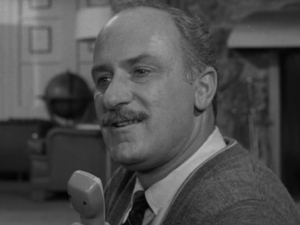
“A world of his Own” is directed by Ralph Nelson. The teleplay is by Richard Matheson. As for our cast, we have three players here who all do the heavy lifting: Gregory West is played by Keenan Wynn. Now if that name sounds a little familiar, it should. This is the son of Ed Wynn, as in Lou Bookman, the salesman from “One for the Angels.” So, we’ve got a father and son duo in The Twilight Zone. Victoria West is played by Phyllis Kirk, and Mary is played by Mary La Roche. The episode first aired on July 1st, 1960.
Episode Tidbits
As for our tidbits, I’m going to go to Marc Scott Zicree’s Twilight Zone Companion for what is an interesting what-if quotation. Matheson, the teleplay writer for the episode, notes, “Actually, the first outline I submitted was a serious one in which it became very nightmarish to him when his characters came to life. I guess it was a little melodramatic for them, so they suggested that I try to lighten it up, and I redid it as a comedy, which I think worked out well” (129). Oh, Matheson, Matheson, Matheson…I wish you had listened to your original gut. This premise, to me, doesn’t land all that well as a comedy, and it’s not just because there aren’t really any funny marks in it–something we’ve talked about before in the “Mr. Bevis” episode. But…well, okay, since I’m about to critique this episode a bit, we might as well go right into my initial thoughts.
My initial Thoughts
My initial thoughts after rewatching this episode were actually quite negative. It’s not that it is a particularly poorly done episode from the production standpoint. The actors themselves, as in their experience and professional credits, are great; the scene itself being largely contained in just that one room is also great. I actually love single-scene shows or movies. But, there’s a bit of a disconnect for me between the genre that it aspires to be, in this case a comedy, and what is actually showing up on the screen, which is not a comedy, not even really in the ancient Greek sense, as we’ve discussed before. The best way I can describe it is like listening to a drummer who is playing a song in the wrong time signature–nothing is hitting correctly, and you never get that sensation of feeling like you’re in rhythm with what is happening in front of you. I honestly just find the Gregory character to be really difficult to like: the way he talks, the things he says, and then there’s Mary…sweet, sweet, charming…well, let’s just go ahead and get right into that first question.
Question 1: Should we be focusing more on Mary in this episode?
How art thou fallen from heaven, O Lucifer, son of the morning! how art thou cut down to the ground, which didst weaken the nations! / For thou hast said in thine heart, I will ascend into heaven, I will exalt my throne above the stars of God: I will sit also upon the mount of the congregation, in the sides of the north: I will ascend above the heights of the clouds; I will be like the most High. (Isaiah 14:12-14). I begin with these passages from the Old Testament because it highlights something in this episode that hit me early and then started pounding my brain as I watched the episode the second time through. At the very beginning of the episode, we have this scene between Mary and Gregory. She fixes him a drink just the way he likes it; and then sits with him lovingly. And when the camera pans a little bit toward the window in the room, we see Victoria, the spouse of Gregory, looking on in disgust at the sight of her husband in the arms of another woman. Lucifer, Mary, and Victoria–what is the word that binds all three together? Jealousy. But, one of these things is not like the other–and it ain’t the prince of darkness.
This might seem like an odd question, but I’m going to try and make the case that there’s something about Mary. I’ve seen this episode a few times over the years, but I don’t think I’ve seen it on any recent marathons, and I don’t go out of my way to watch it on demand. So, when I saw it this time, it was an odd experience. What I immediately recognized was actually Mary’s role in all of this. Let’s go back to the very beginning of the episode, when Victoria is knocking on the study door, asking for Gregory to open up. As Gregory prepares to cut Mary out of existence, she pleads with him, “Greg, not again.” She clearly wants to be Greg’s full-time spouse. She wants to own him all to herself. But, there’s more here if you look deeper. Her protest of “not again” indicates that she knows full well what she is and what is going on. Greg brings her into life when he wants and then conveniently sends her back when he’s done with her. There’s definitely a kind of psychological battle going on here, so let’s bring in a specialist to help us better understand what’s going on.
Melanie Klein is a name we have not mentioned before on the show, a psychoanalyst specializing in object relationships, especially involving children, but not limited to them. In one of her most famous works, Envy and Gratitude, she states the following: “My psycho-analytic experience has shown me that envy of creativeness is a fundamental element in the disturbance of the creative process. To spoil and destroy the initial source of goodness soon leads to destroying and attacking the babies that the mother contains and results in the good object being turned into a hostile, critical, and envious one” (202). We’ll put the attacking babies aside for a moment. [Now that’s a line I didn’t think I would say out loud. Put the attacking babies aside. Are we having fun or what?]
Embedded within Klein’s reading of envy is the disturbance of creativity. What is Mary ultimately trying to achieve? Yes, if we’re giving her our most kind reading, the answer is the love of Greg. Look, let’s be honest here for a moment: the Twilight Zone is not short on terrible spouses, both male and female. But, ask yourself an important question: is Victoria a bad spouse? Is anything that she has done, or even anything that Greg says about her an indication that she is a miserable woman? In fact, Greg gives us his reason for why he’s cheating on her with Mary. He says, “The only reason I did it the first time is that I was lonely. Oh, don’t you see Victoria, you’re so perfect; you’re so impeccable. You’re so flawless, and I’ve just felt inferior.” There’s nothing in that rationale that indicates any of this is Victoria’s fault. In fact, if we go ahead and take into consideration that Gregory made Victoria, whose fault is it really? It’s his. Yes, Victoria is jealous, but guess what, so is Mary. Listen to her language.
When Mary comes back the second time in order for Greg to show Victoria what’s going on, she says, “Is that why you brought me here–just to show her?” “Why do you do this to me, Greg? I just got here, Greg.” “Don’t bring me back again, Greg. Just…don’t. I can’t bear it any longer.” This last line is a direct attack on Greg’s creativity; it’s exactly what Melanie Klein is talking about. She wants to be Greg’s final and greatest creation, and if she can’t be, then she simply doesn’t want to exist. This is drama at its height. Mary is doing something actually quite intelligent. In creating this ultimatum she is not simply forcing Gregory to make a choice on her grounds, she is also exerting control over his ability to create. Now, there is some question as to whether or not Mary knows the big secret: that Victoria is herself a creation of Greg’s. I think she does, and I’ll lay out why I think so in a moment. But, we cannot ignore this power move by Mary. In some ways, she is smart enough to understand that I don’t need to be the creator if I can control the creator, can conquer the creator’s sense of agency. In short, corrupt the creator and you will also damage all further creations, rendering them always beneath you in the social hierarchy.
This brings us back to my opening quotation from the book of Isaiah and depictions of Lucifer/Satan as a jealous figure, almost hateful of the fact that he is a created being and not the creator himself. In the biblical sense, Satan is a corruptor, not a creator, and with each being he corrupts he is able to move up the false hierarchy that he creates in his mind. Now, I mentioned earlier that I think Mary knows the big secret about Victoria. Why? There is a specific line in Mary’s creation that is both romantically beautiful and yet horrifically mishandled. Gregory says of Mary, she’s “ a simple, unassuming female, but with that quality of inner loveliness that brings real beauty to a woman, a tender, gentle woman, an understanding woman.” These are all wonderful things to say about someone, but how is Mary understanding at all to Victoria? She isn’t; how is she tender to the the feelings of Victoria? She isn’t. (And don’t worry, we’ll get to Gregory in question 2.) Mary is actually quite cold to Victoria, which means, I think, that she knows that Victoria is one of Gregory’s creations, and so she doesn’t care, which means she also probably has a disturbing sense of her own worth as one of Greg’s created beings. So, if you want to give Mary a bit of a break here, we can say that Gregory has only really left her with the option of control. It’s either control Gregory’s creative impulses or disappear forever. In that sense, we can certainly understand a bit of the underlying motivations here.
I know I sound a bit crazy on this one, but actually, I promise you, if you go back into this episode and you take a look at Mary’s body language, the way she speaks to Gregory, and the effect that she has on him, there’s something going on there. And it’s quite odd. It might be as simple as the acting in this episode, which, to me, is somewhat out of sorts, and I say that with some reluctance because all three of these players are quite seasoned. I’ll talk a little more about this in my rating, but suffice it to say, we can make a really generous reading of Mary here and say that it’s probably supposed to read like a woman in love, but, I challenge all of you out there to rewatch this episode with an eye on Mary and tell me that you don’t get at least some sense of what I’m trying to get across here.
Question 2: Is Gregory a kind of Twilight Zone god?
On the surface, this question will probably get really quick reactions from some of you out there: no, he’s just a guy in typical Twilight Zone circumstances. Yes, he has the ability to create life. There is, of course, a middle ground as well that we’ll get to a little later. So, why is this question interesting to me? Here’s what we know: we’ve already seen supernatural beings in the Twilight Zone: Death, Satan, guardian angels, magic, Hell or “the other place” as it’s called in “A Nice Place to Visit” and even that in-between kind of a purgatory space from “A Passage for Trumpet” so there is some basis for us to really think about this topic and consider how it might make us conceptualize this Twilight Zone space a little differently.
Right off the bat, we can see that Gregory has arguably the number one god-like ability: the ability to create life. Okay, okay, yes, we humans can make life as well. But, what I mean is in the old sense of creation as in making life out of either nothing or organic material that we would not make humans out of today: in this case, audio tape. Greg speaks the words and the words become existence. Yes, this does remind me of the opening verse from the book of John, in the beginning was the word. But, I’m going to go in a bit of a different direction here.
A common theme in many cultures that have a creation story is that a god or gods begin by putting order to chaos. This actually reminds me of something that I’m always trying to pound into the heads of my students about writing. Writing is the highest form of thinking: why? Because you’re instilling order on the chaos of our minds. When you think in your own head, you can take all sorts of shortcuts and move from thought to thought; and even when you’re speaking out loud, you can use gestures and sounds to let the other person get a sense of what you’re trying to say, but with writing, words have to connect; paragraphs have to build; pages need to be organized. There’s a reason why we still use writing as a major form of therapy and healing; it’s because we are trying to make sense of something we’ve been through. In fact, Serling himself believed this. In Ann Serling’s book on her father, she notes that Rod, upon returning from the war, felt “a kind of compulsion to get some thoughts down and the desperate sense of a terrible need for some sort of therapy” (76). He wants to give his experiences a sense of order and by doing so take control of them. Many returning veterans write poetry, stories, and in journals for this very reason. So, how do we connect this to Gregory?
Well, to me at least, there’s a problem. Gregory is simply not that good at it. As I mentioned earlier in the Mary section, there is something wrong with how his language turns out in reality. He creates Victoria to be perfect, but she isn’t; she’s jealous–and I don’t say that as really a slight against her; Victoria acts perfectly rational to me throughout the episode. He creates Mary to be understanding and tender, but she isn’t; she’s quite controlling and also jealous. His words tend to create beings who are constantly jealous of him. To be blunt, he is a problem. In this sense, it’s almost like there is another Twilight Zone twist within this episode: that being, Gregory is a bad writer and thus a bad creator of life. But, is he a god? Well, maybe. There is one scene that we have to acknowledge before we can really answer this question truly.
If you’ve seen The Twilight Zone before, you know that in some of the episodes, Serling is directly in the scene of the set, as in the camera just pans a bit over to him–not a whip pan, which is different; that’s when you blur the screen by passing quickly from one set to another set that is in a different location. Serling has plenty of whip pans in the The Twilight Zone. But, he also has those rare treats where he is on the set itself of the episode, something that Tom Elliot over in the Twilight Zone Podcast absolutely loves. Shout-out to Tom and his amazing podcast. But, this is the most unique appearance of Serling in arguably the entire series. He is not simply in the setting, but he’s interacting with a character. Greg interrupts Serling’s monologue, holding an envelope with his name on it and then throws the envelope in the fire, making Serling disappear. Now, I’ve always thought, and I still do, that Serling is a kind of character in the Twilight Zone. So, does the fact that Greg is able to get rid of him make Greg sit above even Serling in the hierarchy of deities and supernatural beings? Well, no not really. Why? Because you still hear Serling’s voice at the end. It’s as if Serling simply allows Greg to get the impression that he has the power to remove him, but he really doesn’t. I do wonder if Serling did this on purpose sometimes. Did he think to himself, I can’t let this character get the final word. So, although Gregory does seem to have the powers of a deity, it is, at best, a lesser god. And we can rest easy knowing that there is no one who sits above the true god of the Twilight Zone, Mr. Rod Serling.
Question 3: What are your moments of awe?
My moment of awe came when I realized that this is really not that far off from where we are today. Yes, it’s true; we all have preferences and things that we find more attractive. However, we’re getting very close to the point where people are just going to create significant others like there at a build-a-bear shop. It’s already happening on a digital level. You can plug in any description you want, and instantly get the image of a person…and with AI, this person can talk to you, ask you about your day, all of that. In fact, I put the description that Gregory gives of Mary into ChatGPT’s image creator, and here is what it popped out. For those of you who are listening only, it’s actually pretty close to the actor Mary La Roche’s portrayal of the Mary character, maybe a little younger looking, in the mid 20s. And the hair looks a bit reddish in the picture, but it’s not that far off. And if you can do this and create a woman just like Mary in the episode, a woman who calls you master–a la I dream of Jeannie–well, I can’t help but wonder what the future holds for the human species. Nonetheless, I remain largely optimistic. My 18-20 year old students absolutely abhor anything that they believe is fake, which is pretty interesting. So, it may be that they are the ones who will push back against the potential build-a-spouse future. I certainly hope so.
My Rating
As for my rating, I’m going to keep this one in the middle tier because I think the production value is largely there, but I’m dropping it into my Middle Lower-tier because it just isn’t a likeable episode for me, and although the story makes sense, I’m just not really sure what to do with it. I like the actors, but I don’t necessarily like the acting. I think Victoria and Mary, at times, seem like they are in different plays. I mentioned in the tidbits section that Mattheson originally did this as a serious script, and then it shifted to comedy. It’s as if that shift plays out a bit on the screen.
Next Episode
Next time, we’ll be embarking on to season 2, and our first episode is going to be “King Nine will Not Return,” and here are your questions to consider when watching the episode:
Question 1: What role does reasoning play in Captain Embry’s understanding of his situation?
Question 2: Is there a hidden discussion of time and space happening here beyond the
plot?
Question 3: What are your moments of awe?
Announcements and Shout-outs
I’ve got a couple of great comments to highlight from the YouTube channel. The first one is actually connected to the “A Stop at Willoughby” episode. @melissastruxness512 writes, “The thing with this episode is he dies. I think that creepy conductor pushed him to jump pun intended. People compare this to Walking Distance. I don’t see anything that is the same. Willoughby is where he goes after death but who is to say it’s heaven??? We don’t know. I don’t know it seems very much a downer episode like [Elegy].” Melissa, thanks for leaving your thoughts. I’m one of those people who see a connection to “Walking Distance” but in a negative sense. I see it as what Martin Sloan would have eventually become without the wise words of his father. As for the Willoughby conductor being creepy, I’m actually with you on this. I talked about that in my KOI episode. I was also a bit disturbed by the willoughby conductor.
Speaking of “The Lonely” episode, @rick6963 wrote an incredibly thoughtful comment regarding how his opinions have shifted on the episode over the years. I’m going to quote the latter part of his comment: “I have seen some of the companion robots coming out and let me tell you, should I ever find myself alone I would love to have a synthetic person around pass time with. So this episode has moved up the rating ladder for me. I'll give it a upper-middle ranking. I reserve the right to update my ranking in 10 years ..... who knows, it might be a middle-high ranking then.” This is why I love doing this show. I think the majority get that I’m not trying to give anyone definitive answers about any of these episodes; I’m trying to spark conversation. I don’t value my thoughts any more than any of yours out there really, and that’s how it should be. Rick’s comment is a good reminder that it can be pretty easy to cast philosophical thoughts and ideals all over the place, but there are certain basic needs of the biological human that philosophy can’t fulfill: namely, loneliness. Do I love the idea that we might have to outsource companionship to robots? No. It makes me quite sad, but not as sad as the thought of someone’s abject loneliness. And so, maybe elasticity is the key word here: being open to stretching a bit, open to the possibilities of good coming from over the horizon. I can do that.
How to Support the Show
You can continue our conversations by heading over to our Discord server and either starting a conversation about this episode or taking part in one that is already happening. The link to join the server should be in the episode notes section. You can also head over to thekeyofimagination.com, where you can rate this episode, learn more about me, watch previous episodes of the show, and check out my curios page where I showcase some of the Twilight Zone trinkets I’ve bought over the years. I encourage people to email me thoughts and comments, whether it’s about a particular Twilight Zone episode, your rating for an episode, or about the Key of Imagination Show. You can get those to me as a text email, an audio clip, or even a video clip of roughly no more than 5 minutes to keyofimaginationshow@gmail.com. Keep in mind, even though we talk about some serious topics, we’re trying to maintain as family-friendly of an atmosphere as we can. If you would rather I not use your comments on the show, please indicate that so I can respect your decision.
If you enjoyed the show, I ask that you please take a moment and do one of the following to help build our community. Rate the show, review the podcast, leave comments, thumbs up, all of the usual algorithmic gymnastics. That will help get the show in front of more people and help us build our community of Twilight Zone fans. However, even if you do none of that and absolutely hated every minute of this, I would still like to thank you for spending some time with me. Until next time, remember, all doors are open to those who possess the key of imagination.
Works Cited
Klein, Melanie. The Writings of Melanie Klein. New York: Free Press, 1984. Print.
Serling, Anne. As I Knew Him : My Dad, Rod Serling. Citadel Press/Kensington Publishing Corp.,
2013.