
The Twilight Zone Season 2: Episode 48
"Dust" Episode Transcript
Introduction
Welcome to the Key of Imagination. This week we’re going to be looking at the Twilight Zone episode “Dust.” We’ll talk about how this episode approaches the complex topic of vengeance vs. justice; we’ll dive into how landscapes and environments can sometimes play a role in how we react to things; and I’ll reveal my moment of awe, or rather, a moment of awe for one of our characters. So, grab your keys and let’s open up this door to the fifth dimension.
Plot Summary
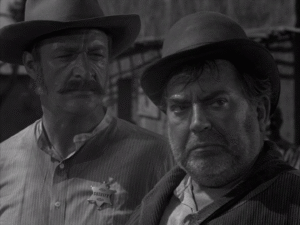
A young man named Luis sits in a jail cell, waiting for his public execution. What for? A reckless night of desperation and inebriation, leading to the unnecessary death of a little girl. As one father walks through the town with his child no more, another desperately attempts to save his own, the very same young man who sits in the jail cell. Luis’ last hope?A merchant, a peddler of all matters of false hopes named Sykes, the man who, incidentally, sold the rope that will be used on this day, now promising that he can save Luis with magic dust that will turn hatred to love. Luis’ father gathers all of the money from his friends and neighbors and purchases this magic dust, which is little more than the dried dirt of the ground. As Luis’ father hurls the dirt through the air at the people who are waiting for the scaffold to give way, a horrible sound can be heard: the crash of the false platform bottom falling through. But, when Luis’ father turns around, he sees his son, safely sitting on the ground, and a brand new rope, frayed to pieces, swinging in the wind. When the sheriff asks the parents of the little girl how they would like to proceed, the mother intercedes and says that enough is enough. There is a part of this young man that is already dead. The husband sets the rest of the town straight that this matter has been settled, perhaps by a power much greater than them, and so Luis will go home today. As for Sykes, the man who sold the rope and the magic dust, he drops the money on the ground, and leaves it for better purposes, some hungry children.
Episode Details
“Dust” is directed by Douglas Heyes. The teleplay is written by Rod Serling. And as for our cast, we have quite a group: John Alonso is our young man, Luis Gallegos; Vladimir Sokoloff is Luis’ father; Paul Genge is the father of the young girl; Dorothy Adams plays her mother; John Larch is our Sheriff Koch; and Thomas Gomez plays Sykes. And just to round this out a bit. You have Douglas Heyes Jr who plays a young farm boy, and Andrea Margolis is Luis’ sister, Estralita. The episode first aired on January 6, 1961.
Episode Tidbits
I have a wonderfully fascinating tidbit from our friend Martin Grams Jr.’s Unlocking the Door. When a columnist asked actor Thomas Gomez about what it was like to repeatedly play bad guys, this was his response: “I don’t understand those categories. I just call myself a leading man and let it go at that. If you ask me what I like best, I would say a comedy part with some rascality, warmth and dimension – and parts where Latin people are presented with sympathy, or at least with “humanity” (354). What a great quotation. It’s not about bad or good; it’s about representing what is human. Fantastic.
Question 1: How does this episode approach the topic of vengeance vs. justice, and what do we take away from it?
“Dearly beloved, avenge not yourselves, but rather give place unto wrath: for it is written, Vengeance is mine; I will repay, saith the Lord” (Romans 12:19). Now, why begin this question with this biblical verse? It actually exposes something interesting about this topic. 1. First, it’s an acknowledgement that there is a part of us that likes both the seeking of revenge and how it has an effect of slaking our thirst for comeupens, otherwise there would be no need to make such a declaration. 2. It introduces a more complicated aspect of the conversation: how yearning for revenge or vengeance affects those who are seeking it in potentially negative and/or destructive ways. And we somewhat intuitively know these concepts to be true. Think about our media. One of the most successful film franchises of the past decade is the John Wick storyline. And why did people want to see this first movie when it came out? The word of mouth was that it was a movie about a guy who is seeking revenge for the death of his dog. Now, when you watch it, you realize there is certainly more to it than that. But, that word-of-mouth story made a lot of people want to see it. And we root for him; we root for John Wick to kill everyone. And we accept what he has to become, the bobayega, the boogyman, in order to accomplish his mission of total destruction. Now, I’ll bring up another example of a great movie with this theme, but one that differentiates itself by explicitly saying it’s not about revenge: Tombstone.
I’m of course referring to the fun cowboy flick from 1993 starring Kurt Russel, Val Kilmer, Bill Paxton…a whole host of great stars. But, when Russel’s character, Wyatt Earp, experiences a death in the family, and he starts to go after the men responsible, one of his friends says, “If they were my [family] I would want revenge, too.” And then Doc Holliday corrects the friend and says, “oh, make no mistake. It’s not revenge he’s after. It’s a reckoning.” What a fun line to deliver. But what does it really mean? So, we’ve got these examples, but we need to get a little bit closer to a definition before we can use it for our Twilight Zone episode. So, what’s the difference between vengeance and justice? When you look up the difference online, you end up with essentially two definitions. First, revenge is a disproportionate reaction to a harmful event, so it uses the idea of proportion to mediate the difference. Going beyond an equal proportion to the original slight moves you beyond justice and into vengeance territory. Another definition states that revenge is an emotional reaction to harm, whereas justice is a dispassionate one. Okay, okay, now we’re getting somewhere. Let’s bring our episode into the conversation.
In the case of our Twilight Zone episode, I will go ahead and admit that Serling sets us up with a very difficult situation to parse. We cannot downplay that we have the death of a child here at the hands of a man, a young man, but a grown man. And this young man also happens to be someone’s child. So, if we’re thinking about our first definition from earlier about proper proportion, you have a life for a life or an eye for an eye. The sheriff seems to understand that there is a kind of cold math involved here. He tells Sykes, “as for that boy in there, he had his trial and today he’s going to swing for it.” He certainly doesn’t seem happy about it, but he also doesn’t fight it. As for our second definition, the notion of a passionate vs dispassionate response, I find the parents of the little girl to be interesting here. They seem quite dispassionate about the situation throughout much of the episode, especially when they talk to Luis’ father and his little sister. They aren’t mean; they listen; and then they simply ask Luis’ sister to move out of the way and let them pass; they are likely still in shock of the situation, but they’re also not depicted as thirsting for Luis’ death. So, in some ways, the approach that the episode is taking here lines up with both of our definitions of justice instead of vengeance. So then, if everything lines up so nicely with our definitions, why does everything feel so wrong all the way through the episode? Well, I’m going to make the argument that Serling is actually doing something quite clever here, and it’s something that we all need to keep in mind in our currently divided climate.
At the 14:47 mark, when Luis is kneeling for his final prayer, the townsfolk begin to get impatient, and they start to yell out things like, “hurry up,” come on, get it over with,” and “you should have done that in the jail.” And then, it’s such a beautifully subtle move by Douglas Heyes, the director, but he has the parents of the little girl look at each other for a moment, as if to indicate that this event is moving beyond justice, to a yearning to see the death of a young man. And that’s a terrible thing for society. We have human institutions and mechanisms that either require or ask for the death of another individual, but that doesn’t mean we should enjoy it. But, when a group of people get stirred up into a frenzy, it can be difficult–almost impossible–to move them out of that frame of mind, out of that yearning for some kind of vengeance. And that’s when Serling introduces a miracle–except, it’s not the one you think.
What ultimately brings everyone back into a state of normalcy and out of their yearning for vengeance? Why, the rope breaking of course, right? That’s the miracle here. Actually, with respect, I disagree. Yes, Sykes confirms that this is supposed to be a brand new rope, one that could hold the weight of basically the entire crowd of people there, and so there is no earthly reason for it to really break. And yet, that’s NOT the miracle that matters most. The true miracle is the strength of the parents, that from within this well of despair and utter loss, staring at the man who, even with no ill intentions, stole a future from them in a moment of his own despair, for them to be able to see through that pain to a place where they can envision that this young man both has suffered and will suffer for years to come yet, and that he will have to find his own way to reconcile the fact that he has stolen a potential future not just of the young girl but from himself by his own terrible decision, for these parents to see beyond all of this…that is the real miracle.
Like we talked about in the previous episode of “The Night of the Meek,” miracles of exceptional humanity do happen, but we must have our eyes, ears, and hearts open in order to experience them. To close this question out, in some ways, this episode shows us that there is something beyond both justice and vengeance when it comes to tragedy, and it’s not quite forgiveness–I don’t think the parents forgive Luis, although maybe someday they will. Rather, it is a relinquishing. It’s the decision that I will not hold this detrimental feeling in my heart, nor will I allow others to use my pain as a springboard for hatred. And so, I simply relinquish it to the world, and let it dissipate into the ether, but, ladies and gentlemen, having such a vision of humanity during tragic times is incredibly difficult–I think we can all agree on that. In fact, as Serling shows us here, it practically takes a miracle.
Question 2: How is the landscape shaping the characters, and where does its culpability
end?
I remember when I was younger reading about a Chinese concept known as Feng shui.
You might have come across this idea in some form over the years in terms of interior design. However, there is a long, historical and spiritual connection to Chinese culture that extends well beyond interior decoration.
This concept of creating an easier flow in life to maximize positive engagement or energy is actually interesting to me. And it made me think of a particular recurring theme in, of all things, the film It’s A Wonderful Life. If you’ve ever seen the movie, you know it’s about a man named George Baily, played by the incomparable Jimmy Stewart, and his struggle with the fact that his life is not exactly going as he planned. Now, there’s a lot more to it than that, but I’m going to keep it simple. George gets married, has children, and buys a house that he pretty much hates because it’s old, drafty, and because it represents roots, a reminder that he cannot simply up and leave when he wants. Now, you can make the argument that the sum of his frustrations can be found squarely in a single newel cap. What’s a newel cap? It’s the top, sometimes ornately decorative, part of the first post usually at the bottom of a set of stairs. Every time George goes up stairs, he puts his hand on the cap and it comes right off. Well, when he’s at his absolute lowest point in the film, he grabs this cap and makes a motion as if he’s just going to throw it through the wall. But, he composes himself and puts it back. The reason I bring this up is twofold. First, I hadn’t really thought about this newel cap as a microcosm for George’s life before writing for this episode; secondly, it made me think about how this small, largely decorative item can have such power over someone’s emotional state in a given moment. The problem is that it’s a high-contact point in the house, which means you can’t simply ignore it; it’s always there causing frustration, reminding him that petty worldly troubles constantly stand in his way of great adventure. I guess what I’m arguing is, had George fixed the newel cap, it would have solved all of his problems and there would be no need for Clarence. Okay, maybe that’s a bit reductive, but I think you see my point. If that item or some item that is in your way is literally playing a role in dictating your emotional value for the day, and you can do something about it, do it; change it. Now, we can’t always change characteristics of our environment, much like our friends in our Twilight Zone episode.
We get an interesting interpretation of the role the landscape plays on the people of the town from Luis. When the sheriff makes his remark that God should have essentially thought more about the need to create people, Luis says, “they’re tired of hating this place: the sun, the ground that is dead under your feet; they must go out and find something else to hate.” This is actually philosophically interesting to me, and here’s why.
Oftentimes, when we hate something, we want to hurt it, and what is hurt? It’s the recognition of pain and discomfort of the body. When we try to hurt a person, we’re trying to not just cause them pain and discomfort, but there’s a part of us that wants to see it in them–so that whatever it is that we hate about that person can somehow be made manifest into a kind of physical reality. Did you ever see a toddler get mad at another child? What do they do sometimes? They ball up their little fist and just throw a haymaker at the kid next to them. Why? Because they don’t know what else to do with that emotional energy, and in some ways all human energy has to come out in some sense, even if it just dissipates from the person with time into the ether. But, how do you cause harm to the landscape? Well, you can try and burn it, I suppose. You can stomp your foot on the ground as hard as you can, but does any of that hurt the landscape? Not in the sense that we’re talking about here. You can harm the ecosystem, but I think you know what I’m trying to get at here. So, what Luis is saying here is actually quite philosophically sound. If you can transfer the hate that you have for the place, for the harm that it causes you, for the ways that it makes your daily life more difficult than you believe you deserve, you still need a way to get that hate out of you, and you still have that yearning to see something harmed, and we humans have always made it easy to target the people around us.
Here’s the difficult part. Luis is no different from anyone else in this regard. He also had that hate inside of him and wanted to see it manifested in the real world. No, I’m not saying he wanted that young girl to die; he obviously didn’t. The person that he wanted to see suffer was himself. Luis’ father says, “He had a sadness, deep inside, a sadness that there was nothing left to eat, a sadness that they had no work, sadness that the earth around him was growing barren.” And that is why he was drinking and riding off into the night, trying to outrun the realization of how little control he had in this environment, because if he slowed down enough to actually see what was left of him, he knew that he would not be able to withstand the sight of that image. Now, a young girl is dead because of this, because of his inability to understand how to deal with that level of pain. And that is his fault. We cannot remove that from him, and I don’t think Serling wants us to. But, as the mother of the little girl says, a part of Luis is dead as well now.
So, what do we do with this question about landscapes? In some ways, I think one of the messages is that we need to be at least aware of how our environments are shaping or reshaping us into people we might not want to be. I think I’ve said this before but I’ll say it again. My students are often surprised when I teach them something about philosophy and then tell them to only use it if it makes you a better version of yourself, otherwise throw it away. Philosophy is about understanding the human experience in relation to existence. You have more agency than you think to alter the world around you. In other words, don’t let a broken newel cap be the reason why your loved ones, your friends, and the rest of us are not getting the best version of you.
Question 3: What are your moments of awe?
My moment of awe has to do with one of the final times we see Sykes. As he truly starts to contemplate what has happened before him, he looks at the coins that he took from Luis’ father, and then he looks at the hungry children in front of him, and he drops them to the ground, and informs the children to go ahead and take them. Now, why does he do this? In a world where a man like Sykes can do so many despicable things, this is an interesting choice. It might be that something the little girl’s parents said has truly shaken him to the core. The father of the little girl, after the mother tells him that she does not want the execution to continue, the father says, “Sheriff Kotch, there must be another hand in all of this for the rope to break like that,...maybe the hand of providence.” Now, if we extend this thought out a bit and the rope breaking is a kind of divine decision, a granting of mercy, then…well, the money in Sykes hands takes on a greater meaning…it’s no longer the collective money of the people, but the collective prayers of the people, their willingness to give up what little they had, but all of it, to try and help their friend. You think about what would happen if we as a people ever decided to do such a thing, to give up so much, in order to make something miraculous happen. No, I’m not trying to make people feel guilty; I’m really not. It’s a moment of awe for me, however, because it seems like what Serling is intimating here is that, when we move together toward the aim of a greater good, we have a great power in hand, perhaps even the ability to catch the ear of the divine.
My Rating
As for my rating, ugh…I am going back and forth on this one between Upper lower-tier and Middle Upper-tier. I think I’ll settle on the Upper Lower tier because of the acting and because Douglas Heyes is quite a wonderful director with the way he sets up some of these shots. By now, those of you who have been with me long enough, you know I’m a bit of a sentimental fool when it comes to deep stories like this about what it means to be human. This is one of those episodes that genuinely leaves me thinking about it for a while after I’ve watched it.
Next Episode
Next time, we’ll be taking a look at “Back There” and here are your questions to consider when watching the episode:
Question 1: What exactly is the time travel theory here?
Question 2: Do you think if we travelled back in time we could ever actually return
psychologically the same as when we left?
Question 3: What are your moments of awe?
Announcements and Shout-outs
Quick announcement: barring any unfortunate incidents, I’ll be at Serlingfest 2025 when this episode first airs. I’m hoping to make an exciting and a bit frightening announcement while I’m there, so stay vigilant.
I received a wonderful email from Raymond Fontaine. He writes, “Hi Joe, just wanted to say that your podcast is enjoyable and I appreciate that you keep it clean and family friendly….I enjoy yours because you deep dive into each one and don't get too carried away with tiny details, which can make it drag on….I would not mind at all if you share this on the podcast.
However, even if you do none of that, and you absolutely HATED this feedback.... I'd still like to thank you for spending some time reading this. Keep up the good work.
Raymond, thank you for this. As I mentioned to you in my response, my niece and nephew were 12 and 14 when I started the show, and I wanted them to be able to watch it. The themes of the Twilight Zone episodes themselves can be quite mature, like the one we’re talking about today, but I do think they can be watched by kids who are 12+. It seems to me like so much of the shows and movies today are created for either infants or 25+ year olds, we’re losing a little bit of that young adult space for them to be able to start processing that the world is not always wonderful, but we as a species persist and we have the ability to find our way to hope eventually. And yes, I did laugh out loud at my own words being used against me at the end. Nicely done.
How to Support the Show
If you enjoyed the show and want to support our journey through the Twilight Zone, consider subscribing, liking, and sharing the show with a friend. And if you would like to share your thoughts on the Twilight Zone or the KOI episode, leave a comment. I just might highlight it and give you a shoutout in a future episode. If you don’t want me to use your comment, make sure you indicate that. You can also head over to thekeyofimagination.com to learn more about me, my work, and various academic projects that I might be working on in relation to the Twilight Zone and Rod Serling. That being said, even if you hated every minute of this, I’m still going to thank you for spending some time with me. Until next time, remember, all doors are open to those who possess the key of imagination.
Works Cited