
The Twilight Zone Season 1: Episode 20
"Elegy" Episode Transcript
Introduction
Welcome to the Key of Imagination. This week we’re going to be looking at the Twilight Zone episode, “Elegy.” We’’ll take a deep dive into the rationale behind Wickwire’s decision to kill the men; we’ll talk about why people, especially rich people, would want to live in this dream-fulfilling suspended animated state; and I’ll reveal to you my moment of awe. So, grab your keys, and let’s open up this door to the fifth dimension.
Plot exposition
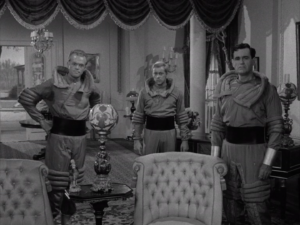
Three men in a spacecraft, looking for a new beginning. With their home planet earth in shambles and very little fuel to take them anywhere else, they stumble upon an asteroid that just happens to have the right atmosphere, perfect gravity, and all the right materials to produce air. And if that wasn’t sweet enough, when they land, they find odd objects that seem earth-like: a dog, a tractor, and people. Although, the people they find have one particular problem: they seem to be trapped in suspended animation, unable to move or speak. At their wits end, the men stumble upon a man, or man-like entity. His name is Jeremy Wickwire, and he’s the caretaker of this place. What kind of a place, why a cemetery, of course. The good people at Happy Glades gave people who could afford it a once-in-a-lifetime opportunity: to be forever frozen in the state of your wildest dreams: a knight fighting dragons, a serene farmer, a beauty pageant winner. Anything you desire. What are our astronauts' dreams? To get on their ship and go back home. But, not everyone gets their wishes in this tale. Our space friends aren’t going anywhere. You see, they have disturbed those who were resting in peace, and now they will have to join the rest of the people. Happily ever after, in Happy Glades.
Episode Details
“Elegy” is directed by Douglas Heyes. The teleplay is by Charles Beaumont and based off his short story of the same name, published in the February , 1953 issue of Imagination, of which I have a copy sitting right over there. The cast is made up of Don Dubbins as Peter Kirby; Kevin Hagen as Captain James Webber; Jeff Morrow as Kurt Meyers; and our caretaker extraordinaire, Jeremy Wickwire is played by Cecil Kellaway. We’ll see Mr. Kellaway in one of my favorite episodes from season 4, “Passage on the Lady Anne.” The episode first aired on February 19, 1960.
Episode Tidbits
As for tidbits, the main problem that director Douglas Heyes had to confront was the stillness of the human actors. We’ve all seen videos or maybe even in-person people who can stand like statues, but that’s really not everyone’s skill, so what do you do? In Martin Grams Jr.’s book, he highlights the approach that director Douglas Heyes took to mitigate this. Essentially, they moved the camera a bit more than usual when the crowds were in the shot so that it appeared as though any movements that were happening were because of the camera and not the people (250). I love when people come up with simple, elegant solutions to problems.
In Marc Zicree’s Twilight Zone Companion, he relays a story about how Beaumont originally had a suspended car race as part of the scenes, but Douglas Heyes didn’t think it would translate well to film–they would just look like parked cars, so he axed it. Instead, Heyes replaced it with the beauty pageant. Beaumont was not pleased with this replacement apparently; however, Zicree notes that the beauty pageant setup is arguably the most memorable of the scenes (106). I agree with Zicree. The beauty pageant scene is quite moving and helps you get a better sense of the kinds of people who were taking advantage of this post-life offer.
My initial Thoughts
My initial thoughts on this episode are mostly positive. Beaumont episodes always provide a bit of psychology, which is great. He makes you work to understand that there is often a difference between what is happening before you, as in the plot, and what is happening behind the scenes. It’s similar to “Perchance to Dream” in that way. That being said, I think Beumont episodes were also difficult to squeeze into the teleplay form, and those moments tend to come through at times when characters appear a bit underdeveloped. I think that happens here as well, but it doesn’t take away from the entertainment value, which is there in spades.
Question 1: What is the rationale behind Wickwire’s ultimate decision?
As I watched the episode, something about Wickwire hit me in an odd way. He both does and does not act like a typical robot. He exhibits traits of humanity that we do not normally see in machines; his speech pattern is a bit erratic and almost comical at times; he is easily placed in states of confusion and wonder; and even the way that he talks about himself with a kind of reflective, almost self-deprecatory manner. It all led me to wanting to do a deep dive into what exactly he is and the rationale behind his decision at the end to essentially kill the astronauts and preserve them forever on the asteroid. What I ultimately found by the end, however, made me think about the future of AI in a different way.
When Wickwire is asked about who he is and what he’s doing on the asteroid, he says something interesting. He says, “Now you’re forcing me into a rather embarrassing admission. You see, I’m not actually human. Oh, I am now, but when you’ve gone, I shall go back to sleep again until I’m needed. You see I’m, I’m merely a scientific device.” Let’s break this down because there’s a lot packed into just that one statement. He says, I’m not actually human, but then in the next line he says, Oh I am now. In a sense, he is referring to being awake, being conscious, as being human, as in, I’m an interactive, conscious being right now, so I’m human. But, when I’m off and cannot interact with anything, i.e., unconscious, I go back to being a machine. As actual people, we know that this is not what makes one human. Consciousness certainly adds a level of meaning to human existence, but it is not what classifies an entity as human. Already, Wickwire is quite different from Alicia in “The Lonely.” Alicia believed that she had feelings and emotions, but she knew she was not confused about her actual state of being as a robot. But, there’s something else in this little exchange that bothered me even more. Did you catch it? He also says that he’s embarrassed to admit this, meaning that there is a part of him that is, perhaps, jealous of our ability to be conscious at all times, to have agency in our existence. I want to key in a bit more on this idea that he is embarrassed because I think it highlights something important. Why should a robot be embarrassed? That seems like an odd emotion to place within AI because embarrassment on the human level usually leads to negative outcomes, whether they are personal or public. There are rare occasions when embarrassment can be used as a positive force for correction, but the negative reaction is more likely. In fact, embarrassment can have horrifying consequences, from removing one’s self from further social interactions to entire nations pursuing wars. But, there is a deeper level here still: is embarrassment even warranted here? This is like your toaster being embarrassed for making toast. I would argue that this answer from Wickwire is already showing us that he lacks an ability to properly understand how to contextualize complex human emotions. Embarrassment is actually quite complex. We’re often embarrassed in ways that only make sense when we think about it, not logically, as in pure rationale, but through human logic, which is not always rational but it is understandable. Okay, let’s just hold this in the back of our minds for a moment and briefly talk about our astronauts.
For much of the episode, the astronauts wander around in a perpetual state of confusion, disbelief, and curiosity. However, when it comes time to exhibit emotions, two of them, the Captain and the young one, seem to fall back on aggression quite a bit, especially around Wickwire. In fact, Wickwire’s first introduction to the astronauts, at least on screen, involves the young astronaut yelling when he’s on the beauty pageant stage. He balls up his fists and screams to the audience, “answer me!” What is Wickwire’s reaction to this scream? He smiles. Again, another inappropriate reading of the room from Wickwire. As the great philosopher Foghorn, Leghorn once said, “I say, I say somethin’ ain’t right with that boy.” Nonetheless, Wickwire witnesses anger and frustration.
Then, when we move our little play into the house with Wickwire in the room, we witness a key exchange between the astronauts and Wickwire that we have to be careful not to miss. And this is prior to Wickwire’s very gracious serving of refreshments, which means he could still decide not to kill the men if he wanted to. Two of the astronauts, the young one and the Captain, continue this trait of acting in an aggressive manner. The Captain says, “Mr. Wickwire, now you’ve got some things to explain to us before we go out of our minds.” Then, after Wickwire offers refreshments, our young astronaut friend interjects, ““now you tell us one thing right now: where are we?” If you watch this scene you’ll note that the two astronauts say these lines with what seems to me to be a lot more aggression than the scene warrants.
Then we get to a section that when I was watching it the second time through I scared my dog because I said out loud, “wait, what?” After Wickwire gives out the drinks and makes his toast, the astronauts start to talk about where they came from and what the date was when they left. After the Captain tells Wickwire that they came from 2185, our AI friend is astonished. He says, “2185? Now I understand.” After the young astronaut, once again, frustratingly interjects, Wickwire then says this: “You see when you arrived here, I thought you were the men from Happy Glades, but by your behavior of course I see that you couldn’t be.” Okay, now do you see why I said, “wait, what?” What does Wickwire mean when he says, “by your behavior of course.” Now, he could mean behavior in a general sense, as in they didn’t behave like people who had come from Happy Glades–they’re too unnaturally interested in the deceased. However, I think that this line also makes just as much sense if you read it as their peculiar aggression toward Wickwire.
Now, for those of you who love watching those body language break-down videos on line, this is the section for you. At approximately the 20:26 mark in the episode, the Captain stands up and walks over to Wickwire, and he gets really close. He’s a tall man, so he’s towering over Wickwire. The caretaker explains that it’s his job to make sure that “the guests aren’t…disturbed”. On that last word, “disturbed.” He looks up and down at the Captain. If you pay attention to the body language here, Wickwire seems to be acknowledging that the Captain is standing a bit too close and aggressively. This scene occurs after Wickwire has already given the men the eternal preservation drink. It’s as if Wickwire is saying in that look, “I made the right decision here.”
So, where is all of this going? Let’s think about this way for a moment. Someone is walking past you on the subway; they step on your foot. You say, “ow.” They, hopefully, say, “I’m sorry. I didn’t mean to do that.” On most days, that’s the end of the exchange. But, why? That other person physically hurt you. Shouldn’t you physically hurt them back? Well, no. You see, we’ve developed a system by which we usually socially code that situation as do-not-respond in kind. As philosopher Raymond Gibbs points out in his book Intentions in the Experience of Meaning, “Determining whether someone performs an action intentionally, or with the intention to communicate something to other people, requires something more than just observing what people do. Intentionality is a social judgment, not an objective fact about the world” (22). And what is the mechanism that we use to code that situation as such: intentions. We will grant people mistakes, even aggression, as long as we feel that we can accurately read their intentions as being at least a hair more benign than malignant–Let’s be honest for a moment. There are times when we’re not even sure if people meant an insult or not, and we’ll still grant them the benefit of the doubt. But, Wickwire, as simply a scientific device, does not really get that concept. All he can do is read actions and emotions. Anger and frustration will lead to aggression; aggression will lead to violence; violence will lead to the destruction of the cemetery, much like it did on earth. Wickwire even admits this. When the men are writhing in pain from the poison, the professor says, “we meant you no arm.” To this, Wickwire says, “I realize that, and I’m sorry. Truly I am.” He’s admitting to making a mistake in judgment, which, again, is horrifying to think that a machine is making a mistake that is leading to the death of people, but why shouldn’t it? It cannot fathom
When the astronauts ask why us, Wickwire says, “because you are here, and you are men. And while there are men, there can be no peace.” I read an interesting article on the Psychology Today website about AI and intentions, and the point that the author was really driving home is that AI will simply act out the intentions that are programmed within it. “AI reflects the intention of the person who created it. If the intention is to make a profit, then that is what the AI will do. If the AI intends to replace a human’s work, then that is what the AI will do. If the intention is to mimic a human’s voice and expression, then that is what the AI will do. AI has no inherent sense of caring, intuition, or intrinsic conscience” (link). So, what we’re seeing through Wickwire is not simply his own interpretation of humanity, but our own vision of it. We don’t believe that where there are humans there can be peace. But, the problem here is that Wickwire doesn’t understand why the men are acting aggressively. He doesn’t get human logic. We know why they’re frustrated, and that their frustration is not bent toward violence; it’s looking for resolution. They are frustrated because they want to find peace.
What’s, perhaps, most interesting about this episode is that it both shows us the complexity of being human when you break down something like the importance of intentions, and how we’ve had to earn that understanding through mistakes, wars, and unearned acts of violence. But, because Wickwire has not had to experience that, he has no reference point for learning how intentions function within a human framework; there are only the revealed emotions of actions and words. This episode speaks to yet another problem with giving our lives over to our robut overlords. Will they understand when aggression is the manifestation of fear and anxiety? Or, will they only see it as a precursor to violence. I’ll leave this section with a very funny, awkward, but human, thought that I had on my third watch of the episode. When the men finally realize that they’ve been poisoned, the young astronaut throws his drinking glass on the floor and, aggressively, screams, “I told you not to trust him; I told you.” But, when I rewatched the episode a third time. I didn’t find any section where he told his astronaut friends not to trust Wickwire. Isn’t that a very human thing to do? To have your final words be essentially I told you so, even though you didn’t. Also, had they actually acted in the ways that Wickwire is implicitly accusing them of being, they would likely still be alive. Now, isn’t that something?
Question 2: Why might people choose to be preserved like this on an asteroid?
First, let’s reacquaint ourselves with what is going on in the episode. Wickwire explains that not everyone in these scenes were once alive. There is a mixture of people who were once real people and artificial humans, basically mannequins who fill in the gaps. The purpose of the cemetery is for people to, well, we’ll use the word experience, after death things that they always wanted to do when they were alive. For example, there’s a man who wanted to be a knight and fight dragons, so that’s what he’s doing in, I don’t know, dragon land. Now, initially, my mind initially went to ancient Egypt and mummification; however, that doesn’t really work here because something else is happening. When I started doing my research, I ran into some fantastic research on the opening of the mouth ritual that occurred in Egyptian funerals, which I did not know about, and I even learned about some Incan rituals that involved removing their dead from their places of rest in order to honor them through parades. Again, something I hadn’t really heard of before. But, none of that represents what’s going on in the episode, which left me back at the beginning.
The one area where this episode does connect with my initial research into various burial cultures is in the link between death and money. The more money you have, the more options you have for preservation upon your death. In the episode, Wickwire says to the astronauts, “the management [at Happy Glades] hit upon this scheme for those who could afford it.” So, the most basic, surface-level answer to our question is that they did it because they could afford to do so. That answers a lot of questions in life, I suppose. But, we’re better than that. We know that there has to be more to it. After all, think about it. This scheme as Wickwire calls it has no connection to religion, and even more than that, it has no real connection to humanity at all, because it’s not like people could just go out and visit their departed loved one, so there has to be more to it than that. To approach this question, we need to build potential psychological profiles, and particularly, I was interested in whether or not there was a connection between these people and fear.
I began my new research pursuit by asking if people who are rich fear death more than those who are not well off. What I found first was a fascinating little editorial from the Washington Post dated August 10th, 1900. The editorial opens with the following: “A man who, while poor, is not more afraid to die than most people, often develops a haunting terror of death after he has made a big fortune, and spends an unhappy life and huge sums of money in trying to avoid the coming fate, frequently hurrying himself into a premature grave…” (9). Now, this might not be research of the peer-reviewed kind, but it provides an interesting claim that is worth thinking about. I can see how once someone finally receives full financial security there would be this sense of preserving as much time as possible living in that experience. I can also see how it might distort someone’s mind into thinking that, just because you have the means of purchasing everything that is material on the planet, you can begin to think that the immaterial must certainly be for sale as well. So, it seems pretty clear. Money is bad, and having lots of money is even worse. Wait, why are you making that face at me? You don’t believe me? Fine, let’s see what the peer-reviewed research has to say, “quick! To the library!”
There actually isn’t much here regarding the question of rich people and fearing death; however, I did find a pretty interesting article from 2013 that links money and existential anxieties, which include the fear of the death. Here is what researchers Zaleskiewicz et all found: “We conclude that, beyond its pragmatic utility, money possesses a strong psychological meaning that helps to buffer existential anxiety” (55). In other words, having more money helps to reduce one’s anxiety about existential concerns like death. Well, I for one am shocked by these results. More money reduces one’s anxieties? Next you’ll be trying to convince us that happiness is actually important to one’s health.
I’m being somewhat of a jerk here, so my apologies to Zaleskiewicz et al. There is much more to the study, and it’s actually a really good read if you’re interested. In fact, one of the areas it touches upon is how money can create this greater sense of self-sufficiency. It cites work done by Vohs et al, arguing that “money makes people rely on themselves and focus on themselves as self-contained, strong and independent entities” (65). And herein is where I want to start making our descent.
As I write this section of the episode, I’m becoming increasingly more sad by the situation of the people on the asteroid. On the surface, we’re supposed to read this as a kind of celebration of them fulfilling the dreams that they could not achieve on earth. I’m especially thinking of the woman who wanted to win the beauty pageant. She had all of this money, and yet she never felt beautiful enough. I feel sorry for her on a human level. I feel sorry for all of them. If the research by Vohs et al is correct and people with money tend to focus on themselves as self-contained, it means that they simultaneously pull away from society. These people in the cemetery must have been so unhappy inside, so unfulfilled, that they needed to know, to bring the knowledge with them in death, that in at least one moment of physical existence, they were happy, and they realized that with their money, they could preserve this happy moment in perpetuity. It’s like when people are at concerts and they hold up their phones and watch the event through their phones. My belief is that people do this because it’s a moment in which they are genuinely happy, and they believe that by recording the event, they are preserving that moment of happiness for themselves. But, it’s unlikely that they will ever watch that video; and it’s even more unlikely that they will feel the same way as they did in that moment even upon viewing it again. My friends, when you are confronted with a moment of pure happiness, just enjoy it, and then, let it pass. Do not try to live in it. Because if you do, you end up like these people in the cemetery–completely removed from others and frozen in a perpetual state of self-exile.
Question 3 What are your moments of awe?
My moment of awe here is the thought of being trapped in space with fuel running out and nowhere to go. These thoughts have to be in the minds of astronauts at least somewhat. We talk about existential horrors and loneliness, but I couldn’t imagine that feeling of being out in space, just floating, with no sense of direction, no sense of rescue, no sense of what is to come. That to me is truly a horrifying thought, and it gives me some additional respect for those who boldly go where no man has gone before. I salute your bravery.
My Rating
As for my rating, there is alway something fascinating about Beaumont stories, so I’ll give this one a Medium Medium-Tier rating. There are parts of the episode that still seem a bit rushed and underdeveloped, but I still enjoyed it quite a bit.
Next Episode
Next time, we’ll be taking a look at “Mirror Image” and here are your questions to consider as you watch.
Question 1: Does this episode highlight our complex relationship with rationality?
Question 2: Why are doppelgangers so fascinating?
Question 3: What are your moments of awe?
Closing
Well, that was an interesting episode. I had to delete quite a bit of the initial research I had done on Egyptian and Incan funeral rites. But, as I tell my students, writing is thinking. I would not have been able to arrive where I ended up without having done that work, so all went as it should. I hope you enjoyed the episode, and if you see me on asteroid frozen in time, please steal my body and bring me back. I guarantee I did not sign on to be there. I’ll be eternally grateful to you.
Announcements and Shout-outs
I have a particular comment that I would like to highlight from the YouTube channel because it was a good reminder to me. On my “The Last Flight” episode, TheBillo313 says the following: "Really great video. I especially like how you engage your audience. You come off sincere, well informed and humble - it's a fantastic combination that I wish more people had. I wish.” Thanks, friend. You know, sincerity in this space can be difficult sometimes, even for me because I have an ego like everyone else. But, teaching in the classroom, especially my background in teaching literature, helps. Because if you make the class about the material and not yourself, the students will also love your sincerity, but the moment you make it about you and not the material, the students notice it and the class dynamic is quite different. As long as I keep much of my focus on the material, I think the sincerity will remain. But, you know, I want to thank you for this comment because it’s a great reminder for me.
How to Support the Show
Head over to thekeyofimagination.com to continue our conversation. You can rate this episode, learn more about me, watch previous episodes of the show, and check out my curios page where I showcase some of the Twilight Zone trinkets I’ve bought over the years. I encourage people to email me thoughts and comments, whether it’s about a particular Twilight Zone episode, your rating for an episode, or about the Key of Imagination Show. You can get those to me as a text email, an audio clip, or even a video clip of roughly no more than 5 minutes to keyofimaginationshow@gmail.com. Keep in mind, even though we talk about some serious topics, we’re trying to maintain as family-friendly of an atmosphere as we can. If you would rather I not use your comments on the show, please indicate that so I can respect your decision.
If you enjoyed the show, I ask that you please take a moment and do one of the following to help build our community. Rate the show, review the podcast, leave comments, thumbs up, all of the usual algorithmic gymnastics. That will help get the show in front of more people and help us build our community of Twilight Zone fans. However, even if you do none of that and absolutely hated every minute of this, I would still like to thank you for spending some time with me. Until next time, remember, all doors are open to those who possess the key of imagination.
Works Cited
Gibbs, Raymond W. Intentions in the Experience of Meaning. 1st ed., Cambridge University
Press, 1999.
From Answers. “DO NOT WISH TO DIE: Strange Freaks of Rich Men Who Seek to Dodge
Death.” The Washington Post (1877-1922), 1900, pp. 9-.
Zaleskiewicz, Tomasz, et al. “Money and the Fear of Death: The Symbolic Power of Money as an
Existential Anxiety Buffer.” Journal of Economic Psychology, vol. 36, 2013, pp. 55–67,
https://doi.org/10.1016/j.joep.2013.02.008.