
The Twilight Zone Season 2: Episode 42
"Eye of the Beholder" Episode Transcript
Introduction
Welcome to the Key of Imagination. This week we’re going to be looking at the Twilight Zone episode “Eye of the Beholder.” We’ll talk about why Serling felt the need to include “The State” as a central concept for this episode; we’ll dive into whether or not there is some hope at the end for us to cling to; and I’ll reveal my moment of awe, a bit of a plea for the importance of discomfort. So, grab your keys and let’s open up this door to the fifth dimension.
Plot Summary
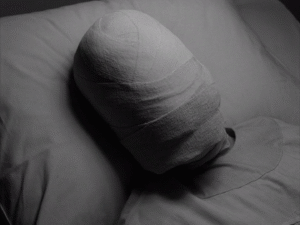
Janet Tyler lives in a dark, lonely world, one that is filled with hospital visits, emergency rooms, and bandages that not only cover her face but shroud her thoughts. You see, Janet has an unfortunate condition, one that makes her look quite different from well the way that a normal person should. And because the glorious and righteous State will only allow for so many chances to correct miss Tyler’s deformations, this is her last chance to emerge with a proper visage, one that will allow her to live among us normal folks. But, she does have someone who is rooting for her, a doctor, a man who is doing what he can to help, but he is limited by what The State will allow him to do or even to think. Is she really so hideous? Does she deserve to be excommunicated from society? The State says, yes, and that’s just the way it is. And so, a miracle is needed, but as the doctor removes the final bandage from her face, it is clear that there will be no miracles here. Her face is unchanged. There is nothing left to do but remove her from either society or existence. As she frantically runs through the hospital trying to get away, she heads straight into the arms of a man who looks just like her, Walter Smith, and he is here to take her away and to help her learn to accept the love of people who are just like her. For you see, beauty is in the eye of the beholder. And as sad as it is to say, Miss Tyler will have to internalize this old saying if she wants to live some semblance of a normal life.
Episode Details
“Eye of the Beholder” is directed by Douglas Heyes. The teleplay is by Rod Serling. As for our cast, let’s start with our unbandaged Miss Tyler played by Donna Douglas. William D. Gordon is our main doctor, and if you noticed something about the voice, he also played George in “Nervous Man in a Four Dollar Room.” Edson Stroll is our horribly disfigured human male at the end of the episode, but, we’re going to give our key to the city to Maxine Stuart. Maxine is the woman in the bandages, and I’ll have some more to say about Ms. Stuart in my rating section. The episode first aired on November 11, 1960.
Episode Tidbits
We’ve got a nice tidbit that will lead us into our first question. In Martin Grams’ Jrs. Unlocking the Door, he’s got a nice quotation from Serling about the role of the writer when he or she wants to say something. Serling states, “‘The Monsters are Due on Maple Street’ was a parable having to do with prejudice. ‘Eye of the Beholder’ on the other hand made a comment on conformity. No audience likes a writer’s opinion thrust down their gullet as simply a tract. It has to be dramatized and made acceptably palatable within a dramatic form” (332). Serling actually talks about this throughout his career in various interviews. Much of the time, I think he’s upset about the fact that he can’t simply be straightforward when discussing important social issues. The most famous example being his wanting to tell the story of Emmet Till. But, by the time the sponsors finished having their say about it, the story was no longer about Emmet Till. I can see where that would be pretty soul crushing. However, there are myriad ways to get your point across when trying to tell an important story, and I think Serling is still able to get those important stories out there through The Twilight Zone. Speaking of which…
Question 1: What does the concept of “The State” add to this episode?
I’m going to begin my answer to this question with a word that we love to use in academia: reification. Why do we like it so much? Well, it’s a bit of a fancy word, and sometimes we can overuse it in situations–and yes, I’m guilty of that myself. The word essentially means to treat an abstraction of something as if it were tangible. But, as with all words, there are also nuances to it, connotations, and cultural ways of using it that make it expand and evolve a bit. For example, we might say that it is perfectly normal for a person to stand on their heads when company comes over and belch three times while singing “Lydia, the Tattooed Lady.” Now, you might think that sounds silly. [Personally, I would be impressed and probably visit more often if someone greeted me in such a fashion. I’m just sayin’.] You might think that is silly. However, if we got another person to do it, and then another, and maybe we got a few hundred or thousand influencers to do it and to keep repeating that this is the norm, what happens to you, the person who thinks that it’s silly? Well, you become the abnormal one for NOT doing it. This is a kind of reification process as well. The more that the idea becomes normalized, the more it feeds and cements its status as normal. And this is why we were all dancing the Macarena at weddings in the late 1990s.
I actually want to begin our exploration of this topic by focusing on the main doctor first. He’s actually a fairly complex character. If we’re being kindest, he certainly conveys a sense of genuine concern for Janet’s unfortunate position, and of course, later on, he makes some comments to one of the nurses where he questions the validity of the State’s conclusions–a rather dangerous thing to do. So, let’s give him some credit for that. However, he is also quick to remind Janet that the rules are what they are for a reason. He says, “You realize…why these rules are in effect?” This seems like an odd question, considering that she is the one who has to remind the good doctor that this is her 11th and final visit. But, it’s also a kind of question that we often see even outside of the Twilight Zone as well. You see, it's really more of an appeal than a question, one that is supposed to speak to her common understanding of how humans within a particular cultural context think. But, underneath this kind of appeal is also the doctor’s hope that she will bear some of the weight of the burden of his conscience. The more she admits that she understands, the less that he has to feel sorry for his actions and participation. It also has another effect as well. The more she agrees with the rules, the more normal she feels–the more that she can show that she’s worthy of being a part of this normal culture. And here is where we start to make descent toward the heart of the question: why do we need The State?
Two human beings in the same room together can often manufacture a reason to dislike each other. But, to be a thoughtful human, to be a person who wants to find the commonalities and the ways that we connect meaningfully can actually be pretty difficult and uncomfortable at times. There’s an interesting book of essays titled The Evil of Utopia edited by Stewart Clegg et al. As the title indicates, it tries to look at the dangers of the yearning for utopian societies. In one of the essays, titled “The Four Roots of Organizational Evil”, the authors talk about the importance of self-control. They write, “For self-control to be effective, people need to consider the broad implications of their actions. Evil actions must be identified before they can be avoided. In order to determine whether an action is evil, it is necessary to step back and thoughtfully consider its consequences” (218). This sounds perfectly reasonable, but I want to highlight something here. In order to exercise self-control, we need a little bit more than just what our academic friends mention in the previous quote. We also need time, energy, patience, and a word that is built into the very concept itself: control. Do we always have control of everything around us, of others, of how we’re feeling? No. Don’t get me wrong; we can control a lot of things in our lives, but we can’t control everything–and that is sometimes difficult for people to come to terms with. I read a fascinating study on the National Library of Medicine website that sought to study how psychotherapists themselves defined and thought about the topic of loss of control. The majority of the therapists defined it as helplessness, specifically citing “ feelings of helplessness or powerlessness, using expressions such as feeling passive and hopeless” (link). What I find particularly interesting about their definitions are the notions of passivity and hopelessness, both of which produce within us a state of lethargy and an unwillingness to exert energy or time beyond what we can control. But, what if we didn’t have exert unnecessary force? What if we could just spend all of the energy we do have on ourselves? On our goals, our wants? And not have to worry about all the rest of the nonsense that we have to put up with? Enter The State.
The concept of the State gives us the broadest, most comforting, easiest pair of shoulders you’ve ever seen in your life, from which you can unload all of the things that take your precious time and energy, provided you’re willing to give up one thing: you. What I mean is the essence of who you are, the parts of you that make the people who love you smile: the awkward ways you order food at a drive in, your complete an utter inability to stay on track when you’re trying to tell a simple story; the way you offer a most inappropriate joke at the most inappropriate time.
You want to know what is really creepy about this episode? For much of this episode, we focus on Janet; however, have you ever really watched the episode with the intention of just looking at how the pig-people talk and interact with each other? Let me ask you something. Do they seem miserable? Do they seem to be suffering from anxieties? Do they seem lonely, unfulfilled, void of any sense of meaning? No.
Joe…my man…my friend…you’re starting to scare me here a bit. Are you saying that the State is a good thing? No. Absolutely not. What I’m saying is that I think the reason why Serling introduces the State into this episode is because he wants to expose us to something even more dangerous than the surface story of beauty indicates. Serling is saying, this is The State, this is what existence can look like, glorious, glorious conformity, as the Pig-people leader promises. Serling wants us to see, if you want to gain ultimate control, if you want to do away with all of the complexities of dealing with different personalities, and if you’re willing to give up your messy humanity, you can gain the one thing that we’re always seemingly yearning for today: control. Here it is. Right in front of you. So, should we ever ultimately decide that total control and pure comfort are worth more than our humanity, worth more than our fellow man, worth more than even the people we love, well, then we simply need to evolve a bit and become like pigs, with our heads forever entrenched in the very slop of our own creation.
Question 2: Is the ending problematic or hopeful?
I’m going to confess something here: even after writing about this question, rewatching the episode, and then erasing like two pages worth of writing for this section, I’m still torn on where I stand with this one. It might surprise some of you to learn that when I propose these questions, I don’t really know where I’m going to go with them before I start writing. (Well, given my penchant for meandering a bit, maybe it isn’t so surprising to some of you.) That being said, I do think that there is room to explore both sides here a bit, so that’s what I want to do.
In one of the more beautifully tragic moments of the episode, Janet asks the doctor if she can go outside, and experience the air, to be in the world but safely encapsulated by her own personal darkness. She then cries on his shoulder, exclaiming, “I want to belong; I want to be like everybody else.” As she is saying this, you can’t help but feel for her, but let’s not forget that there are two tragedies involved here, not one. The most obvious one is the ridiculousness that her very humanity is in question because of how she looks. But, hidden within this plea is something arguably much sadder. She is quite desperate to be a part of the conformity, to take her place within this world of The State. Yes, she lashes out at the doctor and screams, “the State is not God, which is an absolutely gripping moment, and a theme that Serling will come back to in a future fantastic episode about the State. But, her plea to be a part of the conforming society speaks to the point we made in question one. You cannot underestimate that there is always this slight pull for the creation of a State, this allurement for a kind of comfort for conformity always ready to be brought back to the surface. Breaking down this scene put a fairly terrible question in my head for the ending of the episode. Let’s face it together.
As Janet and Walter are walking through the valley of the shadow of snouts, the pig-people display odd reactions at this scene. Some shake their heads some just stare at them. And it even looks like one is crying, but I can’t tell if that’s the case or if it’s just make up glinting in the light. There’s a bit of ambiguity in this scene. The main doctor does look genuinely sorry for Janet, but the rest of them…the rest just seem to be helplessly cold. Again, I don’t often like to be self-referential but this speaks to that aspect of the importance of self-control. How do you maintain control of an entire people, you stamp it into the heart of the individual. They all know deep inside that they must moderate their reactions to events, so that, even if they are sad about this, they can’t show it. This reminds me of another fantastic Sci-Fi work that is often equated with The State: “The Invasion of the Body Snatchers.” I highly recommend reading the Jack Finney novel first. Then, of course, I recommend watching the original film with Twilight Zone alum Kevin McCarthy. In fact, I like all of the adaptations of the story, including the 1978 version with Donald Sutherland and…Twilight Zone alum Veronica Cartwright. Then there’s also the 1993 version…with Twilight Zone alum Forest Whitaker. Well, the 2007 version has Nicole Kidman…and Veronica Cartwright. Hmm…Where there are body snatchers, there are Twilight Zone alum involved. I like it.
Okay, back on topic, here is my uncomfortable question for all of you: if given the chance, would Janet still choose to stay in the world of the State at this point? I think the answer is probably yes. Now, I’m not trying to nail her on that or judge her too harshly. This is terrible moment for her, so we can cut her some slack here. It’s just that we’re left in this space where in order to experience the fullness of human kindness the undesirables still need to segregate from society. In that regard, this episode always leaves me with a bit of a sour taste in my mouth, as is probably the point that Serling wants to make. So, wait, what then of hope?
I think the doctor does provide some hope in one particular sense. When he’s talking to the other nurse, she’s telling him that he shouldn’t take this case of Janet so personally. But, he admits that he can’t help himself. He says, “I’ve looked underneath those bandages…,deeper than that pitiful twisted lump of flesh, deeper than even that misshapen skeletal mass. I’ve seen that woman’s real face….the face of her real self. It’s a good face; it’s a human face.” The hopeful part is the knowledge that there is something very real behind the concept of humanity, as in this structured understanding of what it means to be human, a concept that is so much greater than the what we might call the taxonomy of our biology: arms, legs, ears, noses…the true beauty of what it means to be human is how we think of and treat each other, how we fight for each other, how we make each other smile and cry. There is something about the human condition that somehow finds a way to break through even the starkest of situations. And I do believe that this notion provides us with an inextinguishable hope. So long as there are humans on earth, there will be this hope, that, although it seems easy to find reasons to dislike each other, there are deeper, more enduring bonds that hold us together.
Question 3: What are your moments of awe?
In the first encounter between the doctor and Janet, she starts to explain how she is processing a life lived in bandages. She says, “There’s a kind of comfort sitting inside this cave.” The cave of course being the dark, isolated existence within the world of her bandages. There’s something beautifully poetical about her words, about the ways in which she describes her isolation. But, there’s more to it than that. I talked a bit about control already in the first question and it even spilled into the second question, and I’m going to talk a bit about it here as well, but from a different perspective. There are essentially two ways to gain control: the first way is by active participation. That’s basically what we’ve been discussing to this point. But, there is another way: the complete removal of one’s self from society, self-ostricization. There was a time in the not too distant past when I had to yell at my college students to stay in their dorms every so often and actually do work. But today, and I’m not joking about this, I actively tell my students to get out of their dorms. More and more people are finding comfort in removing themselves from society. Why? Well, I think it has a lot to do with control. When I’m in my living room, I can do what I want, watch what I want, think how I want, and I don’t have to worry about others giving their opinions. You know, some days, that’s me. But, like Janet and her bandages, we have to be careful about letting that become the only times we’re comfortable. Go out, sit at a coffee house, people watch, make up funny stories about what you see. Start to remember what it feels like to draw power from having other people with you. Yes, being with people can be very tiring, but the benefits are worth it. I promise. So, get out of your dorms, everyone.
My Rating
As for my rating, I’m giving this an upper upper tier. This is one of the great episodes, and it’s one of the great reveals in The Twilight Zone. But, why an upper upper-tier? I have probably seen this episode 15-20 times over my lifetime. However, I did something a little different when I watched this one. I shut off all of the lights, ran the audio through a decent set of speakers, and it actually changed the experience for me. Particularly, Maxine Stuart, who plays the woman underneath the bandages and does the voiceover work for Janet Tyler, she single-handedly catapulted this into the upper upper-tier for me. There are these points when she contorts her body as she is screaming and I never realized how horrifying it actually looks. Then, when you add her screaming, especially when she is pleading, “take it off, take it off!” You almost feel like she is asking for her skin to be removed. This experience of watching it this way awakened in my senses that there is a kind of horror movie genre within this episode. I’m sure many of you out there already felt that, but I never really had. It’s fantastic.
Next Episode
Next time, we’ll be taking a look at “Nick of Time” and here are your questions to consider when watching the episode:
Question 1: Is the mystic seer machine actually telling the truth?
Question 2: Does the cafe owner play a role in all of this?
Question 3: What are your moments of awe?
Announcements and Shout-outs
I’ve got some comments to highlight from the YouTube channel.
The first one comes from friend of the show elmermedina. He writes, “Finchley was such a jerk that I rooted for the machines. I kind of see him as someone mishandled and mistreated machines for years and the machines finally fought back like the toys did to Sid in Toy Story.” Thanks, Elmer. A couple of people pointed out this Sid connection. This…this is why I love you all. That’s a fantastic connection that I never would have figured out on my own.
Fred-s7e comments on my “A Nice Place to Visit” episode, “it’s like they kinda’ punish him [Rocky] by granting him the power of God but with humanity’s ability to get bored and creatively stuck.” Thanks for the comment, Fred. I like this idea of Rocky being a kind of god with limited creativity. There’s something about that concept that really struck me as interesting. I would love to see what happens to Rocky in like a follow-up episode to the original, but I don’t think that’s going to happen any time soon.
How to Support the Show
If you enjoyed the show and want to support our journey through the Twilight Zone, consider subscribing, liking, and sharing the show with others. And if you would like to share your thoughts on the Twilight Zone or the KOI episode, leave a comment. I just might highlight it and give you a shoutout in a future episode. If you don’t want me to use your comment, make sure you indicate that. You can also head over to thekeyofimagination.com to learn more about me, my work, and various academic projects that I might be working on in relation to the Twilight Zone and Rod Serling. That being said, even if you hated every minute of this, I’m still going to thank you for spending some time with me. Until next time, remember, all doors are open to those who possess the key of imagination.
Works Cited
Ent, Michael R., Roy F. Baumeister. “The Four Roots of Organizational Evil.” The Evil of Utopia.
edited by Clegg, Stewart et al..1st ed. Routledge, 2012. 203-22.