
The Twilight Zone Season 2: Episode 55
"Mr. Dingle, the Strong" Episode Transcript
Introduction
This week, we’re taking a look at the Twilight Zone episode “Mr. Dingle, the Strong”. We’ll try and learn something through Luther’s failures; we’ll attempt to figure out why he keeps returning to this less than ideal establishment; and I’ll reveal my moment of awe, a bit of an update on the fifteen minutes of fame concept. So, grab your keys and let’s open up this door to the fifth dimension.
Plot Summary
Luther Dingle sits quietly at a table in a bar that he frequently visits. In the background, two men argue over a disputed call from a baseball game. When the two men seek out a third party for an unbiased opinion, they turn to Luther, but all he gets in return for his honesty is a swollen lip. In fact, it seems like all he ever receives for his opinion is a busted jaw. That is, until a rather odd extraterrestrial duo enters the bar, unbeknownst to the patrons within. You see, Luther is perfect for their little experiment: what would a pathetic human being become with an exorbitant amount of human strength? And so, a few bleeps and bloops later, and Dingle can now lift a building. It isn’t long before everyone has come out to see Luther at the bar work his magic: a fist through the wall, lifting a stool that was once bolted to the floor with one finger. He even grabs the man who punched him earlier and lifts him off the ground, spinning him like a top with ease. But, there is another patron at the bar–and they are not happy with what they see: the same extraterrestrials who gave Luther his strength. They don’t like what he is doing with it, and so they take it back. Once a Samson among men, Luther is now barely able to lift himself off the floor. He’s back to his old, weak self. Well, not quite. As one set of extraterrestrials exits another comes in, and they also want to run an experiment: what happens if we give superior intelligence to a wholly intellectually inferior mortal? And just like that, Luther is back in the game. Will it last? Who knows. Well, I suppose Luther might, considering that he pretty much knows everything, at least for the moment.
Episode Details
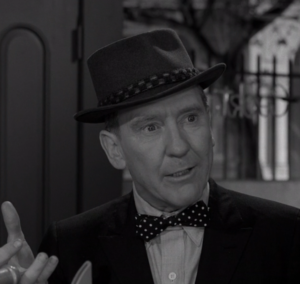
“Mr. Dingle, the Strong” is directed by John Brahm. The teleplay is by Rod Serling. As for our cast, this is our second of four episodes from Twilight Zone royalty Burgess Meredith, who of course plays our Luther Dingle. Our bartender, Anthony O’Toole is played by James Westerfield; James Callahan, the bookie, is played by Edward Ryder; and who is this handsome guy? Why that’s none other than comedic royalty, the great Don Rickles playing our bettor with the hot temper. The episode first aired on March 3, 1961.
Episode Tidbits
As for our tidbits, oh, my friends, have I got a good one for you. Don Rickles had the following to say about the episode, according to Martin Grams’ Jrs’ book: “The main man I remember was Burgess Meredith. He was one of the greats. I’m telling you he played his part so well that Rod Serling is probably shaking his hand to this day. That alien thing was stupid but what the heck, that was The Twilight Zone. You know what I remember about Meredith? In between takes he was a warm fellow who had a great sense of humor. We shot jabs at each other and he took ‘em as fast as he pitched them. They don’t make men like him anymore” (377). Wow, what an awesome compliment. Just more reasons to love the great Burgess Meredith.
Question 1: What can we learn from Dingle’s failure?
Something that I had never really thought of before regarding this episode is the title. “Mr. Dingle, the Strong.” The teacher in me is looking hard at that comma, as we are want to do sometimes. And we should. In fact, a comma can save your life one day. If someone in your group text says, let’s eat Joe with no comma–well, Joe needs to get the heck out of there fast. But, if they include the comma to indicate a direct address, Joe can breathe a sigh of relief. Now, in the case of our Mr. Dingle, this use of the comma is to create what is known as an epithet: a word or phrase that describes an essential or glowing characteristic of someone. We still use epithets today, and actually they go back a long time. In fact, you can find quite a few of them in ancient Greek culture, famously in the works of the great poet Homer: swift-footed Achilles, or Odysseus, the great teller of tales. And then there is one of the most famous epithets of all time: Alexander, the great. And now, you can also find it in our Twilight Zone episode as well with Mr. Dingle, the strong. As I stared at the title of this episode, probably for far too long, I started to think about what it would mean to have an epithet in modern culture. Today, it would probably be used sarcastically. Joe, the genius. But even in 1961, it rings a bit ironically. And yet, I do think this epithet idea has a bit of a role in our question. Keep this in the back of your mind for a moment. Let’s start to get into our episode specifics before I become Joe, the meanderer.
It’s pretty obvious rather quickly that people look down on Luther Dingle. They pick on him, even physically assault him–and apparently it happens pretty routinely . Even Serling disparages him. He says, “Mr. Dingle lives with one foot in his mouth and the other in the Twilight Zone.” Now, being potentially talkative or even a bit of a pain in the butt, doesn’t make someone bad or a failure at life. And yet, there is something to Dingle that doesn’t quite jingle–if you know what I mean. Actually, I don’t know what I mean, I just liked the way that sounded in my head: Joe, the great poet.
The disparaging remarks don’t end there. Serling goes on to call him “a consummate failure in almost everything,” and the aliens call him an “abject coward,” completely devoid of any strength, at least in the physical sense. And yet, there is a kind of strength to Dingle, and actually, Serling tells us what it is right at the beginning with his opening monologue. Serling says of Luther that he is “a good listener and has a prominent jaw.” These are interesting words to say about someone. These two characteristics are actually often the building blocks of great leaders: they listen to what the people need so that they can respond accordingly; and they can take the blows that life delivers and keep punching back. It reminds me of that great line from the movie Rocky Balboa when he’s talking to his son, and says to him, life isn’t about “how hard you can hit; it’s about how hard you can get hit and keep moving forward. That’s how winning is done.” I remember hearing that in the movie theater back in 2006 and thinking it was actually a pretty good metaphor for life. In the case of Dingle, you have to admit: he is able to get hit and keep moving forward. And yet, as Serling tells us, he fails constantly. Why? Well, I think I have an answer for this as well.
Dingle is a bit like an object in an aluminum box. Now, aluminum is a rather strong piece of material, especially relative to its weight. It’s able to withstand quite a bit of pressure and direct blows. However, the more you hit an aluminum box and dent it, the smaller the space becomes inside, until you make the box so dented, and so constrained, that any object inside that was previously able to move around at one point can no longer do so. You know, people are a lot like this as well. Relatively strong, but the more you beat them down and dent their ability to see beyond the crushed walls of their existence, the less likely they are to see a point to even bother to move at all. You see, Dingle’s failure is not that the strength goes to his head; it’s not that he does stupid, ill-thought out things like lift that woman up who is sitting next to him on the bench, which drives me crazy every time I see it; it’s not even that he takes a bit of a revenge on the Don Rickles character: no, it’s that he never quite sees that the blows he was taking from those men in the bar were having a greater effect on him than he realized. Yes, he has a prominent jaw, but that doesn’t mean he has to trade it for his human dignity and his self-respect. It’s interesting. The bartender tries to stick up for him, and he even genuinely makes it known to the other men in the bar that they are not to pick on Dingle any more. But, you also have to be willing to stand up for yourself. To realize that we were not created to constantly have the walls crushed around us. And if you feel that way now, you don’t have to beat someone up to make it stop. But, you do have to take the first step, which is admitting to yourself that you are worth more.
There is a whole world out there for us–with wonderful adventures, wonderful people, wonderful versions of you that you never knew could exist because you’ve never thought that you were worth the time. If that’s you out there, it’s not too late. I don’t care how old you are. What we should learn fromDingle, the Strong is not that he loses his strength; it’s that he never really needed it to exact positive change in his life. I started this section by talking about epithets. Well, the beauty of an epithet is that they are connected to the noun–to you; they have to match the characteristics of us, which means, today you might be Jim, the unsure. But, tomorrow, you could be…well…what do you want to be?
Question 2: Why does Dingle repeatedly come back to the bar?
After the betting man punches Luther the first time, the bartender asks Rickles’ character, “Hows come you always gotta’ be hittin’ Dingle. Now, you hit him last week and you hit him the week before.” When I heard the bartender say this on my first watchthrough, I made an odd face at the screen. Yes, I do that–even when I’m all by myself. Some people talk to their shows like they’re an audience member; I make faces and look around like I’m being filmed for a YouTube reaction video. The reason for my odd face is because this line is said in an odd way. It’s probably supposed to be somewhat funny because clearly Luther can, as Serling hints at in his monologue, take the hits due to his iron jaw–and also because there are clear cues that this episode is supposed to have a comedy feel to it. But, at the same time, I kinda’ just wanted to know why does he keep coming back to the bar? And that led me to a very memorable opening theme from a show that was great in the 80s, moving into the 90s, and still holds up pretty darn well today. Grab your beverage of choice for this one, my KOI friends, and sing along if you know the lyrics.
Making your way in the world today
Takes everything you've got
Taking a break from all your worries
Sure would help a lot
Wouldn't you like to get away?
Sometimes you wanna go
Where everybody knows your name
And they're always glad you came
You wanna be where you can see (ah-ah)
Our troubles are all the same (ah-ah)
You wanna be where everybody knows your name. (Gary Portnoy and Judy Hart Angelo)
Ah…nostalgia: both wonderful and yet with just enough sadness that you realize you can’t stay there too long. The beauty of that song is the idea that you’re a part of something, a group of people, that if something were to happen to you, if you just stopped showing up at this place, there would be people who would say, “hey, what happened to Tracy? I haven’t seen her in a while.” In short, there would be concern. Now, we can go even a level deeper, if you’re feeling a bit philosophically frisky. On a subconscious level, the yearning for someone to feel concern is also, perhaps, simultaneously, the yearning for an outside entity to acknowledge one’s existence. In other words, although I can say I exist, and even feel I exist; all of that could still be my mind playing tricks on me. But, if something from outside of my inner world is willing to acknowledge my existence, although far from foolproof, it’s at least an additional layer of credence to the notion that I exist. And that is important because existence is necessary for experience and experience is how we interact with the world around us. Now, you might be thinking…Wow, Joe, that was one of your more epic side tangents. HO HO! My dear KOI friends, I never go on a tangent without a healthy supply of breadcrumbs to lead me back–I prefer focaccia, but I’ll settle for a nice Italian bread or baguette.
Do you know what the oddest moment is in this episode? It isn’t the feats of strength or even the aliens appearing out of nowhere. It’s at the very end of the episode. When Don Rickle’s character, the betting gentleman who can’t seem to stop himself from pummeling Mr. Dingle–it’s when this character after disagreeing with his bookie friend about whether or not a baseball player will get on base, then turns to Dingle and says, “Dingle, what about it? What do you think he’ll do?” Now, mind you, this is after Luther just got his nose twisted and would have received his third punch from the bettor in just this episode. And yet, the bettor wants to know what Dingle thinks. And I do think that this is at least one of the reasons why Luthor keeps coming back to the bar.
We talk a lot today about how people feel more lonely than ever–somewhat ironically in the age where it is the easiest to connect with someone over social media. And of course being able to find a community of people who share an interest–like a famous sci-fi/fantasy show from the 1950s and 60s–can go a long way toward making someone feel not so alone, a part of something meaningful and special. I’m certainly grateful for all of you out there. But, here’s the part of this that I really want to focus in on. There’s a body of people out there who believe that they are always due some kind of negative outcome in life–that nothing good can happen in isolation–there must also be some kind of accompanying pain or suffering. And so, what they try to do is control what negative outcomes come their way. (You know, truth be told, I can actually be this way a little bit myself.) And that takes us back to our question. Why does he keep coming back?
If you put all of this together in a blender, what pops out is the bar for Dingle. They know his name–even somewhat value his opinion, so he isn’t quite so lonely; the world is going to give him punishment anyway, and at least with the bar, he knows what he’s going to get–and he can even somewhat control it. Now, if you can’t see the problem in this line of thinking then listen up: pain and suffering will come to all–that’s a part of the package of being human. But, we shouldn’t seek it out, and we aren’t inherently deserving of it. We should also not court it as if it’s some kind of badge of honor. We should be understanding when it comes to others so that they can hopefully be understanding when it comes to us, and we should help each other as much as we can to avoid it when necessary. To my lonely friends out there. Look for communities of interest; look for people who want to build concern. Look for a place where everybody knows your name. I promise you, there is one out there. And it doesn’t require a punch in the face. Well, unless it’s some kind of boxing club. And I can hear my fellow Gen Xers out there making a fight club joke. Have you forgotten the first rule of fight club: donuts and coffee are mandatory.
Question 3: What are your moments of awe?
My moment of awe has to do with something that has been on my mind for a few years actually. Dingle has this wonderful moment in the bar where he’s doing his feats of strength, and everyone is cheering for him and loving him. Some might call it his fifteen minutes of fame. I think all of us should experience that feeling at least once in life, a moment where the world seems to stop and just focus on us. Now, I’m sure some of you out there are thinking: that sounds horrifying. The whole world stopping to look at me? No thank you. Well, okay, it doesn’t have to be so dramatic as the whole world. But, I do think with so much data, emails, texts, posts, videos–with so much information that passes before our eyes on a given day, it’s pretty easy for us to feel a bit like no one needs to really listen to me or even acknowledge my existence. And that’s a horrible feeling for a person. There was a show that ran in the 1940s, 50s, and I believe into the 60s called Queen for the Day. Female contestants would talk about things in their lives that were not going well in the hopes that an audience would choose them to be the queen of the day. If they won, they got help with their problems and even some additional prizes and goodies. Now, to our cynical 21st-century brains, that might sound pretty inauthentic. But, actually, I would love it if they brought something like that back–with some modifications. I would love to see a show where a regular person always wanted to try and do X–sing at a concert; cook a great meal in a big restaurant; write something significant–and the show recruited professionals in that area to help the people see their goal through. Will it be perfect? Not at all. But, would they have at least experienced it and done it? Yes. And that would be the real purpose. We would get to enjoy seeing another human being feel like king or queen of the day–or at least feel a bit like Mr. Dingle, at his happiest moment–with an arm punched through a wall.
My Rating
As for my rating: oh boy…oh dear sweet Dingle…my KOI friends, I’m so close to dropping the dreaded Lower upper-tier on this episode. Again, my barometer for measuring if an episode deserves to be in the lower upper-tier is whether or not it at least makes good on its premise–-and ladies and gentleman, I do think you have to work pretty hard here to even gain a grip on the premise. Now, mind you: it’s not that we don’t have a story; we do. Dingle receives powers from aliens; it goes to his head; he blows his opportunity; and then gets another one. But, do we ever actually get a sense of drama, a sense of stakes involved? Even in episodes like Mr. Bevis, we have conflict in the sense that Bevis learns he doesn’t want supernatural help. But here? You’re lucky, Mr. Dingle. I think the great Burgess Meredith just pulls you up out of the dreaded lower tier–but, if Meredith looks behind him, I will make him into a pillar of salt with a lower tier rating. I swear. I suddenly feel dirty.
Next Episode
Next time, we’ll be taking a look at “Static” and here are your questions to consider when watching the episode:
Question 1: In an age of easy video, is there still an argument to be made for the value of just listening as a form of entertainment?
Question 2: Do you think it’s possible that we will experience a nostalgic return for
television--I mean in the non-recordable, in-the-moment sense of it?
Question 3: What are your moments of awe?
Announcements and Shout-outs
We have a new member of the key KOI partner group: Scott Mystery-Man. Scott, I didn’t get the chance to do this before the holiday break, as I had already recorded the episode, but I wanted to make sure that I thanked you properly for your support of not only the show but of the charities we’re trying to help bolster as well. Thank you, sincerely. And thank you m9d2gyn4c for the super as well. I very much appreciate it.
I’ve got a couple of comments from the YouTube channel. On my “Twenty-Two” episode, @CardsharpChris had the following comment: “I hope that you keep on going with your channel! Easily in my top 5 shows of all time. Good luck!”
Chris, that’s so kind of you. I mean I work hard on the KOI show, but to say it’s in your top 5 shows of all time…well…that’s…umm…wait a second. Now that I’m reading this for the recording I think you probably mean that the Twilight Zone is in your top 5 shows of all time. Okay, that makes more sense. You know what? That’s okay. I still appreciate the compliment, the well-wishes, and the time you took to let me know. As many of you know, I always appreciate a kind thought.
On that same episode, I wanted to clip a portion of @davidzdziarek-zl8cu comment on
…wait, do you think Chris meant the KOI show is in his top 5 shows about the Twilight Zone? I have to at least be in the top 5 shows about the Twilight Zone hosted by a guy named Joe, right?
Nevermind. Davidzdziarek-zl8cu had the following to say about “Twenty-Two”: What makes Twenty-Two effective is NOT acting or storyline, but the instant uneasiness, and the spooky hospital scenarios. The Morgue confrontations ARE what command the most attention, but two other scenes stand out. There is a subtle uneasiness when Liz just exits her hospital room, and takes notice of the Morgue nurse watching her in the open elevator shaft.
David, I actually went back and rewatched this moment just for this comment, and you’re totally right. Seeing the nurse close the door on the elevator as Liz walks toward it is genuinely creepy. Nice call.
And actually I love when people call out specific scenes from the episodes, whether it is to make a point, like David here, or just because you want to say that you like a particular scene. This channel is a community of fans. I enjoy reading about what you love about a Twilight Zone episode.
How to Support the Show
Want to support the channel? Consider subscribing, liking, commenting, and sharing the show with a friend–you know all of the usual algorithmic gymnastics, that will help us expand our awesome community of Twilight Zone fans. Plus, you never know, I might just highlight your comment in an episode of the show–as long as it's family friendly. And if you want to be immortalized on our list of key KOI supporters, consider joining one of our membership tiers on YouTube or Patreon. 50% of all money taken through this channel, after the platform fees, is going to charity. 25% to the Rod Serling Memorial Foundation, and 25% to the Gary Sinise foundation. For more information about me, my scholarship, and the show, head over to the keyofimagination.com. That being said, even if you hated every minute of this, I’m still going to thank you for spending some time with me. Until next time, remember, all doors are open to those who possess the key of imagination.
Works Cited