The Twilight Zone Season 2: Episode 43
"Nick of Time" Episode Transcript
Introduction
Welcome to the Key of Imagination. This week we’re going to be looking at the Twilight Zone episode “Nick of Time.” We’ll try to determine if the mystic seer is actually telling the truth; we’ll have some fun diving into the role the cafe owner plays in all of this; and I’ll reveal my moment of awe, my opinion on the existence of free will debate. So, grab your keys and let’s open up this door to the fifth dimension.
Plot Summary
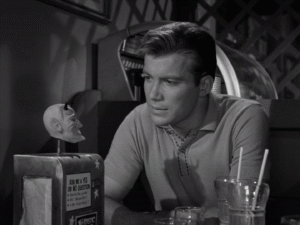
Don and Pat are on a road trip when their car breaks down in the cozy little town of Ridgeview, Ohio. With plenty of time to spare before a new fuel pump can be obtained, our couple heads over to the Busy Bee cafe for some refreshments. Don’s in a pretty pensive mood, waiting to hear about a potential new position as office manager, so to pass the time, they begin to feed pennies into the charming looking mystic seer napkin dispenser on the table, a fortune telling machine. Things start out innocent enough, questions like, “does anything exciting happen around here?” It isn’t until Don inquires about his promotion that things begin to get serious. The seer responds, “it has been decided in your favor.” A phone call back home proves the seer to be telling the truth. At this point, Don is trapped, caught in a vicious cycle of seeking answers to all matters of questions from this mystic machine, including when they are allowed to leave the cafe. Pat is able to finally convince Don that they should just leave, but when a car almost kills them both, Don is fully convinced that the seer is revealing their future, and they return to the cafe for another round of inquiries. Question after question–Don can no longer tell where his thoughts end and the seer’s begins–that is until Pat steps in. She convinces him that, even if the machine is telling them the truth, she doesn’t care. They need to make their own decisions, need to have their own agency in life, carve their own path toward the future. Thankfully, this works. Don and Pat leave the cafe, never to return. As they exit, another couple enters, sits down at the machine, and begins to feed it pennies. “Do you think we might leave Ridgeview today,” the man asks. This couple, having given over all of their agency, and serves as an example of what Don and Pat’s future might have been had they decided to stay.
Episode Details
“Nick of Time” is directed by Richard L. Bare. The teleplay is by Richard Matheson. As for our cast, we’ve got…umm…wait I forgot his name, William Shatner? I thought he did a pretty good job on this. It’s too bad he never really did any meaningful acting after it. (You can address all hate mail right to keyofimaginationshow@gmail.com. This is, of course, one of two great Shatner episodes. By the way, he is his most Shatner self between 20:00 and 20:04 seconds. The way he says, “no.” and then “I don’t know.” Is just pure Shatner. Patricia Breslin plays Pat. She’s a wonderful actress and had a fantastic career. She actually stars in my favorite Alfred Hitchcock Presents episode, “The Crooked Road” with Walter Matthau. I won’t spoil it, but that is in my opinion the most frightening episode of the series. “Nick of Time” first aired on November 18th, 1960.
Episode Tidbits
I’ve got a great little tidbit for this one from Martin Grams Jrs’ Unlocking the Door. Matheson actually tells us how he got the idea for this episode. “My wife and I were in a coffee shop in the San Fernando Valley, and there was this little [fortune-telling] machine that answered yes or no….And so I just thought, ‘Oh, that’s an interesting idea’” (340). I love quotations like this because it reminds us that there are stories all around us. We just need to see them.
Question 1: Is the mystic seer machine actually telling the truth?
The first thing we’re going to have to do here is define what we mean by truth. Yes, I’m going to get a bit philosophically/pedantically obnoxious, so you might want to grab an appropriate beverage and some snacks. Go ahead, I’ll wait. Truth is a much more complex concept than it appears. The heuristic shortcut that we tend to use in life is that we tie it to facts and call it a day. The reason we do this is because it works like 75-80% of the time. You ask a kid, what did you do? And you follow up with tell me the truth, as in, tell me what factually happened. But, even with that example, we start to see where the concept of truth tends to peel away slightly from facts. In the parent example, they’re saying, tell me what factually happened, so that I can determine the truthfulness of your statements and intentions. Let’s expand our situation even a bit more. If I say, it’s true that Americans love large portions of food, most of you in the audience are thinking, “yep, that’s true.” But, there are also at least a few of you, my fellow Americans, out there who don’t like large portions of food because maybe you see it as potentially wasteful. Therefore, the cultural heuristics might, again, work 75-80% of the time, but it isn’t a fact. See what I mean? From this perspective, truth is a heuristic expression of agreeableness that allows us to function fairly well within our local and–for the most part–within our global communities without the need to devote too much processing power from our brains for every decision we make. Doesn’t that sound sexy? Eat your heart out Plato, Descart, and Nietzsche.
Now, why did I just bore that hole into your brains? This is something that we tend to struggle with today in our daily conversations. How many times have you heard someone say that a situation, an event, or an idea is true, and you think, no it isn’t. I think that largely has to do with the different ways that we value the ratio of facts to interpretation within a truth. Again, truth is not all facts–although it should have a factual basis from which to build. If I said that the man got hurt in the grocery store because he morphed into a werewolf and someone threw a silver spoon at him, you would probably…not accept my version of the truth because we don’t have werewolves, but there could be some truth hidden within the statement. Maybe someone threw a spoon at a really hairy guy and he got hurt. Don’t throw spoons in grocery stores, kids. [the more you know]. So, where did the werewolf thing come from? The person who mentions the werewolf snuck in a personal belief as a fact, mixed it with an interpretation of the senses (watching the spoon fly in the air) and said, this…this is the truth….This is why we must always carry silver spoons with us wherever we go…to protect our children from grocery werewolves. Okay, let’s start applying this information to our episode.
I’m going to skip over the first two questions and move to the one that really starts Don down his spiraling pathway toward losing his agency. He asks, “Is it really going to be four hours before we get out of here?” Already, we’ve got a bit of a problem with the construction of the question. Let’s break it down. The word “really” is our main culprit. What Don doesn’t really understand is that the word “really” is actually an attempt to derive a fact from a problematic premise. Here’s what I mean. The mechanic tells Don that “nobody stocks fuel pumps around town.” Can you see where I’m going with this based on what we’ve already discussed? This is a heuristic truth, one that is statistically reliable enough to be correct more times than it isn’t. But, it’s obviously not factual because someone did stock the pump. The mechanic tells Don and Pat at the cafe that he “found a fuel pump right here in town–last one they had, too.” If it’s the last one, it means that there were obviously others, which means they stock the fuel pump. So saying no one stocks fuel pumps is just factually incorrect. But, wait, there’s more. Don’s problematic use of “really” extends itself even more when we consider the time element. Will it really be four hours? Think about that question. If it’s 3 hours, 59 minutes, and 59 seconds or four 4 hours and 1 second, it still ain’t really four hours, but in our usual understanding of time, it’s four hours. Let’s not even get into the problem of time and space here. In order for this to be true the time element would have to be taken quite literally. So, “really” is causing some real problems with answering our question. Now, what does the mystic seer answer? It says, “you may never know.” Is that true? Well….
If we turn the tables a bit on our Mystic Seer, it also has a bit of a problematic word that is doing A LOT of the heavy lifting. Can you find it? If you said “may,” congratulations! With the help of my course, you too, can become a mystic seer, for just three easy payments of $19.99. Act now, and I’ll throw in a free fuel pump. Okay, what is “may” doing here? May is an expression of possibility. Something may or may not happen. It resists being specific; it simply wants to establish that something can exist or occur within the realm of possibility. Is it possible for Don and Pat to know that their car has been “really” fixed in four hours? Yes. It’s extremely unlikely, but yes. However, the word “may” also includes all other scenarios where they don’t find out, so because it literally includes all possible scenarios, it has to be true. Inconceivable. And of course, that’s the source of the problem for Don. As they are walking away from the cafe, just prior to almost being hit by the car, Don pushes back against Pat. He says, “It doesn’t change the facts, though.” Don sees the answers as factually in line with the questions and their outcomes. And he’s not really wrong. It is a fact that the mystic seer is telling the truth. Why a fact? Because the way the seer constructs the answer it includes all possible scenarios of known existence. Therefore, it has to be factually true. Pat, however, is able to intuit that the factual nature of the language, however, does not actually grant it a useful heuristic truth for them, which is why I began with that long-winded conversation about how truth is not always connected to facts. It is a fact that they may or may not know. But, how useful is that fact for them or even for any of us? It’s not really at all.
Okay, before we close up shop on this question, let’s have some devious fun. There is, of course, another definition for the word “may,” as in the granting of permission. You may leave now; you may enter the room. What if “may” is actually functioning in that way here? That means that the Mystic Seer is actually being even more truthful–if you’ll allow me the flunkyism there. Why? Because he’s saying “I will not tell you the answer. You may never know.” That would even connect to our couple at the end. What’s the question they ask? Did you catch it? The man says, “can we ask some more questions now?” This can also be said as “May we ask more questions?” My grammar people out there, I love you. I see the difference between may and can. I’m just trying to get the point across as clearly as possible. They want permission. So, does the Mystic Seer machine tell the truth? Sure. I’m totally willing to grant that it does. But, it’s on us to understand how we value its truth, and how we use it as not just a philosophical jaunt through thought, but as an actual tool for how to navigate our social existence.
Question 2: Does the cafe owner play a role in all of this?
We had a rather dense answer to our first question, so I want to have a little fun with this one and expose some potential concerns I had about the cafe owner/manager. I had a strange moment rewatching this episode. At one point, I thought, hmm…the cafe owner actually has a few lines in this episode. I’m going to focus on him a bit and see where it goes. I did find some interesting connections here, so let’s explore them together.
First, I want to break down the scene where Don and Pat order their food. Pat orders the lettuce and tomato sandwich, and Don says that he’ll have the same. To this, the owner replies, “I’ve got some very good chicken fried steak out there.” But, they shake it off and stick with their orders. Then, at the 6:40 mark of the episode, when the owner brings them their food, he says, “you ain’t gonna like that as much as you would that chicken fried steak.” And Don says, “we’ll bear up.” But, you know what? They don’t like the sandwiches. Pat says, “why don’t you ask [the mystic] seer why he didn’t warn us the whole wheat bread was stale.” The owner knew. How did he know that they wouldn’t like the sandwiches? I mean, he made the sandwiches and knew he was giving them an inferior product, but the answer fits; he knew they wouldn’t like it. He has the gift.
When Don and Pat leave the first time, he asks for their check. The cafe owner says, “you don’t need a check; I know what you had.” He then proceeds to rattle off every item and even includes the tax. Now, why is this significant? Because math is evil. No. Because, he clearly does not want to have a paper trail, something that will prove that people have come to the Busy Bee cafe. He then says, “come on back, now.” Toward the end of the episode, when Don and Pat are triumphantly leaving, he says it again to them: “come on back, now.” It’s as if this is him beckoning for people to be trapped in the cafe, to always return.
At the 10:22 mark, the cafe owner gives Pat a very fascinating look. I’m actually torn on how to read it because the actor, Guy Wilkerson, gives the most blank stare I’ve just about ever seen. What we can do is try and use Pat to get a better sense of how to interpret the look. At this point, she has been waiting around for like 45 minutes or so and is just meandering around the cafe. When the owner walks over to her and gives her the look, she clearly feels uncomfortable. She gives him a nervous smile. It’s the kind of smile that indicates that she understands that they should not still be here, and that she apologizes for the inconvenience. Now, that energy helps us interpret the owner’s energy as being fairly negative. He wants them to leave. But, wait. I thought you said he wants them to be trapped and stay. No, not stay–return. He knows that if they leave before 3pm the car will almost hit them and it will solidify their return to the cafe and to the mystic seer machine. That’s why he has that huge jar of pennies, just ready to give out to his customers.
At this point, you might be thinking, Joe, we should call you plastic man with the amount of stretching you’re doing here. Okay, fair enough, but, ask yourself this. At the end of the episode, the same couple comes in, maybe every day, maybe every other day–we don’t really know. But, we do know that they are repeat customers who sit at the same table and feed that mystic seer machine constantly. That by itself is not a bad thing. If you’ve ever worked in the food industry, you’ll see ritualistic customers. But, you cannot deny that they look incredibly haggard and upset. If you’re a caring human, you’re going to at least ask them if they’re all right. You would think that, once the cafe owner found out what was going on, he would address it. But, he clearly doesn’t. In fact, he seems to ignore them completely.
So, what is our conclusion here? What is the cafe owner’s role in all of this? Serling says something really odd at the end of the episode in his closing monologue. He juxtaposes Don and Pat with the couple at the end who are trapped by the mystic seer’s words. He adds at the end that Don and Pat are “facing the future with confidence, having escaped one of the darker places of the Twilight Zone.” Think about that statement for a moment. This connects back to something Serling also says at the very beginning of the episode. Serling says, “this town happens to lie on the outskirts of the Twilight Zone.” It’s not just the machine or even the cafe; it’s the entire town, which means the people who are interacting with Don and Pat are somewhat characters in this little malevolent play. The mechanic was always going to find that fuel pump; that car was always going to ALMOST hit them; and the cafe owner always stocks plenty of pennies for the machine. I think this space is similar to the one in “A Passage for Trumpet.” What I mean is that you have a mixed reality situation. You have background people who are not really alive; you have otherworldly beings who interact with the targets; and you have the targets, people like Don and Pat–and the couple at the end. The cafe owner plays his part to make sure that all sense of purpose and agency are sufficiently drained from the targets. In that sense, I guess I see the cafe owner as a kind of malevolent, supernatural agent, in one of the darker places of the Twilight Zone.
Question 3: What are your moments of awe?
My moment of awe has to do with a prominent theme of this episode and a fascinating conversation that is happening today in quite a few different academic circles: the existence of free will. With the help of neuroscientific imaging, we can now get a better sense of how the brain works biologically in terms of the firing synapses. And one of the most fascinating discoveries that came out of this technology is the belief that free will as we know it cannot exist. The crux of the issue is essentially in the order of operations. If you’ll allow me a flunkyiestic way of saying it: your brain knows what it wants to say before your mind has decided. This has led public figures like Sam Harris and Robert Sapolsky to conclude that free will simply cannot exist because our brains literally do not have enough time–or even the chance–to consider an option other than what our brains have concluded. All choices are deterministic, meaning they are determined by previous causes. Now, there is a lot more to it than that but that is essentially the core issue. This has led to quite a philosophical conundrum. With no such thing as free will, what happens to agency and institutions like the justice system? Can you blame someone for a crime if they never really chose to do it? Can you really claim to love someone? With no free will, what can you truly claim to be your own? If I’m being honest, I’m not really all that satisfied with the answers that people like Sapolsky and Sam Harris give to these questions. So, what do we do about it? Nothing. Not a damn thing. Here is where I might get into a bit of trouble with some of you out there. Not all knowledge is useful knowledge if our goal in life is to maximize meaningful engagement with existence. The dark romantic authors like Byron, Coleridge, the Shelleys, and even Hawthorne, Melville, and Dickinson understood that knowledge can sometimes bring genuine destruction and darkness to a person. I’ve seen people struggle with this free will problem to the point that they are exactly like Don in “Nick of Time,” completely frozen, unable to figure out what’s the point of anything in life. If that’s you, then listen up: you’ve still got to get up in the morning, go to work, help others, impart some good into this world, ie build a meaningful existence. Think about this: your physical brain still needed to be here on this planet, at this time, and in this position to make things happen in this moment–and that makes your existence pretty darn blessed and purposeful. I guess you can say, I’m like Pat from “Nick of Time.” I’m not going to try and disprove or prove the existence of free will. To be honest, I don’t have the time, the energy, or even the care. I have too many important other things to do with my life. So, what are you going to do? Or, perhaps I should rephrase the question: what are you going to choose to do?”
My Rating
As for my rating, I’m giving this one an upper middle-tier. It slides just out of the upper upper-tier for me. The acting is good; the premise is phenomenal, and as I just indicated in my moment of awe; there is something prescient about it as it relates to this conversation on free will. When I was younger, I used to think that the couple at the end was actually an older version of Don and Pat, but that’s not the case. Still, I think it would be kinda’ cool if it were them. It’s a fantastic, classic episode.
Next Episode
Next time, we’ll be taking a look at “The Lateness of the Hour” and here are your questions to consider when watching the episode:
Question 1: Why did Dr. Loren build will into his robots?
Question 2: Is this living arrangement the future of family?
Question 3: What are your moments of awe?
Announcements and Shout-outs
I’ve got some comments to highlight from the Youtube Channel.
On my “The Howling Man” episode, Zephyrcat7 offered the following:
“Love your new set up! We can see your TZ memorabilia a lot better now 
I think he told the maid the story because he assumed the devil would prey on her while he was gone. So he explained what happened so she wouldn't be fooled.”
Thanks, Zephyrcat7. I’ll probably settle in on a somewhat consistent background soon, but I will definitely always add at least one or two different items per episode to keep it fresh. As for your comment about the maid, I think you’re probably right. Ellington certainly meant well in trying to explain it to her. I do wonder, however, if this is one of those scenarios where it’s just better to lie, which brings me to my apology for the horrible hypothetical I posted for that episode, and I want to give a special shout-out to friend of the show Elana Elyce–definitely correct me if I’m saying that incorrectly. Elana did a fantastic job of answering the question and pulling out a good-faith reading of it.
On the same episode, Torgo and the Lucifer Cat added a wonderful observation. “It's perfect that the devil says he was caught while sitting under a tree with a girl, i.e., eden.  ”
”
Torgo! Torgo you absolutely made my day with that comment. Here I am bringing in THE story of the fall of man in Milton’s Paradise Lost and you drop this connection with the Devil and the “Howling Man” on me. How the heck did I miss that in the 20 or 30 some-odd times I’ve seen this episode, I have no idea. But, I’ll be honest and admit that I never made the connection. Now, it will always be there with me. Fantastic stuff.
How to Support the Show
If you enjoyed the show and want to support our journey through the Twilight Zone, consider subscribing, liking, and sharing the show with a friend. And if you would like to share your thoughts on the Twilight Zone or the KOI episode, leave a comment. I just might highlight it and give you a shoutout in a future episode. If you don’t want me to use your comment, make sure you indicate that. You can also head over to thekeyofimagination.com to learn more about me, my work, and various academic projects that I might be working on in relation to the Twilight Zone and Rod Serling. That being said, even if you hated every minute of this, I’m still going to thank you for spending some time with me. Until next time, remember, all doors are open to those who possess the key of imagination.
Works Cited