
The Twilight Zone Season 1: Episode 2
"One for the Angels"
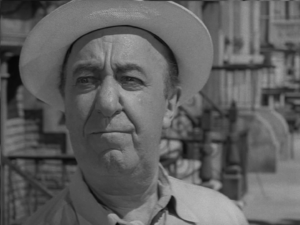
In Martin Grams Jr.’s The Twilight Zone: Unlocking the Door to a Television Classic, he chronicles that this is not the first time that Serling and Wynn would work together. In 1956, Serling saw his teleplay “Requiem for a Heavyweight” come to life on Playhouse 90 on CBS. Wynn took on a serious role as the character Army. He played alongside his son Keenan Wynn (who we will see in a later episode of the Twilight Zone). Jack Palance may have played the boxer, but it was Serling who won big in the end, scoring an Emmy Award. I was able to find a copy of “Requiem for a Heavyweight” and I have to say, I enjoyed it a lot. It’s one of those rare moments in entertainment when writing, acting, and directing come together quite well. In Zicree’s Twilight Zone companion, he relays that Ed Wynn was nervous about the character Lew Bookman. After all, it was meant to be a fast-talking pitch man, and Wynn had a noticeable lisp and could fumble with his words. Serling assured Wynn that any mistakes could be filmed again, and we end up with a wonderfully moving performance by Ed Wynn. I like this episode. I always have, even when I was younger. There’s something incredibly beautiful about the idea of someone moving from fear to heroism, and for me, that is what happens here in “One for the Angels.” I also enjoy watching Ed Wynn on the screen. I’m fortunate enough to have parents who would force me and my two sisters to sit down and watch older films and shows. I say forced because, at the time, we didn’t really appreciate it. But, once I hit about 25ish, that magical time when the brain finally decides it’s finished fully forming, I became grateful for that cultural education. I watched Laurel and Hardy, Abbot and Costello, the Marx Bros.Jimmy Stewart, James Cagny, Jeanette McDonald, Ann Miller, Ann Margarette, Peter Lori, Charlie Chaplan, Buster Keaton, and Ed Wynne. So, when I recognized an actor in the Twilight Zone, it was always a special treat. This one was no exception.
As was the case with Serling’s boxing teleplay, In “One for the Angels,” Wynn takes on a more serious character, a departure from his comedic roots. But, there is a sense of quirkiness and levity in the episode that pushes the drama even further. We smile at the idea that this pitchman from New York has just cheated Death. But, then when Maggie is hit by the car, things turn much more serious. Tell me if you think I’m crazy here, but I feel like if this were written today, Bookman would continue to struggle with whether or not he should take Maggie’s place as the person who has to go with Death. That would be at least one of the sights of drama for the episode. But, the only drama here is that Bookman is horrified by the fact that this young girl has taken his place, and he must find a way to give her back her life. I like it. I like that the source of the drama is saving life and accepting death.
Let’s dive into question 1. Do you think the angel of death always knows what is going to happen in the end? In other words, is he simply pantomiming for the benefit of Bookman? We’re going to treat Mr. Death like an angel, an emissary for God. There are, I think, two parts to this question for us to explore: The first part is knowledge of events. Mr. Death reveals what happens if he isn’t in Maggie’s room by midnight to take her away. Quote, “If I didn’t get in there by midnight, then the whole timetable would be upset.” We know, theologically speaking, that God knows what will happen, but what about Death? Let’s bring in St. Thomas Acquinas for a moment to help set the stage. According to Acquinas’ Summa Theologiae, “Whatever is the exclusive sign of the Divinity, does not belong to the angels. But to know future events is the exclusive sign of the Divinity, according to Isaiah 41:23: ‘Show the things that are to come hereafter, and we shall know that ye are gods.’ Therefore, the angels do not know future events.” Pretty straightforward, but Acquinas adds something else here that might make this more of an interesting question. “But events which proceed from their causes in the majority of cases, are not known for certain, but conjecturally; thus the doctor knows beforehand the health of the patient. This manner of knowing future events exists in the angels, and by so much the more than it does in us, as they understand the causes of things both more universally and more perfectly; thus doctors who penetrate more deeply into the causes of an ailment can pronounce a surer verdict on the future issue thereof.” What Acquinas is saying is basically that Angels are better than we are at recognizing the relationship between causes and effects. The cause and effect here certainly seem easy enough that even us humans can see what is going on. Therefore, it would stand to reason that an angel would be able to see the potentially problematic situation that he’s in even more. Let’s hold that thought for a moment and we’ll come back to it. The second part of this question has to do with desire. When talking about desire and angels, one can’t help but think about the once brightest angel of all, the light-bearer, Lucifer–also known as Satan. Let’s bring in arguably the greatest poet of the English language–no not Shakespeare, I’m talking about John Milton, author of many incredible works, but none more captivating than the epic poem of the fall of man: Paradise Lost. Any time I get to bring Paradise Lost into the classroom is a good time, particularly book IV, or Satan’s lament. What I’m about to read is Milton’s Satan’s thoughts about earth, and how it relates to God and heaven. Just listen for a moment and get lost in the sublime language from Book IX of Paradise Lost. This is Milton’s Satan speaking.
O Earth, how like to Heav'n, if not preferr'd
More justly, Seat worthier of Gods, as built [ 100 ]
With second thoughts, reforming what was old!
For what God after better worse would build?
Terrestrial Heav'n, danc't round by other Heav'ns
That shine, yet bear thir bright officious Lamps,
Light above Light, for thee alone, as seems, [ 105 ]
In thee concentring all thir precious beams
Of sacred influence: As God in Heav'n
Is Center, yet extends to all, so thou
Centring receav'st from all those Orbs; in thee,
Not in themselves, all thir known vertue appeers [ 110 ]
Productive in Herb, Plant, and nobler birth
Of Creatures animate with gradual life
Of Growth, Sense, Reason, all summ'd up in Man.
With what delight could I have walkt thee round,
If I could joy in aught, sweet interchange [ 115 ]
Of Hill, and Vallie, Rivers, Woods and Plaines,
Now Land, now Sea, and Shores with Forrest crownd,
Rocks, Dens, and Caves; but I in none of these
Find place or refuge; and the more I see
Pleasures about me, so much more I feel [ 120 ]
Torment within me, as from the hateful siege
Of contraries; all good to me becomes
Bane, and in Heav'n much worse would be my state.
Milton’s Satan is jealous of the beauty and care with which God took to make the Earth. He sees all of the things (rivers, vallies, forests) that he has been denied–and he wants them, but he does have the clarity of mind to realize that his want for these things is not out of appreciation of its beauty but jealousy in his belief that God made something more wonderful for a more worthy and loved being in humans. Who among us has not at some point tied the value of things to the value of our self worth. That’s what makes it one of the 7 deadly sins. In Milton’s world, it leads to the eventual belief that Lucifer/Satan deserves everything that God has.
Turning back to our Twilight Zone story, what makes Mr. Death so willing to buy what Bookman has to offer? He doesn’t need any of the items. You can make the argument that what Bookman is selling is desire, the need to have the special items that others do not. He plays on the old angelic fear that what humans have is somehow greater than what God can offer to his angels. If I’m crazy, then so be it. But, there is a part of me that can’t help but feel at times that Mr. Death must know where all of this is going. There’s something in the exchange at the very end when Bookman says, “Well, I guess it’s time for me now,” and Death responds, “as per our agreement.” It just makes me feel like Death knew that this would relieve Bookman of his fear and prepare him to go. Of course, I’m sure Maggie’s parents and the gentleman who hit her with his car won’t appreciate that.
Question 2: Does Bookman’s reaction to death represent how most people think about it, or does he have a unique view? In a 2020 study by Gegieckaite et al entitled, “Fear of Death and Death Acceptance Among Bereaved Adults: Associations With Prolonged Grief,” they found “that neutral acceptance of death was associated with older age, a natural cause of death, and the ability to find meaning in the death of a close one. Fear of death was negatively associated with the frequency of practicing religion. We found that fear of death but not neutral acceptance was significantly associated with prolonged grief symptoms.” It’s an interesting study that highlights something that might seem like common sense to anyone who thinks about it for a moment: the more an individual can find meaning in death, the less he or she is apt to experience prolonged feelings of grief. Even the most ardently religious individual will experience great sadness and loss with the death of a loved one, but solace tends to come to those who can integrate meaning into the experience.
In the case of Lew Bookman, he creates enough meaning through his pitch for the angels to experience a kind of calmness about his own passing. The study I previously mentioned also talked about how older people tend to land on a more neutral acceptance of death. But why? Wouldn’t older individuals have as much of a yearning to continue living as anyone else? I think the answer is probably, yes. However, what they do have is a blessing of experience. They can look back on their accomplishments–not just the things that we do for work, but their accomplishments as a human being, as someone who has taken part in the history of the species. When we’re young, we want to leave our indelible mark on the world and have people sing our great deeds for centuries, like Achilles in the Iliad. But, as you get older, you realize, my greatest deeds to this world might have been the times that I spent with my spouse, my children, or the times that I went out of my way to see if a neighbor was okay. Or mentoring young people about the ways of the world. These are great deeds. ANy time you can convince a young person to think about the best parts of themselves, set a goal for that, and initiate action to become that ideal, you’ve just made a pitch for the angels. And you will undoubtedly hear in your last moments, “Well done, good and faithful servant.”
Where did you find your moment of awe, something that moved you or inspired you to think beyond the surface? I only really have one moment of awe for this episode. It’s the look of proud resignation on Bookman’s face at the very end. To be so prepared to go is a wonderful thought, and it’s one that I hope I can experience–hopefully after many more great pitches to the angels and many more episodes of this show. Rank the episode as either low tier, mid tier, or upper tier.
As for my ranking, I give this another middle-tier ranking. Mention the next episode and introduce your three questions to consider as you watch. I highly recommend that you watch with your kids or loved ones and ask them these questions. It will help spark interesting conversation. Next time, we’ll be discussing “Mr. Denton on Doomdsay.” Here are your questions to consider as you watch. Question 1: Has the need to maintain the skills that define us only become worse by the voyeuristic nature of social media and content creation? Or, is the pressure the same as it always has been? Question 2: How much responsibility should we give fate for Denton finding his worth again? Question 3: What are your moments of awe here?
I’m still working on a website for the show; however, if you head over to thekeyofimagination.com, it will take you to the YouTube channel, where you can see me deliver my monologues. There are certain podcasts that I think lend themselves to audio only, and this might be one of them, but I, nonetheless, offer the video option.Use the links in the description to continue the conversation: you can rate the episode and leave your thoughts on One for the Angels. If you enjoyed the show, I ask that you please take a moment and do one of the following to help build our community. Rate the show, review the podcast, leave comments, thumbs up, all of the usual algorithmic gymnastics. However, even if you do none of that and absolutely hate my work, I would still like to thank you for spending some time with me. Until next time, remember, all doors are open to those who possess the key of imagination.