
The Twilight Zone Season 1: Episode 25
"People are Alike All Over" Episode Transcript
Introduction
Welcome to the Key of Imagination. This week we’re going to be looking at the Twilight Zone episode, “People are Alike All Over.” We’ll test the premise of the episode are people alike all over; we’ll dive into whether or not Sam should have seen the signs of what was to come; and I’ll reveal to you my moment of awe. So, grab your keys, and let’s open up this door to the fifth dimension.
Plot exposition
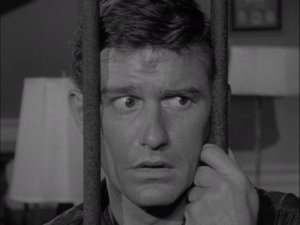
Two men staring at a spaceship that is about to carry them to new worlds. One of them, Marcusson, is excited about the prospects of meeting a new version of people; the other, Sam Conrad, in fear of… meeting a new version of people. But, for Marcusson, there is no need to fear because he believes that people are alike all over: with hope, care, and a thoughtful sensibility. When the spaceship crashes, leaving only Sam alive to greet the Martians waiting outside, his fears are quickly assuaged by the gentle hands and warm welcomes of the local people. When the Martians build a beautiful home, complete with all of the trimmings an earthling could want, things seem to be just perfect for Sam. That is…until something strange comes to his mind: no windows anywhere in the house. When he tries to open the doors to leave, he finds them shut, bolted somehow from the outside. As a large bay window slowly opens before him, Sam begins to realize the truth: he is not a guest; he is an exhibit. Earth creature in his native habitat, the sign outside of the bars reads. And Sam is left with the words of Marcusson ringing in his ears: people are alike all over.
Episode Details
“People are Alike All Over” is directed by Mitchell Leisen. The teleplay is by Rod Serling but it’s based off of a short story entitled, “Brothers Beyond the Void” by Paul W. Fairman. I’ve got an original first printing of that story from the March 1952 edition of Fantastic Adventures right here.
As for our cast, Sam Conrad is played by Roddy McDowall; Paul Comi is our ever-optimistic Warren Marcusson; and Susan Oliver portrays the kind and perpetually unnerved Teenya. The episode first aired on March 25th, 1960.
Episode Tidbits
In Martin Grams Jr’s Unlocking the Door, he notes that “The exterior of the Martian Landscape was actually the huge painted cyclorama of the desert landscape of Altair 4, which was originally created for Forbidden Planet and took up an entire sound stage at MGM” (270). There are a bunch of these shared resources between The Twilight Zone and Forbidden Planet. They’re always fun to see. I’ll note one other thing. According to Grams Jr.’s research, veteran actor Roddy McDowell was quite a joy to work with for everyone. He got along really well with both Paul Comi and Susan Oliver. Again, this is always something that I love to read about, so tip of the hat to you, Mr. McDowell.
My initial Thoughts
As for my initial thoughts, I both like this one and don’t. I do think it’s a clever premise, but boy is it cynical. That doesn’t make it bad, by the way. It just makes it a little difficult to stomach. This is one of those rare episodes that I actually think would have been a dynamite hour-long episode if it were in season 4. I think some extra interactions between Sam and Teenya would have been interesting, and more exploration of the world and its people would have made the ending even more disturbing. But, no doubt, it’s a solid episode.
Question 1: How realistic is the premise that such people would be alike all over?
This is essentially the primary question throughout the episode, and, of course, what makes it Twilight Zone esque is that Marcusson uses it as a form of hope, as reassurance that the good in earthlings is innate within a human-like species. Now, even someone as optimistic and hopeful as I am would probably look a little sideways at his comment. We value moments when we see great acts of kindness and goodness in humanity because I think we know that there is a kind of natural pull toward selfishness and competition. It’s my belief that we have to work hard to be good, to create good, but that makes it all the more wonderful when we witness it happening. Now, before we can really dive into the premise and answer our question honestly, we somewhat have to establish parameters for what we mean by the question. When we ask if something is alike, we’re setting up a comparison of traits, but which traits are we comparing: the physical, the psychological, the emotional? I think all three play somewhat of a role here in our question and, therefore, are worth considering, so let’s dive into this.
The first trait I want to introduce is the physical part and the role that this plays. The Martians have two arms, two eyes, two legs, and torsos. They fit what we would consider to be the basic schema of a human being. When we extend this a bit further, however, it starts to get interesting. One of the questions that I originally had with this episode is whether or not their appearance is a hypnotic illusion. Remember, they are able to recreate Sam’s house from his own memory. A fair question then becomes, are they doing the same thing here? Well, maybe. I think the biggest pushback to this answer is how they are dressed. They all essentially dress alike, like Romans on a Thursday evening at the Colosseum. I obviously have no idea how Romans dressed. I’m totally going by images I’ve seen in movies and television. If you’re a scholar of Roman dress, I’m truly sorry. Would Sam’s mind tell the Martians that this is how people on earth dress? Probably not, so it seems more likely that this is actually how the Martians look, which means that we would already have a sense of their potential physical advantages and limitations. Let’s hold that for now and turn to the psychological.
The most obvious difference between the Martians and us is their neurological capability. They are able to read minds and tap into our brains enough that they can actually see our thoughts. But, even more disturbing than that, they are able to tap into the recesses of our minds and construct a reality out of what we’re not even thinking about. Did you catch that in the episode? When Sam asks them how they could build such a perfect replica of a home, one of the Martians responds, “from your mind. You think very clearly, Mr. Conrad. Very clearly indeed.” It’s not likely that Sam was randomly thinking about houses, so the Martians were able to infiltrate our brains in a way that even goes beyond the usual sci-fi tropes of reading a person’s surface-level state of consciousness. That’s…unnerving. With that kind of power it would seem to me that it would alter the relationship between the mental and the physical and even our relationship to reality itself. Reality would simply become what is being represented as much as what is actually physical. Does that make sense? I hope so. We’ll also note that the people are not really particularly physically strong. They still need multiple Martians to carry out Marcusson from the ship, so there is clearly no need for them to become any stronger than the human physical form already calls for. The last thing I’ll say about this connection between mind and matter is that it seems like it would essentially even everyone out in terms of status. What would be the need for bullying when everyone can pretty much produce whatever they want seemingly over night, and that takes us to the final trait of comparison, and in my opinion the most important one for us to dissect: the emotional.
Of course, one of the main sources of species pride and at times problems is the emotional side of being a human. Now, for as many problems as emotions can bring for us, they also provide us with a sense of meaning. When we say we love someone, we’re expressing a meaningful engagement to go along with a chemical and emotional feeling. You can put that on a Hallmark card and make it play “More than a Feeling” by Boston. I mean, I think that’s pretty romantic”
Let’s connect this with the episode. Right from the beginning we know that this episode is about emotion because one of the very first conversations we witness between and Marcusson is about what? Fear. Sam asks, “Marcusson, are you afraid?” This of course foreshadows multiple moments throughout the episode when the Martians constantly tell Sam to not be afraid. It also connects with one of the final moments that we see of the Martians: they recoil in fear when Sam steps toward them in the enclosure. This is basically the most emotion that we see in the Martians, well, except for Teenya. She represents that outlier of goodness. But, I could also see why she would be a problem to them. Given that the Martians don’t seem to value emotions with their intellectual superiority, what would be the point of valuing empathy and sympathy when everyone is essentially the same? What’s the point of humility and gratitude? One of the things that I noticed on my second watch of the episode is how grateful and humble Sam actually is to the Martians. Yes, his initial instinct is to emerge with a gun in hand, but once he realizes he’s safe, he’s nothing but the perfect guest. Why? Because as different as we are as a people on earth, I still believe that we share values: those being that there is suffering in the world; that people are flawed but worthy of redemption; that kindness can be a power that can overcome the hardest of hearts. When we put all of this together, I think we can finally answer our question.
Are people alike all over? Well, on earth, as I said, I think we have emotional concepts that bind us together, universal feelings that allow us to connect with each other. When it comes to extraterrestrials, it will solely depend on what they value emotionally. Writing for this episode made me think about how it connects with two other episodes: one that we’ve already discussed and what that we have not yet. In “Third from the Sun,” Sturka takes his family and friends to another planet where they come in contact with entities that are similar to them: it just so happens that those extraterrestrials are actually us. But, we value similar emotions, so we know that they will likely be just fine on earth. However, when we think about an episode like “To Serve Man.” The Kanamits are nothing like us emotionally, and so to them, it’s no big deal for them to…well…I won’t spoil the ending here. I think the answer to our question is that people are NOT alike all over for various reasons, but there is one saving grace. They can look different; think differently; have different forms of leisure and food; but if they have an emotional value structure that is similar to ours, we might just have a chance at making some new friends. Although, you can count me out. I’m not getting on any ships to go meet our extraterrestrial friends. No. I’m good here. Thanks.
Question 2: Were there signs from the Martians that Conrad should have picked up on?
The second question of our episode is usually when I try to have a little fun, and we can get a bit more speculatory about things. Now, I’m not trying to paint Sam in a bad light here. He has been through a terrible ordeal, and I’m sure his reaction of just kinda’ going with the flow is probably how many would react. But, when we look back on this and use our superhero powers of hindsight, can we develop a picture that would lead us toward enough skepticism that we could almost tell what was about to happen?
Let’s talk about the obvious for a moment: Teenya. Poor thing: Teenya was not really built for deception. There are numerous times throughout the episode where she exhibits signs that something is going on. I think one of the more subtle but impactful ones actually takes place on the spaceship. When the other Martian leaves the ship, Sam isolates Teenya and tries to explain to her that he was frightened before but he isn’t now. She tells him, “Don’t be frightened, Mr. Conrad. No one will hurt you.” She then doubles down, “No one will hurt you; you must believe that.’ This is a fairly typical signal of distress for us earthlings. The emphasis on the word hurt should have triggered within him the understanding that she is specifically referring to his physical form. But, as humans, we know that we can be hurt in a multitude of ways. She then leaves the ship, but, and this one is for my body language gurus–she won’t look him in the eyes. It’s really quite a wonderfully acted little scene by Susan Oliver. So, at the very least, Sam should have picked up on the fact that something was going because of how Teenya was acting, but there are more signs here.
The next thing I want us to analyze somewhat connects back with something we spoke about in our first question: emotions, as in, the Martians have absolutely no fear of him whatsoever. Not only that, but can we break down something from the episode that started to bother me on my second viewing? Sam is waiting in the ship because he’s scared. This feeling makes him not want to open the ship door. Then, it just magically opens on its own. Now, when this happens, the Martians say something to him that is actually kinda’ weird. They say, “We’ve been wondering when you would come out. We’ve been waiting for hours.” Umm…what? That’s creepy. So, they get impatient and they’re like, “open it up, Ted.” That should indicate to Sam that these beings have a pretty strong confidence in their abilities. They believe that they have nothing to fear from him and they demonstrate no prudence in the situation. Look, for all of the problems that we exhibit as a species, I think we probably would at least be somewhat cautious enough to wait for the beings to come out on their own. Am I wrong here? Let me know in the comments or an email if you disagree about our level of cosmological patience. The Martians’ lack of patience would immediately signal to me that I need to act somewhat confidently myself. I wouldn’t want them to be so sure of their decisions that they were comfortable with just bossing me around and making decisions around me, which by the way, is essentially how Sam ends up somewhat stuck in that house. He’s so trusting that they know that they can just leave him there and he will stay. Is there something to be said here for being a bit stubborn and testing boundaries? Well, maybe.
The last thing that I want to point out is this whole hypnosis thing. Sam is essentially blind to what is really happening around him. It’s like he doesn’t understand. When they say that he’s speaking their language through a kind of hypnosis, that should have signaled to him that they can manipulate my psychological reality. That would freak me out, but it would also let me know that I would have to guard my thoughts as much as possible and recognize that they have powers that go way beyond advancements in technology. I would start to cozy up to Teenya and see how it works. I might even try to pretend like I’m really afraid again in order to get them to admit some information to help calm me down, like a child. Yes. in that situation, I am not above throwing a tantrum like a three year old. Recognizing that my very reality might be nothing more than a hypnotic projection might have been enough for me or any of us to recognize that there were no windows in the house, no connection to the outside world. This is where I’ll speak really highly of my wife’s perception. She is one of those people who is quite sensitive to when there are no windows in a room. She loves light and being able to see outside, even at night. She would have been the first to notice this–probably before me.
Okay, we’ve had our fun here, and I’m not really necessarily blaming Sam. However, when we break some of these down, I do think it’s possible that for at least some people–maybe even some of you out there–it’s possible that someone could have seen his entrapment coming. If I’m being my most honest, I think I’m probably about 60/40 on it. I definitely would have picked up on Teenya’s body language; I would have really been annoyed by the whole hypnosis thing; but I can’t say that I would have figured out that there were no windows in the house. So, I think I would have at least been worried about the whole thing. How about you?
Question 3: What are your moments of awe?
My moment of awe has to do with a bit of cynicism winning out here. As we already discussed, the Twilight Zone part of this episode is the ironic joke that Marcusson is correct: people are alike all over. But, that’s referring to the negative aspects of humanity: the greed, the jealousy, the carelessness over another life. But, you know what, Marcusson is not wrong in his assertions about the good, either. I do believe that we want to see good things happen to others, but we’re so taken up by the ways of the world, I’m not sure we even know what that means or looks like anymore. There was a time early on in the craze when my wife and I would watch American Idol–as in the singing show. And something I’ll never forget: the British judge Simon Cowell had just informed a woman that she was accepted to the next round, and the woman went crazy with joy. In fact, her whole family jumped into the room with her and went crazy with her. And you know what Cowell said? He said, something that he loves about Americans is the way we get genuinely happy for the achievements of others. I thought to myself: what a wonderful thing to hear someone say about one’s countrymen. My moment of awe is the reality that yes, the human species has perpetrated great atrocities on each other, but I think we do love seeing someone besides ourselves experience a nice bit of joy–and not just Americans, of course.
My Rating
As for my rating, I give this one a Middle Middle-tier. The concept is not the strongest, but it does hit upon a theme that rings true to us, of course. I enjoy watching it when it comes on a marathon, but it won’t spark a run for me, so it doesn’t quite make it into top tier or even middle top tier.
Next Episode
Next time, we’ll be taking a look at “Execution,” and here are your questions to consider when watching the episode:
Question 1: What does this episode want to say about evil?
Question 2: What is the difference/line between vengeance and justice?
Question 3: What are your moments of awe?
Closing
Well, I for one am glad that people are alike all over. All of you out there are from all over the place, and you produce some of the most thoughtful and insightful comments that I’ve seen on YouTube. So, score one for the good guys. Does that line work here? I don’t know, but I’m sticking with it.
Announcements and Shout-outs
Anthony over at Fever Dreamland Theater commented the following on my “A World of Difference” episode: “Ah, so this was a Matheson episode. Very interesting, I feel like it covered some of the ground Serling tended to explore, such as alcoholism, questioning reality and the need to escape from your own life. Wonderful review Joe and your Serling impersonation is perfect man! Keep at it.” First things first, if you have not gone over to Anthony’s Fever Dreamland Theater channel and checked it out, it’s a great channel. Not only are his Twilight Zone episode breakdowns great, but, as a child of the 80s, his deep dives into Night Gallery and horror are fantastic as well. Now, I want to address the most critical thing that Anthony said in that comment: my Serling impersonation is perfect. That’s right. Look out, Mark Silverman, I’m coming for you. I think I lost it again.
How to Support the Show
Head over to thekeyofimagination.com to continue our conversation. You can rate this episode, learn more about me, watch previous episodes of the show, and check out my curios page where I showcase some of the Twilight Zone trinkets I’ve bought over the years. I encourage people to email me thoughts and comments, whether it’s about a particular Twilight Zone episode, your rating for an episode, or about the Key of Imagination Show. You can get those to me as a text email, an audio clip, or even a video clip of roughly no more than 5 minutes to keyofimaginationshow@gmail.com. Keep in mind, even though we talk about some serious topics, we’re trying to maintain as family-friendly of an atmosphere as we can. If you would rather I not use your comments on the show, please indicate that so I can respect your decision.
If you enjoyed the show, I ask that you please take a moment and do one of the following to help build our community. Rate the show, review the podcast, leave comments, thumbs up, all of the usual algorithmic gymnastics. That will help get the show in front of more people and help us build our community of Twilight Zone fans. However, even if you do none of that and absolutely hated every minute of this, I would still like to thank you for spending some time with me. Until next time, remember, all doors are open to those who possess the key of imagination.
Works Cited