
The Twilight Zone Season 1: Episode 27
"The Big Tall Wish" Episode Transcript
Introduction
Welcome to the Key of Imagination. This week we’re going to be looking at the Twilight Zone episode, “The Big Tall Wish.” We’ll talk about why Boli feels like he has to ruin the magic; we’ll discuss whether there is any use for wishes in this world; and I’ll reveal to you my moment of awe. So, grab your keys, and let’s open up this door to the fifth dimension.
Plot exposition
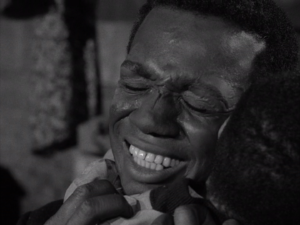
Boli Jackson is a man whose external scars serve as a cover for the greater ones that lie within. He is a fighter, a boxer past his prime but convinced that there is no other place for him in the world. When he steps in the ring with his opponent, it isn’t long before Boli is on the mat being counted out: 7, 8, 9. And then everything stops. A wish has been made, a big tall wish, by a young boy who happens to think the world of Boli: Henry. You see Henry has a special kind of power that is probably best left in the hands of children: the ability to wish for things. And when the referee counts 10, it isn’t Boli who is lying on the mat; it’s his opponent. By the time Boli realizes what has happened, he is already being bombarded with congratulations and handshakes. But, he can’t shake this feeling that he should have been the one being counted out. When he confronts Henry, and Henry tells him of the big tall wish that he made, Boli breaks down, unable to believe in magic and wishes–although he wishes that he could. With no belief to sustain it, the magic begins to crumble, and Boli finds himself once again on the mat in the boxing ring, being counted out. But, all is not lost. Boli is able to find a bit of magic in himself, and in the love and belief of a little boy named Henry.
Episode Details
“The Big Tall Wish” is directed by Ronald Winston. The teleplay is by Rod Serling. And as for our cast, we have Ivan Dixon as our man Bolie Jackson; Steven Perry as our little man Henry Temple; Kim Hamilton plays Frances Temple; and Walter Burke is Bolie’s man in the corner. The episode first aired on April 8, 1960.
Episode Tidbits
As for our tidbits, there is a wonderful quotation by Serling that I want to read. “Television, like its big sister, the motion picture has been guilty of the sin of omission….Hungry for talent, desperate for the so-called ‘new face,’ constantly searching for a transfusion of new blood, it has overlooked a source of wondrous talent that resides under its nose” (276). Of course, Serling is referring to African-Americans. In 1961, The Twilight Zone would go on to receive the Unity Award for “Outstanding Contributions to Better Race Relations” (277). That’s quite the testament to the idea that one person can make a difference in the world. I’ll return to this topic in my moment of awe section, but I’ll just say that Anne Serling’s book As I Knew Him does a phenomenal job of talking through just how much the idea of prejudices of all kinds absolutely made Serling sick to his stomach.
My initial Thoughts
As for my initial thoughts, this episode is one that has evolved quite a bit for me from when I was a child. For much of my youth, I thought it was boring–why? Because it doesn’t have that exciting twist. I think when you’re younger, you love the twist endings, but as I got older, I started to appreciate the episodes that address the complexities of life more, and this is certainly that kind of episode. I’ll talk a little bit more about this in my ratings section, but I’ll just simply say that I watched this episode a full three times for this review, and I didn’t even really need to watch it the third time–I just wanted to; I wanted to pick up on certain human nuances in Ivan’s acting. I suddenly realized that watching this episode was like watching a beautiful play on stage, and you don’t really watch a play the same way that you watch a movie or tv show. The beauty of watching a play lies in the smallness of it, in the ways that an actor chooses to express a thought or an emotion. By the end of that third watch, my initial thoughts had shifted dramatically toward quite the positive.
Question 1: Why does Boli ruin the magic?
Serling, in his opening monologue, says that Boli, “might do well to look for some gentle magic in the hard-surfaced glass that stares back at him.” First, can we admire Serling’s writing here for a second. That juxtaposition of gentle magic and hard-surfaced glass is actually really quite a beautiful mental image. It wonderfully encapsulates a particular way that we feel sometimes about the world, that it’s hard, unforgiving, and that in some ways we wonder if we were ever made to be able to withstand the harshness of this reality. This is an interesting opening line because when you break it down what Serling is actually saying is not simply that we need to look for magic in general, but that we need to look for magic in ourselves. But, what does that mean and why? I’m going to use something from my own area of research to make our way into this point in the episode: transcendentalism and one of America’s greatest philosophers, Ralph Waldo Emerson.
Why Transcendentalism? Well, in truth, it’s a movement/philosophy that, in some ways, becomes more complicated the more you read it, which is why Edgar Allan Poe mocked it in one of his short stories, “Never Bet the Devil Your Head,” which I have to admit is a really funny story when you bring that background knowledge of Transcendentalism with you to it. But, let’s simplify Transcendentalism for our own use. One of the primary cores of Emersonian Transcendentalism is the notion that within each individual resides the spirit of the deity, all that is necessary to experience the divine encapsulated within each of us. Here is a quotation from Emerson’s famous lecture in 1842 entitled “The Transcendentalist.”
It is simpler to be self-dependent. The height, the deity of man is, to be self-sustained, to need no gift, no foreign force. Society is good when it does not violate me; but best when it is likest to solitude. Everything real is self-existent. Everything divine shares the self-existence of Deity. All that you call the world is the shadow of that substance which you are, the perpetual creation of the powers of thought, of those that are dependent and of those that are independent of your will. Do not cumber yourself with fruitless pains to mend and remedy remote effects; let the soul be erect, and all things will go well. (text)
Okay, you might be thinking, what? It takes a little time and experience reading Transcendentalist thinking, especially Emerson when he gets going–and again, there were plenty of great authors at the time in addition to Poe who were thinking what is he going on about? Here is the important thing to take away fromthat: all things that can be experienced in the external world or inside of you; you are a part of this entire organic experience that we call existence or even consciousness. Since God is a part of this net, we are intimately connected to God, and can experience the divine will within our own selves, without the need for external mediation. So, carry yourself as if you are in conjunction with the divine, and let that spirit of greatness guide you into the world.
I might have gotten a little transcendental myself there. Let’s connect this back to Boli and even Serling’s monologue. When Serling says at the beginning for Boli to look for the magic in himself, he is asking Boli to see what lies within him already; Serling is in some ways foreshadowing for us that he does not need a wish to highlight his greatness; there is already greatness there within him. Henry’s wish becomes little more than the belief that we need an external force to bring out what is already divine within us.
When Boli talks to Henry on the roof of the building, he tells Henry, “listen, kid, I’ve been wishing all my life. You understand, Henry, I got a gut-ache from wishing. And all I got to show for it is a face full of scars–and a head full of memories of all the hurt and miseries that I’ve had to live with and sleep with all of my miserable life.” Now, if you love acting, this moment, this scene by actor Ivan Dixon is just about perfect. It’s very theatrical. Fritz Weaver comes to mind here as well. The tone, the hurt, all of which likely comes out of his life experience, it’s just so beautifully tragic. His whole life Boli has been forced, coerced by society and even by himself to believe that nothing within him is good enough, nothing within him is great. He spent his life wishing, and all he’s left with is the continued destruction of his inner self. But, now, now that he finally has something that he believes he can claim for himself, the knockout, now he is being told that even that came from an external source–from something other than him. You see, when you take away a person’ ability to claim ownership of their experiences, of their victories, and even of their losses, you take away their ability to claim ownership of themselves. And you end up like Boli: twisted inside, punching at walls, sabotaging yourself because what does it matter?
Let’s answer our question. Why does Boli ruin the magic? Because he has to. In fact, for decades of watching this episode and feeling so sorry for Boli, and questioning what is wrong with you, man? Take the victory! Society hates you; your community hates you; you hate you! Why won’t you just take this one good thing that has been offered to you? It’s only in writing about it that I realize, this is the moment that Boli Jackson becomes a person who is no longer defined purely by the external world; this is someone who just realized I am sufficient to love and be loved; I am strong enough to be knocked down and get back up; I am the magic; I am a man.
Question 2: What’s wrong with Henry’s wish?
If you’ve been with me long enough, you know that I enjoy bringing in philosophy to help us understand aspects of the human condition. But, I only really scratch the surface of what actual philosophers do. The more you dive into the field, the more you begin to see almost a mathematical element to our language, what we might call tautological, or if p then q. I will be open and honest and say that when it starts to get into that realm, my eyes start to glaze over and I start to notice shiny things in the room. There is a subset of philosophy that deals with this very matter of wishing, and the way that they approach it is through a semantic view of various propositions. One of the more commonly cited individuals in the peer-reviewed literature that I looked through on the topic is a man named Kyle Blumberg, and in his article, “Counterfactual Attitudes and the Relational Analysis” he talks about the language of desire and the potential logical problems of the wish scenario. It’s a rather dense article that utilizes a lot of the tautological, mathematical language I mentioned before, but I was able to get what I think is the sense of the issue at hand. Once we establish that, we can make our way to the episode and Henry’s wish.
Okay, Blumberg in this article uses worlds as containers for possibilities. Let’s use an example that he gives in the text: “John wishes he had taught on Tuesdays.” In this example, there are multiple worlds established for the various states of John’s wish. Now, what we’re going to focus on here is not necessarily fulfilling the wish but the ideal worlds in which John makes his wish. If that’s unclear, the examples we go through here might help. In one world, John teaches on Mondays. In that scenario, does his wish to teach on Tuesdays make sense? Yes. You can then extend that to worlds where he teaches on Wednesdays, Thursdays, Fridays, etc. In all of those worlds, his desire or wish that he had taught on Tuesdays makes sense. But, let’s establish a world in which John does no teaching at all. Does it also make sense or at least satisfy his wish that he had taught on Tuesdays? Yes. And that is one of the potential problems or complexities surrounding the semantics of desire and wishing according to Blumberg. That last world in which John does not teach at all does not really seem to hold true to the heart of the matter, which appears to be that John is a teacher; John likes teaching; but John wishes he had taught on Tuesdays. So, in order to help bring this more in line with the wish scenario, Blumberg brings in another philosopher named Irene Heim to introduce the notion of “Comparative Desirability.” “The general idea is that wish reports are true when subjects prefer worlds in which the thing being wished for holds to worlds in which it doesn’t.” What this means, as far as I can interpret it, is that the wish or desire needs to be able to hold true in all worlds where the desire is preferred more greatly than any other possibility in which its not true, in this case, John’s desire to teach on Tuesdays needs to be so strong that it can even be preferred to a world where he does not teach at all. Okay, enough of that, let’s bring this to our episode and start to see how this connects with little Henry.
First, let’s establish what Henry’s wish actually is. It seems as if it is simply that Boli trades places with Consiglio at the point of knockout on the mat. Now, what is actually happening behind the scenes of the wish is also important. It isn’t just that Henry’s wish trades out the bodies of the two fighters; Henry’s big tall wish also restructures the events that occurred in the ring. He establishes a world where Bolie beats up Consiglio and everyone who exists in the world sees it that way as well. Well, except for two people: Henry and Bolie. Now, think about this for a minute. What this means is that Henry, little sweet Henry, is actually maintaining and balancing two existing worlds at one time. How? Think about it. You have the world that was created when Bolie knocks out Consiglio, a world where everyone sees the reality as it was reconstructed by Henry; but there is also the world that stayed behind, the one where Bolie was knocked out. How do we know this world still exists? Because both Henry and Bolie know it, and they can actually experience this other world through their memories, their thoughts. And so, Henry’s wish is far more intriguing an interesting than we give it credit for.
So, what’s wrong with Henry’s wish? I think there is something to be said about whether or not Henry would have even been able to continually balance those two worlds as he got older. You think about what it would be like to know that another timeline very much exists where something else occurred, where you changed the course of events and altered the perceptions of reality for everyone else except two individuals. This is very different from the time that he wished for rent for his mother. I think eventually Boli’s wish would have collapsed on him as an adult, but he is protected from these thoughts by his innocence, by the fact that a child can often move in and out of reality, dream of different worlds through their imagination, and then snap these worlds away like Thanos with an infinity gauntlet.
But, and here’s the important part, baked into the failure of Henry’s wish is also the most beautiful part of him. He believes that there is absolutely nothing wrong with Boli, that he’s perfect–he’s a tiger. And because he believes that his idol is nothing but the perfect image of what a man should be, he never even considers that he would have to alter the way that Boli thinks of himself and sees the world in order to make the wish stand. Boli is the ideal, and you don’t change an ideal; you aspire toward it. And so, at its most basic level, it’s only because of Henry’s love for Boli that the wish truly fails.
Question 3: What are your moments of awe?
For my moment of awe, I’m going to read a section from Anne Serling’s book As I Knew Him. In the book, she relays a story that a friend of Serling’s told her about her father from when he was a student at Antioch college. The friend is Mike Newman, and here is the story:
Your father’s convictions and anger were focused on anyone who did either of the following: Got a haircut from anyone but Mr. Pemberton, the only barber in town who would cut the hair of African-Americans. [And secondly, those who] Did not go to the Old Trail Tavern but rather to the establishment across Xenia Avenue which did not serve African-Americans. (75)
It’s well established that Serling’s nemesis in life was prejudice in all forms, and he took quite a big personal risk in delivering this episode of the Twilight Zone with its predominantly African-American cast. But, there is always the risk of being hated when trying to expose a wrong or in doing the right thing. Something that I’m in awe of here is that, today, we often feel like our actions and decisions matter very little. After all, I’m just one person. Well, yes, you are, and so am I. But there are people who look up to you, people who care about you, people who see what you do with the time that you have. I’m going to say something that might sound silly or even wrong, but hear me out: I think it’s a mistake to say that Serling did these things in opposition to the bad; I think it’s more accurate to say he did these things in favor of the good. We should all think carefully about the difference between those two things when we make our decisions today because they are not the same.
My Rating
As for my rating, when I started writing for this episode, I had this in the middle upper-tier area, but after having written for the questions, I’m actually going to place it in the upper lower-tier. There is a journey here, and it’s one that many people walk through and don’t always come out the other side better for it. Boli experiences this place where his anger and resentment leads him to essentially sabotage himself by punching the wall. Then, he’s so broken by the world, he can’t accept the gift that he has been given by Henry. If the story stopped there, we could all understand it. Instead, Boli finds the means to continue onward, to turn away from the hatred that he feels from society and even from himself. He emerges as a man who is determined to find good, to make good in the world. I give Serling a lot of credit for including that in the ending because he didn’t have to.
Next Episode
Next time, we’ll be taking a look at “A Nice Place to Visit,” and here are your questions to consider when watching the episode:
Question 1: How are Rocky’s drives connected with his particular version of hell?
Question 2: What is this episode saying about the need for the unideal?
Question 3: What are your moments of awe?
Closing
Okay, I’m going to just put this out there. I’ve always wanted to see one of the Twilight Zone reboots do an episode where Henry from this episode and Anthony from “It’s A Good Life” meet. I think Henry is probably the only character who could take Anthony out, but it would be a phenomenal kind of magical war. Anthony sends Henry to the cornfield; Henry wishes Anthony could feel and see the terrible things that he has done. I mean…come on! You can’t tell me that this wouldn’t be just an amazing episode.
Announcements and Shout-outs
As always, I have some shout-outs and comments from the YouTube channel, and both come from the “People are Alike All Over” episode.
PhilipDarragh writes, “Note, the original alien movie was "It, the Terror From Beyond Space," starring Marshal Thompson, [from] the 60's TV show Doktari, and Ray(Crash) Corrigan, as the alien. [from] 1958 or '59. A great movie!😊” Philip I love the information here, and I appreciate anyone who offers potential movies or shows that we can watch to add to our enjoyment of both the Twilight Zone and…well…life quite honestly. Awesome comment and much appreciated.
Collector261 comments: “This is not my favorite episode of The Twilight Zone. But I do consider it one of the most ironic! In about four or six years, Roddy McDowell will HIMSELF be playing a similar role on the other side of the cage. McDowell will himself play the role of an alien that imprisons human earthlings that lands on HIS planet. And Rod [Serling] was even one of the writers! We all know that role, don’t we?” Collector, you cheeky such-and-such, well done! I have to admit, I didn’t even think about that connection here, but yes, you’re absolutely right. And, I’m going to continue in the spirit of your comment by not mentioning this connection directly and instead letting others figure it out for themselves. I appreciate the time.
How to Support the Show
You can continue our conversations by heading over to our Discord server and either starting a conversation about this episode or taking part in one that is already happening. The link to join the server should be in the episode notes section. You can also head over to thekeyofimagination.com, where you can rate this episode, learn more about me, watch previous episodes of the show, and check out my curios page where I showcase some of the Twilight Zone trinkets I’ve bought over the years. I encourage people to email me thoughts and comments, whether it’s about a particular Twilight Zone episode, your rating for an episode, or about the Key of Imagination Show. You can get those to me as a text email, an audio clip, or even a video clip of roughly no more than 5 minutes to keyofimaginationshow@gmail.com. Keep in mind, even though we talk about some serious topics, we’re trying to maintain as family-friendly of an atmosphere as we can. If you would rather I not use your comments on the show, please indicate that so I can respect your decision.
If you enjoyed the show, I ask that you please take a moment and do one of the following to help build our community. Rate the show, review the podcast, leave comments, thumbs up, all of the usual algorithmic gymnastics. That will help get the show in front of more people and help us build our community of Twilight Zone fans. However, even if you do none of that and absolutely hated every minute of this, I would still like to thank you for spending some time with me. Until next time, remember, all doors are open to those who possess the key of imagination.
Works Cited
Blumberg, Kyle. “Counterfactual Attitudes and the Relational Analysis.” Mind 127.506 (2018): 521–546. Web.