
The Twilight Zone Season 1: Episode 17
"The Fever" Episode Transcript
Introduction
Welcome to the Key of Imagination. I’m not much of a betting man, but I’ll wager you love the Twilight Zone, like the rest of us. With that in mind, we’re going to discuss the episode “The Fever.” We’ll decide if Franklin is a tragic figure in the ancient Greek sense; we’ll talk about some psychology behind Franklin’s descent; and I’ll reveal to you my horribly sappy, gross attempt at uplifting you moment of awe. So, grab your keys and let’s open up this door to the fifth dimension.
Plot exposition
Gambling is easier than ever. Heck, just about all of the major sports in America are actually encouraging people to make a bet. And, if you’re a lover of sports, like I am, you probably fancy yourself knowledgeable about the players, the coaches, the teams, and even the rules, which means when you place a bet on a baseball player or a football game, you probably feel pretty good about it. Every year, my wife and I fill out our March Madness brackets. I watch a lot of college basketball, so I usually feel pretty good about the rationale behind my picks. My wife, not so much. That being said, I’m pretty sure over our 11-year marriage, my record against my wife in March Madness brackets is roughly 3-8. She almost always wins, but even she can’t beat the proverbial house. If you take nothing else away from this episode, let it be this: bet only what you can afford to lose and only what is for entertainment. For Franklin, our lead character in “The Fever,” nothing is entertaining, not even the free trip that his wife, Flora, wins to Las Vegas. In fact, Franklin abhors the thought of gambling. It isn’t until he experiences that initial feeling of winning something for doing almost nothing that he begins the chase to win more. Franklin feeds the slot machine until it is so full of his desperation, it breaks, and so does he. When he’s back in his hotel room, Franklin experiences the chase yet again, but in reverse. This time, it’s the slot machine that is chasing him, right out of the hotel window, and on to the pavement. The one-armed bandit has not only taken Franklin’s money, but his very life.
Episode Details
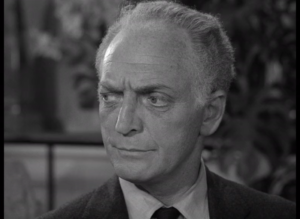
“The Fever” is directed by Robert Florey with a teleplay by Rod Serling. As for our cast of characters Vivi Janiss plays Flora Gibbs and Everett Sloane plays our lead protagonist, Franklin Gibbs. The episode first aired on January 29th, 1960.
Episode Tidbits
In Unlocking the Door, Grams Jr. has a wonderful quote from Serling about how he got the idea for this episode: “I got this idea about three o’clock in the morning in a Las Vegas gambling casino….I’d been about sixty minutes battling a one-armed bandit and I got a feeling of what an extension of this kind of weakness might be to somebody a little different than I am…making an assumption, of course, that there is someone weaker than I in this nefarious area” (237). I love this quotation, and I’ll make a similar point toward the end of this episode about why it’s so important to recognize that you are human and can fall victim to things like everyone else.
Additionally, in Grams Jr., he talks about how Serling wrote a short story adaptation of this episode later, and how he added a final section that talked about Flora’s life after the death of Franklin. Essentially, she lived a quiet life, until at a church bazaar, someone brought in a slot machine. It took multiple women to stop Flora’s screaming and get her back home to bed (238). That’s horrifying. Why Serling? Why are you messing with poor Flora? That woman deserves a happy ending.
Question 1: Is Franklin a tragic figure in the Aristotelian sense?
Sometimes, I like to begin these sections by talking about my thought process for how I arrive at these questions. I want to do that here quickly because I think it’s relevant. Serling was a writer’s writer. What do I mean? He knew the ways in which characters could create dramatic spacing. He understood the old Aristotelian model of drama as the space in between the rise and fall of great individuals. And by great, I don’t mean morally. I mean in terms of power and authority. So, when I look at a character like Franklin, it made me do a bit of a double take. Franklin is a strong, rather one-dimensional figure; there is no real nuance to him. He’s surly, petty, and at times, incredibly disrespectful to his wife–and that’s before the gambling addiction begins. So, there is NOT really a great amount of space in between the height of his greatness and his eventual fall–pun intended–to the depths of his addiction. And that led me to the somewhat simple question of…why? Why did Serling create this character, this way? He’s so unlikeable.
Let’s get better acquainted with some essential Aristotle here to help us out. According to the Greek philosopher:
Tragedy is an imitation not only of a complete action, but of events
inspiring fear or pity. Such an effect is best produced when the events come on us by sunrise; and the effect is heightened when, at the same time, they follow as cause and effect. The tragic wonder will be greater than if they happened of
themselves or by accident; for even coincidences are most striking when they
have an air of design. (11)
Okay, let’s break this down a bit and then apply it to Franklin. First, we have the idea that tragedy emerges, not out of a single moment, but out of multiple events. Taking one of the most well-known Greek tragedies as an exemple, Oedipus Rex is certainly more than the singular moment of King Oedipus gouging his eyes out. The audience is aware of multiple steps that happen along the way, from his birth under a prophecy, to his unfortunate meeting with his mother and father when he grows older, to then learning of all of the ways in which he fulfilled the terrible prophecy that was laid at his feet as a child. What’s particularly gripping about this is how the audience is aware of everything and is brought along for the ride.
When we think about our Twilight Zone episode, we have multiple events that lead to Franklin’s ultimate ending as well. His wife wins a contest that allows them to be there; Franklin, for as much of a curmudgeon as he is, agrees to their going on this trip against his better judgment–and let’s be honest, I think we can all agree that he has no problem denying his wife something that she wants, so this is really his way of showing kindness to her; then you have the drunk gentleman who takes Franklin’s hand and forces him to put the coin in the machine; and then you have that great scene where he looks at his wife and almost decides not to do it; and finally, he does and wins the money. So, you’ve got multiple small events along the way. Additionally, Aristotle says that the events should come upon us by sunrise. This just means that they should take place within a short, controlled amount of time, basically 24 hours. This does seem to happen within that time frame to Franklin, or really close to it. And finally, our Greek philosopher says that there should be a cause and effect. I think I laid most of that out already. There is definitely a cause-and-effect flow to the episode. So, “The Fever” does fall within the scope of Aristotle’s basic elements of tragedy. But, what about Franklin himself? Is he a tragic figure?
Let’s go to another section of the Poetics and see what Aristotle has to say about the figures themselves:
It follows plainly, in the first place, that the change of fortune presented must not
be the spectacle of a virtuous man brought from prosperity to adversity: for this
moves neither pity nor fear; it merely shocks us. Nor, again, that of a bad man
passing from adversity to prosperity: for nothing can be more alien to the spirit of
Tragedy; it possesses no single tragic quality; it neither satisfies the moral sense
nor calls forth pity or fear.Nor, again, should the downfall of the utter villain be exhibited. (14)
Okay, all right, we’re still looking pretty good here. Serling certainly does not paint Franklin as a virtuous man, especially when it comes to how he treats Flora. It’s not virtuous to make your spouse feel like every moment that they breathe is a burden to your existence, nor is it virtuous to allow them the privilege of enjoying a moment of joy in life. So this is not a case of a virtuous man being brought from prosperity to adversity. It also doesn’t fit in the other category of a bad man moving from adversity to prosperity. But, then what is the right movement for tragic figures?
There remains, then, the character between these two extremes,—that of a man
who is not eminently good and just,-yet whose misfortune is brought about not by
vice or depravity, but by some error or frailty. He must be one who is highly
renowned and prosperous,—a personage like Oedipus, Thyestes, or other
illustrious men of such families. (14).
We’ll get to that last part about illustrious families in a moment. Can we describe Franklin as a man who is “not eminently good and just,--yet whose misfortune is brought about not by vice or depravity, but by some error or frailty”? Oh, I absolutely think so. Gambling was not his vice. There was something within him, what Aristotle calls a frailty, and what we might call today a predisposition, that made it easy for gambling to get its hooks into Franklin. Remember, when he starts the day, he absolutely hates any gambling of any kind, so something internally acts upon him and completely changes how he sees the world around him, and that is absolutely tragic.
Now, my Twilight Zone friends: is he a personage like Oediups–an illustrious man of such families”? Well, I do have something here, and you can feel free to call it a stretch, but I actually think it connects just enough for us here. When Franklin wins his initial amount, he tells Flora, “”We’ll put this in our room and take it home with us. Yes, but not these baboons around here. They’d throw it away; they’d compulsively throw it back into the machine. But not the Gibbs; the Gibbs know the value of money.” Franklin is actually separating his family line from all of us mere baboons. They’re better than us because they know the value of money. But, it’s more than that. In some ways, we can argue that the overvaluation of money plays a significant part in his downfall. Money obviously equals something important to the very core of how he defines his worth, and so chasing the money, a term we’ll get to more specifically in our second question, becomes an important way for Franklin to attempt to reestablish his family’s identity–until he can win the money back, he is no longer a Gibbs; he’s merely one of us. And that takes us to our final part for this question. Do we feel badly for Franklin? Well, I would argue that there’s more to it than that. Let’s go to Aristotle one last time.
If you read through The Poetics, the phrase that is essentially repeated throughout when trying to define what a good tragedy does is that it inspires pity and fear. Now, pity is an interesting emotion. We can often pity someone we don’t particularly like. We even have a kind of saying for just such an occasion: “I wouldn’t wish this on my worst enemy.” What does that mean if not that you pity an individual’s situation, even though you don’t like them? Aristotle’s use of pity is actually a bit more specific and might alter our reading of Franklin: “pity is aroused by unmerited misfortune” (14). Now, this does muddy things a bit for us. Is his misfortune unmerited? As a short answer, I don’t pity Franklin, mostly because of Flora, but the long answer is that I do pity him; I pity his temper; I pity his insecurities that keep him from enjoying his marriage; I pity his fear of letting go sometimes and just being silly, because sometimes life is silly. Like many, I unabashedly love the movie Tombstone, and there are a bunch of quotations from that film that people love to repeat, but there is one line that stands out to me that no one ever really comments on. After Doc Holliday, played by Val Kilmer, kills the young, aggressive Johnny Ringo, played by Michael Biehn, Holliday looks at the body of the young man and says, “poor soul. You were just too high strung.” Like Johnny Ringo, there’s a part of me that believes Franklin was born a bit too high strung, and I do feel sorry for him for that, but we are still accountable for the tempers we are born with. So, let’s answer the question: is Franklin a tragic figure in the Aristotelian sense? I would say, yes–although boy does he and Serling make it difficult to find enough humanity in him for our pity. Does the episode itself excite pity and fear? I actually think the answer to that is yes as well. But, there is one last thing that I want to comment on in relation to this episode and Aristotle’s discussion of tragedy.
We have yet to talk about the slot machine itself. Most people comment on how they think it’s either stupid or even downright unnecessary. Well, guess what? I think Aristotle would actually agree. I lied before, but I hope you’ll have pity on me. Let’s visit Aristotle one last time:
Fear and pity may be aroused by spectacular means; but they may also result
from the inner structure of the piece, which is the better way, and indicates a
superior poet. For the plot ought to be so constructed that, even without the aid
of the eye, he who hears the tale told will thrill with horror and melt to pity at what
takes place. This is the impression we should receive from hearing the story of
the Oedipus. But to produce this effect by the mere spectacle is a less artistic
method, and dependent on extraneous aids. (15)
You all know I love Rod Serling, but I think our slot machine falls under what Aristotle would call an extraneous spectacle. It’s not that it doesn’t make sense. The idea that the machine would be calling to Franklin is perfectly fine–and, in fact, the animation of the slot machine is probably what makes this a Twilight Zone episode, doesn’t it? And that’s likely why it’s here, but it does take away from what might be a stronger psychological reading of a controlled man’s descent into monomaniacal madness. So, if you hate the slot machine as well, take solace in the fact that you’re in the company of one of the greatest minds in western civilization. Not me, Aristotle. I probably didn’t need to tell you that.
Question 2: What is psychologically happening to Franklin in this episode?
Let me begin by saying that gambling addiction is a horrific thing, and although the research might point to a few specific character traits that predispose people toward this addiction, it doesn’t mean that, like many addictions, it can’t get a hold of others. If you think you might have a problem, you should seek help in order to get your life back on track. As I always try to point out, the world needs you, and particularly the best version of you that we can get.
I want to establish some peer-reviewed research for this section right away. The first term we need to understand is “the chase.” One of the best early researchers in the field, H.R. Lesieur defines the term as such: chasing is ““when a gambler bets either to pay everyday bills that are due or to ‘get even’ from a fall” (Lesieur 1). Over the years, this definition has somewhat been expanded or evolved, but I think that’s still a good working definition–a heuristic shortcut to understand where problems might be emerging. According to the DSM, “chasing implies returning to gamble on another day in the hope of recouping lost money. However, chasing is not confined, as DSM criteria might suggest, to between-session chasing (i.e., returning on a later day to recoup lost money). Chasing also refers to the tendency to
gamble too long within a particular session” (Nigro 743). When we think back to our Twilight Zone episode, we somewhat see both happening with Franklin. He initially leaves the gambling floor and goes back to his hotel room, only to then make the decision to return to the floor to start a new session. But, he also persists for an incredibly long period of time within that next session as well, so much so that even the workers at the casino comment on it. This led me to wonder about what obligations casinos might have to intervene if people have been gambling too much. I was thinking something similar to laws that dictate cut-off points for bars when giving out drinks. Now, I’m not saying that the two things are completely apples-to-apples, but I’m just giving an example. What I found was that there actually was a recent judgment on just this regarding Atlantic City casinos. According to an article in the Portland Press Herald, “Atlantic City’s casinos have no legal obligation to stop compulsive gamblers from betting, a judge ruled, dismissing a lawsuit from a self-described problem gambler who accused the Borgata and its parent company, MGM Resorts International, of plying him with offers to gamble despite knowing about his addiction” (link).
What about that fateful first moment, the first time Franklin pulls the lever? One of the questions that I had as I was watching this episode the second time through was if things would have been different if Franklin had not won that money with that first free spin. We can speculate about Franklin specifically in a moment. However, there actually is legit research regarding this particular question, especially when you connect it with gambling goals.
There’s that interesting moment when Franklin is in bed, and he starts to have these visions of the money growing larger and larger. Look, I’m guilty of thinking every so often, “what would I do if I won the lottery?” But, those thoughts quickly disappear and they certainly don’t prompt me to go out and spend my mortgage on lottery tickets. But, with Franklin, those thoughts are not simply visions of what-ifs; they are his way of establishing goals for his gambling, and the goals, in this case the stacks of coins, double based upon the previous goal not being high enough for him. Researchers Lister et al found that “gamblers with higher gambling goals were more likely to chase and chase for more spins in the face of loss (independent of known antecedents). Our findings also suggest that higher gambling goals are predictive of chasing in response to either losses or wins, even when gamblers have met winning money motivations” (Lister 133). So, what does this mean? When you set a high goal for your winnings, you’re just as likely to chase that goal in the face of winning as you are of losing. It makes sense when you think about people who are gambling for a particular bill or dollar amount. The goal is to get that amount irrespective of winning or losing throughout the gambling session. That’s pretty terrifying.
Do I think that things would be different if Franklin had lost that first slot machine play? Yes. I think it would have solidified his belief that it was simply throwing money away. So, I guess the awkward question that we’re left with is was Franklin’s luck good or bad in that moment? Or maybe neither. Maybe it was always simply meant to be, brought to you by the predestinating hands of the Twilight Zone, which brings us nicely to the important conversation of control and how much we hate to admit, but there are times when we have very little of it.
In the first question, we talked about how he makes fun of the other people who can’t control themselves. So, we know that this is a big part of his identity, probably the biggest. Back in 1975, Ellen J. Langer wrote a seminal article that proposed a psychological phenomenon known as “the illusion of control.” Now, for my philosophical friends out there, we’ve always known that control is an illusion, am I right? Okay, let’s make this a little more relevant. According to Langer, the illusion of control can be defined as “an expectancy of a personal success probability inappropriately higher than the objective probability would warrant” (311). In other words, I’m smarter than everyone in the room, so naturally, I’m going to win more money. In the case of Franklin, we have to consider two aspects of his personality, not simply his belief in control but also his elevated belief that he is better than others, that he is incapable of losing control. I’ve often said in these kinds of situations, if you think you’re incapable of being persuaded to do something wrong or evil, to do something unethical, or to participate in something out of your character, you’re probably one of the easiest people to persuade. You see, It’s only by admitting that you’re human like everyone else that you are able to better see when someone or something is trying to manipulate you. It makes you more aware of the connection between your mind and body. Our bodies often signal to us that we’re excited, angry, happy. By knowing your triggers for manipulation, and admitting that you have them, you’re more apt to resist these moments in the future because you can literally feel them coming. Admitting that you’re human and can be taken advantage of does not make you weak; it makes you wise. What often keeps us from admitting this and being able to learn and grow as people? Shame.
It’s sad to say, but the world doesn’t run on Dunkin’; it runs on shame. Now, we have shame for a reason. It’s supposed to prompt us to take action toward bettering our position within ourselves, our family, and society, by bettering I mean ethically and communally, not power and prestige. However, we’ve let shame become the pilots of our existence. Think for a moment on yourselves and how much shame has led you to destroy a relationship, keep you from reaching your goals, and led you to a pathway of destruction. Understand that shame has an evolutionary function. When you feel it, take a moment and reflect on why you feel that way. Reclaim the reason why we have shame to begin with and let it guide you to be a better person. But, for god’s sake, people, throw it away when it has served its purpose and move on with your life. We weren’t meant to live in constant shame; you were not meant to live in constant shame. Address it and move forward.
To sum up Franklin and our question, what is happening to Franklin is a perfect storm of a man who is trapped in the chase, brought on by his obsession with order, heightened belief in his inability to be manipulated, and shame at the loss of his identity as a man of control.
Question 3 What are your moments of awe?
My moment of awe is in seeing Franklin completely eviscerate Flora in front of others on the casino floor, to make her feel like there are no reasons to be joyful in life. Do not crush the joy in others because you can’t see it in yourself. Instead, we have to remind each other that we can plan for the future all we want–and we should plan for the future, but we only ever get one present, and we only have so many hours with the ones we love, if you’re not taking moments to have some fun, to find some joy in the sometimes ridiculousness of our human existence, you’re missing out on something that you can never get back; you’re missing out on the moments that you will remember, when you’re older and you have all that time that you’ve carefully planned for. In the next week or so, I want you to try and do one silly or joyous thing, either by yourself or with someone you care about, one thing that is absolutely unnecessary to your present self or your future plans. And, when you’re in the middle of that one thing, I want you to take one minute, and just say to yourself, “I’m here. I exist in this moment that will never happen again in history; it’s just for me; and just for smiles.” Try it. And if it blows up in your face, that’s okay. Laugh at it. If anyone actually takes me up on this, come back and let us know in the comments how it went.
My Rating
As for my rating, you know, there's a weird kind of inverse law that is forming with these episodes–I think that’s the right term. I would rate this Twilight Zone episode a lower upper-tier episode. I don’t particularly like it. But, I really enjoyed writing and thinking about it. And through that writing and thinking it made me enjoy the episode more. It’s one of my least favorite episodes, but it has been one of my favorites to think, research, and write about. So, how about that?
Next time, we’ll be taking a look at “The Last Flight” and here are your questions to consider as you watch.
Question 1: Does Lieutenant Decker’s courage stem from his supernatural experience?
Question 2: Who is Georges Guynemer, and why is he referenced in this episode?
Question 3: What are your moments of awe?
Closing
That’s another episode in the books, but not gambling books. You know, and I don’t mean this as a joke, when I try to teach research and confirmation bias to my students, I usually talk to them about the research dopamine hits that we get from finding new information that matches exactly what we wanted to find. I definitely had that with this episode a little bit. I was experiencing a kind of chase of my own there. I say that because it’s something that I have to be aware of myself. That being said, I hope some of my excitement and enjoyment came through in the episode.
Announcements and Shout-outs
I want to give a bit of a general shout-out to the YouTube community. In my hypotheticals in the Twilight Zone for the “Third from the Sun” episode, I asked if we should hold scientists more accountable than people on the assembly line when it comes to the creation of potentially extinction-level weapons. And the feeling that I got from your responses skewed more toward overall accountability, which I read as all of us just need to be more aware of how our works are being used in potentially destructive ways. I definitely think that’s probably a healthy way to look at it, so good on you.
With each episode, I also create a Google form for us to rate the Twilight Zone episodes and offer some additional comments. You can find the forms on thekeyofimagination.com and I place a link in the episode notes as well. I encourage people to share their ratings and thoughts. Well, Bradford from Florida has some thoughts on the inaugural episode: “Where is Everybody?” he rates it Top Top-tier and offers the following comment about the episode: “The isolation and anxiety in this episode really hit me hard. I have social anxiety and frequently daydream about a world without people and this episode is a stark reminder that my fantasies can have a monkeys paw effect. It’s no wonder my other favorite episode is Time Enough At Last.” Yes, yes! Bradford, that’s a fantastic point that I didn’t mention in my episode. We often have these moments of wishing we were isolated and on a desert island, but there’s a reason why social isolation is a form of punishment. Great stuff, Bradford from Florida. Thanks.
How to Support the Show
Head over to thekeyofimagination.com to continue our conversation. You can rate this episode, learn more about me, watch previous episodes of the show, and check out my curios page where I showcase some of the Twilight Zone trinkets I’ve bought over the years. I encourage people to email me thoughts and comments, whether it’s about a particular Twilight Zone episode, your rating for an episode, or about the Key of Imagination Show. You can get those to me as a text email, an audio clip, or even a video clip of roughly no more than 5 minutes to keyofimaginationshow@gmail.com. Keep in mind, even though we talk about some serious topics, we’re trying to maintain as family-friendly of an atmosphere as we can. If you would rather I not use your comments on the show, please indicate that so I can respect your decision.
If you enjoyed the show, I ask that you please take a moment and do one of the following to help build our community. Rate the show, review the podcast, leave comments, thumbs up, all of the usual algorithmic gymnastics. That will help get the show in front of more people and help us build our community of Twilight Zone fans. However, even if you do none of that and absolutely hated every minute of this, I would still like to thank you for spending some time with me. Until next time, remember, all doors are open to those who possess the key of imagination.
Works Cited
Langer, Ellen J. “The Illusion of Control.” Journal of personality and social psychology 32.2
(1975): 311–328. Web.
Lesieur, H. R. (1984). The chase: Career of the compulsive gambler. Cambridge, MA:
Schenkman.
Lister, Jamey J, Lia Nower, and Michael J.A Wohl. “Gambling Goals Predict Chasing Behavior
during Slot Machine Play.” Addictive behaviors 62 (2016): 129–134. Web.
Nigro, Giovanna et al. “To Chase or Not to Chase: A Study on the Role of Mentalization and
Alcohol Consumption in Chasing Behavior.” Journal of behavioral addictions 8.4 (2019):
743–753. Web.