
The Twilight Zone Season 2: Episode 41
"The Howling Man" Episode Transcript
Introduction
Welcome to the Key of Imagination. This week we’re going to be looking at the Twilight Zone episode “The Howling Man.” We’ll philosophize a bit about why David is so easily tricked by the Devil; we’ll seek to answer a question that often plagues this episode: why would you leave Satan alone with the maid; and I’ll reveal my moment of awe, one that was roughly 20 years in the making. So, grab your keys and let’s open up this door to the fifth dimension.
Plot Summary
David Ellington is on a trip through Europe, a lovely idea, until he finds himself lost and caught in a terrible rainstorm at night. Desperately in search of shelter, he finds an old castle inhabited by an order of monks. But, something isn’t right. They seem bent on getting rid of him as soon as possible. And there is an unnerving sound running through the corridors, a howling. Just as David is about to leave, he collapses on the floor. When he wakes, he finds that there is a man being held captive in an adjoining room. Through his inquiry, he finds out that Brother Jerome, the head of the order, had become jealous of this man’s relationship with a woman, so he knocked him on the head and locked him away in this cell. When David confronts Brother Jerome, he is given a different story. There is no man being held captive. Rather, it is the Devil himself, kept at bay not with a padlock but by the staff of truth. David plays along with Jerome’s story at least long enough so that he can be trusted to stay the rest of the night, under the careful watch of Brother Christopher. But, as soon as Christopher nods off, David escapes his room and heads over to the captive man. Removing the staff from the door, the man emerges from his confines and immediately renders David unable to move. With each step the man takes, his visage begins to change. It is Satan, let loose once again upon the world. But, he won’t be free for long. David will spend the coming years of his life looking for him, until he finally does recapture the Devil, placing him in a closet in his home. As he leaves to make preparations to send the Prince of Darkness back to the Brothers of Truth, the maid hears a horrific sound, the howling of a man. And once again, the Devil is let loose upon the world.
Episode Details
“The Howling Man” is directed by Douglas Heyes. The teleplay is by Charles Beaumont, based on a short story he wrote for Rogue magazine under the pen name C.B. Lovehill. As for our cast, let’s start with the great H.M. Wynant as David Ellington. This is as good a place as any to plug Steven Peros’ book H.M. Wynant: You Must Believe. It’s a really quick read, but an interesting look into the life and career of Mr. Wynant. John Carradine is Brother Jerome, and he puts in a fantastic performance. Frederich Ledebur is our sleepy friend, Brother Christopher. Ezelle Poule plays the unfortunate maid, and last but certainly not least, Robin Hughes is our Devil, the howling man. The episode first aired on November 4, 1960.
Episode Tidbits
As for our tidbits, let’s go to our friend Martin Grams Jr.’s Unlocking the Door for a great quotation about the infamous transition to the Devil scene. Douglas Heyes is quoted as saying, “One [film scene] that influenced ‘The Howling Man’ was the Werewolf of London, with Henry Hull. In that, he did a slow, moving transition into the werewolf, which I had never seen before. He was walking up a staircase, and as he would move behind pieces of the set, he would come out from the next piece of set looking slightly more advanced in the transformation” (330). The scene in the “Howling Man” is quite remarkable, and I think it still holds up well. We certainly have advanced VFX today that could maybe make it more visceral or something, but I think this scene shows that practical effects still have tremendous value. It’s a great moment in the episode.
Question 1: How is Ellington able to be tricked so easily?
Serling, once again, gives us some important information in his opening monologue. He describes David as “scholar, seeker of truth.” Now, why is that pertinent? As someone who has been in academia now for over 20 years, there are certain characteristics that one often comes across in the academy. And one of the more prevalent ones is the feeling of being a fraud, that someone is going to realize that I don’t have all of the answers to all of the questions in my field. I went through a bit of that myself early in my career. I was always nervous that students would ask questions and I would have to come up with some amazingly eloquent and highly sophisticated answers. Today, I just say, “that’s a good question. I have no idea.” It’s even worse when you’re at a conference and you think, “Oh, god, my peers are going to realize I’m a moron.” Now, I just admit I’m a moron and they usually move on to the next question. Okay, no that doesn’t happen. To be honest, I’m just not interested in these intellectual battles of superiority anymore. I just like good, genuine conversation. But, I would be lying if I didn’t say that I still don’t have my moments when I would like my peers to think of me as a highly intelligent and capable interlocutor. So, what does this have to do with David?
When David first encounters the Devil, Satan says, “You’re not one of them.” This line is easily glossed over if we’re not careful, but think about the brilliance of it. What does it immediately do? It separates out the two sides and automatically places David on his side. You’re not one of them; you’re one of us, and who is us? It’s the side that is standing against everything that is wrong with this scenario. This is one of the ways that we commonly divide ourselves even today in our discourse, and we do it because it works. And we know that this works on David because of his exchange with Jerome right after this scene. Jerome says, “My son.” And Ellington snaps back, “I’m not your son.” This is both a rejection of what David sees as an infantilization of his agency and his intellect, but it is also a rejection of being a part of team Brotherhood of Truth. By the way, let’s think back for a second on Serling’s words. He describes David as a “seeker of truth.” You can make the argument that it’s not that David can’t see the Devil; it’s that he can’t see the truth. We often think of the pursuit of the truth to be not only noble but one of the highest orders of philosophical/intellectual engagement. However, and this is where you get the pure, unfiltered version of my years of philosophical study: the more you seek the Truth, the less likely you are to see that it’s right in front of you. The truth is your family, your loved ones, your friends–all of the things that remind you of your humanity. I used to teach a very famous line from Henry David Thoreau to my students, and now I’ll give it to all of you: ““It matters not where or how far you travel,--the farther commonly the worse,--but how much alive you are.” David is on a trip to find the truth, and when he is finally confronted with it, he can’t see it. Because, the truth was always already with him. He wasn’t trying to find it; he was walking away from it. For all my fellow philosophers and intelligent interlocutors: be careful that in your pursuits of great knowledge, you don’t fly right past the truths that matter most.
Now, the last scene I want to discuss here, and, again, I think it is one that is potentially easily missed, takes place when David goes to release Satan. He asks the Devil why he hasn’t simply lifted the wooden staff himself. To this, Satan replies, “If you fail now, they’ll kill both of us.” For most people, the threat of force and death would probably be persuasive enough, but the Devil adds, “don’t you understand that?” Again, this is an attack on David’s intelligence, and an attack on his ego. The smart individual would clearly see the value in setting this unfortunate howling man free, so if you want to be seen as a smart man, you need to make that decision. You can’t tell me that you don’t run across this scenario in the real world. And it works, just like it does on David.
Joe, so what you seem to be saying is that intelligence and the pursuit of knowledge is evil? No, definitely not. What I’m trying to explain is something that I’ve discussed with my students before both in class and in private conversations. I love philosophy and great literature. I’ve mentioned before but I’ll say it again. I pretty much spent my entire 20s just reading whatever great works I could get my hands on. And I can certainly hold my own in various philosophical conversations. But, and this is important: sometimes the pursuit of knowledge can lead us away from the most basic aspects of what it means to be human. In short, sometimes a hug can do a lot more good for someone than reading a treatise on the existential value of physical intimacy. I do think that David is led astray by a need to feel intelligent, by his yearning to always be in search of the truth. And if you spend your life seeking, you’ll often never see what can be found right in front of you.
Question 2: Why does Ellington trust the maid with his secret at the end?
This question is a source of great consternation for not just others but for myself as well. You’ve caught the Devil and removed him from the world, and your first thought is, I think I’ll explain all of this to the maid and then leave her alone with him. I mean…the story sounds legit enough, right? Pay no attention to the howling person who is locked away in my closet. It’s fine; I mean…he’s the Devil, the Father of all lies, but like…you get it, right? Okay then, I’m going out for a bit; I’ll bring back a pizza for us. Remember, don’t open that closet and let the person, I mean Satan,out.
All fun aside, you would think that David, having already been in this situation before, would simply watch Satan by himself and make sure that no other human beings get near the Prince of Darkness. Instead, he has this maid. And I’m certainly not going to blame her. I want to just put this disclaimer out there: If you invite me over to your house and I hear a human being howling to be let free, I’m calling the police–I would just like to be upfront about this.
So, why does David allow this to happen? Well, we have a few ways to approach this question.
After David releases the Devil from his cell, he laments to Jerome, “I saw him and didn’t recognize him.” Then, as Brother Jerome tells him that he will forever remember this night, David just stares out into the space where the Devil had vanished. He doesn’t blink; he doesn’t move. He is, in short, in shock and awe–traumatized by what he has just seen, and, more importantly, done. This kind of traumatic shock is not something that people easily get over. In fact, Ann Serling, daughter of Rod, talks a lot about this in her book about her father, and how he was always quite open with his children about how fighting in World War II changed him forever, and how it simply isn’t something you shake off. So, what can we do when we are faced with such a traumatic moment? There are a multitude of approaches, but I’m going to just mention one here that will connect back to our question: storytelling.
Now, I’ve actually done some research in this area myself. Years ago I published a peer-reviewed article on the character Henry Fleming from The Red Badge of Courage. In that article, I discussed Fleming’s need to create a coherent narrative to make sense of the traumatic events he has witnessed in war. I’m actually currently working on a similar article about Rod Serling’s war-time short story “First Squad, First Platoon” that was finally published last year in The Strand. I’m still editing that article, but I hope to send it out to a journal by the end of the summer. Wish me luck with the peer review. My point is this. One of the ways that we deal with trauma is by trying to narrate the events, to give them a kind of beginning, middle, and an end. This approach is called Narrative Exposure Therapy. I won’t go too much into the weeds here, but one of the important parts of narrative exposure therapy is finding a willing audience who will listen to our stories. And this is where we start to come back to Ellington and the maid.
You can see it in David’s face at the end of the episode; he has never recovered from that night in the castle. He looks a bit disheveled, uptight, and dare I say, a little mad. Then again, we all go a little mad sometimes. Okay, nevermind that. In Ellington’s mind he has never been more clear headed, more sound in mind and judgment, just like Brother Jerome. And yet, he is clearly a man who is dealing with a great trauma, and so he wants more than anything to tell his story. He wants someone to bear witness to what he has been through and to witness that he has made it right. In doing so, he likely believes that it will bring some closure to the traumatic event he experienced years prior in the castle. And so his act of telling the maid his story is an attempt at healing himself and potentially moving forward with his life. Was it the right decision? Well, I mean she opens the door at the end and lets Lucifer loose, so I guess not. But, does it make sense that David would want someone to hear his story, to put an epilogue to his traumatic tale? Yes. Absolutely. Although, he probably should have just kept a journal or something, a little Doogie Houser moment where he just clicks away on a keyboard. Boy, that’s a dated reference. I’ll make a note to include it in my own journal.
Question 3: What are your moments of awe?
I have been waiting a long time to write about this episode, and I knew what my moment of awe was going to be back when I started this channel. I have taught just about every age of literature from Gilgamesh in Mesopotamia to graphic novels of today. One of my favorite literary movements to teach is the British dark Romantic period: Byron, Wordsworth, Coleridge, the Shelleys–all fantastic. And one of the great muses of the Dark Romantics was none other than John Milton, certainly one the greatest British poets in history. And his magnum opus, which I’ve mentioned before on the channel is Paradise Lost–the story of the fall of both man and Lucifer. Now, the dark British Romantics were fascinated by Milton because they believed that this incredibly pious Christian man had secretly made Satan, and not God, the hero of his 12 book epic poem. How? There are some who read Milton’s God character as a tyrannical figure who torments Lucifer. At least, this is how the Romantics saw it. Think Shelley’s monster from Frankenstein. As a young man reading Paradise Lost, I found myself exhilarated by the Lucifer character: he’s charming; he’s charismatic; he’s willing to stand up to authority. Huzzah! And all that. However, as I got older, and I began to teach the poem to my own undergraduates, I began to realize that Milton had not made a mistake; he did exactly what he set out to do. He made evil seem heroic, made suffering seem romantic, made lying and dragging others down with you into a pit of hell seem triumphant. I soon realized that I was the fool. Like Ellington, this Devil was right in front of me, and I didn’t recognize him. You see, this was Milton’s point: evil can be alluring and exhilarating. My moment of awe is that we have to be careful that, in trying to do what we believe is good, we are not actually championing the wrong. So, how do we do that? We keep sight of love, hope, mercy, and charity.
My Rating
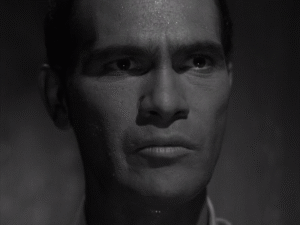
As for my rating, this is 100% certified Top Top-tier, no questions about it. And one of the reasons why I particularly find this episode to be among the very top of the top tier is because of the cinematography. You probably noticed how the camera will, at times, tilt at an angle. These are called dutch angles, and they are used to indicate disorientation. But, what’s cool about how they are used here is that you have a dutch angle that smoothly feeds into a regular shot, and vice-versa. In other words, the dutch angles do not cut away; they indicate changes in how Ellington is perceiving his situation. The other shot I want to quickly mention is one that seems odd and almost poorly done at first. During the initial exchange with Satan, when the Devil asks Ellington if it is wrong to kiss, the camera goes to Ellington for a closeup, but it’s an odd closeup. The composition is just his head, with very little else in the background. And that’s the point. Ellington is so wrapped up in his own ego, his own world that this shot perfectly encapsulates how he does not consider anything else around him, especially some outdated religious monks. Finally, this episode has incredible rewatchability. You want to see it again because you want to try and find some clues, places where Ellington should have seen something. Plus, the acting…oh, the acting, is just perfect–especially John Carradine as Brother Jerome. If I were a stage actor, I would absolutely yearn to play that role on a live stage. “The Howling Man” is about as good as you’re going to see in the Twilight Zone.
Next Episode
Next time, we’ll be taking a look at “The Eye of the Beholder” and here are your questions to consider when watching the episode:
Question 1: Why does the concept of “The State” add to this episode?
Question 2: Is the ending problematic or hopeful?
Question 3: What are your moments of awe?
Announcements and Shout-outs
I’ve got a couple of comments to highlight from the update video I made actually. AliceBowlly comments: “Take your time, your fans aren’t going anywhere! Good things come to those who wait’, right?”
I wanted to highlight this because it is exactly what I needed to hear when I read it. You never known when something kind that you say to someone can have a big impact on them, which is why I’m a big believer in telling people something positive when it comes across my mind. It doesn’t have to be profound or Shakespearean. But, I do know that often times when I tell a student, you did a good job in class today, it tends to stick with them. And this stuck with me. Thank you.

Old friend of the show Brooklyngal6334 comments: “I look forward to seeing your new desk! My dad once built a "Tiki Bar" out of old desk and bookcase wood. It was so nice while it lasted, but the weather eventually ruined it because we had to keep it in the backyard. I am excited to see the new directions you take with the show. I have a ton of catching up to do!”
I always appreciate you stopping by Brooklyngal. You also hit upon something important. The desk build was a lot of fun, but it also had some really challenging moments, including a fairly big mistake that I made regarding the doors–and God bless my wonderful wife for her support in listening to me ramble on and on about hinges, deceivingly level surfaces, and why ¾” Oak just ain’t what it used to be. But, with your story about the tiki bar build, it reminded me that the mistakes are a part of the story, and the story behind the build is waaaay more important than some perfect Platonic vision of a desk par exemplar that I had in my head when I started the build. No. The desk isn’t special because it’s perfect; it’s special because I built it. Think about the desk builds in your own life and recognize that those mistakes that you’ve made are sometimes best thought of as the markers that you exist, that you have played a role in the story of life. And that is a good thing.

How to Support the Show
If you enjoyed the show and want to support our journey through the Twilight Zone, consider subscribing, liking, and sharing the show with others. And if you would like to share your thoughts on the Twilight Zone or the KOI episode, leave a comment. I just might highlight it and give you a shoutout in a future episode. If you don’t want me to use your comment, make sure you indicate that. You can also head over to thekeyofimagination.com to learn more about me, my work, and various academic projects that I might be working on in relation to the Twilight Zone and Rod Serling. That being said, even if you hated every minute of this, I’m still going to thank you for spending some time with me. Until next time, remember, all doors are open to those who possess the key of imagination.
Works Cited