
The Twilight Zone Season 1: Episode 7
"The Lonely"
As the man, the myth, the legend, Rod Serling was using his uniquely rather matter-of-fact delivery to introduce each episode of his brand new television show “The Twilight Zone” to audiences in 1959, a young man serving in the Army was starting to write a song that would become a defining work for what would be an incredibly successful career. That young man was Bobby Vinton, and the song that he was starting to write, and that would eventually steal the hearts of many young women when it was eventually released in 1964 was “Mr. Lonely.” Quite a few crooners over the years have taken to the microphone in order to pour out their lonely souls. There is something that is so universal about loneliness, something so terrible about its presence that we simultaneously use it as one of our greatest forms of punishment, and protest its use for being too inhumane. I was put in timeout a few times in the early years of my primary school education, and although I’m a bit of a lone wolf–as the cool kids say today–even I know that I am a much better man and a much more fulfilled human being having so many wonderful people in my life. But, life is hard, as the cool kids say. Okay, that well is dry, I promise I won’t go back to that joke again.
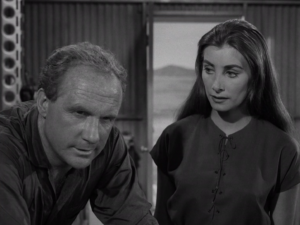
The odd thing about today is that people have access to each other 24/7 through phones, social media, emails, even someone hollering at you from from the next room, as the cool kids…never mind. Even with all of this access, there is still this problem of loneliness. But, what if we could do something about it, without making a single change to our own lives? What if we just allowed robots to become our friends, family, significant others–our misters and sisters built with transistors. In our episode, “The Lonely,” we are introduced to James A. Corry. A man who has been convicted of the crime of homicide, and given a 50-year sentence as pennants. The length of the sentence is not the most disturbing part; it’s the location, the place where Corry will have to live out his time: an asteroid, millions of miles away, with no one but the hills and the wind to keep him company–until, Alicia arrives. Who is Alicia? A gift, and a curse, a mockery of the beauties that women possess both on the outside and on the inside. She also happens to be a robot, brought to Corry on a routine visit by a man of sympathy, Captain Allanby. As Corry learns to accept and even love Alicia, he also learns to accept his fate on the asteroid. That is, until Allanby comes back with news of a pardon–no one will ever be sent to an asteroid again. But, because Allanby and his crew have been picking up all of the other asteroid prisoners, there is no room for Alicia. Corry can only see her eyes, her lips, and her doting heart. Allanby is forced to remind Corry of the wires, the transistors, and the metal. Luckily for Corry, he is able to see the truth again–and join the rest of the men on the ship back to Earth. But, somewhere on an asteroid, is a metallic angel, a woman, or robot, who was able to keep a man alive just long enough for him to get his life back.
“The Lonely” is directed by Jack Smight. Teleplay by Rod Serling. As for the cast, it’s the great Jack Warden who does much of the heavy lifting in this episode, but the gold star goes to Jean Marsh who plays Alicia. Marsh does a good job of balancing the warmth of a human with a kind of robotic blankness–absolutely wonderful. John Dehner plays Captain Allenby, and it features Ted Knight who plays one of Allenby’s crewmembers. Many people will probably recognize Jack Warden. He’s a phenomenal actor with a lot of great credits to his name. He plays Juror 7 in one of my favorite movies of all time: 12 Angry Men by Reginald Rose. Rose will actually pen an episode for the Twilight Zone: “The Incredible World of Horace Ford.” Jean Marsh continues to write and work even today, but I couldn’t believe I missed this as I was rewatching the episode. Jean Marsh plays the main villain in one of my favorite films from my youth: Willow . She plays Queen Bavmorda. I make no apologies for loving that film–Val Kilmer as Mad Martigan and Warwick Davis as the titular character. It still holds up today in my opinion as a great transition movie for young kids to move them into more serious and scarier films. Marsh lent her voice to the 2022 Willow show on Disney+, which was very kind of her. Ted Knight, of course, would go on to have quite a career as well. Most people probably know him from either The Mary Tyler Moore Show, or as the uptight Judge Smalls in Caddyshack. I was introduced to him, however, through syndicated episodes of the show “Too Close for Comfort” when I was about 7 or 8 back in 1987. To this day, I can’t see the word “Monroe” without hearing it in the voice of Ted Knight. And now, just to pull this all together with a nice, neat bow–it turns out that Ted Knight was the first ever guest on…wait for it…The Bobby Vinton show–that’s right as in Mr. Lonely himself. If I’m being honest, that was just a lovely little bit of Twilight Zone magic. I wrote the introduction to this episode prior to doing my research on the actors. Life is pretty awesome like that sometimes. “The Lonely” originally aired on November 13, 1959
Martin Grams Jr.’s Unlocking the Door to a Television Classic has quite a few interesting tidbits in it about this episode, but I’ll only provide two here. I always recommend picking up Grams Jr’s book and Zicree’s Companion. Our first little Twilight Zone tidbit has to do with language. The De Forest research company sent some corrections to Serling regarding a specific line in the episode. When Corry reads Alicia’s instructions, he says, “For all intent and purpose this creature is a woman.” De Forest countered, “since ‘creature’ refers to a living being, this line states that the robot has become a woman and thus is subject to moral laws.” Serling, being the boss that he is, left the line as it is, but it’s actually an interesting point for us to think about. I like the idea that creature means something different. The second tidbit has to do with where Serling got his idea for the episode: Serling says, “This one was created from whole cloth. Again triggered by the sense of poignancy that comes with loneliness” (193). In Zicree’s Companion, he also has a lot to say about this episode. But, I’ll relay one story here: when Buck Houghton had to locate his asteroid, he turned to the desolate lands of Death Valley. Director of the episode, Jack Smight, remembers, “The temperature was around 130 degrees. One day the caterer very foolishly served a very heavy meal for lunch, and about eight crew members just dropped in the afternoon. George Clemens actually fell off the camera crane right into the sand. I thought he was having a heart attack, because he was up on the crane, we were setting up a shot, and he just topped off” (39). Ultimately, they had to move the scene to the MGM studios for the last few days because it was just too hot. That sounds like a smart move, and it’s nice to hear that people were actually thinking of others here.
As far as my initial thoughts, I love this episode, and it has only become more relevant with our progress in the fields of robotics and AI. I will say this. Something that hit me differently this time around was Corry pleading with Allenby that he killed the other man in self defense. It’s not that I had never noticed the line before, it’s that, in some ways, the plea made it a little less complex than what Serling sold it as in the beginning. Let me explain, and I’ve rewritten this section a few times, but I think it’s still a bit clunky.
Serling’s announcement that Corry is a convicted criminal in his opening narration sets us up to look at this individual with less empathy than if he had said nothing at all. But, with Corry’s story of self-defense and Allenby’s belief in his friend, it makes it a little easier to just root for Corry to get off of the asteroid. Whereas, if he were an actual criminal, we, as the audience, would have to struggle a bit more with our morals. We would have to ask some tough questions: should he be on the asteroid; does he deserve Alicia? I bring this up because, even though we have loneliness and robots as our primary storylines here, there is also the important theme of punishment for criminals. It forces us to question what our goals are for those who break the law: justice, retribution, vengeance? These are not synonyms–they carry vastly different connotations. Anyway, this is just a thought that came into my head as I watched this episode.
Dive into question 1: Should we ever grant robots human rights? Okay, some of you might know where i’m going to take this question, but don’t spoil it for others. Let me lead us all there together. On February 14th, 2016 Sophia was born, or perhaps, it’s more accurate to say, she was activated. Sophia is a robot, a social robot, created to express human emotions and to induce us to be emotive back toward her. I remember when Sophia was all over the news, and my first thoughts were, “that is freakin’ creepy.” Sorry, I’m not the person that you want making big statements for history-making moments. If I were on the Apollo 11 Mission that first landed on the moon, I probably would have said something brilliant like, “weren’t we supposed to have ice cream last night?” Just to make it abundantly clear: I am NOT a big proponent of granting human rights to robots–and I don’t suspect that I will change that stance. It’s not that I don’t think robots can add value–quite the contrary, I think they can become incredibly valuable for us. But, the problem for me is, I only see a further devaluation of human interaction by granting robots rights. We are already making it so easy to just never talk to a real human being: customer service is an algorithm; shopping is all automated; even ordering food barely requires a human being on the other end these days. At what point do we simply remove the human being from all of our interactions? After all, it’s tough to deal with humans. I’m a married man. I spend a lot of time doing my best to think about what I can do to make my wife’s life a little better than it was the day before, and I fail miserably more times than she is willing to admit. And she does the same for me. Ladies and gentlemen, human relationships are hard and require actual work. I’m amazed when young people think that we are lying to them when we say you have to put in actual work into your relationships. They think that these relationships are perfect and run themselves. No, they require a lot of decisions, sacrifices, and moments of complete and utter failure, followed by flowers and Mexican food. But with robots, I don’t have to buy flowers; I don’t have to put in work; I can literally be the absolute worst version of myself and I expect my robot to still love me and do exactly what I bid it to do, and yes, I’ve changed my language here because that is ultimately what it’s going to become, servitude, followed by dissatisfaction, and then, in the end, a return to loneliness. But, you might be thinking, well Joe, we’re a long ways off from having to really deal with this, so just don’t worry about it. Actually, my dear friends. It’s already happened.
In October of 2017, Sophia was granted Saudi Arabian citizenship. She is the first robot to receive legal personhood in any country. I don’t think I need to say this, but I am very much against this–even if it’s being done as a kind of marketing ploy.
Let’s bring this back to our Twilight Zone episode. By the end of the show, we see that Corry has already given Alicia full personhood in his heart. He continually shouts at Allenby at the end of the episode that “Alicia is a woman.” I can definitely see this becoming a problem in the future, where people no longer can tell the difference between the two. But, we can barely grant the actual human beings that we have on earth now their human rights, granting them to robots just feels like, as Corry says to Alicia, Mockery.
Dive into question 2: Can robots fill the gap of loneliness, and should we let them?
I know it’s not a particularly well-liked film by many, but I enjoyed the I, Robot movie with Will Smith in it. One of the things that I found to be fascinating in that movie is how robots were integrated into the lives of older individuals as caretakers. Now, I’m not going to lie, there is something both a bit odd and sad about seeing that–even just in the film. We seem to struggle today just to take care of ourselves and children, but we have an older population who deserve our care and consideration as well, people who helped to create pathways for us to thrive or opened new doors for us to walk through where there previously were none. And even if they have not done something quite as poetic as that previous sentence may have sounded, they should still be afforded the dignity of human interaction as much as anyone else. So, when I think about that scene from I, Robot, I can’t help but feel a bit like we’ve failed somewhere in our evolution toward modern civilization. That being said, we still need to address this glaring problem, and the I, Robot future of using artificial companions to push back against loneliness in our later years, may already be here.
Let’s bring in some chemistry first, a quick reminder of how we as a species develop strong bonds with each other through a hormone known as oxytocin, or, “the love hormone”, as it is sometimes called. Let’s set the mood: I’ll inch just a little bit closer to the microphone to get that proximity effect. Oh, yeah. Oxytocin also helps us improve our proximity effect with each other. Can you dig it? I knew you could. Okay, enough of that. As a teacher, I cannot abide enjoyment and frivolity while learning.
As previously mentioned, Oxytocin is a hormone–and an important one at that. It plays critical roles in our reproduction, but it doesn’t simply end there. Oxytocin is produced by both men and women, although women tend to produce a bit more. It’s an important hormone because it helps us form meaningful bonds with each other, the kind of bonds that help stave off those terrible feelings of loneliness. In a very recent study by Immumura et al, scientists studied the Oxytocin levels in people from South Korea who had companion robots and those who did not. Here is what they found: “The results reveal that the steady-state concentration of oxytocin, a hormone related to affiliative relationships, was significantly higher in Owners than in Non-Owners. In addition, the Owners showed more behaviors indicative of intimacy than the Non-Owners. These results suggest that humans can build affiliative relationships with robots. Fifteen minutes of contact with the robot decreased the concentration of cortisol in both groups, suggesting that even a brief contact can contribute to improving mental health. Therefore, relationships between humans and robots may be one option to improve mental health and enhance well-being” (Immamura).
Okay, so we’ve set the stage chemically, but what about our original question of our elderly population? Well, we’re starting to make connections there as well. In a 2022 article by Othelia Lee et al entitled, “My Precious Friend: Human-Robot Interactions in Home Care for Socially Isolated Older Adults,” researchers wanted to look into whether or not Hyodol, a companion robot, would be a viable option to help with elder care and mental health. Here is what they found in their study: “The most common aspect of utility companionship reported by all participants was Hyodol’s role as their health coach who reminded them to take medication and to exercise. Participants also found pleasure in playing with Hyodol and reported reduced feelings of loneliness. In the absence of other social supports, all participants also regarded Hyodol as a surrogate family member or human-friend, and interacted with Hyodol as such.” What I will say about reading these studies is that, if you know anyone who has to take a fairly significant amount of medicine on a daily basis, the idea of a robot companion who can remind someone to take their medicine and continually promote healthy engagement with the mind is promising at least. However, again, there’s a part of me that feels a bit like this exposes our own cultural failures–although, maybe I’m being too hard on us? I admit that I don’t 100% know.
Coming back to our Twilight Zone episode, it’s pretty clear that Alicia provides Corry with both social companionship and stimulation of the mind. You might recall when Allanby arrives the first time in the episode, Corry screams with delight, and he immediately takes out playing cards and sets up a kind of make-shift checkers game. There are two reasons for this. For anyone who likes playing board games, you’ll probably agree with me that the best part of playing them is the social interaction that comes with it. I played board games growing up, but I married into a real board game/ card-playing family. And yes, they are a competitive group of people, but they also realize that it’s a great opportunity to just sit together and experience each other under the banner of a common interest. Of course, they also help to keep the mind sharp. You’re not simply playing the game; you’re often testing how well you know the people you’re playing with and basic human approaches to competition. At the midpoint of the episode, they show both Corry and Alicia playing checkers. We often talk about how AI learns from us, but we should be learning from it as well. We should be learning ways to think about humanity and science that we haven’t thought of before–within reason, of course. We do have to be careful about what we take away from this relationship. Nonetheless, Alicia is providing him with that ability to stretch his mind and learn something new on a daily basis, and that is important for us.
So, will robot companions solve our loneliness problems? Well, yes and no. They can clearly provide a type of companionship, something to listen to us vent about life; they can remind us of important events and help us regulate our medicine; and they can create sites of mental stimulation, which is very important. But, I’m not so sure that it won’t have the same effect as social media. Social media connected us to millions of people, and we’ve never felt more alone. I do wonder if robotic companionship won’t produce, as Corry points out in the episode, a feeling that is more akin to mockery.
Where did you find your moment of awe, something that moved you or inspired you to think beyond the surface? Seeing Alicia on the floor with her face shot off. That left me in this state of awe because it must have been horrifying for Corry to see that. To so immediately be brought back into reality. I think that this scene could have gone horribly wrong in the other direction. I could see a retelling of the story today where Corry grabs the gun, shoots Allenby, and has to go back to an asteroid because he really did kill someone–and not out of self defense–although he will say that he was defending the woman he loves, Alicia. I think that could be a good way to update the story for today in a new way, but I don’t think that it makes it better. I like the ending of the original. Another aspect of awe for me was when Allenby told Corry about how it was difficult seeing Corry each time he visited. That honestly made me think; it probably was difficult. You have to balance giving enough humanity to constantly remind these people like Corry that they are human, but you also have to recognize that they have done something wrong, and they are technically paying for their crimes. It would be really difficult to try and balance those two things.
Okay, so, where do I rate this episode? Well, this is actually a middle-upper tier episode for me. The acting is phenomenal; the writing is quite good; and the thoughts that come out of it are wonderfully complex. I have a feeling that it will become even more loved and appreciated as the years go by. Next time, we’ll be discussing the classic: “Time Enough at Last. Here are your questions to consider as you watch.
Question 1: Why do we seem so interested today in stories that involve the almost complete destruction of the species?
Question 2: Undoubtedly, Bemis is a character who has our empathy–maybe even our sympathy, but should we be laying more blame on him for his difficult life and even the final outcome of the episode?
Question 3: What are your moments of awe?
Okay, so I’m excited to say that I actually have a few messages and comments to bring into the show. I thought about where to place this section, and I think toward the end is probably best, after the primary part of our episode. Hopefully, that proves to be the right place for it.
I’m not afraid to try new things and fall flat on my face, so with that confident introduction, I’ve started to add some additional fun little elements to our experience in the hopes that it will spark some additional interaction and really start to build some healthy interaction. I’m a teacher; I can definitely talk for hours on end, but I think we all know that just hearing one voice and one opinion over and over can get a little tedious. So, i’ve started to dabble in a bit of a social media campaign. Now, this will only be able to be seen by those of you who are either subscribed to the YouTube channel–you can find it by going to keyofimagination.com–or for those of you who are subscribed to my X (formerly known as Twitter) account, which is @keyofishow. I hope I’ve got that right. I don’t really do social media honestly. I’m not interested in my own political ideas, so I don’t expect others to be either, so you’re not going to get political ideas or hot takes from my social media. I just want to be upfront about that now. Okay, so what will you get if you subscribe to the YouTube channel or my X account? In addition to getting updates on the show, you’ll also get trivia questions, Twilight Zone hypotheticals for you to chew on, and a guess the episode game where I give you two pictures and you have to guess what the episode is. On the YouTube channel, Scott has already got a couple of the guess the episodes correct, so good job Scott. He’s both a friend of the show and a friend in real life. So, if you’re interested in getting a bit more out of the experience of the show, consider subscribing to the youtube channel or following me on X as, wait let me actually double check the name, okay, it’s @keyofishow. I was right. If you prefer to just get the episodes every two weeks and enjoy having only the listening experience, I completely understand and I appreciate all of you who have hit the follow/subscribe button on your various podcast platforms and for listening.
Now, I received my first comments recently, and I want to give them a shout-out. Suzy Ride commented, “Brilliant! Excellent thoughtful writing” in regards to my “Sixteen-Millimeter Shrine” episode. Suzy, thank you so much for that. You’re never quite sure if anyone is actually listening. More than the compliment itself, which is more than I deserve, it made my day to just see positivity coming out of the audience. Thank you for that. I want to be clear. You should definitely feel free to push back on my commentary and disagree. That’s a healthy part of conversation, but for those of you who start to become regular contributors in the comment section, understand something: you will be the ones who sculpt the community; you will set the tone for how others follow. I say, we want to build a community because it can’t just be me; it has to be all, or at least most of us, who decide what we want our community to be, how we want to talk with each other. There are plenty of spaces out there for people to be rude, cruel, and even downright mean, but can we build the greatest community of people who love the Twilight Zone and want to have a space to discuss it, to disagree, and then have a drink on the same day? I believe we can. But, it’s going to be you first 10-20 people who start to routinely chime in with comments that will be the ones to build it. I’ll definitely do my best to do my part.
Okay, I hope that went well. I look forward to adding more comments as we move forward.
Head over to thekeyofimagination.com to continue our conversation. You can rate this Twilight Zone episode, learn more about me, watch previous episodes of the show, and check out my curios page where I showcase some of the Twilight Zone trinkets I’ve bought over the years. I encourage people to email me thoughts and comments, whether it’s about a particular Twilight Zone episode, your ranking for an episode, or about the Key of Imagination Show. You can get those to me as a text email, an audio clip, or even a video clip of roughly no more than 5 minutes to keyofimaginationshow@gmail.com. Keep in mind, we’re trying to maintain a family-friendly atmosphere. If you would rather I not use your comments on the show, please indicate that so I can respect your decision. If you enjoyed the show, I ask that you please take a moment and do one of the following to help build our community. Rate the show, review the podcast, leave comments, thumbs up, all of the usual algorithmic gymnastics. That will help get the show in front of more people and help us build our community of Twilight Zone fans. However, even if you do none of that and absolutely hated every minute of this, I would still like to thank you for spending some time with me. Until next time, remember, all doors are open to those who possess the key of imagination.
Works Cited
Lee, Othelia. “Effects of Companion Robots on Depression and Social Isolation among Korean
American Older Adults.” Innovation in aging 7.Suppl 1 (2023): 337–337. Web.
Shuhei Imamura et al. “Higher Oxytocin Concentrations Occur in Subjects Who Build Affiliative
Relationships with Companion Robots.” iScience 26.12 (2023): 108562-. Web.