
The Twilight Zone Season 2: Episode 54
"The Odyssey of Flight 33" Episode Transcript
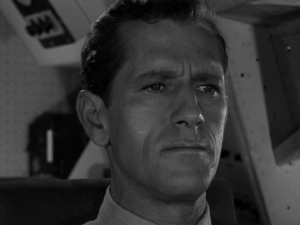
Introduction
Welcome to the Key of Imagination. This week, we’re taking a look at the Twilight Zone episode “The Odyssey of Flight 33”. We’ll see if having a bit of technical knowledge about flight can help us enjoy the episode a bit more; we’ll try and piece together what’s going on with time travel here; and I’ll reveal my moment of awe, a hard look at the predicament that our travelers are in and whether or not a different decision needed to be made. So, grab your keys and let’s open up this door to the fifth dimension.
Plot Summary
Flight 33 is a typical commercial jet on a typical path from London to NY, with a typical flight crew, and typical passengers. However, at roughly the halfway distance between these two major cities, something very untypical occurs. The captain begins to experience the sensation of acceleration–a jet stream unlike any this crew has ever experienced before, catapulting the plane to ludicrous speeds. The flight instruments seem to be of little help: the true airspeed says everything is fine; the ground speed, however, is going crazy–increasing knots by the 100s, seemingly to no end. And then, a sudden shake and a bright light. Somehow, this plane has just reached mach 1–breaking the sound barrier. What’s worse, the second officer can’t seem to get anyone on the radio–they’re all alone and flying blind. All they can do is try to descend in order to find out where they are. But, when they come upon a familiar sight–good old Manhattan. There are no buildings, no cars–no people: only one confused looking brontosaurus. That’s right; they have somehow gone back in time. And so, our pilot crew decides to once again enter the jet stream in the hopes that it will send them back to 1961. Up they go, faster and faster. It seems to have worked. They can now see beautiful skyscrapers and people–people everywhere. But, something isn’t right. They spot a unique architectural piece from another time: a sphere, the very one from the 1939 NY’s world’s fair. They have not gone far enough into the present. And so, they will try once more–and probably again, and again, until they make it back to 1961–or until there is no more fuel left to try. Flight 33, the Flying Dutchman of the Twilight Zone.
Episode Details
“The Odyssey of Flight 33” is directed by Justus Addiss. The Teleplay is by Rod Serling, but with some interesting help, which I’ll get to in the episode tidbits in a moment. As for our cast, we have quite a few players here. Let’s start with John Anderson as Captain Farver. Anderson is somewhat of an underappreciated Twilight Zone actor. We’ve already seen him in “A Passage for Trumpet” as Gabriel. We have him here, and then we get him for two more episodes. He’s a four-time club member, like Burgess Meredith and Jack Klugman, and actually his episodes are quite solid, so hats off to you Mr. Anderson. Paul Comi is first officer Craig; Wayne Hefley is second Officer Wyatt; Sandy Kenyon plays our Navigator, Magellan; Beverly Brown is our stewardess Jane, and our final stewardess Paula is played by Nancy Rennic. The episode first aired on February 24, 1961.
Episode Tidbits
I’ve got a fun little tidbit here for us that comes from Martin Grams Jr.’s Unlocking the Door. We’ve got a lot of technical jargon in this episode. The actors playing pilots needed to at least appear like they knew what they were talking about, and so Serling brought in someone who did know the technical jargon: his brother, Robert or Bob. Robert Serling was “the aviation editor for the United Press International in Washington” and won awards specifically for his writing in relation to aviation. In short, he knows what he’s talking about. Bob had the following to say regarding the script for “Odyssey,” “Frankly, it’s not 100 percent accurate and it can’t be, because the situation you present is so fantastic that you’ve presented the crew with an almost impossible impasse” (373). He then offered Rod some notes to help out the dialogue. As a quick side note, Bob Serling’s son, Jeff, is heavily involved in helping to run the Rod Serling Memorial Foundation, and if you’re able to go to Serlingfest, it’s likely you’ll see him there. Any time I’ve interacted with him, he’s been absolutely wonderful. We’ll bring Bob Serling into the mix of another episode in the future.
Question 1: Does knowing a little bit of the technical aspects of flight help our enjoyment of this episode?
As I was watching this episode the first time through, for whatever reason, I was really paying attention to the technical jargon that was being used by the pilots in the cockpit of the plane. And that led me down a bit of a rabbit hole into trying to learn about what all of these terms mean. Now, I always give my best effort to not simply be able to rehash a definition of something but to actually understand it enough that I can use it practically for the episode. And I do believe that is the case here, although, I have to give a warning: I’m certainly no engineer, and this is, at least somewhat, rocket science–or its older cousin who likes to come and visit and remind you of all the stupid things you did as a kid. Ah…I do love family. Can’t live with em…
Anyway, as is the case, since we’re going to be diving into a topic that requires a bit of science and math, I’m going to need some help from…you know what…the “Staff of Truth!” Okay, I feel better prepared to talk about something that takes people entire degrees and thousands of hours of practice to do professionally. In all seriousness, part of the learning process is being humble enough to admit that you don’t know everything, and I am certainly willing to admit that here. So, if I get something wrong or there’s a bit more nuance to it that you want to add, go ahead and do so in the comments, especially if you’re a pilot or an aerospace engineer. I think that would be awesome. Okay…let’s get into the episode.
The first real problematic moment in our episode occurs when the captain gets a feeling in his stomach. He says, “I felt something funny, like the sensation of speed.” This is something that many of us have experienced before. It’s that odd sensation sometimes when you’re going down a slide or in a fast car–the sensation that there is extra pressure pushing against you. The co-pilot looks at his bezel of instruments and says, “True airspeed 470; we’re level.” In this brief answer, we get a bunch of interesting information that will help us better understand an important exchange in just a moment. First, we need to learn a little bit about speed in relation to aviation. I’m going to keep this fairly simple so that we can apply it more quickly to our episode.
First, we have indicated air speed, which is actually a measurement of pressure or air molecules. As the plane moves forward, air molecules get pushed through a pitot tube, and then that pressure is measured and balanced out against the static pressure ports on the plane to give the pilot the dynamic pressure, which is actually what is being read out by the airspeed indicator: pressure, not necessarily speed. The indicated air speed is important because it carries with it a standard; it’s calibrated for sea-level, but what happens when you’re either not at sea level or there are dramatic shifts in temperature, say when a plane is climbing into higher altitudes? Remember, at higher altitudes the air is thinner, fewer air molecules. So, that pitot tube is no longer being fed by the same amount of molecules. It thinks that you’re slowing down. That’s where true air speed comes in. True airspeed is the actual speed the plane is flying within its air mass–it’s a calibrated number that adjusts along the way to help us accurately maintain constant speeds, cruising speeds, and plan for things like arrival times from point A to B within a constantly shifting environment of pressure and temperature.
Okay, from all of that, you really only need to take away two things: the airspeed indicator measures pressure, not really speed, against a constant (sea-level). The reason we really needed to create a true air speed calculation is because the pressure and amount of available air molecules changes as the plane climbs and descends. So, here’s our first connection with the episode: when the Captain says he feels a sudden acceleration, that’s why our co-pilot says “true airspeed is still 470; we’re level.” If the true air speed were starting to shift or recalibrate it would mean that they were experiencing shifts in pressure or temperature, such as climbing or descending. In this case, the true air speed is simply saying, we’re just cruising along. Nothing is happening. Okay, still with me? Am I still with me? I hope we’re still with each other.
The next piece of the puzzle is that the Captain asks for a groundspeed check. This is actually exactly what it sounds like: it’s the plane’s speed relative to the surface of the earth–how much ground you’re covering. Now, the navigator on our flight 33 starts to become really nervous because the groundspeed is climbing higher and higher with each passing second. And the co-pilot makes the comment, “I hope the wings stay on.” And the captain replies, “They will; don’t worry about the wings.” Now, before I finish the rest of the quotation from the episode. Can you figure out why the captain would say don’t worry about the wings based on what we now know about aviation speed and the difference between ground speed and indicated/true airspeed? The plane at this point, for this particular purpose, doesn’t care a lick about how fast it’s going relative to the earth’s surface. Now, it will in a moment; I promise. But right now It cares about pressure, which is why the Captain says, “It’s the true airspeed that counts; the ground speed means nothing.”
Let’s nuance that line for a moment. When he says the ground speed means nothing, he’s of course responding to the co-pilot’s worry about the plane falling apart from too much pressure on the wings. But, of course, the groundspeed does still matter overall because the purpose of the flight is to move people from one part of the earth to another. And so what you have here is a really interesting dilemma. Pilots are always balancing these three speeds (the airspeed indication, the true airspeed, and the ground speed–and no doubt a lot more information, including other kinds of speeds), but they’re balancing these speeds to accomplish the said goal of moving people from one place to another. If one of those speed indicators can’t be trusted, you’re going to have to find some way of compensating for that information or you’re just an arrow flying through the air, which is why these pilots are growing more and more concerned–it’s not just that the indicators are broken; in some ways, it’s much worse than that. It’s that they are no longer reliably interconnected to each other. It would be like if you were walking and every time you put your left foot out, it went one step forward, but when you put your right foot forward, it could take one step, two, three, nine steps forward. You would be terrified about the concept of walking because the left and the right foot are no longer reliably coordinated.
So, let’s start to land our plane a bit here with this question. As simply a normal viewing audience, we are heavily relying on the reactions and emotional concerns of the pilots in this opening scene. But, when you add in some knowledge about what is going on technically, the pressure, pun intended, actually does ratchet up a bit, and these cockpit scenes with the pilots become a lot more interesting. Particularly, later on when they experience the breaking of the sound barrier, and yet the plane never indicates that their true airspeed changes from 470. I’ll let you work out for yourselves a bit why that’s really cool. If you do nothing else, go back and check out these pilot scenes with this new information. I know I’ll never see this episode the same way again.
Question 2: Is there enough information available in this episode that we can actually develop a theory for how time travel functions?
As many of you know by now, I’malways interested in how episodes approach time travel as a theory–the rules, the ethics, the philosophy of the physics. This episode has always been a bit of a mystery to me, and of course, that’s actually part of the thriller/suspense aspect of it: a bunch of people in a difficult situation for which there is little that can be done or ascertained based on the circumstances of their surroundings–it’s like middle school!. However, that’s not going to stop us. We’re going to do our best to try and figure out how all of this works, and even maybe help our troubled travelers along the way. So, let’s have some fun with this.
The first thing we want to do is try and establish a sense of location and time. Serling tells us, “This is a flight from London to New York.” He then says something…puzzling, which I’ll come back to in a moment. So, we essentially know the flight path here, but we can get even more specific. The second officer on the plane, Wyatt, the man who is the main communicator of all their information in the cabin says at the beginning they are located at “position 52 north, 30 west.” These are good old fashioned latitude and longitude coordinates, which essentially places our aircraft at this point on a map. For the sake of those only listening to the show, it’s a little less than halfway between London and New York, over the Atlantic. The time is 1403 or 2:03pm standard time. They estimate that they will be at Idlewilde, what we now know as JFK airport, at 1830 or 6:30pm standard time. Okay, awesome! So, we know where they are when this starts, and we know what time it is when the Captain starts to get his feeling of picking up speed. We now have a few points of reference to help us, but there is one odd thing going on here.
Remember earlier I said that Serling says something kinda’ funny? Well, in his monologue, which seems to take place in real time, as in right in the thick of when the pilots are experiencing their incredible surge in speed, Serling says that the plane is roughly “fifty-five minutes from Idlewilde airport.” But, unless I’m missing something…that doesn’t seem to…umm…math? In my research I learned about how much jet streams, head winds, and tail winds can really impact flying times. However, for the sake of clarity of the general idea and because I’m not a professional at all in this, I’m going to keep those out of this for the time. Okay, it’s roughly 3,451 miles between the two major cities. If we’re kind and we say that the plane was halfway between, that means they were still roughly 1725 miles away. Now, remember, I mentioned in the tidbits that Robert Serling, Rod’s brother, helped him out with the jargon. One of the things that he mentioned is that he thinks it’s likely they are using a Boeing 707 plane, so let’s assume that model for our calculations. A 707 typically cruises between 550 and 600 mph. Let’s split the difference and say 575. 1725 / 575 = 3 as in that would leave an additional 3 hours of flight time needed to get to NY, with no accounting for winds, and yet Serling says, they’re 55 minutes away. What is going on?
The last groundspeed check we got from Magellen was that they must be doing 3000 knots. That’s roughly 3452 mph. Remember, the plane needs to go another 1725 miles to get to NY. That’s almost exactly half of their current speed in knots, which means if they stayed at 3000 knots, they could cover the remaining 1725 miles in basically a half an hour. It’s not exactly 55 minutes, but they also aren’t exactly halfway between London and NY. They’re closer to the London side. So, Serling is DEFINITELY trying to tell us something by saying they are 55 minutes to NY. But, what does it mean? Again, remember from our first question, this is about ground speed—not true airspeed, at least not yet. The ratio between true airspeed to groundspeed is way off. They eventually break the sound barrier, which I believe does have to do with true airspeed, but they are going so fast in relation to the earth’s surface, the ground speed, that it seems to have affected the actual rate of time itself.
That’s the speed part; let’s try and get a historical point of reference. As they begin their first descent, they see Manhattan, but there are no buildings–only trees. And, one humongous dinosaur. Now, believe it or not the dinosaur is actually a pretty cool reference point. I did a bunch of research on the existence of dinosaurs in NY, and it was like being six years old again–going to the library with my mom and picking out dinosaur books. Good memories. So, what did I find? The dinosaur looks to me like a typical sauropod, the class of long-neck, four-legged herbivore dinosaurs.This means our travelers are trapped somewhere in the late triassic, jurassic, or early cretaecus period. Hundreds of millions of years ago–for you youngins out there, that’s before social media, so we’re talking ancient times, even before Instagram and Tik-Tok influencers roamed the earth. What I learned is that it’s a little bit murky here. There were sauropods in New Jersey, but not really NY–that doesn’t mean it was impossible for a sauropod to be roaming fifth avenue looking for a good deal on a fake gucci bag; it’s just the fossil records seem to indicate that NY had more marine life based fossils. Nonetheless, we can place this point in time at roughly 200 million years ago. And yet when they go up again into the magic jetstream a second time, they’re able to reach 1939 in almost no time. How is time traveling working here?
Well, like our odyssean voyagers, we have to land this plane before I run out of fuel. We’ve got extreme speeds relative to the earth’s surface and we have a plane that went to 200 million years ago and then suddenly is in 1939. It seems crazy. But, then I thought about something. What if they aren’t going back in time? What if they’re going forward? What if the jet stream takes objects and pushes it through time so fast that it ends up just going back to the beginning? That would mean that when they enter the stream the second time, they start at 200 million years ago and just go forward to 1939. If that’s correct, then it at least makes a little more sense in terms of actual time spent in the jet stream. Additionally, it tells us something else about our passengers. if they had infinite time, water, food, and fuel, they could probably time it pretty darn close to get it to 1961 by continuing to loop forward through time. But, they don’t have infinite time, water, food, and fuel. And that actually takes us right to my moment of awe.
Question 3: What are your moments of awe?
My moment of awe came when I had a reaction to this episode that I’ve never had before–and I’ve seen this episode probably 6-7 times over my lifetime. When they see the NY World’s Fair, and they realize that it’s 1939, I could hear the little voice in my head suddenly say, “maybe you should just land.” Now, believe it or not, I had a bit of a philosophical fight with myself here. I get the idea behind wanting to go back into the jet stream a third time in order to get back to 1961–back to family and friends. It makes sense. So, what was the internal philosophical fight about? Well, I sort’ve boiled it down to this: if they land in 1939, they live; if they go back into the jet stream, it seems highly likely that they will never truly be able to get back to when they were, so why not take the 1939 bird in the hand that is right in front of you? After all, 1939 to 1961 isn’t exactly the stone age to today. It’s 22 years. The passengers on the plane will know people down there: loved ones they’ve lost, and ostensibly even a younger version of themselves. Additionally, they can potentially save the lives of thousands and thousands of people all over the world with their knowledge of the, in 1939 terms, upcoming war. There are so many good, logical reasons for them to just land the freakin’ plane! And yet, that’s not the right answer, is it? The right answer is to fight for the life you have now, all of the slings and arrows of outrageous fortune that came your way and have yet to arrive. The scars, both physical and psychological, that you bear are the testament of your persistence, the witness to your strength to get up every morning and say, “a new day lies before me, one that shall be etched into my soul, and I will be the one to compose that message that will be there tomorrow.” And so, when you get up tomorrow do not simply face the day: own it. Clutch it with both hands and drag it with you like Hercules facing the Nimean lion. In short, fight for the beauty that lies in your present. Fight so hard, that you are willing to fly right by the safety and comfort of the past, like our brave, intrepid travelers in this episode.
My Rating
As for my rating, I’m giving this one a good old-fashioned Middle Middle-tier. It’s a good episode. I actually remember watching this one as a child, and there were only two things that stood out to me: first, I thought it was boring. I mean I was just a kid, so I didn’t quite get what the hub-bub was all about. 2. I remember the dinosaur. When I was really little one of my favorite things to watch as a kid was the original King Kong movie. And of course, still to this day, one of the most epic–and I someone who has taught epic literature, I don’t use that word lightly–battles of all time in cinema is the T-rex vs King Kong. And to me, it still holds up today. Well, fast forward to being 45 years old, and I definitely like “The Odyssey of Flight 33” episode better than I used to, and I still get a nice little nostalgic chuckle from seeing that awesome claymation dinosaur.
Next Episode
Next time, we’ll be taking a look at “Mr. Dingle the Strong” and here are your questions to consider when watching the episode:
Question 1: What can we learn from Dingle’s failure?
Question 2: Why does Dingle repeatedly come back to the bar?
Question 3: What are your moments of awe?
Announcements and Shout-outs
I’ve got a couple of comments to highlight from the YouTube channel.
On my “Where is Everybody” episode, @armphidiic2609 had the following to say:
“That feeling of being watched is freaky. There have been studies that show it happens when you have actually seen something or someone watching you but not enough for the conscious mind to realize it. It's your subconscious trying to tell you something is there.” Thanks for the comment. Yes, I definitely think one of the reasons that first episode of the Twilight Zone worked so well in 59’ and still works today is because we still get that primitive sensation that we are almost being preyed upon or at least being looked at in a way that somehow strips us of our agency. As far as first episodes go for a series, it’s pretty tough to beat “Where is Everybody.”
Friend of the show @RobAGabor had the following comment on my “A Penny for your Thoughts” episode that I think sums up many of our thoughts: “I did like this episode, but I’ve got to believe that people have more complex thoughts than were depicted in it.” You and me both, Rob. You and me both. I do see the dilemma they had: you can’t really write what we think or it would come out a bit muddy and almost nonsensical at times because we almost always carry context with us in our brains. But still, it was pretty funny to hear their perfectly constructed sentences. Always appreciate the thoughts, Rob.
How to Support the Show
Want to support the channel? Consider subscribing, liking, commenting, and sharing the show with a friend–you know all of the usual algorithmic gymnastics, that will help us expand our awesome community of Twilight Zone fans. Plus, you never know, I might just highlight your comment in an episode of the show–as long as it's family friendly. And if you want to be immortalized on our list of key KOI supporters, consider joining one of our membership tiers on YouTube or Patreon. 50% of all money taken through this channel, after the platform fees, is going to charity. 25% to the Rod Serling Memorial Foundation, and 25% to the Gary Sinise foundation. For more information about me, my scholarship, and the show, head over to the keyofimagination.com. That being said, even if you hated every minute of this, I’m still going to thank you for spending some time with me. Until next time, remember, all doors are open to those who possess the key of imagination.
Bibliography
I mainly used this video to learn the difference between speeds:
https://www.youtube.com/watch?v=HE7HX7KTmfA
https://www.boldmethod.com/learn-to-fly/aerodynamics/why-true-airspeed-increases-with-altitude/